Trust preseason hype for role and usage, never for box-score production. A roster change, a new starter job or a first-team rep is real information. A 24-yard touchdown in the third quarter of Hall of Fame Week is noise wearing a highlight reel. Managers who learn to tell those two things apart stop rewriting their rankings every August night.
If you are working through your 2026 draft board and want one honest answer to how much to trust preseason hype, this guide is built for you.
That gap is where the edge lives. Preseason hype pulls ADP in one direction, and evidence pulls it somewhere else. The managers who profit are not the ones who know the most football. They are the ones who resist updating their board until a signal earns the update.
This guide breaks the noise into three tiers, ranks the seven preseason signals worth reacting to, and gives you a five-step process for turning any camp or exhibition update into a draft decision. It applies to redraft, best ball and dynasty, though the same news is worth a different amount in each.
Table of Contents
- How Much to Trust Preseason Hype?
- What Makes Preseason Hype Overrated
- Highlight-reel moments
- Anonymous reports
- National-media enthusiasm
- Comparisons that skip the competition
- Rookie hype built on one input
- Camp-report optimism
- Which Preseason Signals Deserve More Weight
- How many preseason games before a signal is worth trusting
- How to Separate Hype From a Real Role Change
- How Much Preseason Performance Tells Fantasy Managers
- How to Turn Preseason News Into Draft Decisions
- The Chase, Monitor, Ignore tiers
- The same news is worth a different amount in each format
- Frequently Asked Questions
- Do preseason stats correlate with regular season fantasy production?
- What is the best pre-draft strategy for fantasy football?
- Should I draft a player based on preseason performance?
- Who should I fade in fantasy football right now?
- What are good predictions for the NFL preseason?
- Can AI or projections replace this preseason research?
- Conclusion: Start With the Role, Not the Buzz
How Much to Trust Preseason Hype?
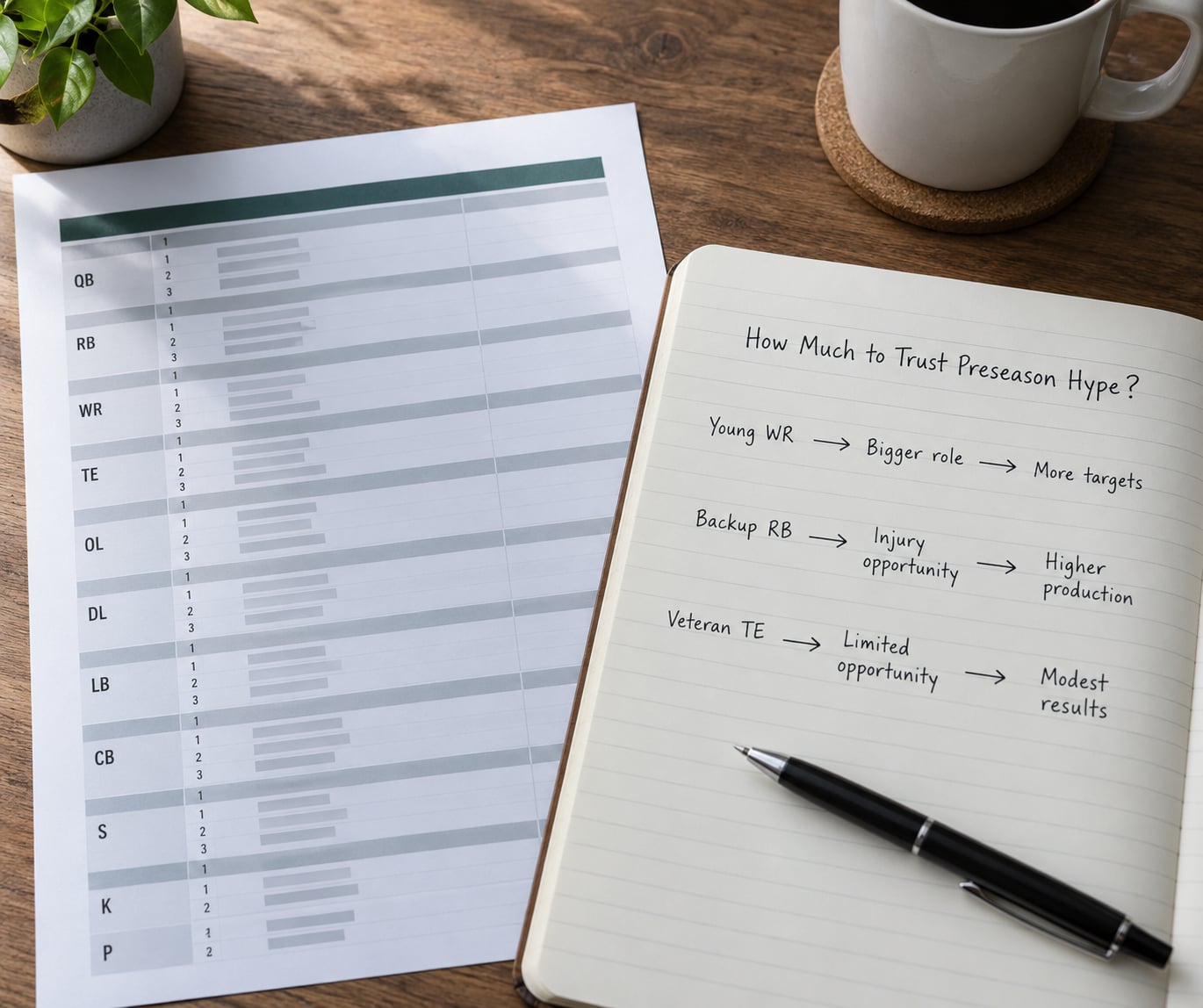
Trust preseason hype for role and usage, never for box-score production. Hype is a lead that a player’s job may have changed, not a measurement of how many points he will score. Its usefulness depends on three things: who is generating it, whether it points at a measurable change in snaps or touches, and whether the source has anything to lose by being wrong.
Preseason hype is the flood of optimistic narratives about a player’s role, upside or breakout potential that builds during training camp and accelerates after exhibition games, before any regular season data exists. Analysts describe it well when they talk about a beat writer noticing a player running with the starters. It becomes a problem when an eight-second clip turns into a draft-board priority.
The window matters because preseason is the only stretch of the calendar where depth chart changes are visible before draft prices lock. Camps open, veterans report, and offenses install new personnel groupings. If you are not paying attention in July, you are finding out about a new starter from someone else’s post in August.
The trap is timing. Your average draft position gets set by other managers who are watching the same games, reacting the same way, at the same speed. By the time a strong performance has fully reached consensus boards, the role information it carried has already been priced in. The edge sits earlier and quieter than the hype.
What Makes Preseason Hype Overrated
Some hype is built on evidence. Most of it is built on volume. These are the weak forms I discount almost automatically.
Highlight-reel moments
A long run or a contested catch against third-stringers tells you a player is athletic. It tells you nothing about how many snaps he will take in September. The best and worst preseason players often share the same tape: one explosive play surrounded by a handful of meaningless reps.
Anonymous reports
“A source close to the team” is a sentence that resets every draft board on its own. Unattributed camp reports are cheap to produce and impossible to check. Treat them as a reason to go watch the practice footage, not as a reason to move a player three slots.
National-media enthusiasm
Coverage volume tracks how well a player narrates, not how well he plays. A generational talent on a bad team will get three times the preseason attention of a fantasy-relevant third-string receiver who just posted 11 catches as the first-team slot. Attention is a marketing metric.
Comparisons that skip the competition
A receiver who posted 140 yards against the worst defensive squad in the league did not prove he is an alpha. Some of the most talked-about preseason performances come against opponents who have nothing to gain and coordinators who have nothing to protect.
Rookie hype built on one input
One dominant college season or a single combine number is not a sample. Draft capital is a better filter: a fourth-round rookie getting meaningful first-team reps is a stronger signal than an undrafted free agent scoring a touchdown, because the former has a roster spot the organization paid real money to protect.
Camp-report optimism
Preseason practices are short, scripted and low-contact. “Looks great” in July can describe a player who cannot play a full series in September. Practices tell you about conditioning and communication. Games tell you about roles.
Which Preseason Signals Deserve More Weight
Seven signals, ordered roughly by how much they should move your board. I weight them by whether they are countable, repeatable and tied to a job.
- Sustained first-team snap counts — Not whether a player started one series, but whether he took the majority of snaps at his position across multiple games. Counting reps is the closest thing to objective in August.
- Verified depth chart competition — Who the beat writer names as the starter, and whether that name holds up on game film across two or three weeks.
- Position changes — A tight end running in a two-receiver set every snap, or a converted defensive back lining up at running back, signals a role redesign rather than a hot streak.
- Route participation and target share — Slot rate and share of targets tell you the actual draft position of a receiver even when the box score is thin.
- Personnel groupings and scheme fit — When a coach keeps building plays around a player, his workload survives contact. When he only shows up in empty formations, it may not.
- Coaching continuity — A new offensive coordinator resets projections. A returning one is evidence that last year’s usage roughly repeats, unless the depth chart says otherwise.
- Contract and roster context — Guarantees, dead money and offseason acquisitions quietly explain a lot of playing time. Money and touches usually travel together.
Here is how I treat each type of preseason information in practice.
| Signal | Reliability | Action |
|---|---|---|
| First-team snap share across two or more games | High | Adjust the role, not the projection |
| Depth chart reported by a team beat writer | High | Re-order tiers, verify on film by week two |
| Position or scheme change (two-receiver sets, slot rate) | Medium-high | Rewrite the usage assumptions |
| Injury news reported by the team | Medium-high | Adjust availability, discount the underlying talent |
| Contract structure and offseason spending | Medium | Use as a prior, not a verdict |
| Single-game yardage total | Low | Ignore |
| Camp report from an unnamed source | Low | Go watch the practice video |
| Combine number or one college season | Low | Use for dynasty only, at a discount |
How many preseason games before a signal is worth trusting
One game is a role signal, not a production signal. It tells you whether a player is healthy, where he lined up and roughly how much work he got. It does not tell you his weekly ceiling, because defensive units, field position and script all differ game to game.
Two full games with a real snap sample is where I start reading volume as a trend rather than a coincidence. By the third game, a player who has led his position in targets two weeks running has a claim worth making. The rule of thumb managers use is straightforward: react to one game’s role, wait for two games before reacting to production.
There is a season-long version of the same caution. Managers on r/fantasyfootball who wrote off proven names after a bad exhibition, then watched those players finish as top-ten scorers, tend to be the loudest about it. That reaction, not the bad tape, is what cost them.
How to Separate Hype From a Real Role Change
A genuine role change passes multiple tests at once. If only one fires, it is a story.
- There is a real job attached. A starter slot opened because someone left, was traded or got hurt. New jobs are easier to verify than talent improvements.
- First-team reps persist. One start is a scheduling accident. Two or three weeks of first-team snaps is a decision by the coaching staff.
- The supporting cast fits. If a quarterback spends the preseason throwing to a receiver in every two-receiver set, the quarterback’s role probably extends there too. Roles travel in groups.
- Expected share is defensible. You can point to a target share, a carry share or a snap percentage you expect to hold in the regular season.
- Nobody important is missing. If the player outranked them on the depth chart is nursing a hamstring, you are looking at a temporary snapshot, not a new baseline.
The reverse test works too. If a player produced well in the preseason but the snaps were spread evenly with three other guys, the production is a mirage built on volume that will not repeat.
One category deserves separate handling. Preseason injuries are genuine information, and preseason statistics are not. A quarterback missing two weeks in August is a real change to September availability. A quarterback posting 16 fantasy points in August is a fact about August.
How Much Preseason Performance Tells Fantasy Managers
Individual preseason box scores are noisy in a specific, structural way. Coaches know the games count for nothing, so they test depth charts and fourth-stringers rather than game plans. Scoring only matters because it makes highlights, which is why the loudest moments are often the least informative.
Read volume first. Snaps, targets, carries and route participation survive a strange week; yards and touchdowns do not. A running back with 22 carries against a prevent defense is usually being fed for durability reasons, and a receiver with nine targets in a designed script is being evaluated, not used.
Then read efficiency with suspicion. Preseason completion rates get inflated by timing designed to be completed. Yardage gets inflated by field position and defensive effort. Ratios that look gorgeous in August are usually an artifact of who was on the other side of the ball.
The number that genuinely deserves attention is ADP movement. When a player’s draft position moves more than his role evidence justifies, the gap is your opportunity. Hype moves ADP; the market corrects it in September. Managers on Reddit describe targeting standouts before consensus boards catch up as the actual source of edge, not the statistics themselves.
The extreme version of that idea is buy on the silence. Jordan Love in 2023 and Clyde Edwards-Helaire in 2019 are the usual examples cited for players who went under the radar in August and overperformed their draft slot. The Reddit threads looking back on hype trains that worked from that era are full of high-ADP risers, not flash-in-the-pan exhibition stars.
How to Turn Preseason News Into Draft Decisions
Here is the process I use whenever a piece of preseason news lands and my board wants to move.
- Write down the claim in one sentence. “Player X is now the starting tight end.” Claims that cannot survive one sentence are usually vibe, not news.
- Name the evidence. Which source, how specific, and is it countable? Snap counts beat adjectives.
- Estimate the role, not the points. Project snaps per game, share of targets or carries, and who the handcuff or committee partner is.
- Set the draft-price reaction. Decide the ADP change you would accept before you look at the current board. This step prevents you from chasing a move that has already happened.
- Schedule the revisit. Note the next data point and the date. Update then, not whenever you open the app.
The Chase, Monitor, Ignore tiers
Every preseason item lands in one of three buckets, and the bucket decides the action.
| Tier | What goes here | Action |
|---|---|---|
| Chase | Repeated first-team snaps, a confirmed new starting job, a scheme change that adds work | Move up and adjust draft slot |
| Monitor | Camp buzz, one good game, a beat-writer depth chart note not yet verified | Keep on the watch list, wait for week two |
| Ignore | Highlight plays, anonymous reports, national media enthusiasm, combine numbers | No change |
The same news is worth a different amount in each format
Redraft, best ball and dynasty managers share one preseason calendar and three very different reactions.
| Format | What a strong preseason role signal is worth | Where to be cautious |
|---|---|---|
| Redraft | Biggest impact, since one season decides the payoff | Do not sell draft capital on August tape |
| Best ball | Large impact only when it moves ADP; otherwise nothing changes | Wasting picks on thin signals |
| Dynasty | Smallest immediate impact, longest horizon | Overvaluing rookies with one strong summer |
One more thing I would not skip: fun is a real input. Managers on r/fantasyfootball routinely say fantasy is more enjoyable when you draft the players you actually believe in. That is a legitimate tiebreaker, and it is still a tiebreaker rather than evidence. Draft the player you want, but draft them because you understand the role, not because a clip made you feel something.
Frequently Asked Questions
Do preseason stats correlate with regular season fantasy production?
Only loosely. Yards and touchdowns from August carry almost no predictive value because coaches run scripts and test depth charts. Snap counts, target share and position changes do carry real signal, because they reveal a job. Rank preseason information by whether it is countable and tied to a role, and the box scores largely fall away.
What is the best pre-draft strategy for fantasy football?
Set your role-based rankings before camp opens, then react only to information that changes a role. Track first-team snap counts, the beat-writer depth chart and scheme changes. Write down your ADP reaction before you check the current board, and revisit it after two or more preseason games rather than after one.
Should I draft a player based on preseason performance?
Draft the role, not the performance. A player who has taken first-team snaps for three straight weeks is worth moving up a few slots. A player who scored 20 points in a single exhibition is worth nothing on that basis, because the volume behind it will not survive contact in September.
Who should I fade in fantasy football right now?
Fade the players whose hype comes from volume rather than a measurable job: one-game standouts, unnamed-source camp reports, and rookies whose entire case is one college season or a combine number. Check whether a hype-driven ADP jump is larger than the underlying role change justifies. That gap is where fades get their value.
What are good predictions for the NFL preseason?
Predict roles, not scores. Look for a new starter left open by a departure, a player who has moved to a different position, and a receiver who has been in two-receiver sets every week. Those three patterns show up repeatedly before draft day. Predicting who will score 20 fantasy points in August is a coin flip.
Can AI or projections replace this preseason research?
Projections are useful for baseline volume and floor, and they cannot see a coaching change or a first-team rep that happened last week. Research fills the gap projections cannot: current role, current health and current competition. Use both, and remember that no model reads an anonymous camp report better than you do.
Conclusion: Start With the Role, Not the Buzz
Preseason hype is worth exactly as much as the evidence underneath it, so the answer to how much to trust preseason hype comes down to that ratio. Roles, snaps and job changes are real. Box scores, clips and anonymous reports are not.
Start by identifying the player’s expected opportunity, verify it with at least two independent signals, and let the stronger evidence override the buzz every time. If you do nothing else with this guide, make that the habit, and your rankings will survive August.