
How to find sleepers in fantasy football comes down to one thing: a player whose average draft position sits well below where he actually gets picked, backed by a role the market has underweighted. Finding one takes about an hour of research once you know what to look at: consensus ADP, depth charts, snap and target data, and the injury news that reshuffles them. Most of the work happens before your draft, not on draft day.
That first paragraph is the whole idea. A player going at pick 90 who projects like a pick 45 is a sleeper. A player going at pick 22 who projects like a pick 22 is not, no matter how good his ceiling sounds. Everything below is just the process for measuring that gap yourself, instead of copying a list that four other outlets published last week.
One note before we start, since the search results get muddled: this is about draft strategy, not the Sleeper app. If you landed here looking for platform help with leaving a league or editing rankings, that lives in Sleeper’s own support docs, not here.
Table of Contents
- What You Need
- Step-by-Step: How to Find Sleepers in Fantasy Football
- 1. Identify Players With Genuine Opportunity
- 2. Check Depth-Chart and Rotation Trends
- 3. Look for Changes in Offense and Coaching
- 4. Use Matchups and Scheduling Wisely
- 5. Compare Statistics With Player Cost
- 6. Create a Shortlist and Test the Thesis
- 7. Monitor Updates Before and During the Draft
- Common Mistakes
- Frequently Asked Questions
- Which positions produce the most fantasy football sleepers?
- How early should I draft a fantasy football sleeper?
- Are rookie sleepers worth targeting every year?
- What is the best way to evaluate a low-cost running back?
- Should I draft a sleeper based on a favorable matchup?
- How do I decide when to abandon a sleeper thesis?
- Conclusion
What You Need
Most sleeper research fails because people start with names and work backwards. Start with data and let names surface. Here’s what to have open:
- Consensus ADP. The average across thousands of drafts, not one analyst’s projection. FantasyPros is the usual aggregation point, and Expert Carrier Replacement (ECR) publishes its own algorithm. If you only have one source, use the one that aggregates.
- Current depth charts and snap counts. Who is actually on the field, not who the team website lists first.
- Target share and route data. Especially for receivers and tight ends, where targets decide fantasy output more than carries.
- Injury and rotation news. The single most reliable source of free value, because the opportunity is guaranteed rather than speculative.
- Your own projection. Even a rough one. The process only works if you bring a number to compare against ADP.
- Your league settings. Team count, scoring format, roster sizes, flex spots, and whether it’s redraft, keeper or dynasty.
- A simple log. A spreadsheet with player name, ADP, your projection, and the reason you like him. You’ll want to check your hit rate later.
The log matters more than people expect. If you don’t write down why you liked a player in July, you’ll rationalize a bad pick in November instead of learning from it.
Step-by-Step: How to Find Sleepers in Fantasy Football
The workflow runs in seven steps, and the order matters. Each step filters the candidate pool from the previous one, so by the end you’re looking at a handful of names with a written reason attached, not a 30-player list of guys somebody mentioned once.
1. Identify Players With Genuine Opportunity
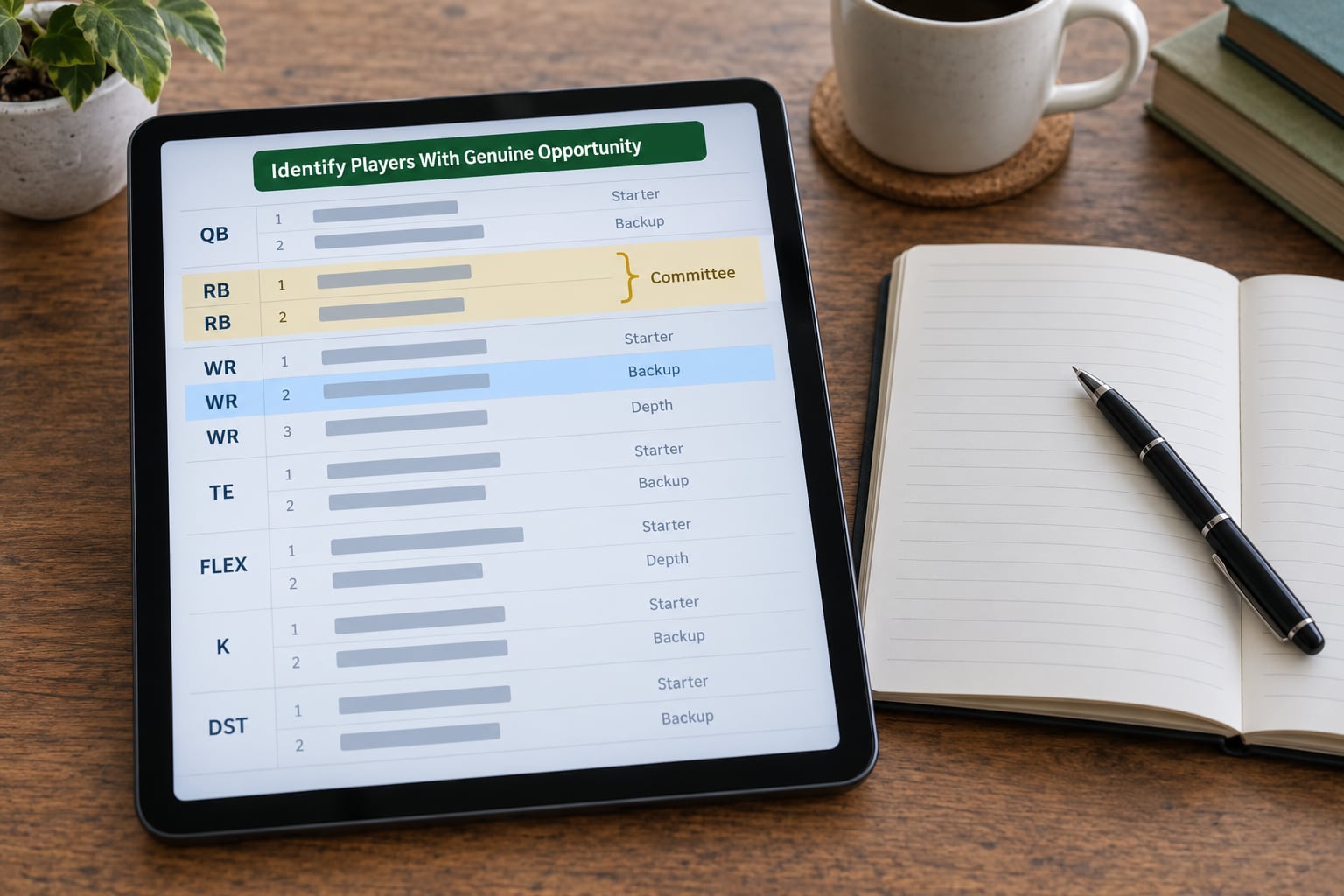
Start from workload, not from names. The categories that reliably produce opportunity are narrow:
- Backups whose starter is hurt, suspended or traded
- Running backs in a genuine committee, meaning a real 40-35-25 split rather than a nominal lead back
- Receivers on low-target teams where one or two pass catchers eat the volume
- Quarterbacks with a soft schedule stretch or a lost starter job already decided
- Players whose coach has described the job as a two-way street rather than a formality
The test for real opportunity versus rosterable filler is simple: if this player’s workload tripled tomorrow, would the results show up in weekly box scores? Committee running backs with an actual goal-line package pass. A fourth-string tight end who catches four passes a game does not, no matter how flattering his route tree looks.
Managers on Reddit keep coming back to the same idea here. The most reliable candidates aren’t the ones with the best hype, they’re the ones where a specific job is about to open up.
2. Check Depth-Chart and Rotation Trends
A depth chart tells you the order. It doesn’t tell you the direction. Compare the chart against what happened last season and read the trend across four numbers: snap share, carries, targets, routes run.
Rising players with steady volume are the cheapest value on the board, because the market prices peak production and discounts progression. A receiver who went from 45% to 68% of snaps and 4.1 to 6.3 targets per game is not a coin flip. He’s the same player with more football.
Watch red-zone usage too. Goal-line and red-zone work is the cheapest path to a scoring spike for running backs and tight ends, and it’s publicly visible every week.
Then check who they’re competing against. A depth chart where the player above them is a 31-year-old free agent in the final year of a deal is a forecast, not a fact.
3. Look for Changes in Offense and Coaching
Scheme changes move volume in ways the market prices slowly. A new offensive coordinator who has never called an offense, a new quarterback who throws more often than the last one, a coaching staff that just added play-action to the menu, an offensive line upgrade that should cut a team’s sack rate.
The problem is that these signals are noisy, and every offseason produces more coaching change news than any of it deserves. So test each one against a specific question: does this change give my player more targets, more carries, or more goal-line touches, and how many per game?
If you can’t answer with a number, downgrade the signal. “New coordinator who loved two-tight-end sets last year” is worth more than “new coordinator, unknown philosophy.” Fantasy managers on r/DynastyFF and r/fantasyfootball are blunt about this one: separating a genuine role change from offseason hype is the hardest part of the process, and the reason most columns produce misses.
4. Use Matchups and Scheduling Wisely
A favorable schedule is the most overvalued sleeper signal in the sport, because it’s the easiest to notice and the most temporary. Everyone sees the same schedule, so a soft slate is already priced into the ADP.
Use schedule to time the pick, not to justify it. A player with a durable role and four tough games in a row is still a sleeper at pick 100, but you might prefer round 12 over round 5 to survive the stretch. In dynasty, a weak early schedule matters much less, because you’re holding the asset for years rather than seven games.
The distinction to hold onto: role changes are durable, schedule is a one-quarter rental. Chase role, use schedule for timing.
5. Compare Statistics With Player Cost
This is where sleepers are made or lost. Take each candidate’s projected workload, convert it to projected fantasy points per game, then ask what the draft market is paying for that production.
A worked example. Call him a committee running back projected for 12.5 points per game in a 16-team PPR league, currently going around pick 140. The equivalent projection at that position in your league started around pick 95. That’s a 45-pick gap and roughly a full round of value, before you count that he’s your only source of production at the position.
Do the same subtraction in auction leagues with dollars instead of picks, and be stricter. Auction prices punish reach far harder than draft slots do.
Managers who’ve run this for a season tend to keep their own ADP-versus-projection list rather than trusting published columns, because several well-known sleeper columns post a lot of misses.
6. Create a Shortlist and Test the Thesis
Cap your shortlist. Six to eight names across all positions is plenty, and having more means you’ll take a bad one when you’re tired at pick 150.
Write one sentence per candidate in this shape: Player, source of opportunity, the risk, expected payoff. For example: “Committee RB, lead back is a 32-year-old free agent, risk is offseason knee issue, payoff is 15 PPG in a playoff spot.”
If the sentence needs two attempts to write, the thesis isn’t clear enough to draft on. Compare your candidates position by position rather than against the entire board, because the useful comparison is never “is my RB12 better than that random rookie TE.”
Then rank by reliability, not ceiling. Injury-replacement opportunities come first because the workload is essentially guaranteed. Clear role changes come second. Camp hype and scheme speculation come last, and usually only as dart throws.
7. Monitor Updates Before and During the Draft
From July onward, check depth charts and injury news weekly. During August, check camp reports for the specific players on your list and skip everything else. Free agents get dropped every week from injured players and cut veterans, and those are the cheapest sleeper candidates you’ll ever find.
During your draft: draft early when the opportunity is guaranteed and you’re confident, wait when the thesis depends on a competition that may or may not happen, and abandon when two of your three supporting signals have disappeared.
During the season, run the same process on the waiver wire. Snap counts, target share, goal-line touches and opponent strength tell you which low-owned players are about to get more work, and taking that player after week five when their ADP was cut in half is the best value in the sport. The community treats weekly in-season sleepers as a bigger priority than preseason draft-day ones, especially in dynasty, where the asset outlives the season.
Common Mistakes
Nearly every failed sleeper pick comes down to one of these six, and each has a specific fix.
Copying published lists. When five outlets name the same player, the market has already priced him, and the edge left is zero. Write your own list from your own projection. The cost is one hour.
Confusing low production with hidden value. A player producing nothing is usually producing nothing for a reason. Value comes from a workload that hasn’t happened yet, not from a track record of blanks.
Ignoring competition. Check who plays ahead of your target and whether that person is actually going to play. The single most reliable sleeper category is someone whose injury is confirmed, not assumed.
Post-hype fatigue. Once a player is discussed everywhere, he’s no longer a sleeper even if the ADP looks generous. If he’s already on three popular lists, the value has been arbitraged away.
Chasing one favorable matchup. Favorable matchups lift weekly projections, not season-long opportunity. A player with a permanent bench role doesn’t become a starter because he faces a weak defense in week 7.
Ignoring your league settings. In 16-team leagues a marginal sleeper is worth far more than in 12-team leagues, because roster spots are scarcer. In tight end premium leagues, a late tight end changes value dramatically. Superflex leagues price quarterbacks differently than 1-QB leagues, which moves every QB threshold in your research.
One more worth naming: don’t treat every deep sleeper as a must-buy. Most sleepers bust, and the base rate is the reason a shortlist capped at eight beats a list of thirty.
Frequently Asked Questions
Which positions produce the most fantasy football sleepers?
Running backs and wide receivers produce the most, because committee backfields and slot receiver rotations are common and the opportunity is often visible a year in advance. Tight ends produce the fewest reliable ones, since a low target share usually means low fantasy output regardless of draft slot. Quarterbacks produce reliable but low-ceiling value picks, which suits deep leagues and dynasty builds better than redraft formats.
How early should I draft a fantasy football sleeper?
Draft an injury-replacement sleeper in the round where the opportunity is confirmed, which is often earlier than you expect because ADP reflects public attention more than guaranteed work. Draft speculative candidates like camp standouts late, ideally as dart throws in the final two rounds of a serpentine draft. If you are waiting on a competition to resolve, letting someone else take a player is often the right move.
Are rookie sleepers worth targeting every year?
Not as a blanket strategy. Rookies are cheap because their role is genuinely uncertain, so most are drafted on draft capital rather than opportunity. The exceptions are rookies in stable systems with a clear path to snaps, or rookies on teams that just hired a coordinator who has a history of featuring one specific position. Judge the situation, not the draft round.
What is the best way to evaluate a low-cost running back?
Check three numbers: committee split, goal-line touches, and offensive line grade. A back with a real share of carries plus inside work is a usable flex option even without a huge ceiling. A back with no goal-line role needs a weekly schedule advantage to matter, which makes him an in-season waiver candidate rather than a draft-day pick.
Should I draft a sleeper based on a favorable matchup?
Only as timing, never as justification. Schedule is visible to everyone, so a soft slate is already reflected in the player’s ADP, and a bench role does not turn into a starting role because of one opponent. Draft the player for his season-long opportunity and use the matchup only to decide between rounds on your board.
How do I decide when to abandon a sleeper thesis?
Abandon it when the specific supporting evidence disappears, not when the player has a bad week. For most managers that means two of three signals are gone: the starter ahead of him is healthy again, the coaching change is reversed, or camp reporting shows him behind two other players. Log the reason and revisit the position rather than holding out of stubbornness.
Conclusion
Learning how to find sleepers in fantasy football comes down to one repeatable loop: measure expected workload, compare it with consensus ADP, and only draft when the gap is bigger than your confidence in the risk. Depth charts, snap counts, target share and injury news feed that loop, and league settings decide how wide the gap has to be.
Start today with one action. Pull the consensus ADP for your position of need, identify the three cheapest names inside your cutoff, then write the one-sentence case for each. If you can’t write the sentence, you don’t have a sleeper, you just have a cheap player. That step takes an hour and it’s the entire difference between researching your own board and copying someone else’s list.
Last updated for the 2026 season. We refresh this guide each preseason and weekly during the regular season, since average draft positions move as much as the news does.