Most leagues let you swap Monday night starters right up until kickoff, so the last scoring window of the week is the one you plan for instead of panic about. Check your current margin after the Sunday games, lock the decisions that are already obvious, then re-open only the players still in play around 7:00 pm ET. That is the whole trick to handling Monday night football in your lineup.
The reason it matters is simple: one or two of your starters may play on Monday, and they can decide or erase a matchup after you have already celebrated a Sunday lead. Most of the anxiety people feel on Monday nights comes from a process gap, not from bad luck. Managers who treat the Monday slots as their own separate decision, with a written cutoff and a bench plan, tend to feel very different at 11:00 pm.
What follows is the routine I would run every week: what to have open before you sit down, the five steps that get you from a locked Sunday slate to a submitted Monday lineup, the mistakes that cost people games, and how the same steps change in PPR, superflex, and dynasty leagues. It takes about ten focused minutes on Monday evening, plus two minutes on Sunday night once the injury news settles.
Table of Contents
- What You Need
- Step-by-Step: How to Handle Monday Night Football in Your Lineup
- How to handle Monday night football in your lineup
- Step 1: Review Your League Rules and Start Deadlines
- Step 2: Separate Locks, Flex Options, and Bench Insurance
- Step 3: Check Schedule, Matchup, and Projected Usage
- Step 4: Monitor Late Injury and Weather Updates
- Step 5: Submit the Lineup and Keep a Contingency
- Common Mistakes and How to Fix Them
- Tips for Different League Types
- Frequently Asked Questions
- When does the Monday Night Football lineup lock in fantasy football?
- Can I bench my kicker or defense on Monday night to protect a lead?
- What happens if my Monday night player gets injured?
- How do I handle a Monday Night Football doubleheader?
- Should I bench a player to protect a lead in fantasy football?
- When do Monday night score corrections and DNF players get processed?
- Conclusion
What You Need
You do not need a subscription to a secret tool. You need your own league settings and enough information to know which of your starters are still playing Monday night.
- Your roster and the exact game time for each starter. Not every week has a Monday player. Some weeks you have zero, some have one, and around the doubleheader weeks you have two games to sort through.
- Your league settings, written down. Scoring format, rostered bench size, how flex positions are scored, whether ties are broken, and above all whether the Monday game is required in your lineup.
- Projections from whichever source you already trust. The specific numbers matter less than consistency. A site you check every week beats a better site you never open.
- A way to read late injury news. The Sunday 4:00 pm and 6:30 pm practice and injury reports, plus the league’s own news feed, cover most of what changes a Monday slot.
- Your bench options. Know in advance who the healthy reserves are at each position, because a Monday scratch means you need a replacement in minutes.
If you have never opened your league settings mid-season, that first errand on Sunday is worth more than any projection site. The rules decide which of your options are legal, and nobody’s projections can tell you that.
Step-by-Step: How to Handle Monday Night Football in Your Lineup
How to handle Monday night football in your lineup
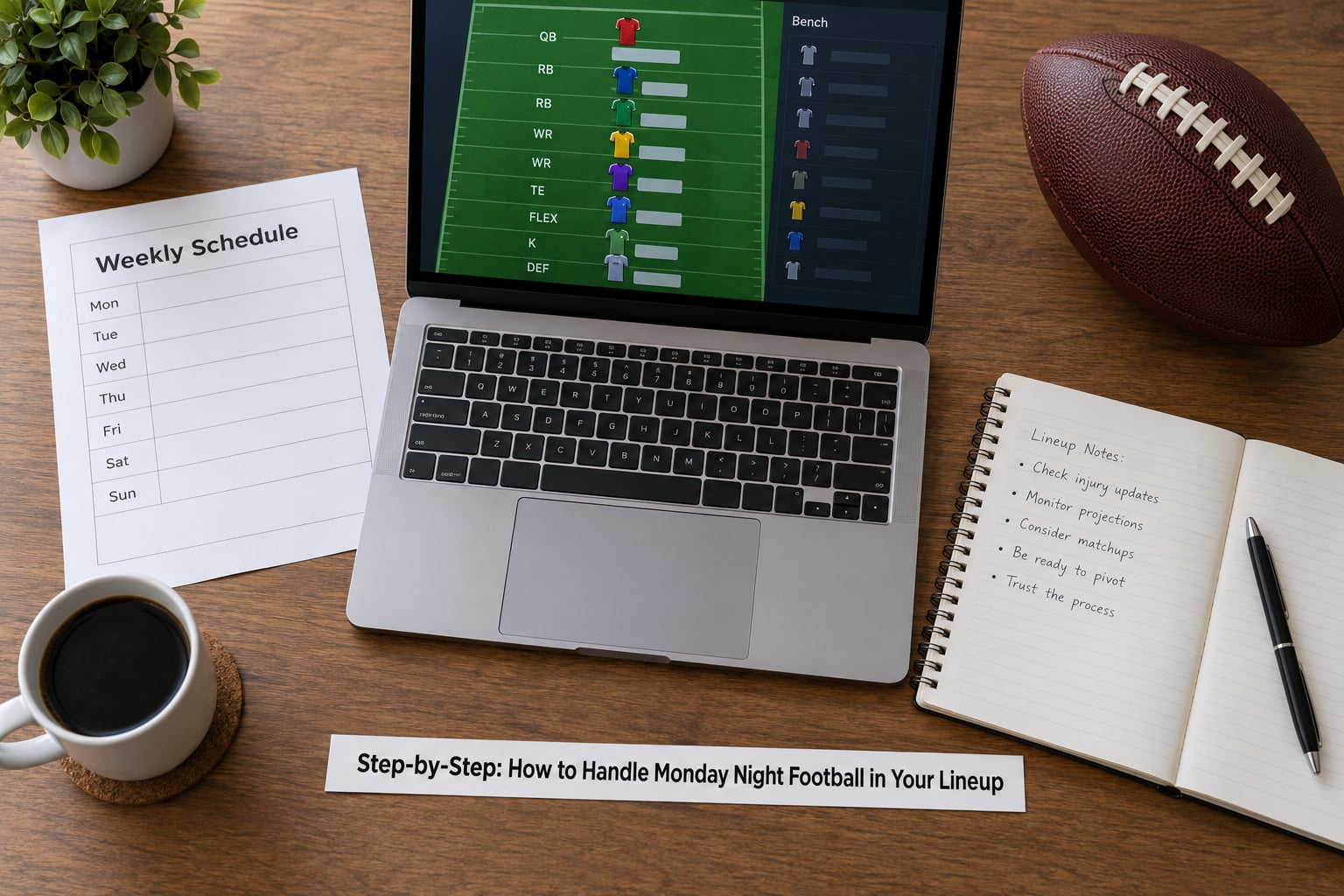
The framework behind these steps is to separate your Monday slots into three buckets and then judge each one by what you need, not by what the loudest take says. Locks are players no reasonable scenario moves. Flex options are genuine decisions where two players have similar projections. Bench insurance is the reserve you want available if a Monday player gets hurt or benched.
For each flex option, compare the floor against the ceiling in your specific format. A defense projected around six points has a real chance of a goose egg, while a workhorse running back with 20-plus touches has both a dependable floor and a ceiling that can win you the week. When the margin you hold is thin, floor matters more. When you are behind, ceiling wins almost every tiebreaker in your head.
Then account for context. A Monday player facing a defense that has not allowed a big play in three weeks is a different player than the same guy facing a secondary giving up the most explosive plays in the league. And every flex option needs a fallback: the specific player you would drop in if this one scratches, decided before kickoff rather than during the game.
Step 1: Review Your League Rules and Start Deadlines
Start by confirming three things: whether the Monday game is required in your lineup, whether you can still make changes after the Sunday window closes, and exactly when the league stops accepting submissions. Most season-long leagues lock Thursday night games before kickoff, run a live window on Sunday afternoon, and then let you change Monday starters until the Monday game begins, usually around 7:00 pm ET.
Check how ties at a flex position are scored too. If your platform counts only the highest scorer at the spot, two similar players are nearly interchangeable. If ties are treated as equal full-position players, your whole flex slot is really a pick-em, and there is no point agonizing over a half-point difference.
Write the deadline on your phone. Managers miss it because they assume the Sunday afternoon window covers everything, then discover that a Monday player was ruled out in a Sunday evening report.
Step 2: Separate Locks, Flex Options, and Bench Insurance
Lay out every starter involved in Monday games and label each one. Most weeks, two or three qualify as locks, one or two are real decisions, and the rest of the question is which healthy reserve you would promote. A player is a lock when the only way you would bench him is a genuine surprise, such as a pregame scratch nobody expected.
Flex options are the ones worth ten minutes of thought. Give each a one-line case for and against, then stop. Bench insurance is easier to skip and matters more: know who the backup running back and the backup tight end are, and whether you can play a defense on your bench if the Monday defense gets shredded early.
Here is the margin-to-action breakdown most managers end up using once they have sorted their players into those buckets:
| Your margin before Monday | What to do with Monday slots |
|---|---|
| Ahead by 30 or more | Run the clock. Keep the highest-floor options and avoid adding injury risk for extra ceiling. |
| Ahead by 10 to 29 | Fill flex spots with players who have a dependable floor. Leave kicker and defense alone unless your rules clearly allow sitting them. |
| Ahead by 1 to 9 | Protect the lead where the rules allow it. Favorable matchups matter more than upside. |
| Tied | Optimize for expected value, not safety. A tie-breaker swing player is worth more than a steady hand here. |
| Behind by 1 to 20 | Chase ceiling. Take the high-variance Monday names and accept the goose egg risk. |
| Behind by 20 or more | Full ceiling mode. Maximize expected points; protecting nothing is pointless when the deficit is already large. |
Step 3: Check Schedule, Matchup, and Projected Usage
For each flex option, look at what the player actually does, not just the projection number. Expected touches, red zone opportunities, and whether a team is likely to trail and pass more all move projections more than most matchup ratings. A receiver whose quarterback throws 40 times every week has a different ceiling than an identically projected player in a low-volume offense.
Opponent tendencies matter too. Check how the opposing defense has handled this position lately, whether it has given up explosive plays or kept everything in front of it. And look for role changes: a new starting tight end, a backfield split, or a receiver moved into the slot are all better signals than a small matchup edge.
Projections should inform your decision, not dictate it. If a projection puts two players within a few tenths of a point, that is a coin flip and you should decide it with matchup context or your league’s tie rules instead of staring at the numbers.
Step 4: Monitor Late Injury and Weather Updates
The Sunday afternoon and evening injury reports are where Monday decisions usually get decided. Work through them in order: first the designations, then the reports about whether a player is a full participant, limited, or held out of the lineup. A receiver limited in practice who is still listed as active usually plays; the same player held out of warmups is a different story entirely.
Weather matters for outdoor late-season games, and so does travel and travel-related news for teams playing a short week. Altitude games occasionally shift projections for skill players. None of this deserves more than a minute of your attention unless two sources agree something unusual is happening.
Sort noise from signal quickly. A beat writer’s speculative post, an unsourced rumor thread, or a report contradicted by the active list is not a reason to swap. A confirmed designation from the team or a reputable reporter, repeated by a second source, is.
Step 5: Submit the Lineup and Keep a Contingency
Once you have made your calls, submit them before kickoff rather than at the final seconds. Most platforms let you revise a lineup right up until the game starts, so submitting early costs you nothing and removes the risk of a technical glitch or a distracted phone from ruining your week.
Then write down the reason behind each close call in a note, one line each. That habit pays off in two places: it tells you in hindsight whether you were right for the right reason, and it stops you from re-litigating the same decision every Tuesday morning when the game did not go your way.
Keep one contingency in your head for each Monday starter: who replaces him if he does not play, and who replaces him if he plays ten minutes and leaves. Finding that backup under pressure during kickoff is how managers end up with a lineup they did not choose.
Common Mistakes and How to Fix Them
- Swapping on every rumor. If every rumor moves your lineup, your lineup is being decided by noise. Fix: require two independent confirmations or an official designation before you change anything.
- Forgetting what is actually on your bench. People lose more weeks to an empty bench than to a bad start. Fix: confirm your healthy reserves every week at the positions you start most.
- Changing a lineup over a tiny projection difference. A tenth of a point of projected edge is not a reason to override matchup context. Fix: use a threshold, such as two full points, before a swap is justified on numbers alone.
- Using projections published before Sunday. Weather, roles, and designations change all week. Fix: refresh your numbers after the Sunday injury reports drop.
- Ignoring league rules on sitting a starter. Deliberately benching a healthy player is a rule question, not a strategy question, and how your league treats it varies widely. Fix: read the settings page, or ask your commissioner in writing.
- Waiting until after kickoff. Some platforms stop accepting changes the moment the game begins. Fix: submit early and revise if you need to, since revisions are usually allowed right up to that moment.
Tips for Different League Types
In casual redraft leagues, keep it simple. Play your best projected lineup most weeks, and treat Monday as the week you can still improve by reacting to real information. The people who win these leagues are usually not the ones with sharper tools; they are the ones who set their lineup on time and do not chase rumors.
In PPR points leagues, volume is the whole game on Monday. Receptions move the needle far more than yards, so bench-clearing receivers and pass-catchers are worth more upside than a comparable kicker or defense. In non-PPR formats the reverse tends to hold: goal-line work and red zone touches carry more weight, and defenses with a healthy turnover rate become more interesting.
In superflex leagues, every Monday decision has a second layer because your lineup must be valid at both a starter and a flex slot. That argues for taking the safer player at flex and reserving the risky one for a quarterback or tight end slot where upside is what you drafted for.
In dynasty and keeper leagues, the weekly result matters less than the asset. A benching that protects a two-point lead is rarely worth demoting a player with a role you want next season, and holding out a starter you are accumulating points on can stall an upward trend. In those formats, a slight margin is not a reason to bench anyone.
Frequently Asked Questions
When does the Monday Night Football lineup lock in fantasy football?
Most season-long leagues lock Thursday night games before that game starts, run a live lineup window on Sunday afternoon, and then let you change Monday night starters until the Monday game kicks off, usually around 7:00 pm ET. That last window is the important one, because it means Sunday evening injury news and pregame scratches are still correctable. Some platforms lock everything at the Sunday deadline instead, so check your league settings once and you never have to guess again.
Can I bench my kicker or defense on Monday night to protect a lead?
It depends entirely on your league rules, not on whether it is a clever move. Many platforms only require you to fill starting positions, which leaves kicker and defense benchable. Others treat any empty starter slot as an illegal lineup. Before you act, read the settings page or ask your commissioner in writing, because deliberately sitting a healthy player is exactly the kind of decision that ends up in a league argument.
What happens if my Monday night player gets injured?
If he is ruled out before kickoff, most leagues let you swap in any healthy rostered player through the lineup window, and some will let you add a free agent. If he starts, gets hurt, and does not finish, scoring depends on your platform and on the stat correction window, which can run into Tuesday. Rules also differ on whether points accumulated before the injury still count. Know this before kickoff rather than discovering it in a group chat.
How do I handle a Monday Night Football doubleheader?
Treat it as one slate with correlated game scripts, not two separate decisions. If both offenses play one style, a defensive player in the same game can benefit from the opponent’s tempo and mistakes, or suffer badly if that opponent controls the ball. Pick one game to lean on for ceiling and treat the other as the stabilizer, then make sure you are not holding three players from the same low-scoring script.
Should I bench a player to protect a lead in fantasy football?
Bench for protection only when your margin is large enough that a single Monday performance cannot erase it, and only if your rules permit it. With a lead of one to nine points, sitting a starter usually swaps a small risk for a smaller one and leaves you exposed to an injury. If your league allows it, the safer candidates are the low-ceiling positions, and always check your rules before you act rather than after.
When do Monday night score corrections and DNF players get processed?
Final scores usually settle overnight, but officials can correct them during the days that follow, and a Monday game played in a later time zone often posts late. A player removed from the game can have accumulated points adjusted, and stat corrections occasionally flip a matchup result after everyone assumed it was decided. If you won or lost by a single Monday score, check your league again the next day before you gloat or move on.
Conclusion
Do one thing first: open your league settings and note the Monday lock time, so every later step has a real deadline attached to it. Then treat your Monday starters as their own decision, lock the obvious ones early, re-check the uncertain ones after the Sunday injury news, and submit before kickoff rather than during it. Managing Monday night football in your lineup is mostly discipline about timing, with the ceiling-versus-floor call handled by how big your margin actually is.