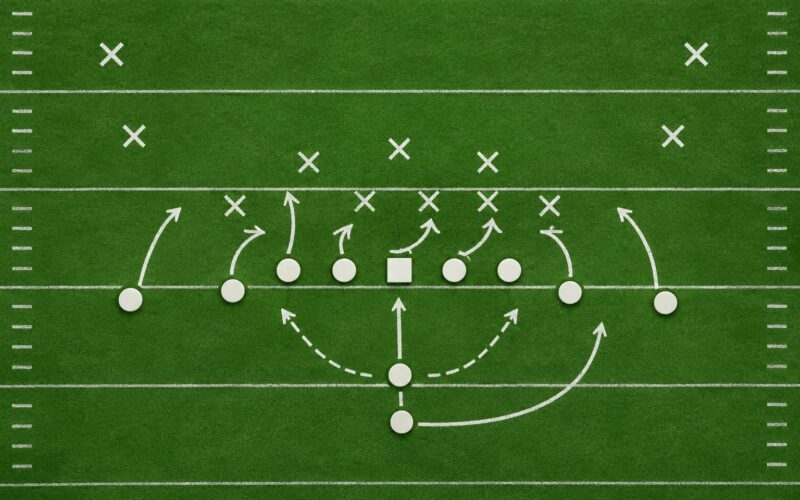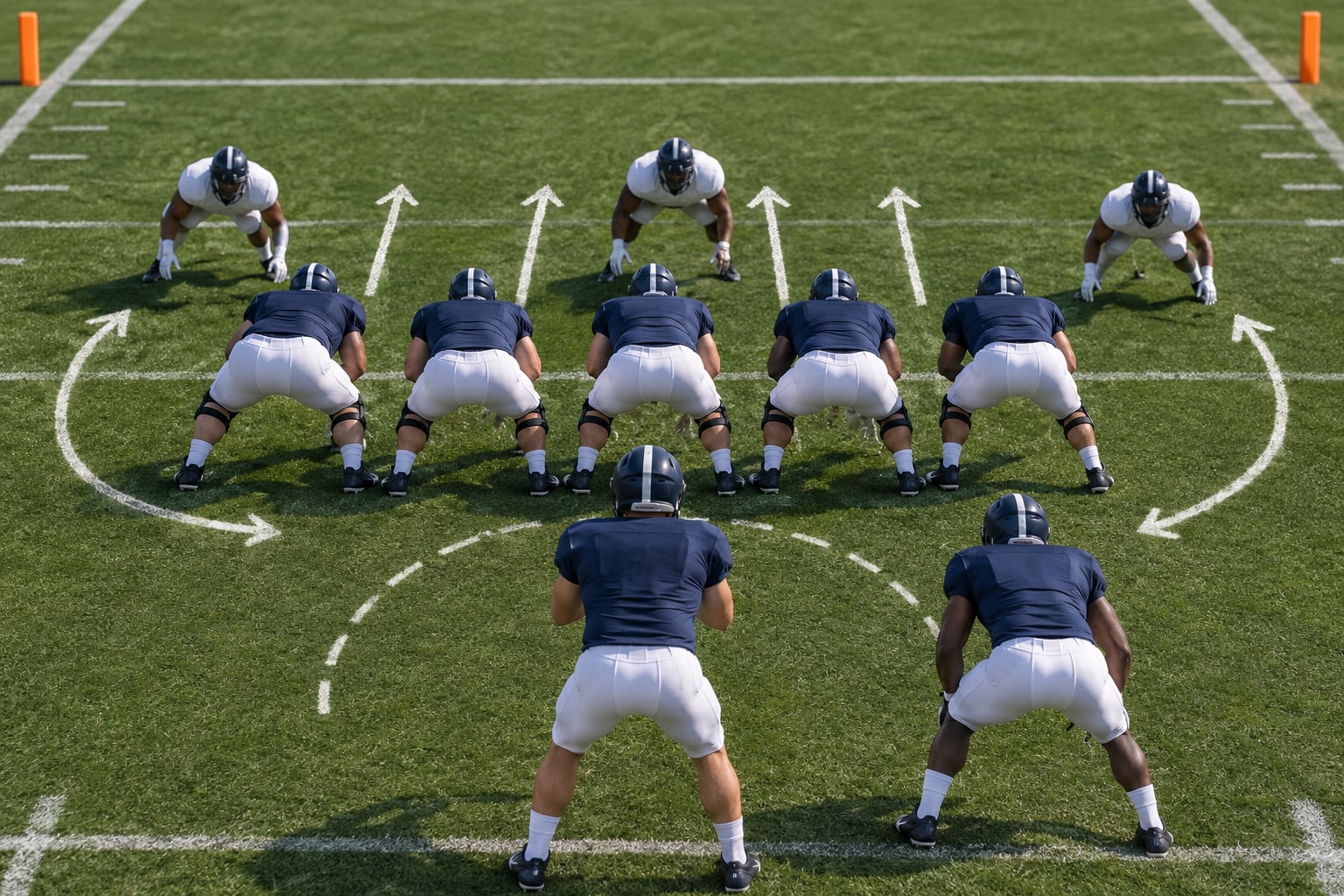
Offensive line rankings matter because blocking sits upstream of nearly every fantasy scoring event: more snaps survive, more drives reach the red zone, and fewer possessions die on a sack or a three-yard loss. But a ranking is context, not destiny. Two halfbacks can share the same unit and produce opposite seasons. Knowing how offensive line rankings affect fantasy football means treating the grade as one input, weighted against opportunity, role and matchup.
Most of the confusion comes from mixing up three separate questions: what the line is capable of, what the offense actually asks of it, and what the opposing defense takes away. This guide walks through each one, then gives you a repeatable process for turning a grade into a projection adjustment you can actually defend.
Last updated for the 2026 season. Offensive line grades and rank orders shift every year with injuries and roster moves, so treat any list you read, including this one, as a starting point rather than a finished product.
Table of Contents
- How Offensive Line Rankings Affect Fantasy Football
- How Offensive Line Rankings Affect Fantasy Football Projections
- Which Fantasy Positions Benefit Most From a Strong Line?
- Running backs: the line is most of the job
- Quarterbacks: efficiency and floor
- Receivers: target share protects them
- Tight ends: the hedge position on a weak line
- Kickers and the rest of the roster
- How to Turn Offensive Line Grades Into Player Projections
- What Do Sacks, Pressure Rate, and Run-Block Grade Really Tell You?
- How Opponents and Game Scripts Change the Value of the Ranking
- How to Use Offensive Line Rankings in Weekly and Dynasty Decisions
- Frequently Asked Questions
- Do good offensive line rankings always lead to more fantasy points?
- Which offensive line metric is most useful for fantasy running backs?
- Should I use offensive line rankings to make trades?
- How much should a strong offensive line change a quarterback’s projection?
- Are PFF grades or team sack totals better for weekly fantasy analysis?
- Conclusion: Start With the Relevant Blocking Factor
How Offensive Line Rankings Affect Fantasy Football
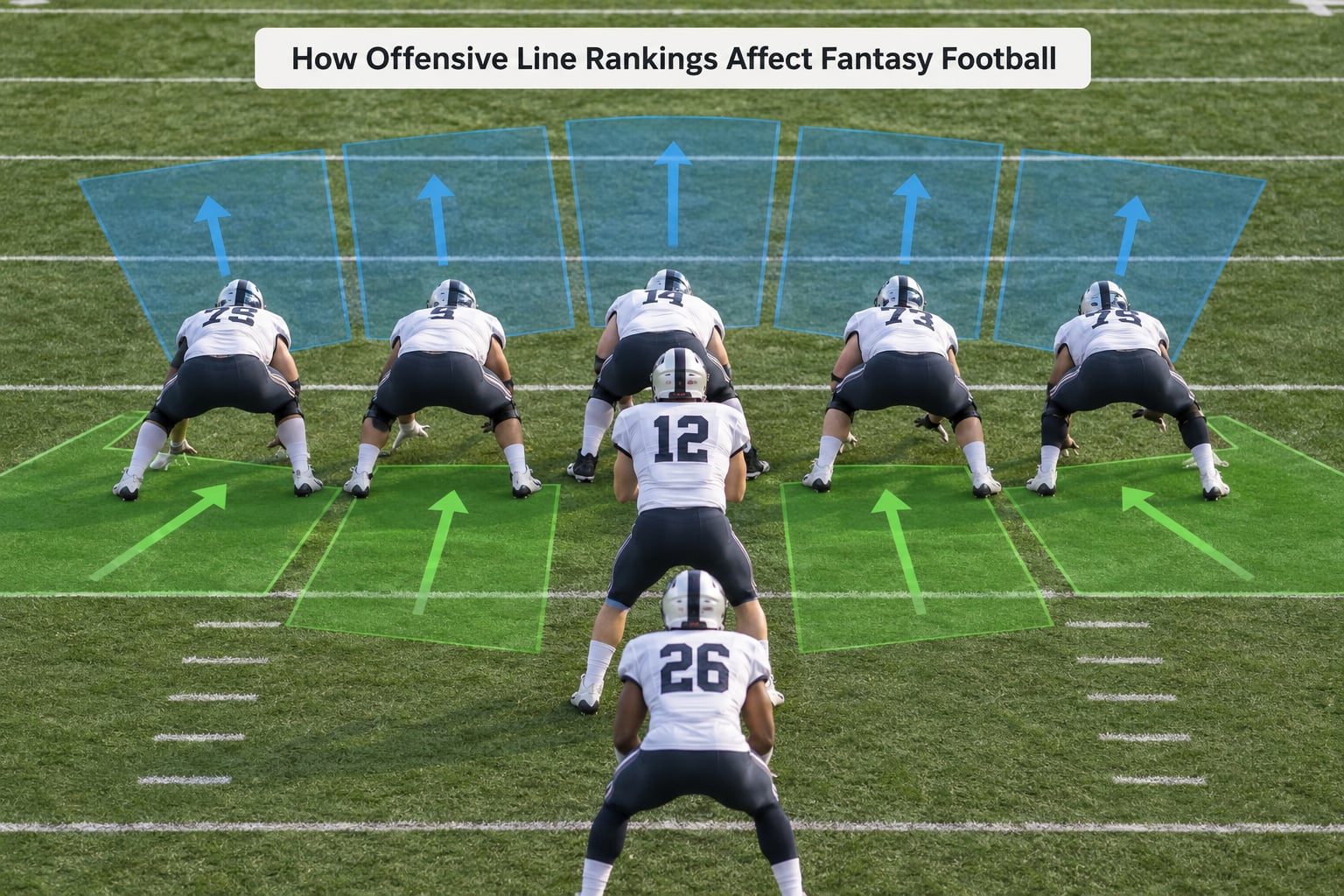
Yes, offensive line rankings affect fantasy football, mainly through running back efficiency and quarterback stability. A strong unit widens running lanes, raises red-zone carry share and cuts pressures, which lifts fantasy output for everyone behind it. The effect is real but uneven, and it shows up as a modest projection adjustment rather than a verdict on a player.
Here is how each blocking factor maps to fantasy reality, and which positions feel it first.
| Line factor | What it measures | Fantasy impact | Felt most by | How to read it |
|---|---|---|---|---|
| Run-blocking grade | Quality of the blocking surface created on designed runs | Yards per carry, rushing success rate, goal-line carry share | Running backs | Strongest single input for an RB projection |
| Pass-blocking grade | How often the quarterback is kept clean on dropbacks | Pocket time, completion rate under pressure, sack rate | Quarterbacks, then WRs and TEs | Judge by pressure allowed, not raw sacks |
| Pressures allowed | Pass-rush wins per dropback, sacks included | Lost plays, hurried throws, deep-route chances | Quarterbacks | More stable week to week than sack counts |
| Sacks allowed | Total quarterbacks taken down | Directly costs passing fantasy output | Quarterbacks | Noisy, heavily opponent and garbage-time driven |
| Adjusted line yards | Rushing yards with opponent quality and box counts removed | The cleanest read on true blocking quality | Running backs, team rushers | The metric to trust when grades disagree |
| Yards before contact | Distance a runner travels before first contact | Whether a back needs elusiveness to produce | Running backs | High value means the line is doing work |
| Line continuity | Returning starters and communication reps | Affects the reliability of every other number | Everyone | A rebuild shrinks your confidence, not the grade |
How Offensive Line Rankings Affect Fantasy Football Projections
A line ranking describes a unit, and a projection describes a player inside a specific offense. Those are different objects, and the gap between them is where most draft mistakes live.
Team run-blocking grade answers the question of whether the blockers created usable space. It says nothing about how many carries the back got, whether those carries happened near the goal line, or how much of the offense went to the passing game instead. A halfback with 60 percent early-down carry share behind an average line will usually out-produce a bell cow with 45 percent carry share behind an elite one, and the line grade explains why without predicting who wins.
Pass blocking is even less direct. Two quarterbacks on the same roster can have identical pocket time and very different fantasy floors, because one offense throws 40 times a game inside the numbers and the other throws 25 times with half its targets over the top. Blocking decides how many throws survive. Usage decides what those throws are worth.
The interaction also runs in both directions. Good run blocking tends to produce early leads, and leads produce more pass attempts, which lifts receiver volume on the exact team whose grading you used to discount the passing game. Bad run blocking has the opposite signature: more passing downs, more dropbacks, more exposure to pressure.
Forum users on r/fantasyfootball have described the pattern plainly: the line makes a player more reliable, not more explosive. That is the right framing. Reliability across a full season is exactly what separates a weekly starter from a boom-bust dart.
Which Fantasy Positions Benefit Most From a Strong Line?
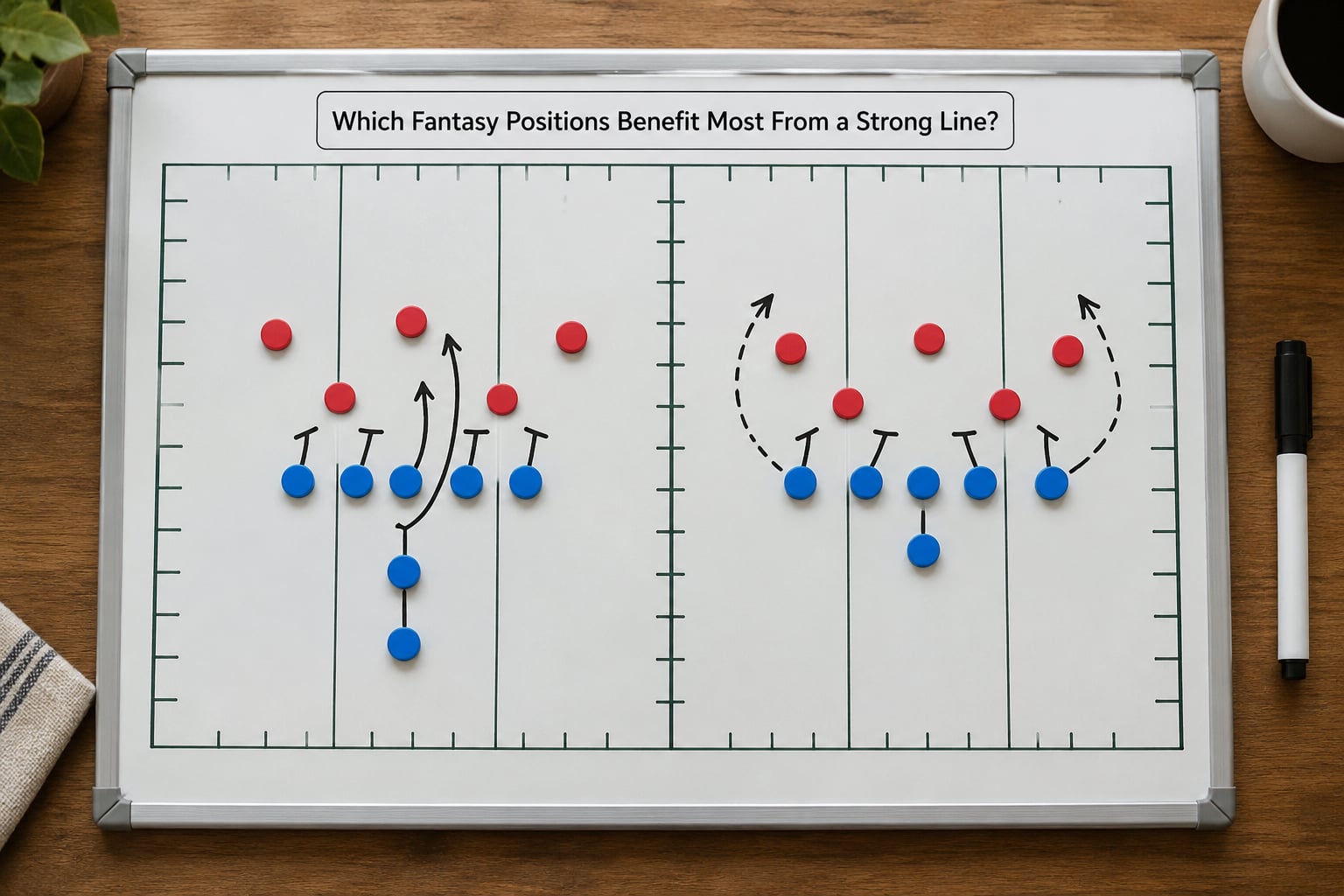
Running backs benefit most, quarterbacks second, receivers and tight ends a distant third, and kickers barely at all. The order follows how directly a player’s fantasy points depend on the blocking surface in front of him.
Running backs: the line is most of the job
A runner’s production is built from volume times efficiency. Run blocking drives efficiency, and goal-line work drives the highest-value portion of volume. Strong units widen the box-counter advantage, push defenders off the line and create extra high-leverage snaps. One forum poster put it as roughly half of top-10 finishers playing behind top-third lines and the other half overcoming weaker blocking through receiving work or elusiveness, which is about the right ratio to plan around.
Two sub-factors deserve special attention. Yards before contact tells you whether the runner needs to be special to produce, and if a back is already elusiveness-dependent, a modest line grade matters less. Goal-line carry share is pure opportunity, and no amount of blocking quality replaces it.
Quarterbacks: efficiency and floor
Quarterbacks feel pass blocking through pocket time, which drives completion rate and the quality of downfield chances. The fantasy effect is less about ceiling and more about floor, since fewer sacks means fewer zero weeks. A strong line rarely turns a low-volume signal caller into a winner. It does help a player who already throws a lot avoid the losses that sink a season.
Receivers: target share protects them
Wide receivers are insulated by target share, which is why receiving work is the usual escape hatch from a bad line. Blocking matters most on downfield routes that take time to develop and on contested throws along the sideline. If a quarterback is getting hit before the route breaks, the volume still lands in the target numbers even when the yardage does not.
Tight ends: the hedge position on a weak line
Tight ends absorb line weakness better than almost anyone, for a structural reason. Blocking schemes that cannot create a clean running lane or hold the edge in pass protection often add a blocker, which creates extra space in the intermediate passing game. That is why a bad offensive line frequently shifts the distribution toward tight ends rather than away from them. It is a real correlation rather than a marketing slogan, and it is the one position where a downgrade signal can point the opposite direction.
Kickers and the rest of the roster
Kickers barely move. A kicker’s range depends on field position and scoring drives, and those shift only marginally with blocking. Defensive players on the same team are affected the opposite way from their offense, since a bad line means more snaps and more opponent possessions.
One warning about this hierarchy. A dominant rushing line does not help a high-volume passing game, and teams often build one without the other. Check both grades before assuming a great run-blocking unit also protects the quarterback.
How to Turn Offensive Line Grades Into Player Projections
The adjustment process is five steps, and its purpose is to keep you from double-counting team context. Work through them in order and write down each change as a separate line, so you can strip any of them out later.
Step one: set the baseline. Start with the player’s projection on projected volume alone, meaning targets, carries, goal-line attempts and red-zone touches. If you cannot state the baseline, you are not ready to adjust it.
Step two: identify the relevant blocking skill. Do not use a composite line grade. A receiving target needs pass-blocking context, a runner needs run-blocking context, and a quarterback needs pressure allowed. Match the metric to the player, then ignore the other one.
Step three: apply the opponent adjustment. Fold in the defensive front you are actually facing, since rushing success rate is defined against a specific box and a specific front. Heavy run fronts push the line’s grade up, light fronts expose it.
Step four: adjust efficiency, not volume. Most of the legitimate adjustment lives in yards per carry and completion rate, not in carry or target counts. Blocking changes how efficient a play is when it happens. It rarely changes how often.
Step five: check for double-counting. If your projection already assumes a big lead or a pass-heavy script, a bump for pass blocking on the same team is counting the same thing twice.
Here is a worked example, using illustrative numbers so nothing here is mistaken for real player data.
Illustrative case: a running back projected at 240 carries and 4.2 yards per carry for 1,008 yards. His team’s line sits in the second quartile on run blocking, and his schedule is soft against light-box opponents for four of six games. That combination supports a small efficiency bump, so add 0.2 yards per carry and treat the result as roughly 1,056 yards.
Nothing in that example touches his carry total. If a separate source projects only 190 carries because of a new offensive coordinator’s pass-heavy tendency, the line grade does not rescue those 50 missing attempts. Line context raises the value of each touch; it does not create touches.
A second illustration, this time in the other direction: a quarterback projected at 34 attempts per game with an adjusted sack rate in the bottom third of the league. A modest pocket-time bump adds completions, but only after you check whether the defense generates pressure without beating the pocket, which produces a very different fantasy outcome than a real pass-rush win.
Once you have the mechanics down, it helps to keep the full process on one page rather than rebuilding it each season. Managers who track this across seasons tend to catch offseason moves early, which is where the real draft-day value sits.
What Do Sacks, Pressure Rate, and Run-Block Grade Really Tell You?
Each metric describes a different failure mode, and confusing them is why people over-react to a bad week. Sacks measure outcomes, pressure rate measures opportunity, and run-block grade measures execution on a specific play type.
| Metric | Source examples | Reliable for | Not reliable for |
|---|---|---|---|
| Pass-blocking grade | Pro Football Focus, Pro Football Reference | Projecting pocket time across a full season | Explaining a single bad game |
| Pressures allowed | Pro Football Focus | Weekly trend lines, opponent pass-rush quality | Attributing blame to one lineman |
| Adjusted sack rate | Football Outsiders and similar | Comparing units across different opponents | Forecasting when a sack will happen |
| Sacks allowed | Official team and league stats | Quick sanity checks | Weekly projections; heavily opponent and score driven |
| Adjusted line yards | Football Outsiders | Separating true blocking from schedule luck | Passing games and dropback situations |
| Rushing success rate | League-wide statistical models | Box counts and front identification | Separating line quality from runner talent |
| Yards before contact | Tracking and charting services | Deciding how much a runner relies on elusiveness | Pass-protection questions |
Three limitations come up repeatedly. First, pressure rate without a quarterback hit is noisy, because most pressures end with the quarterback sliding away or throwing it away rather than a lost down. Second, sacks are not always line failures, since coverage can leave the quarterback holding the ball long enough for the edge rusher to arrive. Third, run-blocking grades inflate when the game script is favorable, and a team leading by twenty in the fourth quarter is not exactly being tested at the goal line.
Sources also disagree, and that is normal. Grading methodologies weight different things, and each provider has a blind spot. The practical fix is to use one source consistently for trend lines and a second for cross-checking, rather than mixing providers mid-season and wondering why ranks shifted.
| Source type | Strength | Weakness | Best use |
|---|---|---|---|
| Player-level grades | Film detail and positional nuance | Hard to assign blame on a broken play | Identifying who is actually struggling |
| Team-level advanced rushing stats | Opponent and box adjusted | Blends line and back together | Season-long run game baselines |
| Consensus ranking lists | Fast to read, easy to scan | Often weight protection over run blocking by default | Quick tiering before a draft |
| Box-count and front data | Explains the run game that actually happened | Descriptive rather than predictive | Weekly matchup preparation |
Community distrust of weekly matchup columns built on data that needs a full month to become opponent-adjusted is well earned. In the first weeks of a season, most matchup-adjusted numbers are still carrying last season’s assumptions.
How Opponents and Game Scripts Change the Value of the Ranking
Rankings describe tendencies, and tendencies get overwritten by context every Sunday. A good line facing a good defense will often look average, and a bad line facing a bad defense will often look fine.
Defensive fronts matter more than most people credit. A team that plays with five defenders near the line will concede yardage to almost any unit, which is why run-blocking grades in heavy fronts tend to look better than the talent deserves. When defenses shift back to light boxes and two high safeties, the same line is suddenly tested one-on-one and the grade falls without a single roster change.
Score situation changes what the line is asked to do. A team expecting to trail will throw more, which pulls in the better pass blockers and reduces the importance of the run grade entirely. A team expecting to lead will run more, protect the ball and hand off to the offense line, which is where run grades finally mean something.
Opponent quality changes what the numbers mean after the fact. That is the whole point of opponent-adjusted metrics. Raw team rushing totals mostly tell you which teams faced soft opponents, while adjusted line yards strip that out and leave the blocking.
Scheme fit is the multiplier people skip. Zone-based systems hide individual blocking weakness and reward continuity, because assignments rely on communication and timing rather than one player winning a rep. Man-gap schemes expose it, because the back waits on a specific blocker to win his gap. A rebuilt line in a zone system can function better than a more talented unit in a gap scheme.
The practical upshot is simple. Never take a ranking’s word for it in isolation, and never rebuild your tier from one week of film. Week-to-week noise is mostly opponent and score situation, not personnel.
How to Use Offensive Line Rankings in Weekly and Dynasty Decisions
The useful split is by format and by horizon. Long-horizon formats reward trend lines; short-horizon formats reward specific matchup data. Using the wrong one is how a good process produces bad calls.
For redraft and best ball: use line context to set tiers, not to pick players. A back behind an improving line is a late-round value pick, which is where the community consistently reports finding the most value: not in avoiding players on bad lines, but in noticing that a late-round back just got a better running lane.
For dynasty: weight continuity and offseason moves heavily, since a returning set of starters improves the floor for every skill player on that offense. Free agent additions, draft picks and coordinator changes all move the trend line before a single snap is played. The community view is that continuity often beats raw talent, because a new line has to learn new assignments together.
For weekly lineups: use matchup-specific data rather than season grades. Look at the opponent pass-rush quality against your quarterback, and at run-game front distribution against your back. Also worth checking is whether the offensive line is intact, since any starting guard missing usually reshapes the whole protection picture.
For trades: do not trade up in draft position over a line upgrade. Reddit discussion on this tends toward modest tier bumps rather than large ADP swings, and that is the right calibration. Where line context genuinely justifies a move is on players going from a bad situation to a good one for a price you already like.
Whatever the format, keep line context below opportunity in your weighting. Volume and role decide most of a fantasy season. The line adjusts the efficiency of what already happens, and it is one of the few context variables strong enough to move a player a full tier, but it is not the variable that decides a draft.
Frequently Asked Questions
Do good offensive line rankings always lead to more fantasy points?
No. Line rankings raise the floor by making each touch more efficient, but they rarely create touches. A runner with low carry share on a great line can still have a disappointing season, and an elusiveness-dependent back can outperform a mediocre grade. Weigh line context below opportunity, target share and goal-line work.
Which offensive line metric is most useful for fantasy running backs?
Adjusted line yards is the most useful single metric for running backs, because it removes opponent quality and box counts before grading the blocking. Yards before contact is a strong companion, since it tells you whether the back is producing on his own or because the line created space. Raw team rushing totals are the least useful of the four.
Should I use offensive line rankings to make trades?
Use them to value situations, not to justify moving draft capital. Line upgrades support modest tier bumps rather than large ADP swings, and that is the calibration most managers on r/fantasyfootball agree on. The better trade cases are players moving from a weak situation to a strong one at a price you already like.
How much should a strong offensive line change a quarterback’s projection?
Enough to raise the floor and trim downside, rarely enough to lift the ceiling. Check pressures allowed rather than raw sacks, confirm the quarterback’s attempt volume is already projected, and then adjust completion rate. Knowing how offensive line rankings affect fantasy football means treating pass blocking as a floor adjustment, not a talent upgrade.
Are PFF grades or team sack totals better for weekly fantasy analysis?
Graded pressures are better, because sack totals swing wildly with opponent quality and garbage time. Totals are fine as a quick sanity check across a full season. Whichever you pick, use one provider consistently for trend lines and add a second only for cross-checking, or the rank shifts will look like real news.
Conclusion: Start With the Relevant Blocking Factor
Offensive line rankings are context, not destiny. Start by naming the single statistic that matters most for the player in front of you: run-blocking grade and adjusted line yards for a back, pressures allowed for a quarterback, target share protecting a receiver.
Then compare that statistic against opportunity and matchup conditions, make one small documented adjustment to the projection, and move on. Used that way, line rankings are the cheapest edge in your research. Used as a verdict on a player, they will cost you more than they give back.