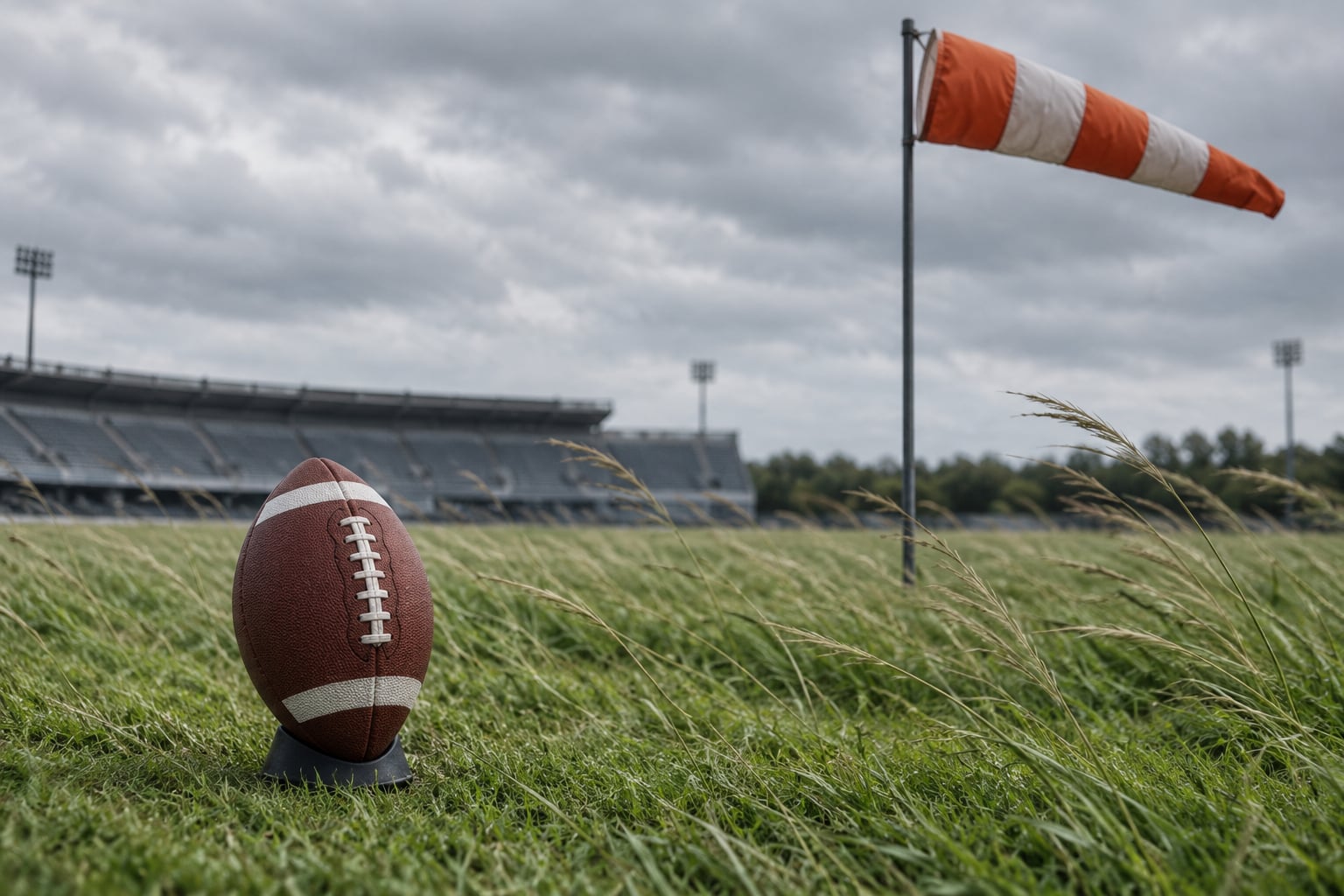
Wind matters because it moves the ball after the foot contacts it, and it loosens the footing under the plant foot. But there is no magic number where every kicker turns into a bad play. How wind affects kickers in fantasy football depends on kick distance, wind direction, gustiness, roof status, and how good the kicker is to begin with.
Most managers get this wrong in one of two directions. Some sit an elite kicker in a 12 mph breeze and lose nine fantasy points. Others leave a rookie streamer in a 30 mph crosswind and watch two blocked extra points sink a matchup.
Below is the framework I use before every lineup lock: what the wind physically changes, which forecast number actually matters, and the four checks to run in under a minute before you decide.
Table of Contents
- How Wind Affects Kickers in Fantasy Football
- What Kicks Does Wind Actually Change?
- How Wind Affects Kickers in Fantasy Football: Direction and Distance
- Why the Same Wind Forecast Affects Kickers Differently
- How Wind Affects Kickers in Fantasy Football Scoring
- How to Adjust a Kicker Projection for Wind
- When Wind Should Change a Start or Sit Decision
- Frequently Asked Questions
- What wind speed actually affects NFL kickers?
- Do indoor and retractable-roof games protect my kicker from wind?
- Does wind change kicker rankings, or only weekly start-sit calls?
- Is wind or rain worse for a kicker?
- What is a good field goal percentage for an NFL kicker?
- Conclusion
How Wind Affects Kickers in Fantasy Football
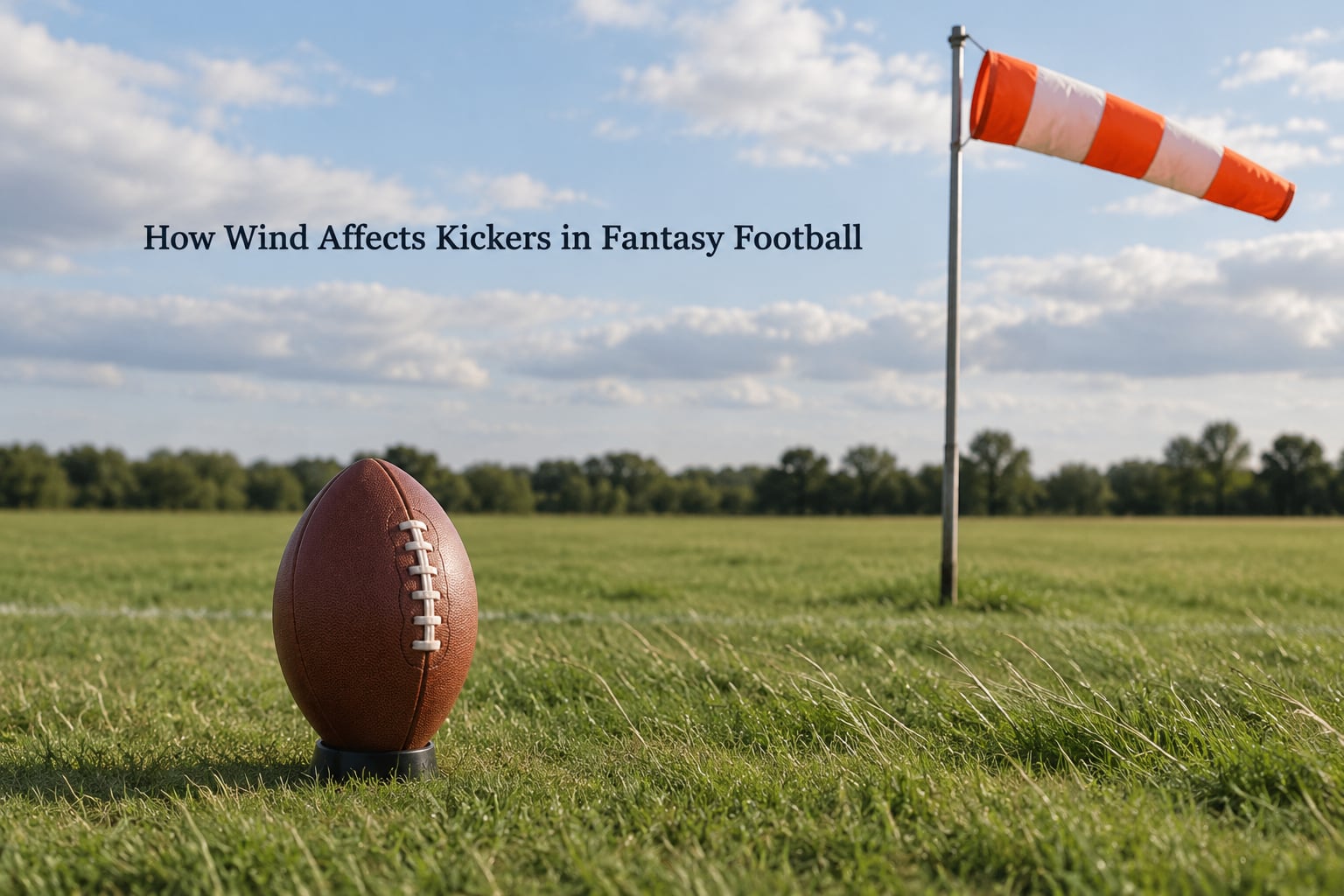
Wind affects kickers by pushing a kicked ball left, right, long, or short after contact. In fantasy terms that shows up as fewer made field goals and extra points, so a lower weekly score than the projection.
The thresholds below are community rules of thumb, not lab results. Treat them as the point where a weather check is worth your time, not as a formula.
| Wind speed at kickoff | What usually happens | Fantasy football action |
|---|---|---|
| Under 10 mph | Below the level most kickers notice. Even long attempts hold their line. | Ignore the forecast. Play your kicker. |
| 10 to 15 mph | Long attempts start drifting. Short ones are unaffected. | Check kick distance and roof status before reacting. |
| 15 to 20 mph | You will see kickers adjusting aim by several yards on 45-plus attempts. | Prefer a kicker with a low attempt distance or a roof. |
| 20 to 25 mph | Misses on attempts a kicker normally makes. Gut plays become real options. | Sit the low-end option. Stream a safer replacement if one exists. |
| Above 25 mph | Meaningful make-rate drop. Games in exposed stadiums can get ugly. | Do not start a kicker you would otherwise stream anyway. |
One thing managers consistently get backwards: the passing game suffers first. On Footballguys forums, the recurring advice is that wind hits receivers and quarterbacks harder, with kickers as the second-order casualty. The forum consensus threshold for fading weather at all sits around 15 mph, and even that is framed as a passing-game call.
What Kicks Does Wind Actually Change?
Two things degrade at once, which is why the effect feels bigger than the wind speed alone suggests.
The first is the plant. A place kicker’s plant foot is his anchor point. Gusty wind on an open-air field makes that foot slide or rotate slightly, and the kicker either adjusts his stance mid-approach or rushes the motion to beat the gust. Either way, contact quality drops.
The second is aim point. Kickers do not aim at the crossbar. They aim several yards behind it and let the drop do the work. Wind requires re-aiming into or around the gust, and a kicker who re-aims badly ends up with the ball on the wrong side of the posts or out of range.
Distance is the reason long attempts are more sensitive. A 20 yard extra point has almost no air time to be pushed around. A 52 yard attempt spends enough time in the air for a crosswind to matter, which is why windy games tend to cost a kicker his long field goals and leave his short ones alone.
Snow and rain are smaller factors than most managers assume. One Facebook group thread put snow’s make-rate effect at roughly a 78 percent rate dropping to about 73 percent, small next to a genuine wind event. Wind plus cold is the combination worth worrying about, because cold makes the ball harder and less responsive to the foot.
How Wind Affects Kickers in Fantasy Football: Direction and Distance
Direction is the detail almost nobody accounts for, and it changes how you read a forecast. A 20 mph wind blowing straight down the field is not the same game as a 20 mph wind blowing across it.
| Wind type | Effect on the kick | Kick distance most exposed |
|---|---|---|
| Headwind (into the kick) | Ball rides higher and longer. Kickers must hit harder or aim lower, and hold accuracy drops with the extra effort. | 45 yards and beyond |
| Tailwind (with the kick) | Ball drifts short and can drop under the crossbar. Often the least costly wind direction. | 40 to 50 yards |
| Crosswind (sideways) | Ball moves sideways across the goalposts. The least forgiving direction for kickers. | Everything past 35 yards |
| Sustained wind (steady reading) | Kickers can pre-aim. The kicker adapts and the effect is largely absorbed. | Long attempts, mildly |
| Gusts (peak reading) | The kicker cannot pre-aim for a gust. Timing the approach is the whole game. | Everything, extra points included |
That last row is the single most repeated question in manager forums: is the forecast number sustained or gusting? A steady 18 mph wind is workable. A forecast showing 18 mph sustained with gusts to 30 is a different problem, because the kicker cannot adjust to a gust that arrives after the approach starts.
Stadium orientation matters too. Stadiums with their long axis aligned to a prevailing wind pattern will produce more crosswinds than venues where the goalposts sit broadside to the usual flow. Managers do not usually calculate this, but they do notice when the same kicker has a strange road pattern at one particular venue.
Why the Same Wind Forecast Affects Kickers Differently
Roof status comes first, because it can erase the entire question. A fixed dome removes wind completely. A retractable roof only helps if it is closed, and that decision usually gets made close to kickoff. An open-air stadium exposes everything.
Check the roof before you check the wind. Too many managers read a 25 mph forecast for a game that ends up under a closed roof, and too many assume a retractable venue is protected when the roof stayed open because it was not raining.
Beyond the roof, a few variables change the magnitude:
- Attempt distance. A kicker whose week projects to four extra points and one short field goal has almost no wind exposure. One projecting six attempts at 50 yards has a lot.
- Kicker baseline accuracy. A Sporting News Week 5 weather report kept an elite kicker as a start in 15 to 25 mph winds specifically because of who he was. Elite kickers absorb weather noticeably better than low-end streamers, because they adjust aim without losing the motion.
- Temperature. Cold air is denser and the ball firms up. That affects everyone equally, but it stacks with wind on the long attempts.
- Precipitation. Rain adds footing and ball-slickness problems. Wind plus rain is a different game than wind alone.
- Field and footing. Soft or wet footing is worse for the plant foot than dry grass.
- Forecast timing. A Wednesday forecast can be meaningless. Kick-time hourly data is the only reading that matches the game.
Altitude gets mentioned less often, and it cuts the other way. A kicker playing in Denver or Mexico City already works with thinner air, which makes the ball fly further and behave differently than his baseline numbers suggest.
How Wind Affects Kickers in Fantasy Football Scoring
Wind erodes the ceiling before it erodes the floor. A blowout win with four made field goals is worth more than a one-possession game with two extra points, and windy road games are far more likely to produce the second outcome.
Standard scoring makes wind a modest concern because kicker scoring is flat per make. If your league adds distance bonuses, wind gets worse fast: a 52 yard miss costs you the make points and the distance points at once. Leagues that reward kickoff touchbacks are barely affected at all, since wind does not reduce the number of kickoffs.
Format also decides who pays. In a rostered league with a dependable starter, one windy week is a small loss. In a streaming league where you rotate kickers every week, a bad forecast means no clean replacement exists, because the waiver wire in Week 8 is full of the same exposed kickers.
Managers in r/fantasyfootball treat the pregame weather check as mandatory specifically for kicker and kickoff return decisions, more often than for any other position. That habit exists for a reason: kicker is where a forecast mistake costs real points and there is no in-game fix.
How to Adjust a Kicker Projection for Wind
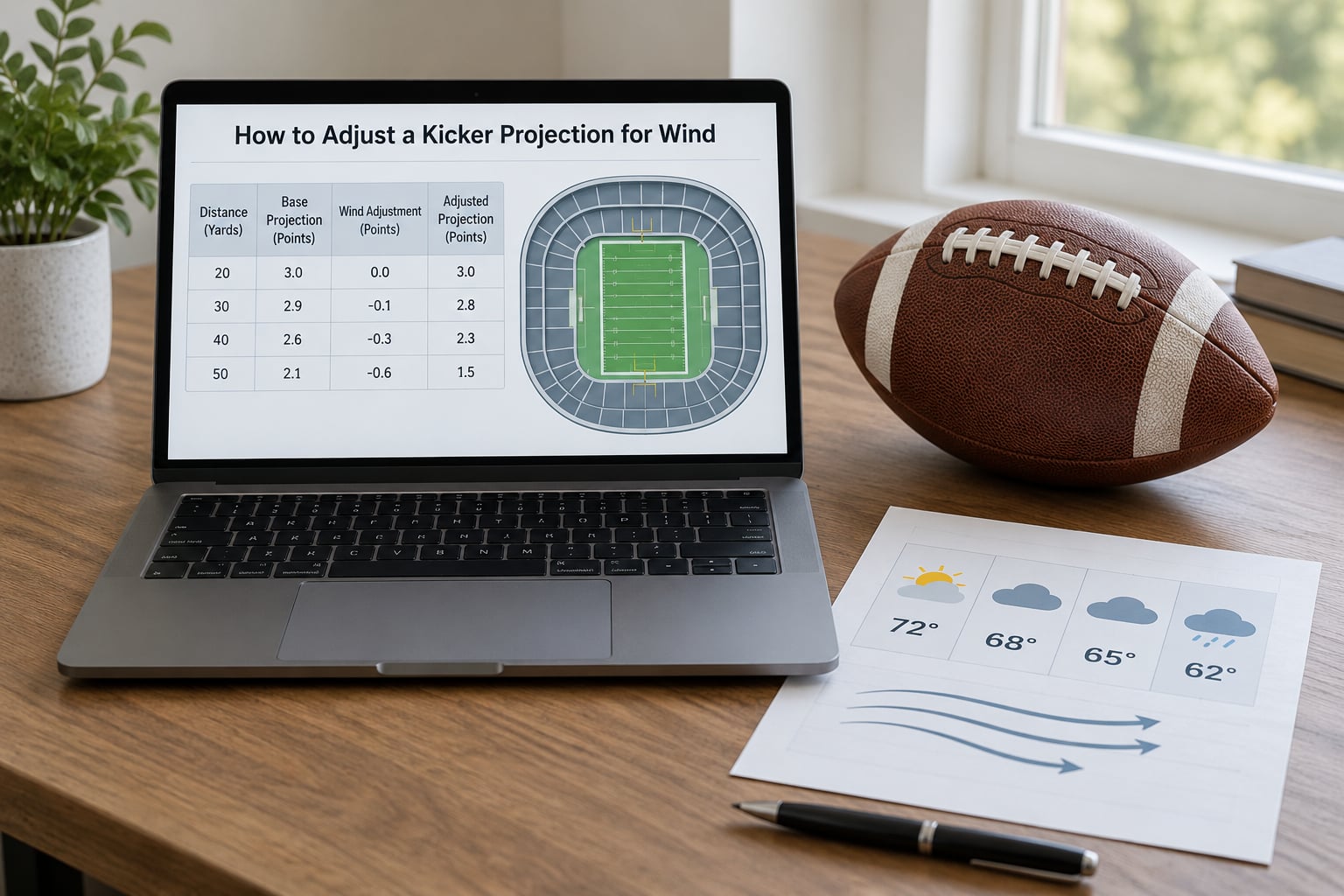
Run this in about a minute, in order, before you lock. Skipping step one is how managers sit a kicker in a closed dome.
- Check the roof. Fixed dome, end the analysis. Retractable roof, mark the question and re-check an hour before kickoff. Open air, continue.
- Read kick-time wind, not the weekly forecast. Use hourly data for the actual kickoff window at the stadium location, and note whether the number is sustained or a gust peak.
- Read the direction relative to the goalposts. Crosswind costs more than tailwind at the same speed.
- Pull the kicker’s expected attempt range. Write down the number of attempts and the expected distance. One short field goal is very different from five attempts at 50 yards.
- Sort by kicker quality. Keep the elite option. Start flagging the streaming option for a replacement.
- Apply a modest adjustment. Most managers subtract a fraction of a point per attempt in the 20 to 25 mph band rather than a fixed penalty. Anything larger than that and you are guessing.
- Look for a replacement with a safer profile. A kicker at a dome, or one with a low projected attempt distance, beats a slightly better kicker in an exposed stadium.
- Re-check the roof and gusts near kickoff. This is the step that separates managers who get it right from managers who got lucky.
Then review the results after the week. If your kicker went 2 of 3 in 25 mph winds, that is not automatically the wind, and neither is it automatically bad luck. Pull up his baseline make percentage for attempts in that distance band before you rewrite your thresholds.
When Wind Should Change a Start or Sit Decision
Sit a kicker when the forecast is material, the roof is open, his attempt distance is long, and you have a real alternative. Drop any one of those four and the case gets weak.
Ignore the wind entirely in a few clear situations: the game is under a roof, the kicker is a reliable starter with a low projected attempt count, your league does not score distance bonuses, or wind actually helps the offense move the ball into scoring range more than it costs on kicks.
That last one is real and often ignored. Heavy wind suppresses passing volume, which pushes teams toward short fields and rushing, and that can produce a kicker with a steady stream of mid-range field goals. A windy game is not automatically a losing kicker game.
Risk tolerance matters too. In a tight weekly matchup against a kicker I trust, I will eat the forecast. In a playoff week where a two-point swing decides my season, I will take the safer venue every time.
One dated piece of history worth knowing: the Cincinnati Bengals published an account called War of Winds in October 2000 describing a field goal moved in mid-flight by wind. It is a useful illustration of the mechanism and a reminder that this has been a real, observable problem for a long time. Treat it as background, not current evidence.
Frequently Asked Questions
What wind speed actually affects NFL kickers?
The commonly cited thresholds start around 10 to 15 mph, where long attempts begin to drift and it becomes worth checking kick distance and roof status. Between 15 and 25 mph the effect is clearly visible, and above 25 mph the make-rate drop becomes material. These are community rules of thumb, not measured thresholds, and kicker quality and stadium roof status shift the number a lot in either direction.
Do indoor and retractable-roof games protect my kicker from wind?
A fixed dome does, completely. A retractable roof only does when it is closed, and that call usually comes late, so you need to check again shortly before kickoff. Retractable venues are the most common source of wasted roster moves, because managers read a 25 mph forecast and forget to confirm the roof state before the game.
Does wind change kicker rankings, or only weekly start-sit calls?
Only weekly calls. Wind is a single-game variable, and it is not distributed evenly across a kicker’s season, so folding it into a season-long projection distorts the player without improving the forecast. Rank kickers on their baseline accuracy, volume, and matchup, then apply wind as a situational adjustment for the specific week.
Is wind or rain worse for a kicker?
Wind, generally. Manager communities put snow and rain effects at a few points of make rate, while strong crosswinds visibly push kicks off line. Rain does add footing and ball-slickness problems, and rain plus cold plus wind together is where the real damage shows up, because the ball firms up and the plant foot loses grip at the same time.
What is a good field goal percentage for an NFL kicker?
Compare the kicker against his own baseline in that distance band rather than a league-wide number, because range is where the difference lives. Anything in the mid-to-high 80s across a full season is strong, and mid-80s is normal. Before blaming wind for a bad week, check what he normally does on attempts of that exact distance.
Conclusion
The rule is simple. Check the roof first, then kick-time wind speed, then direction, then expected attempt distance, then the kicker’s baseline accuracy at that range. Four out of five pointing the wrong way means swap the kicker; one out of five means play him.
Updated for October 2026.