How offensive scheme affects running back production comes down to two channels: how many times the ball is handed to or thrown at the back, and how good the lane is when it happens. Zone blocking creates horizontal lanes with dozens of cutback options. Gap blocking creates one defined hole and rewards a runner who hits it downhill. A play-call mix of counters, sweeps, and shot plays sends more designed carries than a team that runs only when it trails. Here is how each of those choices shows up in weekly fantasy numbers.
Two backs with identical physical profiles can produce wildly different fantasy seasons, and the difference is usually the system around them rather than the talent. That is the part of the position almost nobody projects well, because the scouting report tells you how a player runs while the box score depends on how often the coordinator calls his number.
Here is the short version of the whole thing:
- Volume first. Touches drive fantasy points. Play-call mix, formation splits, and backfield structure decide touches.
- Lane quality second. Gap schemes hand the back one hole. Zone schemes hand him the whole line and ask him to pick.
- Receiving work is real volume too. In PPR, routes out of the backfield can be worth more than two extra carries.
- Pass protection is a hidden tax. A back who stays in to block on most snaps touches the ball less.
- Goal-line role is a separate job. Some offenses hand one back every short-yardage snap, which is worth more than it looks.
- Coaching changes rewrite all of it. A new coordinator can move a back from 18 touches a game to 9 without a roster move.
The rest of this guide breaks each one down, with a play-call glossary, a projection framework you can run yourself, and a checklist for reading a scheme change before the rest of your league does.
Table of Contents
- What is offensive scheme, and why does it matter for running backs?
- Zone blocking
- Gap or man blocking
- Designed versus undesigned run
- Play-action
- The 7 technique
- How does offensive scheme affect running back production?
- 1. Carry volume
- 2. Lane quality and efficiency
- 3. Receiving work
- 4. Pass-protection cost
- 5. Competition for touches
- How formation splits change carry volume
- How run-heavy offenses create fantasy production
- Why does a pass-heavy scheme change a running back’s role?
- Which offensive schemes are best for fantasy running backs?
- How do designed runs, rotations, and committees affect carries?
- How can a running back gain fantasy value as a pass catcher?
- How do blocking and the offensive line affect the numbers?
- How zone and gap schemes compare for fantasy production
- How do defensive fronts interact with the scheme?
- How should you project a running back by offensive scheme?
- Five checks to run after an offensive coordinator change
- What game-script factors can override the base scheme?
- Frequently Asked Questions
- What offensive scheme is best for a fantasy running back?
- Does a running back need many carries to be a good fantasy pick?
- Is a committee back easier to project than a featured back?
- How much receiving work should I expect from a running back?
- Should I downgrade a running back after an offensive-line change?
- Conclusion
What is offensive scheme, and why does it matter for running backs?
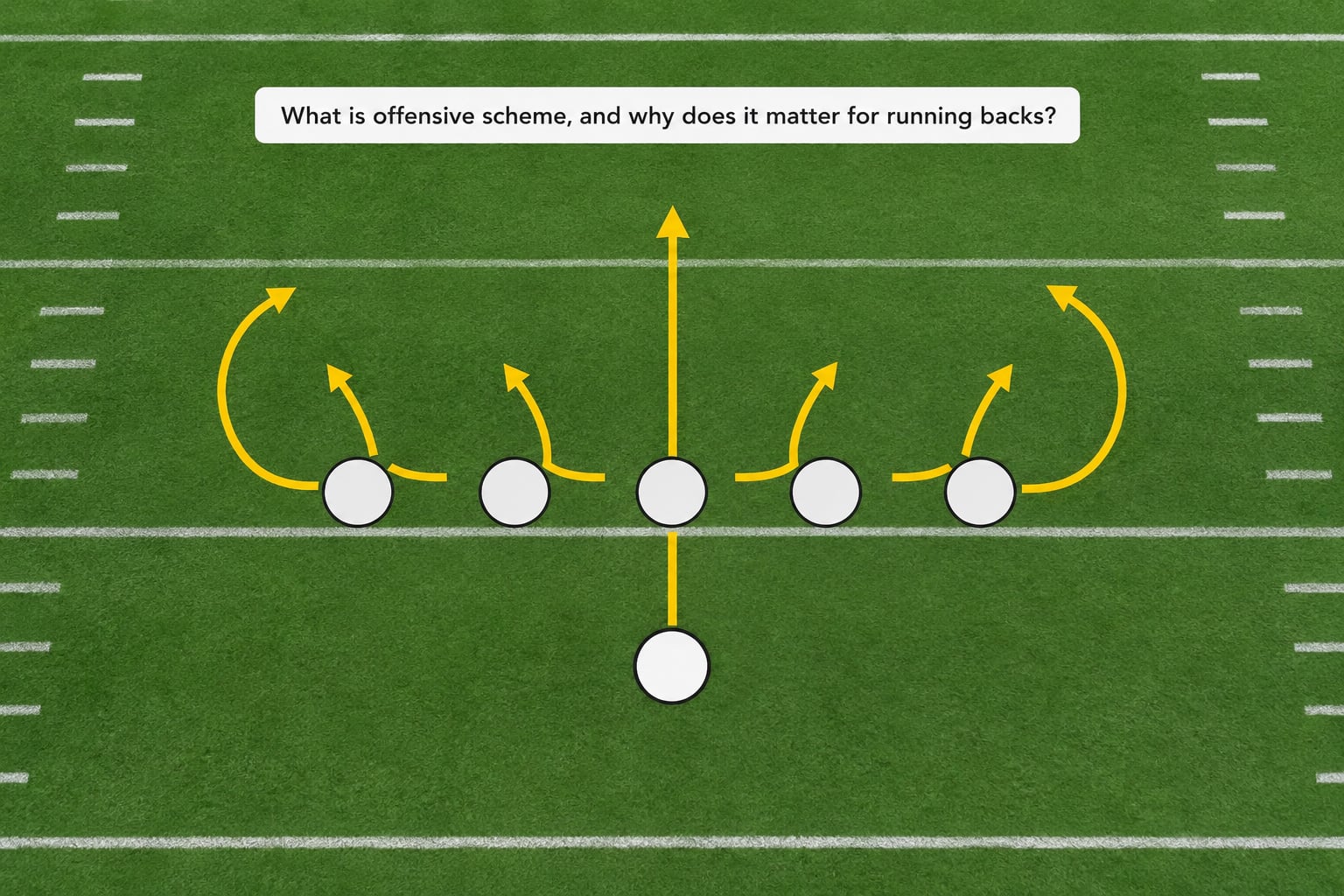
An offensive scheme is the coordinated set of formations, blocking rules, and play calls a team uses to move the ball. It matters for running backs because the running back is the one player whose job changes completely depending on which set of rules the coordinator picked. In a gap scheme he reads defenders and commits. In a zone scheme he reads blockers and adjusts.
That sounds like a coaching nuance. For fantasy purposes it is much bigger, because the scheme also decides how often the ball comes to him at all.
Before going further, here is the vocabulary. Beginner managers get these terms confused constantly, and the same words mean different things on offense and defense, which is half the problem.
Zone blocking
Every lineman takes a set path, usually on an angle toward the play side, and blocks the first defender he reaches in that area. No specific hole is carved out. The running back follows the blocks and finds the opening, which can be behind him, beside him, or outside.
Gap or man blocking
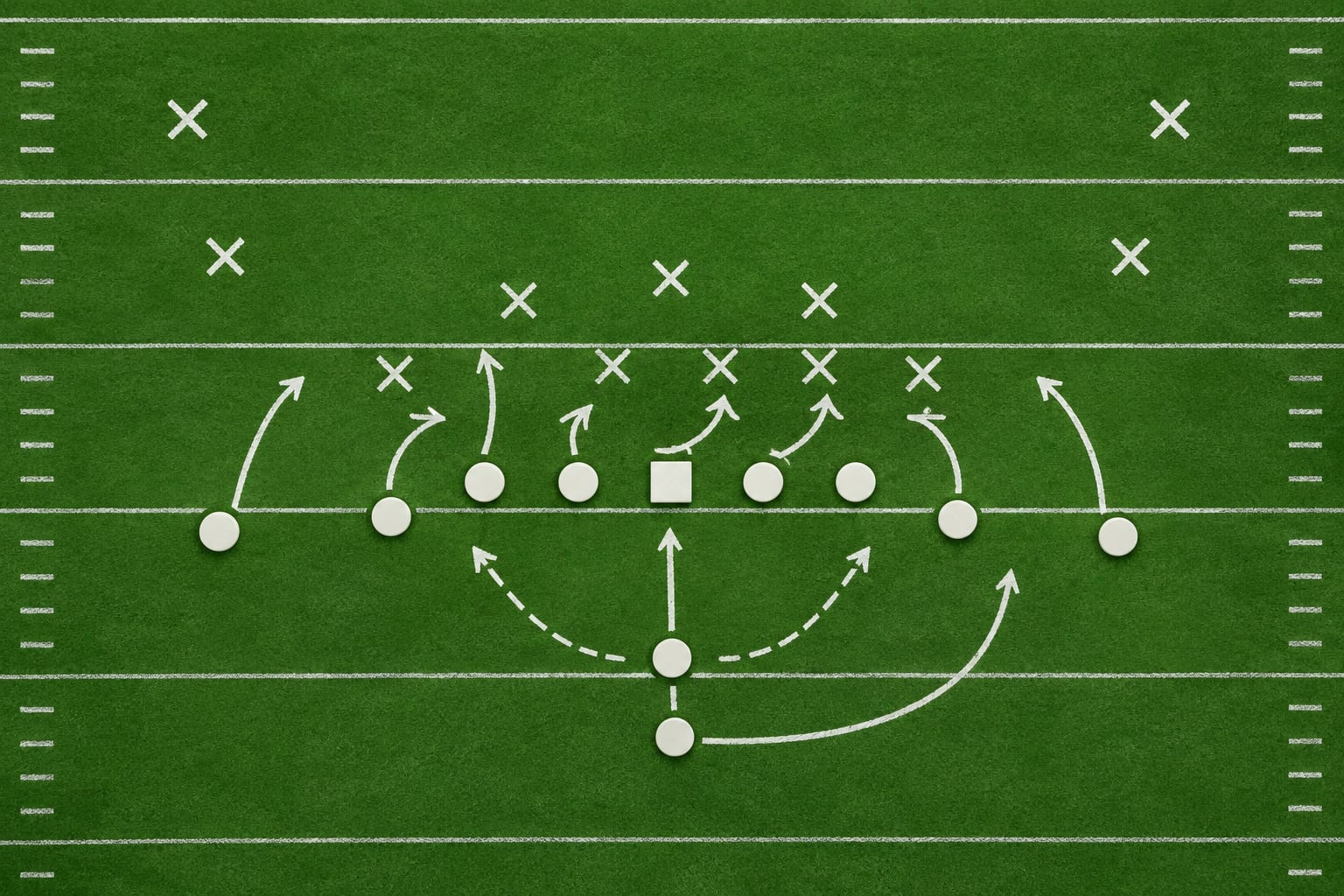
Every lineman moves downfield to block a specific defender, and the collective movement creates one defined running lane. The back’s job is to find that lane and hit it before the line collapses. Power-O, counter, and sweep plays are the classic examples.
Designed versus undesigned run
A designed rushing attempt is called in the play sheet. An undesigned run is a quarterback scramble after a broken play or a bad snap. Scheme describes designed plays, so fantasy projections built on scheme data ignore scrambles unless the quarterback is a known runner.
Play-action
A run fake followed by a pass. It matters to running backs because a defense that bites on the fake gives the runner a wider lane, and heavy play-action teams usually pair it with quick passes to the same back.
The 7 technique
An alignment shorthand describing where a defender sits relative to the offense’s formation and the nearest defender. Understanding alignment tells you how aggressive a defense is being against the run, which tells you how much a given scheme is likely to produce.
How does offensive scheme affect running back production?
Through five channels, and they interact. Most analysis stops at the first one, which is why it usually gets the projection wrong.
1. Carry volume
Volume is the largest driver of fantasy points, and scheme sets the ceiling. A team that runs on roughly 45 percent of snaps has far more touches to distribute than one that runs on 30 percent. Within that, the play-call mix decides whether carries land with one back or three.
2. Lane quality and efficiency
Yards per carry is where the scheme label earns its keep. A defined gap gives the back a clean path and lets him hit a bigger hole at speed. A zone scheme produces more yards overall through volume of opportunity, with a wider spread of outcomes, from two yards behind the guard to 20 yards off a bounce.
3. Receiving work
This is the channel most rankings ignore. A back who runs routes on 30 percent of pass plays has a real target share, and in PPR that share is worth more than the difference between 14 and 16 carries. A back who appears in the game plan as a chip block and nothing else has none.
4. Pass-protection cost
The negative case. Empty backfields and heavy five-man protection schemes put the running back in to block, which removes him from the route tree. Scheme-driven pass volume does not automatically help a running back’s fantasy ceiling.
5. Competition for touches
Scheme interacts with roster. An offense built for a committee splits carries in a stable pattern, which caps the ceiling for everyone involved but raises the floor. An offense with a bell-cow role concentrates the touches, which raises the ceiling and the injury risk.
How formation splits change carry volume
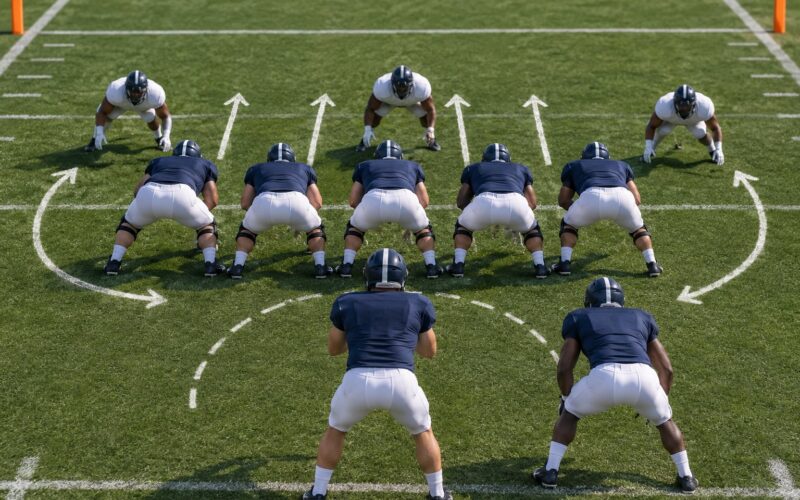
The run-pass split is the headline number, but the formation split underneath it decides where those plays go. I-formation and pistol snaps almost always carry a designed run or a play-action. Shotgun splits the difference. Empty backfields usually mean the running back is staying in to block or checking out to the flat.
Two teams can both run on 40 percent of snaps and hand the ball to their back in very different situations. The one with heavy I-formation usage gives him more early-down carries, which is where blocking numbers and field position are best. The one living in empty gives him fewer touches but more passing opportunities. Track formation splits alongside the run-pass split and the picture sharpens considerably.
How run-heavy offenses create fantasy production
Run-heavy offenses generate fantasy points through early-down volume, play-action, and short-yardage work. Because they hand the ball over so often, the fantasy floor is usually high and the weekly floor is predictable, which is exactly why they are the default answer in 12-team leagues.
The cost is dependence on things outside the back’s control. Run-heavy offenses live or die on offensive-line health and on the defensive front in front of them. A starting guard goes down, and the projection that looked safe in August does not survive September.
Goal-line usage is the piece that swings most weeks. Short-yardage packages are usually assigned to one specific back, and if your league awards points at the goal, that job is worth real points on its own. Track who takes the snaps at 1st-and-goal, not who takes them on the goal line, because the difference tells you which back has the job.
Why does a pass-heavy scheme change a running back’s role?
More passing volume usually means fewer carries, but it can mean a different fantasy role entirely. The back becomes a receiving outlet: checkdowns out of the backfield, swing routes in the flat, screens that count as rushing attempts, and a share of play-action looks underneath.
The trap is treating every appearance as receiving work. A back who lines up, blocks, and runs one route per game for a single target has no real target share, and projecting him off one target is how weekly lineups get lost. The number that matters is targets per game on routes run from the backfield, tracked over a full season rather than a good week.
Which offensive schemes are best for fantasy running backs?
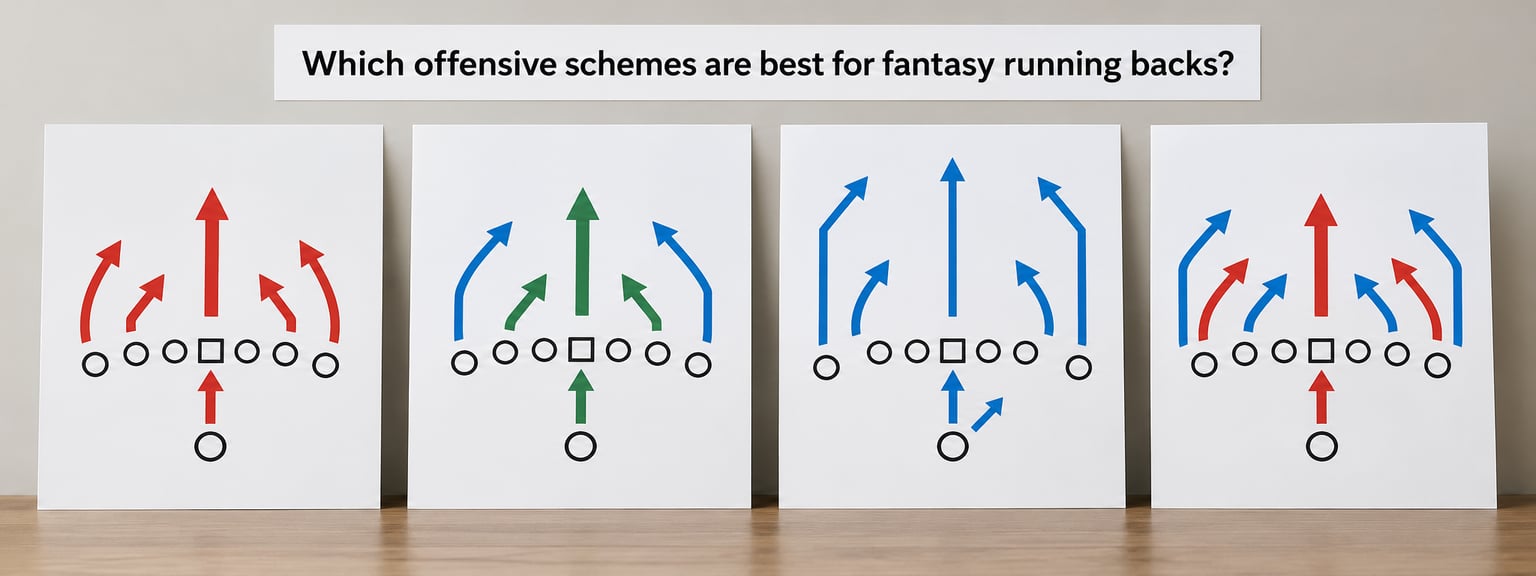
No scheme is best in isolation. What matters is the combination of volume, goal-line role, and receiving work, and how stable each of those is week to week.
| Scheme approach | Typical opportunity profile | Fantasy strength | Fantasy caveat |
|---|---|---|---|
| Run-heavy | High carry volume, early-down runs, play-action, short-yardage package | Most predictable weekly floor | Heavy reliance on line health and defensive front |
| Balanced | Even run/pass split, split backfield, moderate red-zone work | Steady totals with some receiving upside | Shares often means no back clears 15 carries |
| Pass-heavy | Mostly passing, screens, checkdowns, empty backfield snaps | High PPR ceiling for the primary outlet | Carry counts too low to ride out bad weeks |
| Option-based / read-option | Quarterback decides to keep, mesh concepts, designed read handoffs | Unpredictable but high ceiling for the runner | Missed reads mean fewer snaps for the runner |
| Committee | Touches split by down and situation, hot-hand rotation | Adds safe when one back is hurt or benched | No weekly ceiling for any single back |
If you play in a league where the tiebreaker is total points instead of weekly wins, volume and floor matter more than ceiling, and run-heavy or balanced offenses project better. If your format is a playoff that rewards a big week, a pass-heavy offense with a high target share out of the backfield gives you more ways to hit 30 points.
How do designed runs, rotations, and committees affect carries?
Committee does not always mean even. A featured back inside a committee can take 70 percent of the touches because the rotation is by down and situation, not by play. If the third-down back is the passing-down back, the featured back still gets every early-down carry, which is where the real yards are.
The way to tell is to separate carries by down. Count first-and-second-down carries separately from third-and-short carries, and look at who takes the goal-line snaps. A back with 18 carries and no goal-line work has a different weekly profile from a back with 12 carries including five inside the 10.
Rotations cap the floor rather than the ceiling. A hot-hand committee means you might get 20 carries in a game and 6 the next, which is fine in best-ball and painful in a weekly start/sit league. Weekly leagues want a floor, and floors come from predictable carry share, not from talent.
One more wrinkle: a low-carry receiving role is usually more volatile than a high-carry run role. Ten carries with a goal-line snap is a fairly locked-in week. Eight targets can be zero targets, because targets follow the quarterback’s read, not the coach’s game plan.
How can a running back gain fantasy value as a pass catcher?
Receiving value comes from repetition, not from appearances. Track targets per game, routes run from the backfield, and how often he is in on third down when the pass is likely.
Four things create sustainable target volume:
- Checkdowns on early downs. When the coordinator wants a completion to set up the run, the back is the cheapest throw.
- Screens. These count as rushing attempts, so they blur the line between the rushing and receiving projections in a helpful way.
- Play-action looks. Same concept, deeper route. The back sells the run and then breaks out to the flat.
- Red-zone and two-minute situations. Extra snaps where a bigger back is not needed for blocking.
The practical test for sustainability: pull his target count over a full season, not four games. Then check whether those targets came on designed plays or on broken ones. A 4.5 targets-per-game season average with a checkdown playbook behind it projects much better than a 6.0 average built on garbage time.
How do blocking and the offensive line affect the numbers?
The blocking scheme decides what the running back sees, and the offensive line decides how well it works. Those are separate problems, which is why the same scheme label can mean two very different seasons.
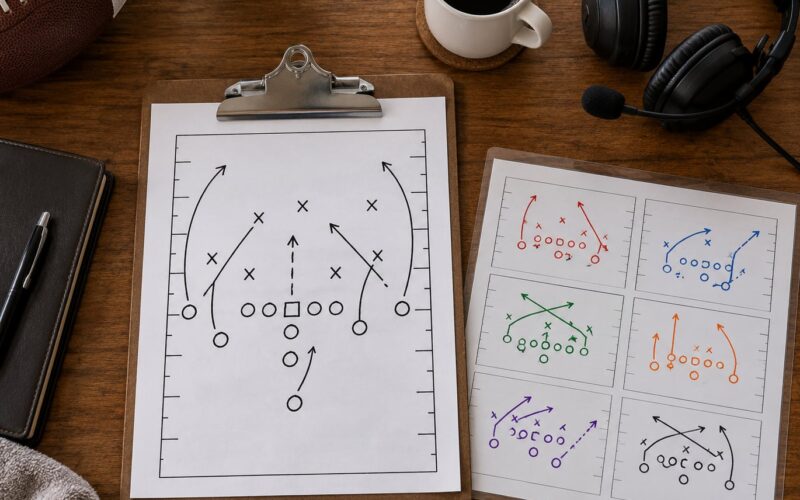
Here is the play-call mix that determines how many designed carries actually reach the running back.
| Play | What it is | Effect on the back |
|---|---|---|
| Power | Gap blocking, backfield receives a handoff behind a pulling guard | One defined lane, rewards a downhill runner |
| Counter | Gap blocking, action opposite the nominal direction | Larger hole, requires reading a moving mesh |
| Sweep | Outside containment, often in motion | Perimeter run, depends on wide tackle |
| Trap | Pulling guard on a delayed path | Big hole if the timing works, costly if it does not |
| Draw | Handoff after the line engages | Delay gives the line time to create a crease |
| Inside zone | Zone blocking, play-side track | Three decisions: stay on path, bounce outside, cut back |
| Outside zone | Zone blocking, wider path | Longer wait, bigger cutback and bounce lanes |
| Wide zone | Zone blocking with horizontal stretch | Most cutback opportunities of the three zone plays |
Practitioners on r/footballstrategy describe a healthy run game as a combination of power, counter, and outside zone, with all of them aiming at the same backside linebacker. The combination matters because defenses can load up against one concept, and a mix keeps the run honest.
The line itself adjusts your number in either direction. Tight-end involvement in the running game adds a blocker and opens the lane, at the cost of a receiver on the route tree. Pass-protection grades matter too, because a line that cannot keep the quarterback upright gets the running back released early, which cuts into his blocking snaps and his touches.
That is why a change in starting guard, starting tackle, quarterback, or head coach can shift a back’s usage without the scheme label changing at all. The playbook is the same, the volume is not.
How zone and gap schemes compare for fantasy production
Zone and gap blocking are not interchangeable labels. They create different lanes, they reward different running styles, and they produce different distributions of outcomes that fantasy managers read very differently.
| Factor | Gap (man) scheme | Zone scheme |
|---|---|---|
| Line movement | Downfield to a specific defender | Set play-side track, block whoever is in the zone |
| Lane offered | One defined hole | Full width, with options behind and outside |
| Run reads | Find the lane and hit it | Stay on path, bounce outside, or cut back behind the center |
| Cutback frequency | Rare | Frequent, especially on wide zone |
| Ideal skill profile | Downhill burst, decisive commitment, short-area vision | Patience, one-cut ability, lateral awareness |
| Outcome spread | Tighter, more predictable | Wider, more boom-or-bust |
| Pass-protection exposure | Higher, since the back stays in to pick up blaters | Lower, since zone plays release him more quickly |
| Fantasy read | Floor-plus, fewer breakouts | More ceiling weeks, more dud weeks |
The counterintuitive part, and the one that trips up rookie analysis, is that both schemes send the back in the same initial direction. The reads are opposite. A gap runner watches defenders and commits to the lane; a zone runner watches blockers and reacts to what they do. A back who learned one style has to relearn the other, and the transition usually shows up as a down season before it shows up as a rebound.
For weekly lineups, the outcome spread matters more than the averages. Zone schemes produce more weeks with a big run because the cutback lane can open behind the pursuit. They also produce more weeks of two or three yards when the line does not move well, which is the trade you are making.
Run fit is why a new coordinator change carries more risk for a 26-year-old than a 23-year-old. Younger backs with one scheme in their head can often absorb the switch. Older backs who built a career on a defined lane lose more when the lane disappears, and that is worth pricing into dynasty valuations.
How do defensive fronts interact with the scheme?
Scheme does not work in isolation from the opponent. A defense that shows a two-high shell plays every run as a man gap look, which means the running lane you designed for gets closed. A defense that plays a lot of two-man fronts and rolls defenders to the run fits are saying the opposite.
The practical adjustment is to compare the offense’s scheme tendency against the defense’s run-defense tendency. Zone offense facing a defense that is aggressive about squeezing gaps is a downgrade. Gap offense facing a defense that gives up yards on the ground is an upgrade. Neither of those is visible from the offensive scheme label alone, which is why cross-referencing tendencies is the step that separates a projection from a guess.
Presnap adjustments count too. Motion, shifts, and formation changes that force the defense to declare its front can change what a designed run produces without any change in the play itself.
How should you project a running back by offensive scheme?
Run the steps in order. The point is not a precise number; it is a range you can defend, built from scheme inputs you can verify rather than a career average someone else guessed at.
- Estimate team pace. Plays per game drives total touches before any other variable matters.
- Get the run/pass split. Multiply by pace to get the raw carry pool.
- Check early-down tendency. Early-down runs carry the most fantasy value per touch because they start closer to the line of scrimmage with better blocking numbers.
- Count red-zone trips and goal-line snaps. Multiply trips by team conversion rate to estimate goal-line carries.
- Split the backfield by down. Apply carry share per down rather than one blended number.
- Add the receiving role. Estimate targets per game from route participation and checkdown rate, and apply your scoring format’s points per target.
- Adjust for blocking. Extra pass-protection responsibilities or a down lineman lower the projection. A fullback brought in for protection lowers it further.
- Adjust for the defensive front. A defense that gives up high rushing success against this scheme is worth a plus; one that closes the gap is a minus.
Worked example. A team runs on 42 percent of snaps, plays 68 times a game, and has a 5.5 percent red-zone trip rate with 55 percent goal-line conversion. The pool works out to roughly 28 carries, 2 goal-line attempts, and about 5 red-zone attempts per game. If the featured back takes 65 percent of the carries plus the goal-line snaps, that lands near 18 touches and 75 rushing yards before matchup adjustment. Add 3 targets in a PPR format and you have a weekly projection in the low-to-mid teens that you can actually audit.
Do the same math and you will catch the errors quickly. If your projection needs the back to score a long run every week to reach a target, the scheme is not supporting it.
Five checks to run after an offensive coordinator change
A new coordinator is the moment scheme matters most, and it is the moment most managers react to too late. Run these in order during the preseason and the first two weeks.
- Find the play-call mix. Game scripts and play counts are public. Look for zone frequency, gap frequency, and whether counters and counters-plus are actually being run.
- Count designed carries by back. Track who has the handoffs, not who has the highlights.
- Check formation splits. A drop in I-formation and pistol usage and a rise in empty backfields means fewer run opportunities.
- Measure play-action rate. It tells you whether the coordinator wants to sell the run, which affects both run lanes and checkdown volume.
- Watch the offensive line, not just the back. New blocking assignments take time. A coordinator who brings zone blocking to a line built for power has a slower start than the roster articles suggest.
Scheme mismatch is the failure case people get burned by. A gap runner who has to watch his blockers move toward the path instead of away from it tends to miss reads and bounce plays outside, and a runner used to defined lanes loses value when there is no defined lane. The scouting report says he can play; the box score disagrees for two seasons.
What game-script factors can override the base scheme?
Scheme sets the plan, and the scoreboard replaces the plan. A run-heavy team that falls behind will pass more in the second half than its season-long numbers suggest, and a presumed committee back can pick up unexpected goal-line or receiving work because he is the smaller, better-passing option.
The practical adjustment is to raise or lower your projection when expected point differential is extreme. Favorite by a large margin with a lead in the fourth quarter means fewer touches, not more. Trailing by three possessions in the fourth means the run game may get abandoned entirely, and the back’s value shifts to whether he can survive as a pass catcher.
Defensive matchup works the same way. A front that is aggressive about stopping the run can turn a designed play into a scramble, which reverses the efficiency assumption. Check the opponent’s scheme tendencies before you assume last week’s efficiency repeats.
Frequently Asked Questions
What offensive scheme is best for a fantasy running back?
There is no single best scheme, because the useful question is which one matches your league settings. In a weekly-start league, a run-heavy or balanced offense with a clear goal-line back gives you the most predictable floor. In a best-ball league or a playoff spot that rewards a big week, a pass-heavy offense with a high target share out of the backfield offers more ceiling. Judge the volume first, then check whether the lane quality matches the runner.
Does a running back need many carries to be a good fantasy pick?
Not always, but carries are the easiest signal to project. A back with twelve carries a game and no goal-line work can be a fine pick in a points-scoring format where receiving work adds to his total. What matters is whether the touches come early, when blocking numbers and field position are best. Eight late carries in a passing script produce far less than twelve early-down carries, so count carries by down before you judge a projection.
Is a committee back easier to project than a featured back?
A committee is easier to project at the team level and harder at the individual level. You can reasonably expect the offense to produce a certain number of carries and spread them by situation, but you cannot say which back collects them on a given week. Hot-hand committees make this worse. Featured backs give you a stable share and a clear ceiling. Committees give you a safer add when someone is hurt, but no weekly upside.
How much receiving work should I expect from a running back?
It depends on the scheme, not the position label. A typical pass-heavy offense gives its primary back two to five targets a game through checkdowns, swing routes, and screens. A run-heavy offense might give the same player under one. The number worth tracking is targets per game on routes run from the backfield, averaged over a full season. One big week on a broken play tells you very little about the sustainable share.
Should I downgrade a running back after an offensive-line change?
Yes, and earlier than most managers do. A new starting guard or a coordinator bringing different blocking assignments changes both the lane quality and the passing-game structure. Check the play-call mix and formation splits from the first two weeks rather than reacting to a bad game. Downgrading does not always mean dropping, but the original projection should not survive unchanged just because the back’s talent is identical.
Conclusion
Find the real play mix and the real backfield role before you project anything. Count designed carries by down, note who takes the goal-line snaps, and check whether the back actually runs routes or just blocks.
Then adjust for the things scheme does not tell you: the defensive front, offensive-line health, and the expected game script. Do that work in August and you will be ahead of the box scores.