A new head coach does not make a player better or worse. He changes how often that player is used, where on the field he lines up, and how much of the offense flows through him. Fantasy points come from volume and efficiency, and volume is set by play-calling. That makes a coaching change one of the largest single-year swing factors you can evaluate before a draft, using nothing but public information.
Most guides on this topic are written in August and worthless by January. They list which players are risers under each new hire, then the carousel spins and a different set of names matters. What follows is the opposite: a method that works on any coaching change in any season, with current-cycle names used as examples rather than as the point.
Table of Contents
- How Coaching Changes Affect Fantasy Football at a Glance
- What Changes When a Team Hires a New Coach?
- The coaching tree beats the job title
- The install, not the hire, is the real deadline
- Personnel moves are a separate variable
- Tenure risk deserves a discount
- Not every rumored change happens
- How Play-Calling Style Changes Player Projections
- Pass frequency and run tendency
- Play action and its side effects
- Tempo and scrimmage downs
- Red-zone distribution
- Formation and personnel groupings
- How New Roles Affect Running Backs and Receivers
- Committee backfields and the bell cow
- Goal-line back and pass-catching back
- Slot and outside receiver movement
- Tight end blocking requirements
- How to tell whether volume is genuinely rising
- Why Quarterback Value Changes Under a New System
- Supporting cast quality
- Turnover expectations
- Rushing involvement
- Red-zone passing volume
- Upgrade and downgrade scenarios
- How Coaching Changes Affect Fantasy Football Projections
- What About Defense, Special Teams, and Game Scripts?
- Coverage shells decide IDP opportunity
- The snap-count split is the real risk
- Special teams is a smaller, cheaper edge
- Expected game scripts cut both ways
- How to Separate Real Opportunity From Short-Term Noise
- Signals worth acting on
- Signals to discount
- How to kill your own thesis
- What to do when it happens mid-season
- How to Update Redraft, Keeper, and Dynasty Leagues
- Scoring format changes the sensitivity
- Waiver wire timing
- Superflex adds one more variable
- Frequently Asked Questions
- How long does it take for a new offense to produce fantasy results?
- Which positions are most affected by a coaching change?
- Do head coach changes or offensive coordinator changes matter more for fantasy football?
- Should I fade players on a team with a new head coach?
- How do I know if a new coaching staff will actually be better?
- Start With Verified Roles, Not Headlines
How Coaching Changes Affect Fantasy Football at a Glance
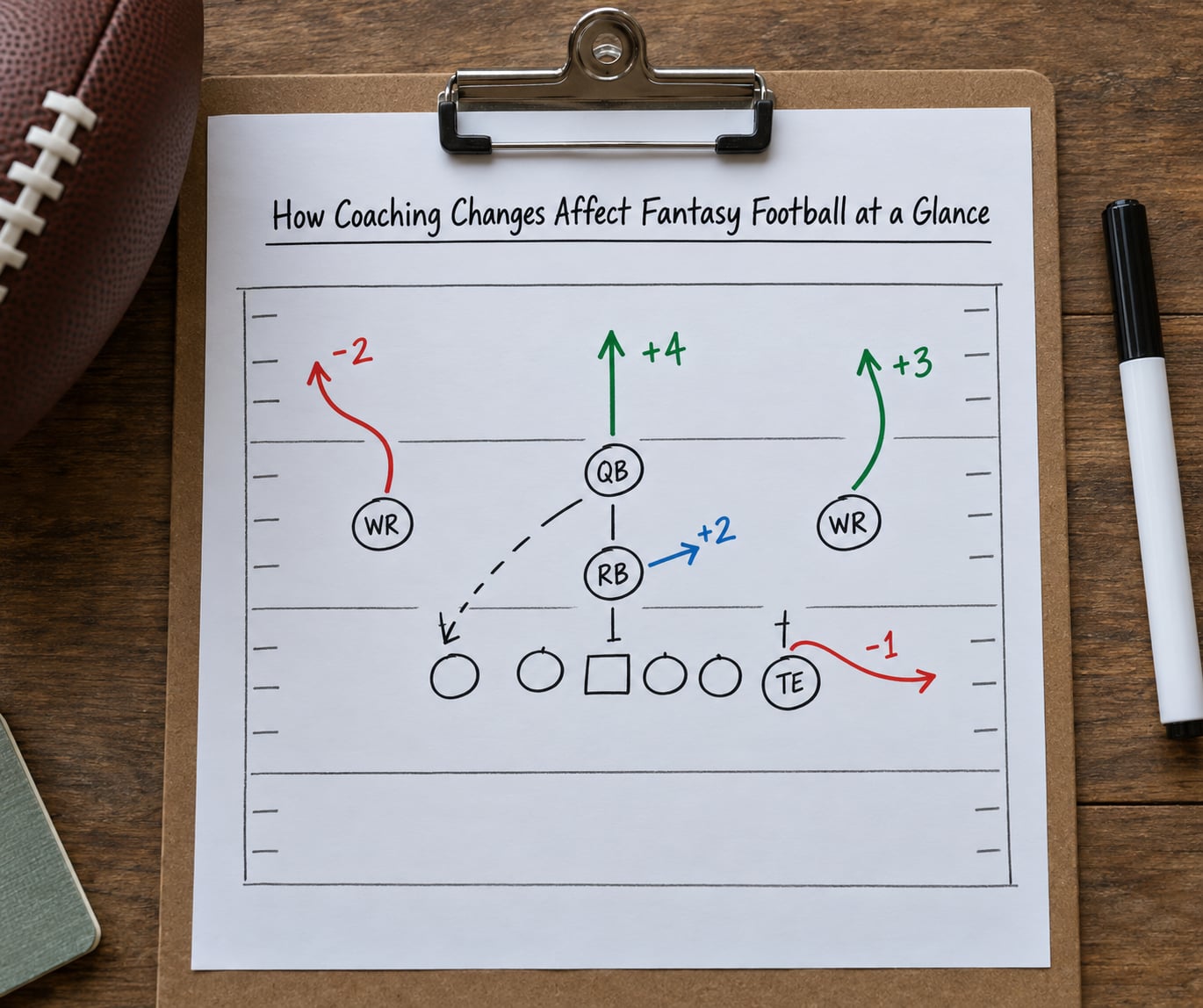
Coaching changes move usage, not talent. A new staff redistributes snaps, carries, targets, routes and red-zone touches among the players already on the roster. The effect shows up in projection math: how many snaps a back gets, what share of routes a receiver runs, how deep the throws go, and how often the offense is near the goal line. Nothing else in the offseason produces that much movement in fantasy value.
Four types of change travel at different speeds and hit different positions. Sorting them out is most of the work.
| Change type | What actually changes | Positions most affected | When it shows up | Confidence |
|---|---|---|---|---|
| Head coach change | Entire offensive identity, install timeline, personnel deployment | QB, RB, WR, TE | Week 1, with a noisy Week 3-4 dip | Medium |
| Offensive coordinator change | Play-call vocabulary, tempo, play-action rate, shot volume | WR, TE, QB, RB checkdowns | Week 1-2 | Medium-high |
| Quarterbacks coach change | Design and timing, quick-game volume, turnover profile | QB, slot WR, TE | Week 1 | Low |
| Defensive coordinator change | Coverage shell, box count, blitz rate, IDP opportunity | LB, DB, DL, safeties | Week 1-2 | Low-medium |
| Special teams coordinator change | Return roles, kicking distance, coverage team roles | Returners, kickers, DST | Preseason | Low |
That table is a starting filter, not a verdict. The next sections explain what sits behind each row.
What Changes When a Team Hires a New Coach?
Five things move when a new staff arrives, and only one of them is usually mentioned.
The coaching tree beats the job title
A new head coach almost always brings an offensive coordinator with him, and that pair usually runs a system refined somewhere else first. The coaching tree is that lineage: the system a coach was last shaped by. It predicts play-calling habits better than a reputation built on one good season, and it is public before the hire is announced.
The clearest historical example is a tight end who was an elite receiver losing his role because a new staff wanted a blocker instead. The talent never changed. The route tree did.
The install, not the hire, is the real deadline
A new system means new terminology, new practice script and new habits for quarterbacks. In most years the offense looks genuinely bad through the first two or three games, then settles. Managers who fade players on bad early production and managers who buy them on hype are making the same mistake in opposite directions.
Personnel moves are a separate variable
A rebuild, a new quarterback and a coaching change often arrive together, then get blamed on each other. If a player is worse after a scheme change, ask whether he is also playing behind a weaker line or a different quarterback. You cannot fix a talent problem with a play call, and coaches do not lose games by ignoring talent for a full season.
Tenure risk deserves a discount
An interim head coach is the least durable signal on the board. So is an offensive coordinator on a one-year deal: the boost is real for that season and gone in year two. Discount those projections accordingly. In dynasty, that means the ceiling is lower than the market reaction suggests.
Not every rumored change happens
Coordinators get hired and then leave inside a month. Assistants get promised play calls and end up calling something else. Treat the first press conference as a hypothesis, not a fact.
How Play-Calling Style Changes Player Projections
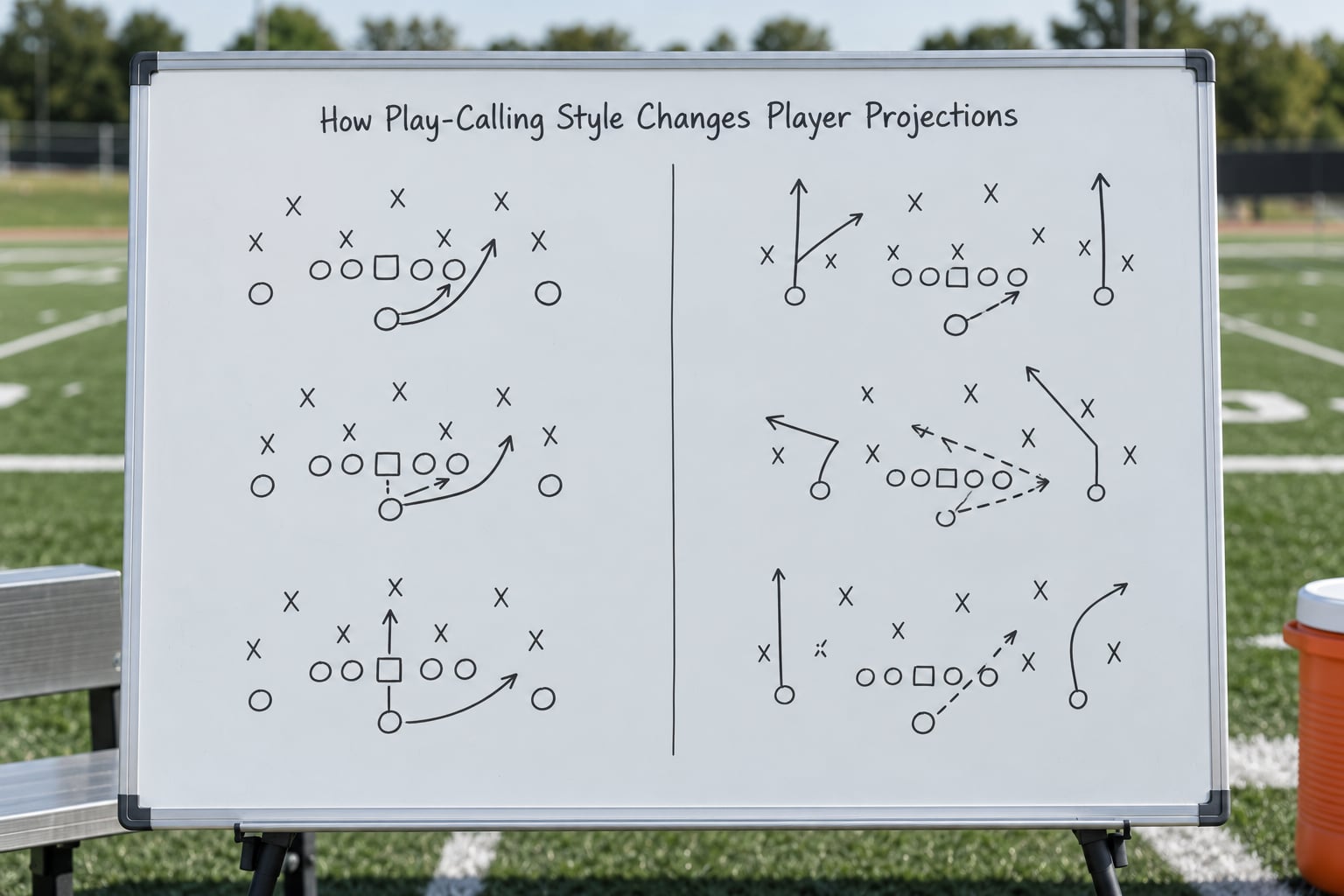
Play-calling style is volume expressed as a preference. Once you can name the preference, the fantasy effect follows fairly directly.
Pass frequency and run tendency
A staff that leans pass-heavy raises the total number of targets available. That spread is thin, so it lifts the floor for pass-catchers more than it lifts the ceiling for the first option on the depth chart.
Play action and its side effects
Play action does not reduce passing, it reshapes it. Run play fakes move linebackers, and the response is usually intermediate routes over the middle. That is why play-action-heavy staffs tend to produce slot receivers and tight ends rather than only boundary players.
Tempo and scrimmage downs
Faster tempo means more snaps. Every player on the field gains a share of those snaps, which quietly raises everyone’s floor without changing any individual role. It also hurts defenses facing volume, which matters in IDP.
Red-zone distribution
The most valuable real estate on a football field is inside the 20. A staff that runs a goal-line back on early downs changes the shape of every rushing attempt in that range, and goal-line carries are heavily concentrated for a reason.
Formation and personnel groupings
Eleven personnel, two-tight-end sets, empty backfields: each grouping redistributes targets. A heavy two-tight-end offense inflates tight end volume and shrinks slot receiver volume, which is the mechanism behind a lot of tight end breakouts in any given year.
How New Roles Affect Running Backs and Receivers
Roles matter more than schemes once the scheme is known. A role change shows up as a change in what a player is asked to do, not in what the offense is called.
Committee backfields and the bell cow
Outside-zone and inside-zone systems built for one specific runner concentrate carries, because the coach can script designed runs and cut the other back into a receiving role. Two-backfield systems do the opposite, and anyone projecting a workhorse total under one should know which system the new staff is actually installing.
Goal-line back and pass-catching back
Splitting those two jobs is common. One back takes the early-down carries near the goal line, the other handles passing downs. Standard scoring punishes the split more than PPR does, which is worth remembering before you compare ADP across formats.
Slot and outside receiver movement
Quick-intermediate systems push volume to the slot and to checkdowns from running backs. Route participation is the metric to watch: a receiver who runs most routes but a low share of targets is a different player from the one who runs fewer routes and owns a third of the targets.
Tight end blocking requirements
When a coach wants a blocker, receiving work disappears. That is the single most reliable fantasy effect of a system change, because it removes the route entirely rather than reallocating it.
How to tell whether volume is genuinely rising
Compare snaps per game, route participation and target share over a multi-week window, not a single game. One high-volume week against a soft opponent is noise.
Why Quarterback Value Changes Under a New System
Quarterback projections shift under a new staff for five reasons, and none of them is arm strength.
Supporting cast quality
A run-first system lowers the ceiling but raises the floor. A pass-first system does the reverse. The quarterback’s projection is really a projection of his offense’s attempt volume plus his own rushing involvement.
Turnover expectations
Some systems throw the ball before the play is ready. Interception rate is a projection input for a reason, and a new staff’s aggressiveness is the hardest variable to forecast before kickoff.
Rushing involvement
Designed quarterback runs inflate rushing attempts in short-yardage and goal-line situations. That is fantasy-relevant in superflex and in two-QB leagues long before anyone else notices.
Red-zone passing volume
A staff that survives to the red zone often times throws differently. Completion probability near the goal line is where good quarterback seasons are usually built.
Upgrade and downgrade scenarios
Upgrades usually come with new volume plus better efficiency. Downgrades often show up as a worse supporting cast wearing a new system, which is why the quarterback’s outcome has less to do with his own talent than managers expect. A low-volume offense can still support a fine season if the running game does the work, so do not treat a bad offense as automatic failure for the passer.
How Coaching Changes Affect Fantasy Football Projections
Revising a projection takes five inputs, applied in this order.
1. Start with the baseline snap count. Use last season’s per-game snaps for that offense, then adjust for the new staff’s tempo. Faster tempo raises snaps for everyone; it does not change role share.
2. Rebuild the role projection. Committee versus bell cow, goal-line versus pass-catching, slot versus boundary. Decide the role before you decide the total.
3. Re-estimate route participation. Route participation predicts targets better than raw snaps for receivers, because a snap without a route produces no target.
4. Layer in red-zone touches and goal-line work. Red-zone targets and carries are worth more per instance than the same volume between the 20s, so distribution inside the 20 deserves its own line in your model.
5. Discount for context. Offensive line quality, quarterback quality, schedule strength and coach tenure all cap how much of the theoretical scheme can actually show up. A scheme cannot manufacture yards from a line that cannot block.
Then translate to ADP. Coaching news moves value well before most managers evaluate it, which is exactly why a projection you update in June will differ from the market’s price in August.
What About Defense, Special Teams, and Game Scripts?
Offensive moves get all the attention, and IDP managers are often left with the least usable analysis of any group.
Coverage shells decide IDP opportunity
A two-high safety shell pushes safeties into coverage and linebackers into run support, which usually means fewer tackles. Quarters coverage and press-man do the opposite. Simulated pressures and heavy blitz rates create extra box snaps for defensive linemen and linebackers, the two positions that score on volume alone.
The snap-count split is the real risk
A new defensive coordinator redistributes snaps before anyone has established a role. That distribution often settles by Week 3, but early IDP tape is close to meaningless.
Special teams is a smaller, cheaper edge
Return roles and kicker distance change with a new coordinator and are usually ignored in draft rooms. They are cheap to monitor and rarely contested.
Expected game scripts cut both ways
Offensive play-calling responds to opponent quality and expected score. A team favored by a lot runs more to protect the lead, which cuts passing volume in garbage-time weeks. A team expected to trail throws more, which helps passing volume and hurts run volume. Your projection should carry a small opponent adjustment for that reason.
How to Separate Real Opportunity From Short-Term Noise
This is where most coaching-change theses die. The evidence looks identical in July and it does not stay that way.
Signals worth acting on
A coach who names a specific role change repeatedly, a coordinator who brings his previous assistant with him, a published install document or play-call chart, and role usage that shows up in preseason game film rather than in a quote.
Signals to discount
Depth-chart labels printed in August that contradict every rep from camp, a single dominant game against a weak opponent, generalities about being more aggressive, and any headline that arrives without a named hire.
How to kill your own thesis
Give it a deadline. If projected role changes have not appeared by Week 3, the thesis is probably wrong about the system rather than about the player. Most big mistakes by new coaches share a short list: installing too much, calling for a quarterback who cannot execute it, and abandoning the plan the first time it looks bad on the scoreboard.
What to do when it happens mid-season
A coordinator change on a Tuesday gives you about 48 hours. Decide whether the affected players were bought for the old system or the new one. If the new hire is an upgrade in the same philosophy, hold. If the philosophy is different, sell the roles that die under it and buy the ones that grow.
How to Update Redraft, Keeper, and Dynasty Leagues
The same coaching news should produce three different actions depending on your league.
| Format | Primary action | How aggressive to be |
|---|---|---|
| Redraft | Draft position and weekly starts | Most aggressive, because the horizon is 17 weeks |
| Best ball | Draft position only, ADP timing | Moderate, and worth entering slightly ahead of consensus ADP |
| Keeper | Keeper decision and trade value | Moderate, weighting the next two seasons |
| Dynasty | Long-term asset value and rebuild timing | Most conservative, discounting interim and one-year coaches hardest |
Scoring format changes the sensitivity
Coaching change moves receptions more than it moves rushing yards, because target volume is the most adjustable input a new staff controls. PPR and half-PPR leagues therefore feel coaching news more sharply than standard scoring does. If you play standard, a passing-volume upgrade matters less to you than the red-zone and goal-line distribution, which is where the running game lives.
Waiver wire timing
The practical move is to wait for the first two weeks of real snap data, then claim the player whose role clearly expanded. Buying a coaching-change narrative in August gets you the ADP reaction; buying the confirmed role in September gets you the production.
Superflex adds one more variable
Quarterback value carries more weight in two-QB and superflex formats, so the tenure-risk discount matters more there. A one-year coordinator is a shorter asset than the market treats it.
Frequently Asked Questions
How long does it take for a new offense to produce fantasy results?
Most new systems show usable structure by Week 2 and settle into something close to their final identity by Week 5. A new coaching staff installing unfamiliar terminology tends to produce messy football early, so pre-season projections usually understate passing volume and overstate run volume in the first three games. Judge the offense on roles and snap distribution rather than on points scored, then re-cut projections once a full four weeks of data exists.
Which positions are most affected by a coaching change?
Running backs and wide receivers move the most in absolute volume terms, because carry share and target share are set directly by play-calling. Tight ends swing hardest in percentage terms, since a coaching change can add or remove an entire role rather than reallocate a share. Quarterbacks move with the supporting cast. Defensive linemen and linebackers are the biggest IDP movers when a coordinator changes box counts.
Do head coach changes or offensive coordinator changes matter more for fantasy football?
A head coach change usually matters more, because it resets the run-pass ratio, personnel usage and install timeline all at once. An offensive coordinator change is more surgical: it alters play-call vocabulary, tempo and shot volume while leaving the roster and often the head coach intact. When both happen, treat the head coach as the driver and the coordinator as the translator of that philosophy.
Should I fade players on a team with a new head coach?
Not automatically. A coaching change is an argument for re-evaluating a role, not for avoiding a player. If the player was drafted because of a specific role under the old staff, that role is the thing to check. If the player produces independent of scheme, such as a quarterback who thrives on volume regardless of system, the coaching change matters much less than it does for a role-dependent producer.
How do I know if a new coaching staff will actually be better?
Look at the coaching tree first, then the install plan, then the supporting cast. Lineage tells you what system is likely to be installed, the install plan tells you how much of it can be taught in the preseason, and the cast tells you whether the scheme can work at all. Give any thesis a Week 3 deadline. If projected role changes have not appeared by then, the staff is probably not running the system you priced in.
Start With Verified Roles, Not Headlines
Here is the first move: take one team with a real change, identify the system the new staff is likely to install, then list which of their players hold roles that system rewards or deletes. Do that before you touch your rankings.
Coaching changes are worth real attention precisely because usage drives fantasy scoring, and usage is public information that moves ADP early. The managers who gain from it are not the ones who guess who is better. They are the ones who check whether the roles changed, then let the evidence confirm it before they commit.