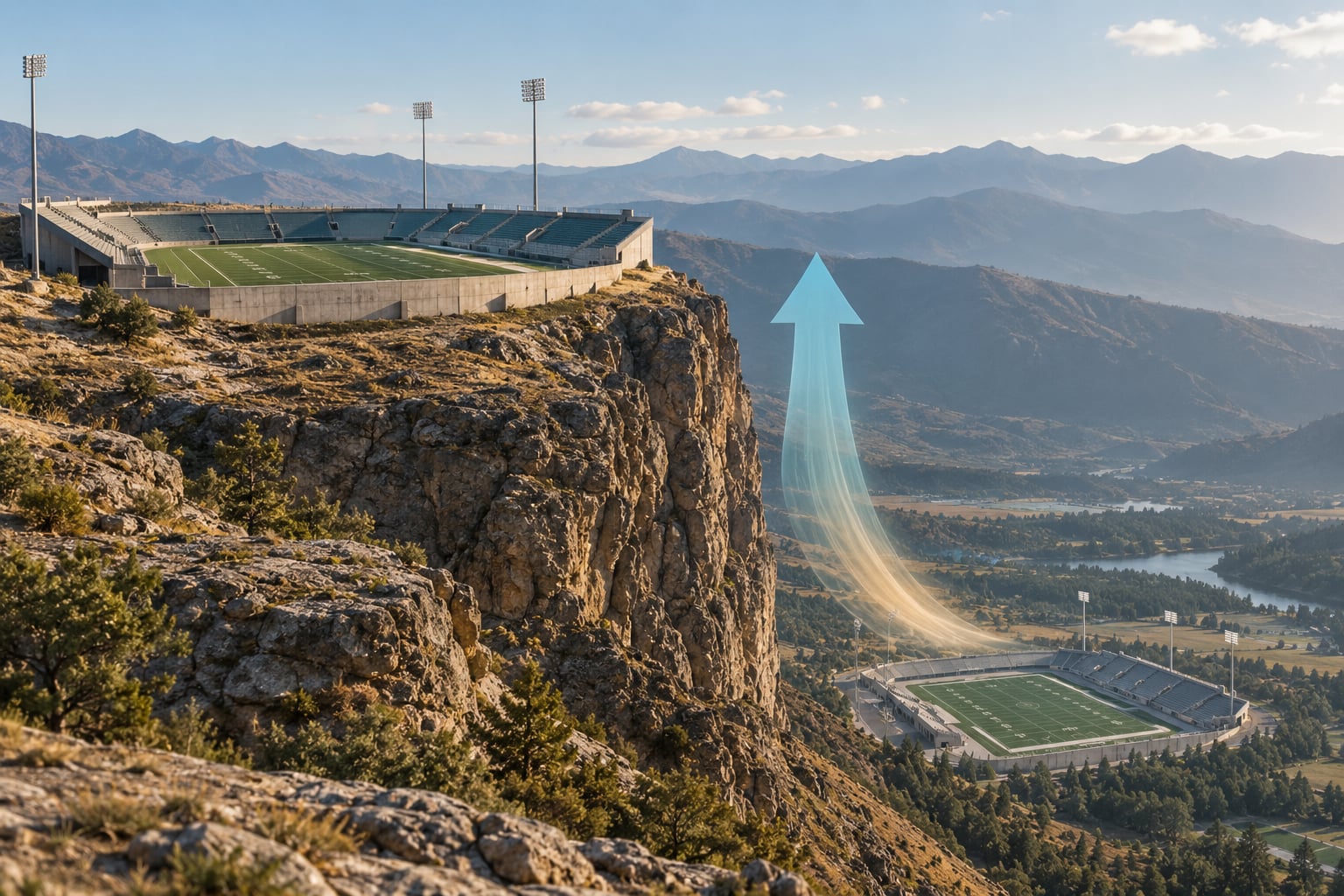
How altitude affects NFL games and fantasy scoring comes down to oxygen, workload and where points come from in a game. Air density falls roughly 3% for every 1,000 feet of elevation gained, so a quarterback at 5,280 feet takes in less oxygen with each breath than he would at sea level, and unacclimated visitors tire earlier than players who live there. In fantasy terms, altitude tends to suppress road rushing volume, push scoring earlier, and lift the value of home players and home defenses. It is a real input to a projection, but a small one next to game script, weather and player form.
Table of Contents
- How Altitude Affects NFL Games and Fantasy Scoring
- What happens to NFL players at high altitude?
- Does altitude consistently reduce fantasy scoring?
- How the running game changes at altitude
- How altitude affects quarterbacks and receivers
- Kickers, field goals, and fantasy kicker scoring
- How to adjust your fantasy football projections
- How team travel, weather, and home-field advantage interact
- What evidence is strong and what is uncertain
- Frequently Asked Questions
- Do the Broncos have an altitude advantage?
- What NFL stadium has the highest altitude?
- Should I downgrade a running back playing a road game in Denver?
- Does altitude make field goals easier?
- How much does weather affect fantasy football?
- Conclusion
How Altitude Affects NFL Games and Fantasy Scoring
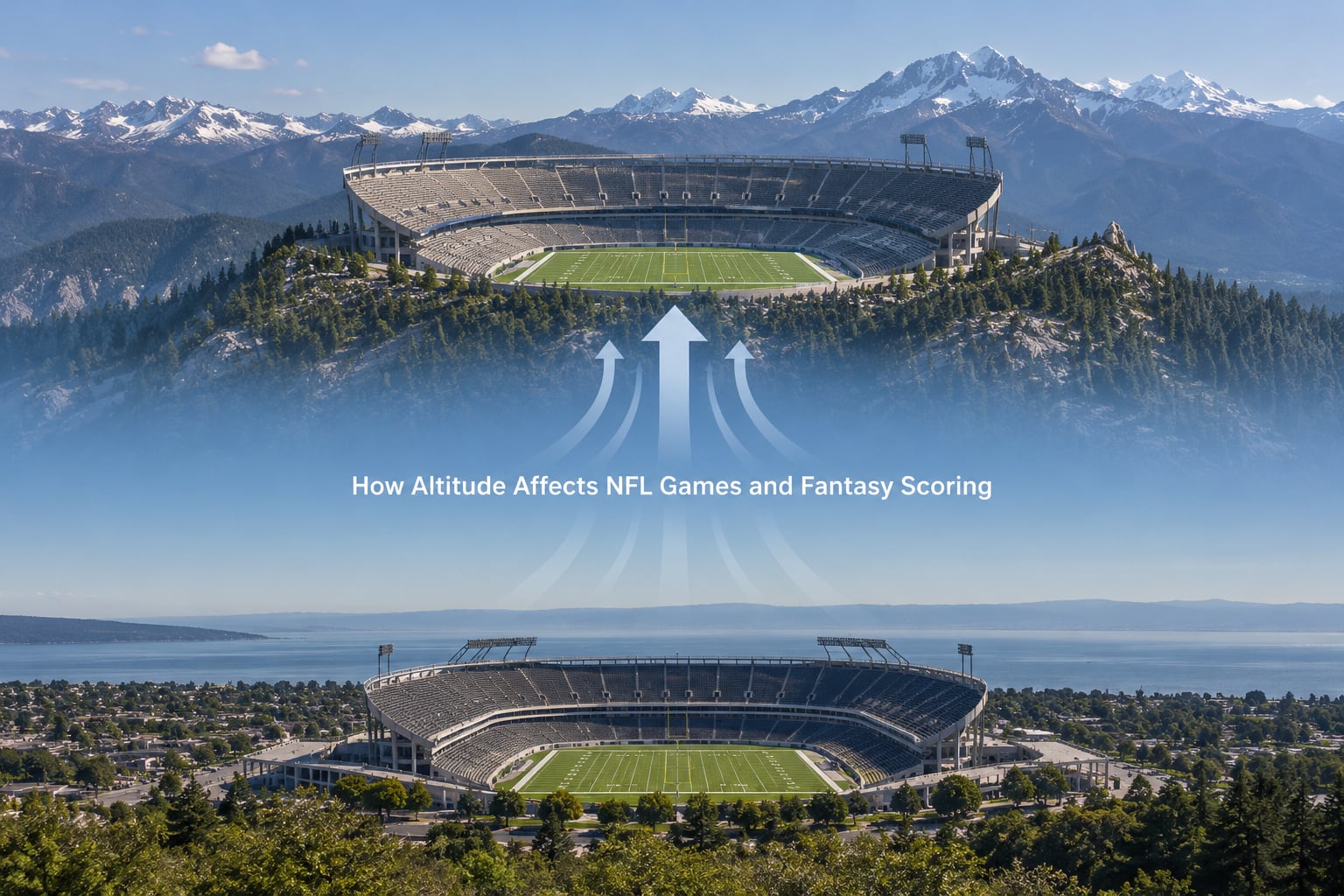
Altitude matters through a chain of four steps: elevation reduces air density, lower air density reduces oxygen uptake, less oxygen shortens the window of high-end aerobic output, and a shorter window changes how a team runs the ball for the last quarter of a game. Fantasy scoring sits at the end of that chain. It never shows up as a stat line labelled altitude — it shows up as fewer visitor carries in the fourth quarter, more home-played snaps, and fewer garbage-time opportunities for a road receiver.
What happens to NFL players at high altitude?
Hypoxia, which simply means the body is not getting enough oxygen, hits the parts of you that do repeated hard work over minutes rather than seconds. A play lasts six seconds, so a single snap at altitude will not hurt anyone. A drive lasting eight minutes will.
Levine and colleagues published the commonly cited estimate in 2008 in the Scandinavian Journal of Medicine and Science in Sports: air density drops about 3% per 1,000 feet. Denver sits at 5,280 feet, Mile High by name and by measurement, which works out to roughly a 15% reduction in air density compared with a stadium at sea level.
That reduction shows up as a shorter recovery window between plays and an earlier arrival at the fatigue ceiling on sustained drives. It also drags on recovery outside the game. A 2016 University of Colorado School of Medicine study found altitude exposure reduces REM sleep, and Yahoo’s explainer on altitude training makes the same point, noting decreased REM sleep plus harder breathing before acclimation. A team that arrives two days early and sleeps badly is still carrying a deficit into kickoff.
Acclimatization is the term for the body’s adjustment to living higher up, and it takes days to weeks rather than hours. Red blood cell response, driven by erythropoietin, needs on the order of a week or more to matter. That is why the home team, whose players breathe this air eleven months a year, is essentially unaffected, while the visitor is running on whatever fitness he arrived with.
Does altitude consistently reduce fantasy scoring?
No. Altitude nudges fantasy outcomes, it does not decide them. A visitor who is behind by 14 in the fourth quarter may end up with a huge volume of garbage-time work that more than offsets a suppressed third quarter. A home team that scripted 45 rushing attempts will hit that number whether or not the air is thin.
| Factor | Denver at 5,280 ft | Lower-elevation venue |
|---|---|---|
| Relative air density | Roughly 15% lower | Baseline at sea level |
| Visitor aerobic endurance | Fades earlier, especially late in drives | Fades on the normal clock |
| Home team exposure | Accustomed year-round | Accustomed year-round |
| Ball flight | Travels slightly farther on deep throws | Standard flight |
| Typical fantasy effect | Small negative on visitor volume, small positive on home volume | Neutral |
The honest read is that altitude belongs in the same tier as dome status and kickoff time: a couple of points of projection context, not a reason to bench a player.
How the running game changes at altitude
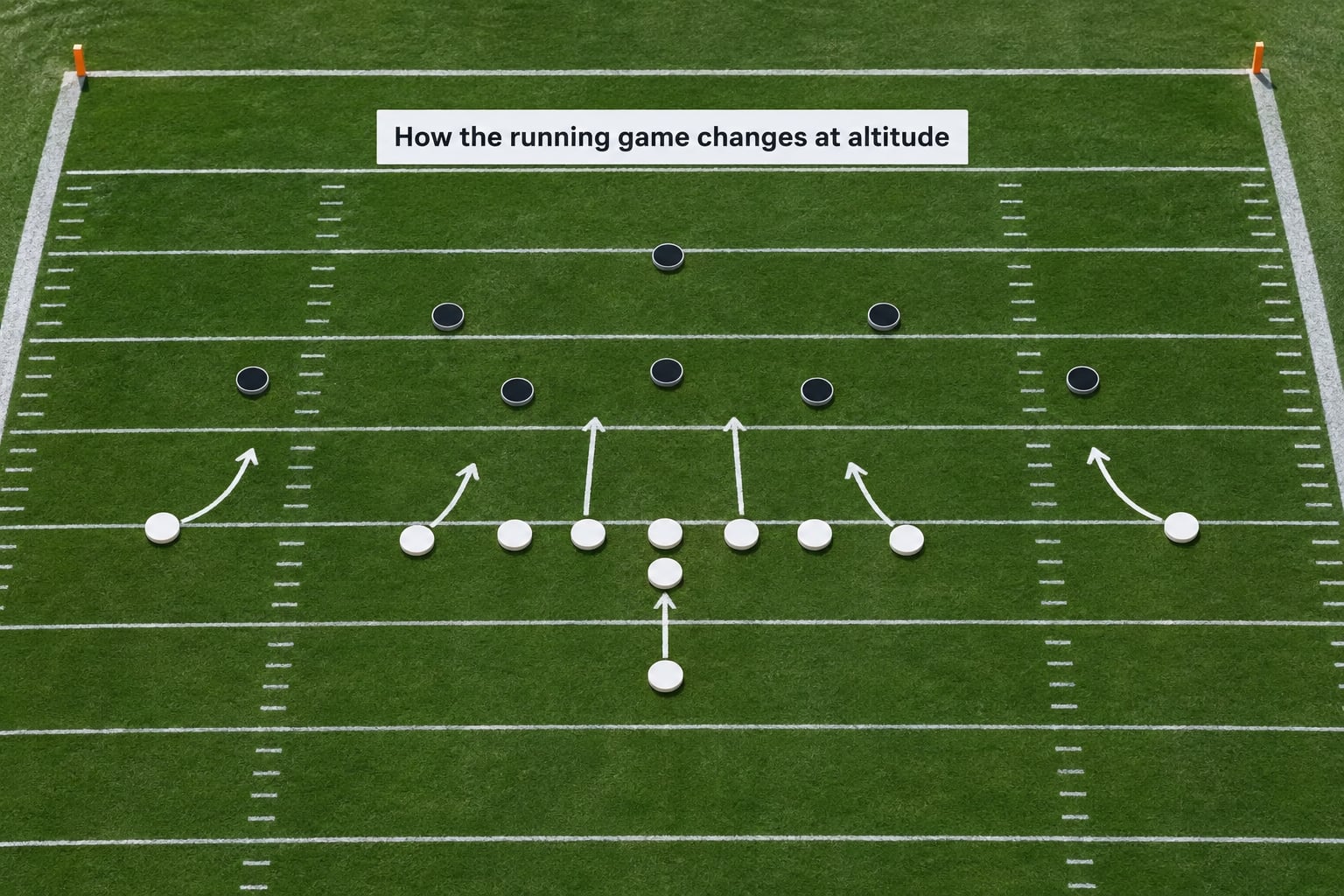
Running is where the effect should be easiest to see, because carries repeat. Every handoff in the fourth quarter is another interval of work in an atmosphere that pays back less recovery than the same effort at sea level. That is also where how altitude affects NFL games and fantasy scoring shows up most often in practice: not in a single carry, but in how a back’s fourth-quarter touches get allocated.
Two things tend to happen. First, an unacclimated offense leans on downhill and outside runs, where the running back’s momentum does more of the work and his lungs do less. Second, once a team gets into a hurry-up or no-huddle stretch, it is burning that same reduced oxygen supply faster, which is why the drop-off in visitor output tends to show up late rather than early.
ESPN’s reporting on the Nuggets’ version of the same problem put numbers on it. Average player speed for visiting teams fell from 4.20 mph in the first quarter to 3.89 mph in the fourth, while the share of game time spent walking or standing rose from 69.1% to 73%. Basketball data, but the mechanism is the same one that decides whether a road back still gets called in the fourth quarter.
| Situation | What the game script looks like | Fantasy read |
|---|---|---|
| Home team ahead by double digits | Clock control, short-yardage runs, one fewer pass attempt | Home RB floor rises, visitor pass-catcher volume falls |
| Home team trailing late | Higher pass rate for the home offense too | Home QB and home WRs benefit as much as visitors |
| Visitor ahead late | Visitor backs see more early-down carries, then the clock drains | Visitor RB floor is fine; visitor WR ceiling drops |
| Visitor lean offensive line | More play-action and short throws | Volume stays, per-play efficiency slips |
For a running back, the adjustment is usually a small trim on the projection, not a removal. Fantasy managers in r/fantasyfootball already treat Denver road games as a mild negative for volume-heavy backs, mostly on instinct rather than data.
How altitude affects quarterbacks and receivers
Quarterbacks are the least exposed position on the roster, because throwing is anaerobic and short. The counterargument that comes up constantly in forums is legitimate: Tom Brady, Peyton Manning and Josh Allen have all performed fine in Denver. A pocket passer is managing a five-second action, not a fifteen-minute run.
Receivers are exposed for a different reason. Their output depends on the quarterback getting the ball out before a tired pocket collapses, and deeper routes cost more recovery. The ball does travel slightly farther through thinner air, which helps quarterbacks on deep throws more than it hurts anyone, so the real risk is volume and target share rather than accuracy.
Elite quarterbacks are an open question worth naming rather than papering over. Track data on visiting offensive output in Denver does show a decline, but it is difficult to separate thin air from a bad road matchup, a hostile crowd or an unfamiliar offense. I treat the quarterback effect as close to zero and put my weight on running back volume, where the mechanism is cleanest.
Kickers, field goals, and fantasy kicker scoring
Elevation by itself does not make a field goal easier, and anyone promising that is overselling it. Thinner air means less drag on the ball, which helps a kick travel farther, but the football’s mass and the kicker’s mechanics do not change with altitude the way a scouting report headline implies.
What does change kicker scoring is the surrounding weather, and Denver is famous for exactly the conditions that suppress kicking: cold, wind, and dry air that hardens the surface. A kicker in a dome, or a kicker in a warm, still game, is unaffected by elevation in any way that shows up on a scoring sheet.
Extra points are the cleaner altitude story. A kicker in a road game who is already facing two or three attempts is more likely to see three or four, because field position on late drives in a low-scoring game tends to be good for the kicking team. That is a volume effect, not a distance effect, and it is worth more in a season-long projection than any range claim.
How to adjust your fantasy football projections
Most platforms carry no elevation field at all, so the adjustment has to be manual and small. My rule is that altitude never moves a projection by more than a few points, and never overrides known player information like a scripted goal-line role or a questionable injury.
| Position | Condition | Adjustment range | What to verify first |
|---|---|---|---|
| Running back | Road game at 5,000 ft or higher | Roughly 5% to 10% off volume projection | Is the offense actually committed to the run? |
| Running back | Home game at 5,000 ft or higher | Small upward nudge, under 5% | Is the home offense controlling the clock? |
| Quarterback | Any elevated venue | No adjustment | Projected pass attempts and pace |
| Receiver | Road game, visitor likely to trail | Flat to slightly positive on garbage-time volume | Does the offense throw when behind? |
| Tight end | Any elevated venue | No adjustment | Red-zone and goal-line usage |
| Defense | Home team favored | Small positive, under 5% | Opponent’s offensive style and projected drives |
| Kicker | Road game, cold and windy | Trim extra point attempts slightly | Forecast wind and temperature at kickoff |
Apply the trim once and move on. The failure mode in fantasy rooms is double-counting, where a Denver road game gets discounted for altitude, then again for a bad matchup, then again because the player had a rough month.
How team travel, weather, and home-field advantage interact
The cleanest example of an altitude effect being neutralized is travel scheduling. Teams that once flew in the night before now routinely arrive a day or two early specifically to acclimate and sleep in a familiar bed. That removes the worst of the shock, which is one reason the skeptical view has gained ground in Broncos fan circles: visitors now show up prepared, with supplemental oxygen available on the sideline under league rules.
Weather stacks on top rather than replacing altitude. Empower Field at Mile High has a partial roof, which softens rain and snow exposure but not the air inside the bowl. Cold and wind at kickoff can matter more to a visiting kicker than 5,280 feet does to a visiting halfback.
Historical home records make the effect look larger than a single game can explain. The Boston Globe cited the Broncos winning roughly 68% of their home games, which is far above any stadium’s baseline, and that gap is the combined product of altitude, roster, coaching and crowd rather than altitude alone.
What evidence is strong and what is uncertain
Strong: the physics. Air density falling about 3% per 1,000 feet is published, repeatable and not in dispute. Strong: the sleep data, including reduced REM sleep at altitude. Strong: the visitor speed decline late in games, which has been measured quarter by quarter.
Weaker: the size of the fantasy effect. No study has isolated altitude from opponent quality, travel schedule and crowd noise in a way that gives a fantasy manager a clean number. Treat any figure you see presented as precise with suspicion.
Worth knowing: some players have a genuine medical reason to be cautious at elevation. ESPN reported that Ty Montgomery raised concerns about playing in Denver with sickle-cell trait, a reminder that individual response is not purely about fitness.
International venues sit higher still. Estadio Azteca in Mexico City is around 7,350 feet and La Paz runs past 11,000 feet, so any international matchup deserves more scrutiny than a Denver game does. The lesson fantasy managers take from most of the online debate is that altitude is real, worth a small adjustment, and not worth arguing about for an hour.
Frequently Asked Questions
Do the Broncos have an altitude advantage?
Partly. The measurable part is physiological: visitors face thinner air and arrive unacclimated, while Denver players live at elevation year-round. The measurable part is not larger than fans sometimes imply, since historical home win rates also reflect roster and coaching. Treat it as a modest edge, strongest late in close games and weakest in the first quarter.
What NFL stadium has the highest altitude?
Denver’s Empower Field at Mile High, at 5,280 feet, is the highest regular-season NFL venue. International games run higher: Estadio Azteca in Mexico City sits near 7,350 feet. Because the NFL plays few games above 5,000 feet, most of the league’s stadiums are effectively sea level for projection purposes.
Should I downgrade a running back playing a road game in Denver?
A small trim, not a bench. Roughly 5% to 10% off a volume projection is a defensible adjustment for an unacclimated back on the road, because repeated carries in thin air cost more recovery than they would at sea level. Override the trim if the offense is genuinely committed to the run, or if the visitor will likely be behind and throwing more.
Does altitude make field goals easier?
Not by itself. Thinner air reduces drag, so a well-struck kick does travel a bit farther, but the effect is small and kicker distance has not moved in a way fantasy managers can bank on. The real altitude-adjacent variables are wind, cold and dome status, which affect a kick far more than elevation does.
How much does weather affect fantasy football?
More than most projection systems credit. Wind, cold and precipitation change play calling, kicker attempts and scoring efficiency, and they usually matter more to a weekly projection than altitude does. The exception is a kicker in a cold, windy road game, where extra point attempts are the number most likely to move.
Conclusion
Altitude is real, measurable and small. Air density falls about 3% per 1,000 feet, visitors tire later than most people expect, and the effect shows up mostly in late-game volume rather than headline stats. Start by checking the venue elevation, the visiting team’s arrival timing, the kickoff forecast, the expected game script and the player’s own recent usage. Then make one small trim to running back volume if warranted, leave the quarterback projection alone, and get back to the matchup that actually decides your week.