
Expected fantasy points (xFP) is the number of fantasy points a player should have scored given his volume alone, based on what an average player would have produced on comparable plays. To know how to use expected fantasy points, you take each target and carry a player receives, assign it the average fantasy value of similar historical plays, and total the result.
That total is not a projection and it is not a promise. It is a measure of opportunity, and once you subtract what the player actually scored you get the differential, which is where the real decisions live.
The workflow below takes about fifteen minutes a week once you have your numbers, and it works in redraft, auction and dynasty leagues. If you have ever sorted a waiver list by raw yardage and regretted it, this is the correction.
Table of Contents
- What You Need
- How to Use Expected Fantasy Points Step by Step
- What Expected Fantasy Points Actually Measure
- Confirm the Projection and Scoring Format
- How to Use Expected Fantasy Points in a Weekly Matchup
- Adjust for Availability and Opportunity
- Set Thresholds for Each Decision
- Review the Results After Each Week
- Common Mistakes
- Treating Projections as Guarantees
- Comparing Scores Across Different Leagues
- Overreacting to the Latest News
- Using One Number for Every Decision
- Tips for Using Expected Fantasy Points More Effectively
- Frequently Asked Questions
- What is expected fantasy points?
- How should I use expected fantasy points in my fantasy football league?
- Should expected fantasy points be used for start-sit decisions?
- How do I calculate weekly expected fantasy points from a season projection?
- Why do different fantasy football platforms show different expected points?
- Are expected fantasy points more useful than player rankings?
- Conclusion
What You Need
You need five things, and only one of them is hard to get.
- Your league scoring settings. Points per reception, bonus structure for yards and touchdowns, whether two-point conversions exist. The same opportunity set produces different fantasy totals under different rules.
- A projection or expected-point source. Some are free, some sit behind a membership. The math matters less than using one source consistently.
- Roster and league context. Positional scarcity, roster construction rules, keeper or auction budgets, and how many teams are competing for the same player.
- Schedule and matchup data. Opponent defensive strength, game environment, and how often a team leans on the pass or the run.
- Recent player news. Injury reports, role changes, and quarterback changes, since none of those show up in a season-to-date number.
If you have none of this and want the concept before the tooling, start with the definition below and build the rest around it.
How to Use Expected Fantasy Points Step by Step
What Expected Fantasy Points Actually Measure
Expected fantasy points measure opportunity, not talent. Every target is valued by how much yardage and scoring the average fantasy-relevant player would have collected on a target with the same depth, down, distance and field position, and every carry is valued the same way.
Think of it as the fantasy value of the work a player was given. If a receiver lines up outside on 30 of 32 snaps, runs an 18 percent route share and eats targets in the flat all game, his expected fantasy points will be high even if he finishes with a quiet stat line.
What xFP deliberately ignores is whether the player converted. That is the whole point, and it is also its limit. It cannot tell you a tight end is better than the rookie behind him, only that the veteran was handed more chances.
Confirm the Projection and Scoring Format
Before you compare any two numbers, confirm what each one is built on. Season-to-date expected points and a weekly projection are different animals, and mixing them produces decisions that look reasonable and are not.
Here is the disambiguation that gets mixed up constantly:
| Metric | What it is | What it is good for |
|---|---|---|
| Expected fantasy points (xFP) | Average points a player should have scored from his opportunities to date | Judging whether the role itself produces fantasy value |
| Projected points | A forward-looking estimate for a specific week or season range | Lineup decisions, where the matchup matters |
| Average fantasy points | Actual points divided by games played | Sanity checking a total, though injuries distort it |
| Fantasy points over expected (FPOE) | Actual points minus expected points | Spotting overperformers and regression candidates |
| Average draft position | The market’s guess at a player’s season value | Trade and auction framing |
Two points on table reading. First, a weekly projection already bakes in matchup and role, so use expected points to test whether the underlying role supports it, not to replace it. Second, dividing a season total by games played normalizes for a player who missed time, which is why some outlets publish expected points per game.
How to Use Expected Fantasy Points in a Weekly Matchup
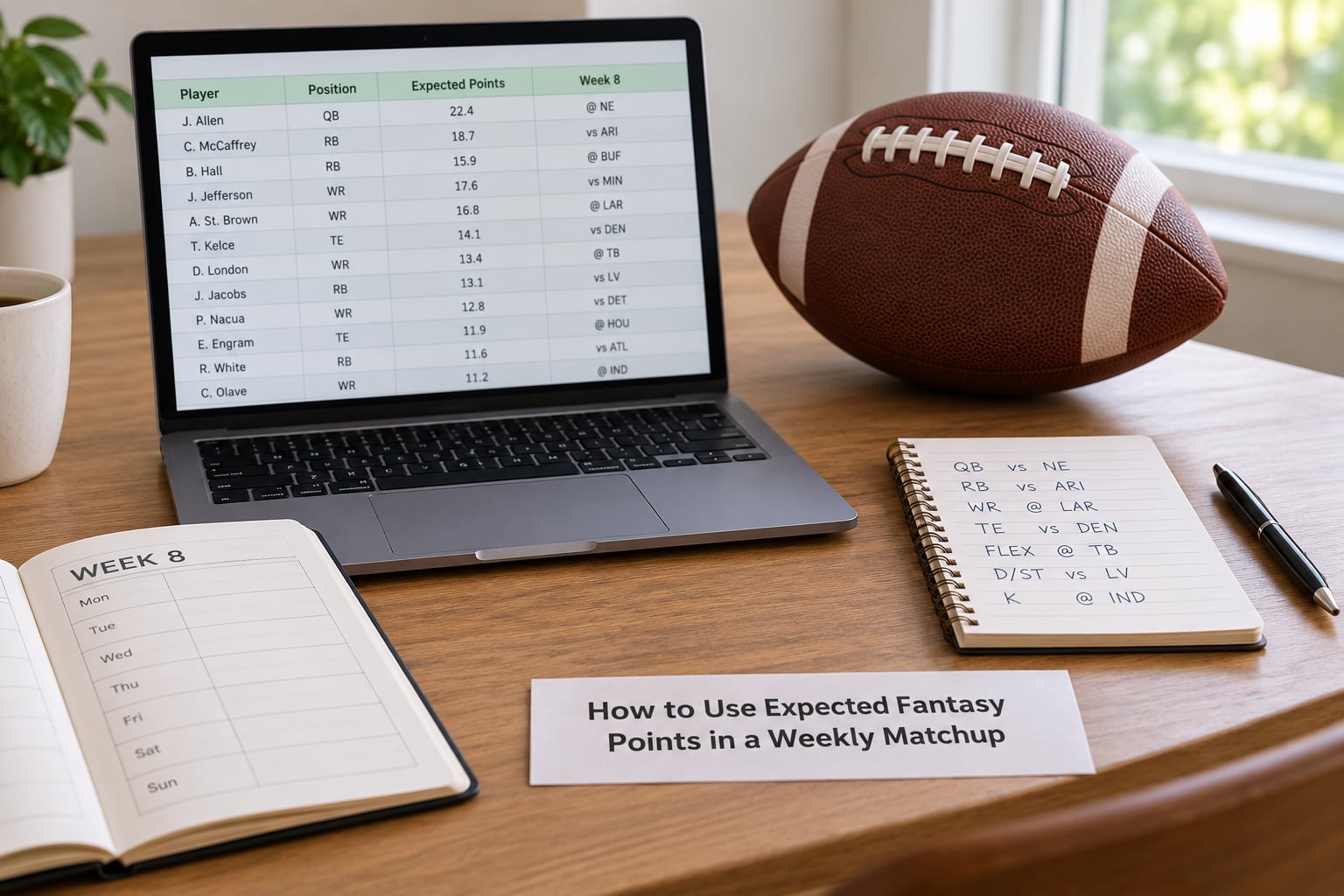
To turn a season-level number into a weekly one, divide the expected total by games played, then check whether anything about the coming week is unusual. A neutral schedule means the per-game average stands. A soft opponent, a high implied total for the opposing offense, or a game the team is likely to trail and abandon early all justify a modest raise.
How much to raise it is a judgment call, and the honest answer is a small percentage. Most managers do well by moving a baseline no more than 10 to 15 percent for matchup and another 10 percent for a genuinely favourable game script.
Worked example, purely illustrative. A playmaker has averaged 18.2 expected points per game over eight games. His opponent sits 24th against the run and the game carries an elevated passing expectation. A fair weekly estimate is somewhere around 19 to 21 points, not 28. Expected points tell you what the opportunity set tends to be worth, not that he will hit his ceiling in one specific matchup.
Once you have a floor and a range, compare it against the player you are considering starting him over. Start decisions are about the range and the matchup. Draft and trade decisions are about the role.
Adjust for Availability and Opportunity
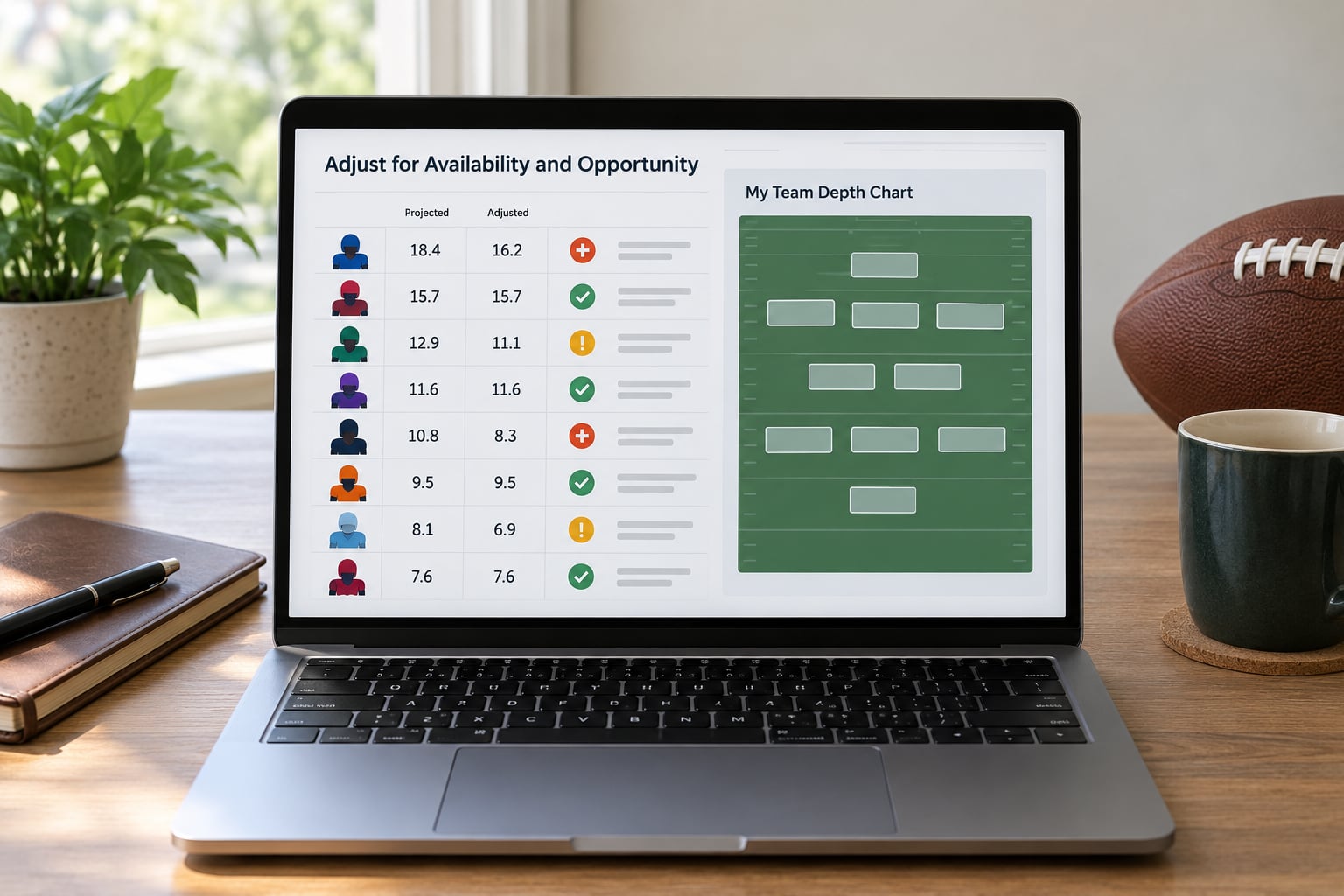
Adjust the baseline when the information changes the opportunity set, not when it changes the player’s reputation. A limited-workload report that reduces a player’s snap share is a genuine adjustment. A report that he is in a great mood is not.
The adjustments worth making: a move to full-time inside five receiver, a quarterback change that shifts target distribution, a new offensive coordinator with a different passing volume profile, or a snap count that has moved 15 percent or more over three weeks.
The adjustments to be suspicious of are single-game reactions. A defender who gave up three big plays in one game has not changed a player’s role, and neither has a red-zone result. Expected points already accounts for field position, so a player who saw six red-zone targets will have a high expected total without any yardage attached, which is exactly why you should not add the touchdowns on top.
Sample size is where most managers overreach. Four to six games is a reasonable floor before an expected-points differential carries much signal; a single week is a story, not a trend.
Set Thresholds for Each Decision
A number only does work once it is tied to a decision rule. Before the season starts, write down what each number means for the players you care about, then hold to it.
| Position | Per-game expected points that signals a real, sustainable role | How to use it |
|---|---|---|
| Running back | Low teens, assuming meaningful goal-line work | Treat the floor as real; a change in goal-line share changes the whole profile |
| Receiver | Double digits with a stable route share | Check whether the volume comes on first and second downs or third down; the latter is volume without value |
| Tight end | High single digits with a genuine slot role | Confirm the targets are not a fluke of one game script |
| Quarterback | Mid-teens and up | Verify the rushing floor before trusting the passing number |
Those reference points are rough guides, not commandments, and they shift with league scoring. In a points-per-reception league the receiving thresholds mean something different than in a standard league, which is why the first item on the prerequisites list matters.
Then build the decision rules themselves: a floor for start-sit calls, a replacement-level number for your bench, a priority order for waiver claims, and a value threshold for trades. If you never write them down, you will find a number that justifies whatever you already wanted to do.
Review the Results After Each Week
Keep a short log with three columns: expected points before your adjustments, actual points, and a one-line note on what you got wrong. Ten weeks of that is worth more than any expert consensus list.
The goal is not to predict outcomes. It is to find out whether your adjustments are adding value or adding noise, because a manager who raises every baseline after a bad week will eventually talk himself into starting backups.
One caution on regression logic. A strongly positive differential means the player scored more than his opportunities justified, which usually fades. A strongly negative one means the reverse. But a player whose role is expanding can produce a negative differential for several weeks in a row and still be the best buy on your board, because the opportunity set is growing while the results lag.
Common Mistakes
Treating Projections as Guarantees
An expected value is a central tendency, not a promise. Roughly half of all players finish above their expected total and half finish below, so treating xFP as a floor guarantees you will be disappointed.
Use it as a floor for the role and a signal for the trend, and keep the uncertainty visible in your decisions by carrying a range rather than a single figure.
Comparing Scores Across Different Leagues
A number pulled from a standard-scoring source means something different in your points-per-reception league. Comparing raw totals across formats is the fastest way to talk yourself into a bad pick, especially at tight end and for receivers who depend on volume.
Normalize everything to your own settings before comparing, and prefer per-target and per-game views over season totals so that injuries and bye weeks do not distort the comparison.
Overreacting to the Latest News
One report about a hamstring should not replace your season number. What it should do is move your adjustment, and only if it changes the opportunity set rather than the player’s reputation.
Write the adjustment down with a reason attached. If you cannot state the reason in a sentence, it is a feeling, not an adjustment.
Using One Number for Every Decision
Expected points describe role. They do not describe matchup, injury risk, opponent strength, quarterback quality, or your league’s positional scarcity.
The managers who get value from xFP pair it with two or three other signals, such as targets per route run for receivers, goal-line carries for running backs, red-zone target share for tight ends, and air yards for anyone whose role depends on downfield volume. One number answers one question. Ask the rest separately.
Tips for Using Expected Fantasy Points More Effectively
- Build a range, not a point. Take your baseline and add a low and high case based on whether the opportunity set plays out at the bottom or top of its usual range.
- Separate baseline from upside. The expected total is your floor. The ceiling comes from the difference between your high case and that floor, which tells you how exciting a player is to roster.
- Use one source, consistently. Mixing models produces fake edges, because two sources can disagree by two or three points per game on the same player.
- Track xFP per target too. A player averaging a modest total can be running one of the best target profiles in the league, and that shows up only when you divide.
- Recheck the sample size before you act. Under six games, treat differentials as descriptive rather than predictive.
- Document assumptions before the week starts. A written note about why you made an adjustment is the cheapest protection against narrative drift later.
If you want to go further, the same logic translates to other formats. Expected points with an assist bonus attached behaves like the daily fantasy versions of the metric, and the concept has direct cousins in baseball batting averages over expectation and in soccer expected goals.
Frequently Asked Questions
What is expected fantasy points?
Expected fantasy points is the number of points an average player would have scored on the opportunities a player actually received. Each target and carry is valued by depth, down and distance, and field position. It measures opportunity, not talent, which makes it useful for judging whether a role itself produces fantasy value.
How should I use expected fantasy points in my fantasy football league?
Use it as the foundation for a repeatable routine: pull the expected total, divide by games played for a weekly baseline, adjust for availability and matchup, compare players by role rather than by talent, and set written thresholds for starts, bench replacement and waiver priority. Consistency across weeks matters more than any single number.
Should expected fantasy points be used for start-sit decisions?
Only as an input. Expected points describe the opportunity a player has been given, not what happens this weekend. For starts, combine the per-game baseline with opponent strength and game script, and carry a range so a bad matchup does not force a coin-flip decision on two players with identical floors.
How do I calculate weekly expected fantasy points from a season projection?
Divide the season total by games played to get a baseline average. Then adjust for context: a soft opponent or a likely high-volume game script justifies a modest raise, usually no more than 10 to 15 percent. Fewer than six games makes the average unstable, so widen your range rather than tightening it.
Why do different fantasy football platforms show different expected points?
Each source builds its model from different historical samples, different definitions of comparable plays, and different scoring settings. Some use a similarity search over past plays, others use simpler average-based formulas. None is more correct than the rest, but mixing them creates differences that look meaningful and are not.
Are expected fantasy points more useful than player rankings?
They answer a different question. Rankings rank players overall; expected points tell you how much fantasy value a role produces before talent is factored in. Rankings are better for comparing players against each other. Expected points are better for identifying regression candidates and for deciding which roles are worth owning.
Conclusion
Start with one player this week. Pull his expected total, divide it by games played, write the number down, and then subtract his actual points to see the differential. Do that for five or six players on your roster and you will have a baseline you can act on, which is more than most managers have right now.
Keep adjusting the number when the opportunity changes, keep a range around it, and remember that expected fantasy points describe the work a player was handed, not the talent doing the work. That single distinction is what keeps the metric honest in 2026 and every season after it.