Learning how to find a bust before draft day comes down to one filter: audit every player on consensus ADP against eight measurable signals, then draft the ones whose floor justifies their price. The work takes a couple of evenings with a spreadsheet and a depth chart, and it is far less glamorous than reading sleeper lists. What matters most is separating a player who is genuinely fragile from one who simply had a bad month, and the difference is almost always visible in touch profile, role, and cost before you click.
Last updated October 2026 for the 2026 season. Everything below is method, not a list of names, because any named list goes stale by Week 1 and the players who bust are rarely the ones anybody flagged in August.
Forum managers ask the same question every year in r/fantasyfootball threads about identifying players with positive skew and finding undervalued and overvalued players. The spreadsheets people build there are more useful than the takes, and the thread on the single greatest indicator of fantasy success keeps landing on draft cost rather than talent. That is the whole argument for doing this audit.
Table of Contents
- What You Need
- Step-by-Step: How to Find a Bust Before Draft Day in Eight Steps
- 1. Define What Counts as a Bust for Your League
- 2. Check the Player’s Actual Touch Profile
- 3. Separate Skill Production from Opportunity
- 4. Investigate Competition Behind the Player
- 5. Translate the Offense into a Ceiling
- 6. Review Health, Age, and Durability
- 7. Compare Value With Draft Cost
- 8. Create Tiers, Red Flags, and a Draft Plan
- Common Mistakes
- Frequently Asked Questions
- What is the best way to identify a fantasy football bust?
- How early should I check players for potential busts?
- Does a bad injury history automatically make a player a bust?
- How do I know if a breakout player’s workload will hold up?
- Should I avoid every player ranked above his ADP?
- Start With Opportunity and Value
What You Need
Six inputs, and you probably already have most of them.
- A consensus ADP source. FantasyPros is the one your league mates actually open, so model that market rather than your preferred outlier. Two separate aggregators are better than one, since drift between them tells you where the disagreement is.
- Team depth charts and offensive scheme notes. Pro Football Reference splits and play-by-play give you the volume picture; the scheme tells you whether that volume is likely to survive a personnel change.
- At least two full seasons of game data. One season is a sample. Two seasons of targets, carries, red-zone touches, and goal-line work tell you what is repeatable.
- Injury and roster notes. Contract status, roster competition, and reported injury patterns for each player’s own position group.
- Salary or auction values for dynasty and auction leagues. Draft capital is a price in every format; it is just denominated in picks instead of dollars.
- A sheet with a risk grade column. Give yourself a place to record A through D next to each name, so the fade list is a byproduct of the audit rather than a separate opinion you form later.
Step-by-Step: How to Find a Bust Before Draft Day in Eight Steps
1. Define What Counts as a Bust for Your League
A bust is a player whose realized production falls meaningfully short of the value his draft cost implied, not a player who finished lower in your league than you hoped. Those are different failures, and conflating them is how most fade lists become useless.
Set the threshold per position before you look at anyone. Quarterbacks drafted inside the top eight are expected to be top-ten weekly; anything less is a bust. Running backs taken in the first round need a floor of roughly fifteen fantasy points per game in PPR, because that price point assumes a workhorse share. Receivers drafted in the first round need volume, and tight ends need either elite target share or elite red-zone work.
Write those thresholds in the sheet before screening. Once you start looking at names, the bar moves quietly in the direction you want it to.
2. Check the Player’s Actual Touch Profile
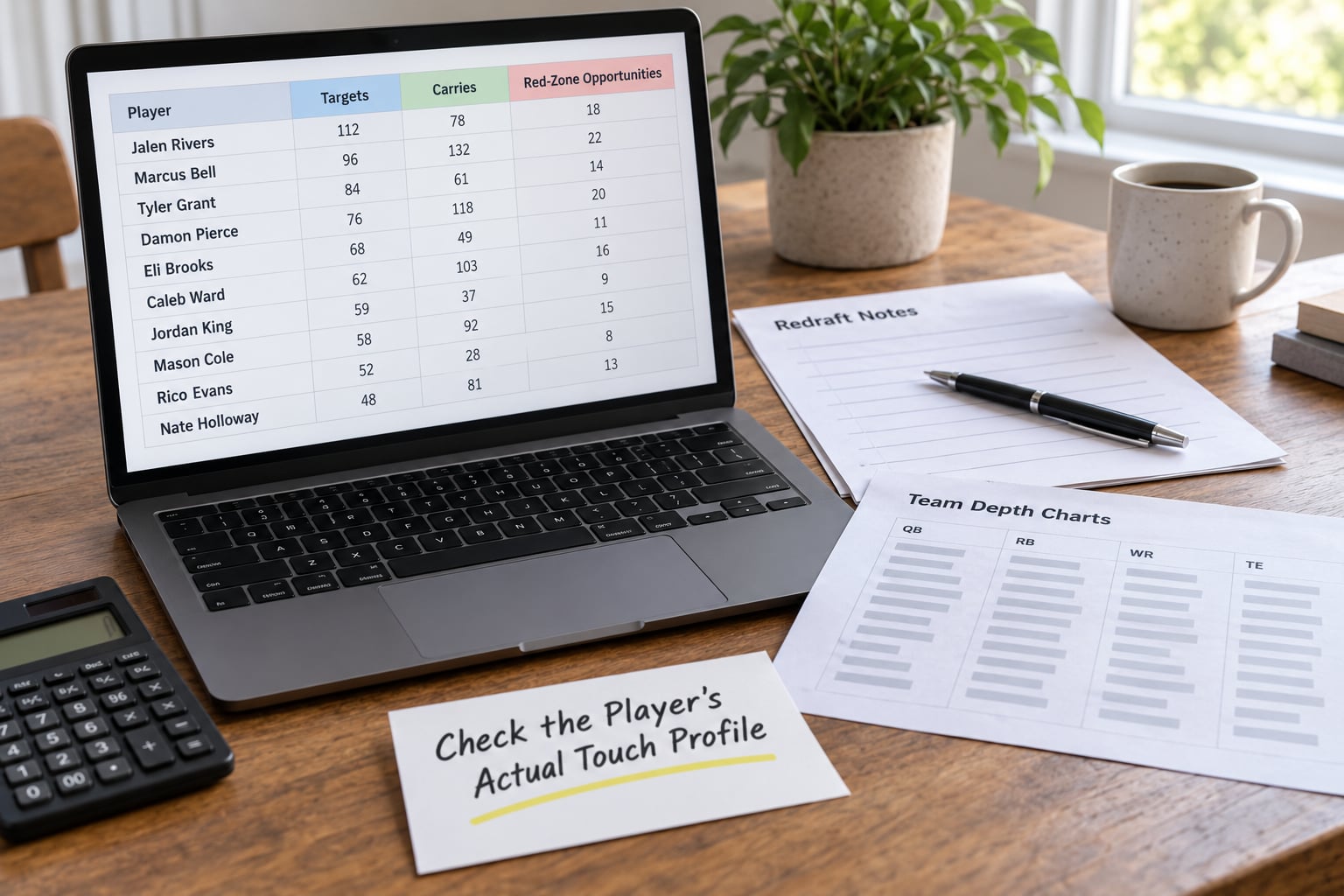
A featured role with sustainable volume is the single strongest defense against a bust, and you can measure it: targets, routes, carries, red-zone opportunities, and goal-line work across two or three seasons.
The number that matters most is red-zone opportunity share, because touchdowns follow red-zone looks far more reliably than yardage follows targets. A receiver with nine, six, and eleven targets in three seasons is a real volume profile. A receiver with one explosive 28-yard score and four targets has a highlight reel, not a role.
For running backs, carries and goal-line touches tell you whether the workload is real or shared. Roughly 200 carries a season is a feature back; 140 with 40 more coming in committee spells is a committee back wearing a feature back’s ADP.
3. Separate Skill Production from Opportunity
Adjust each player’s recent production for the environment that produced it: the quarterback throwing to him, the offensive line in front of him, the coaching staff, and the team pace.
A running back with a 95% rush-share success rate behind one of the best lines in football may not repeat that rate behind a rebuilt unit. A receiver posting seven targets per game as the sole reliable option under one coordinator can lose that share when the staff adds a 2026 draft pick who plays outside. Efficient players are cheap when the environment that created the efficiency is about to change, and that is the cleanest fade available before a draft.
4. Investigate Competition Behind the Player
Ask what happens to this player’s touches if one specific teammate misses six games. If the answer is that they absorb most of them, the player’s projection is one injury away from a ceiling case built on paper.
Also check how much of the role depends on unproven alignments. A tight end who produced because of a specific personnel grouping the team has no reason to repeat is priced like a sure thing by ADP aggregators, and ADP does not adjust for personnel groups. Flag players whose current production rests on one unproven alignment, one healthy teammate, or a crowded depth chart where the coaching staff has already shown a rotation tendency.
5. Translate the Offense into a Ceiling
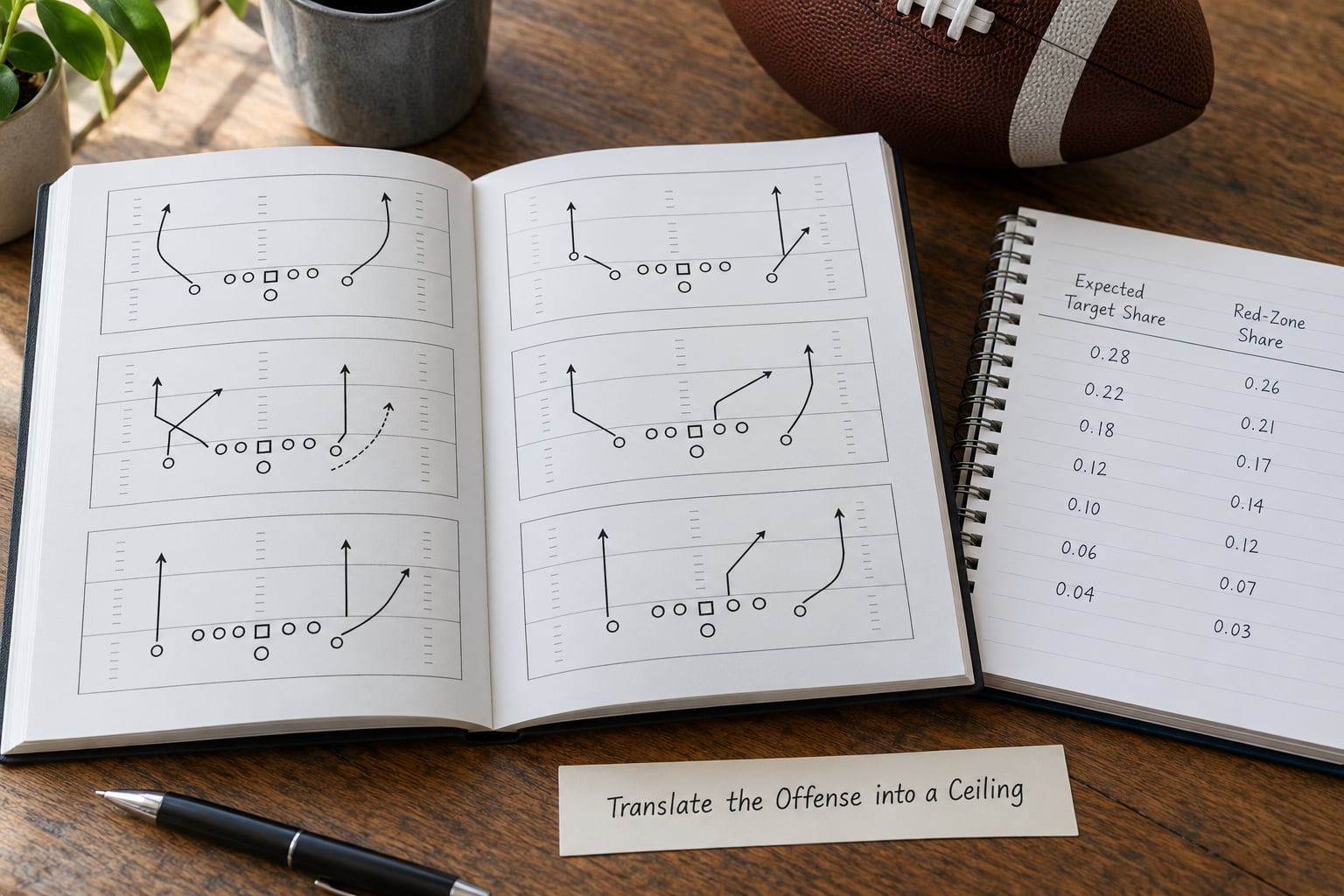
Play-action frequency, team pace, formation usage, route concepts, and red-zone structure determine how much fantasy upside a player can physically reach. Connect those to a range instead of a single number.
Build three outcomes for each player: a low case that assumes the role shrinks, a likely case built on two-season averages adjusted for scheme continuity, and a high case that assumes a full season of the current offensive structure holding together. A player whose likely case already equals the high case has no room, and a player with a wide gap between low and high is a boom-or-bust profile that belongs in the middle rounds, not the first.
Ceilings come from opportunity as much as talent, so treat a scheme that has never produced the stat line before as an untested ceiling rather than a projected one.
6. Review Health, Age, and Durability
Recent injury patterns, age, career workload, and recovery history all change expected games played, and expected games played change everything downstream. Age curves differ sharply by position, and running backs are on the steepest decline of any skill position once they pass the middle of their prime.
Uncertainty should adjust draft value, not produce panic. One missed game is variance. Three significant injuries across three seasons, combined with a workload that has grown every year, is a durability profile that should lower your expected games and your willingness to pay an early-round price.
Forum threads on aging veterans show managers repeatedly asking where the fade line sits, and the honest answer is that no one knows it precisely. Treat age as a probability shift, not a disqualification, and never treat injury reporting as medical fact; anything real belongs in a conversation with a qualified professional, not a draft board.
7. Compare Value With Draft Cost
This is where the audit pays off. Compare projected floor, ceiling, volatility, and positional replacement against ADP or auction cost, and the question stops being whether a player is good and becomes whether he is worth what he costs.
Worked example of the arithmetic. Say a wide receiver is going around pick 20. If your likely case produces him as a top-25 wide receiver, you drafted a top-20 asset, which is a fair pick. If your likely case is top-40 with a ceiling of top-15, the pick is a coin flip with a bad downside, and you can find two or three top-40 receivers ten picks later. That gap between rank and cost, not talent, is what the exercise is measuring.
Players who rank well but offer limited value at a particular cost are the ones to fade. Their name on the board is a sunk allocation of a pick you could spend on two players with real floors.
8. Create Tiers, Red Flags, and a Draft Plan
Summarize each player across opportunity, production, competition, durability, and price, then assign a risk grade: A for a floor that survives one bad week, B for solid with one soft spot, C for two or more red flags, D for priced like an A with a C profile.
Any player graded C at a pick inside the first two rounds of your own draft goes on the fade list, and any player graded D goes there regardless of where consensus puts him. Then build a replacement list for each faded name so that when that player comes up on the board, you already have the answer queued.
The fade list should be short. If it has twenty names, you are drafting against your own analysis instead of using it.
Common Mistakes
Overreacting to a bad single-game sample is the most common error, and it produces fade lists built on two catches. One game is noise; require at least a full season of role change before treating a player as broken.
Ignoring age and role in the other direction is just as common. A veteran running back whose touch share fell from 78% to 62% has changed role, whether the box score says otherwise or not.
Treating all injuries alike wastes the signal. Re-injury to the same structural area, and a first-year player missing time before establishing a role, carry different weight than a veteran missing a game with a known return date.
Relying on a single ranking leaves you with no edge at all, because every manager in your league is reading the same consensus. The entire value of the audit comes from applying your own thresholds to the same public data.
Drafting only by position scatters your exposure and leaves you with no planned answer when your first choice is gone. Build your draft list position by position within a risk grade.
Failing to replace an expected workload is how committee players get drafted as feature players. If a player’s path to volume requires an injury, draft the player who would take that volume.
Calling every underperformer a bust is the mistake that burned most managers’ trust in the genre. Finish the year with a review column: was this a process failure or a variance outcome? Only the first one belongs on next year’s fade list.
Two tips for the draft room itself. Queue your fades with a replacement already listed beside each name, so you never stall with fifteen seconds on the clock, and keep your risk grades visible during the draft rather than in a spreadsheet you closed three picks ago.
Frequently Asked Questions
What is the best way to identify a fantasy football bust?
The best way is a pre-draft audit against consensus ADP: check touch profile across at least two seasons, adjust production for quarterback and coaching changes, count competition for the role, apply an age and durability adjustment, then compare the resulting floor to the draft cost. A bust is a player whose realized production falls short of what his price implied, not simply someone who disappointed you.
How early should I check players for potential busts?
Start two to three weeks before your draft and run the volume work first, because targets and carries change slowly. Update the picture after the final cut and again in the week of the draft, when roster battles and reported injuries settle. Building the fade list early leaves time to find replacement value at every round, which is the part most managers skip.
Does a bad injury history automatically make a player a bust?
No. Injury history lowers expected games played, and expected games played lowers every projection, but a durable player with one past injury can still be a fine pick at the right price. The automatic bust is the player whose price assumes near-certain availability. Weight repeated injuries to the same area, growing career workload, and position-specific recovery timelines far more heavily than a single missed game.
How do I know if a breakout player’s workload will hold up?
Check whether the volume came with repeatable structure: red-zone targets, route participation on early downs, and a role that existed before the breakout rather than alongside it. Then confirm the supporting pieces around him, the quarterback, the line, and the personnel grouping. If the workload depended on one favorable alignment or one teammate staying healthy, treat it as variance and discount it before draft day.
Should I avoid every player ranked above his ADP?
No. Ranking above ADP is a reason to check the player carefully, not an automatic fade. The question is whether the extra cost is justified by a higher floor or a higher ceiling, and many players go slightly above ADP for good reasons. Fade only when the audit shows red flags that consensus has not priced in, then replace that pick rather than simply skipping it.
Start With Opportunity and Value
To find a bust before draft day, grade the player’s opportunity first and his price second. Pick one name at your own target round, look at two seasons of touch profile, name the competition for his role, and write a low, likely, and high outcome. Then compare that likely case to the pick you would spend on him.
That single exercise takes about twenty minutes, and it is worth more than an hour of reading anyone else’s rankings.