To trade for a playoff schedule advantage, you find the players whose opponents across your league’s playoff weeks are softer than the opponents they have faced all season, price that edge in trade currency, and hand it to a league-mate who wants something you already own. The whole thing has a clock on it, and most managers set the clock too late.
A playoff schedule advantage is simply a player whose playoff-window slate is friendlier than his regular-season slate. He is not a different player; he is the same player with a friendlier three weeks. That distinction matters, because a soft slate makes a genuinely good player more reliable, and it does almost nothing for a player who is losing touches, buried on the depth chart, or already behind a handcuff.
So treat schedule as a modifier, not a decision. The steps below run in order: nail down your playoff weeks, map the slates, strip out the role question, set a price, build the offer, sanity-check the news, then monitor. If you have never read your own league settings, start there. It takes two minutes and it changes which weeks even matter.
Table of Contents
- What You Need
- Step-by-Step: How to Trade for a Playoff Schedule Advantage
- 1. Define Your Playoff Matchup and League Rules
- 2. Map the Remaining Schedule
- 3. Separate Schedule Advantage from Player Quality
- 4. Set a Realistic Trade Threshold
- 5. Build an Offer Around Two or Three Assets
- 6. Use Recent News Without Chasing Hype
- 7. Test the Deal and Monitor the Schedule
- Common Mistakes
- Frequently Asked Questions
- How do I actually trade for a playoff schedule advantage?
- How much is a good playoff schedule worth in a trade?
- Can you trade players during the playoffs in fantasy football?
- What are the best fantasy schedules for the playoffs?
- Should I trade a starter for a player with a much better playoff slate?
- Where can I find player-level playoff schedule strength?
- Conclusion
What You Need
Six things, and only the first one is optional. Skipping any of the rest is how people end up trading a starter for a backup with a pretty schedule.
- Your league settings, opened right now. Playoff start week, number of playoff weeks, roster limits, flex and superflex slots, trade deadline, whether your commissioner allows trades after the deadline. Plenty of managers find out their playoff week from the standings page in the same week they need to act on it.
- A schedule grid filtered to your playoff weeks only. A full-season strength of schedule number is the wrong tool here. You care about three columns out of seventeen, and most sites will let you isolate them.
- Your own roster sheet with role notes. Snap share, target share, goal-line work, whether a running back is in a committee. Role is the thing that quietly disappears from a trade thesis and reappears in your lineup in Week 15.
- Lineup and injury news for the teams in that window. Check it weekly, not once. A team that clinches a division early in Week 15 may rest starters in Week 17.
- Two trade value charts from different publishers. FantasyPros, Sharp, Athlon and PFF all publish rest-of-season charts. When two of them disagree, that gap is usually the trade, not a problem to solve.
- A list of league-mates sorted by record. The teams that are eliminated have expendable assets and no reason to hold them. They are your counterparty.
Step-by-Step: How to Trade for a Playoff Schedule Advantage
Seven steps in sequence. The order matters because each one narrows the field, and the price you end up paying depends on how many candidates you eliminated before you made an offer.
1. Define Your Playoff Matchup and League Rules
Write your three playoff weeks on paper before you look at a single schedule. Some leagues start in Week 15 and end in Week 17, some run 16 through 18, and some stretch further when the calendar runs long. You cannot value a window you have not written down.
Then read the settings that quietly change everything else. Flex and superflex slots turn a bench player with a soft slate into a starter, which is the single league setting that makes schedule trading worth real talent. In a 16-team superflex league, the guy with the great Week 15 to 17 run at your flex spot is worth more to you than the same guy on a bare roster.
Tiebreakers are the other quiet one. If head-to-head wins break your tie, a dependable 12-point-per-game floor beats a player who might go 30 and zero. Check your roster construction against the tiebreaker before you decide a boom-bust player is the safer buy.
One-and-done playoff formats sit at the other extreme. A single playoff week means one game decides your season, so a soft slate is worth more, not less, and the variance is enormous. That is a different sport, and you should only be playing it if you actually want the swing.
2. Map the Remaining Schedule
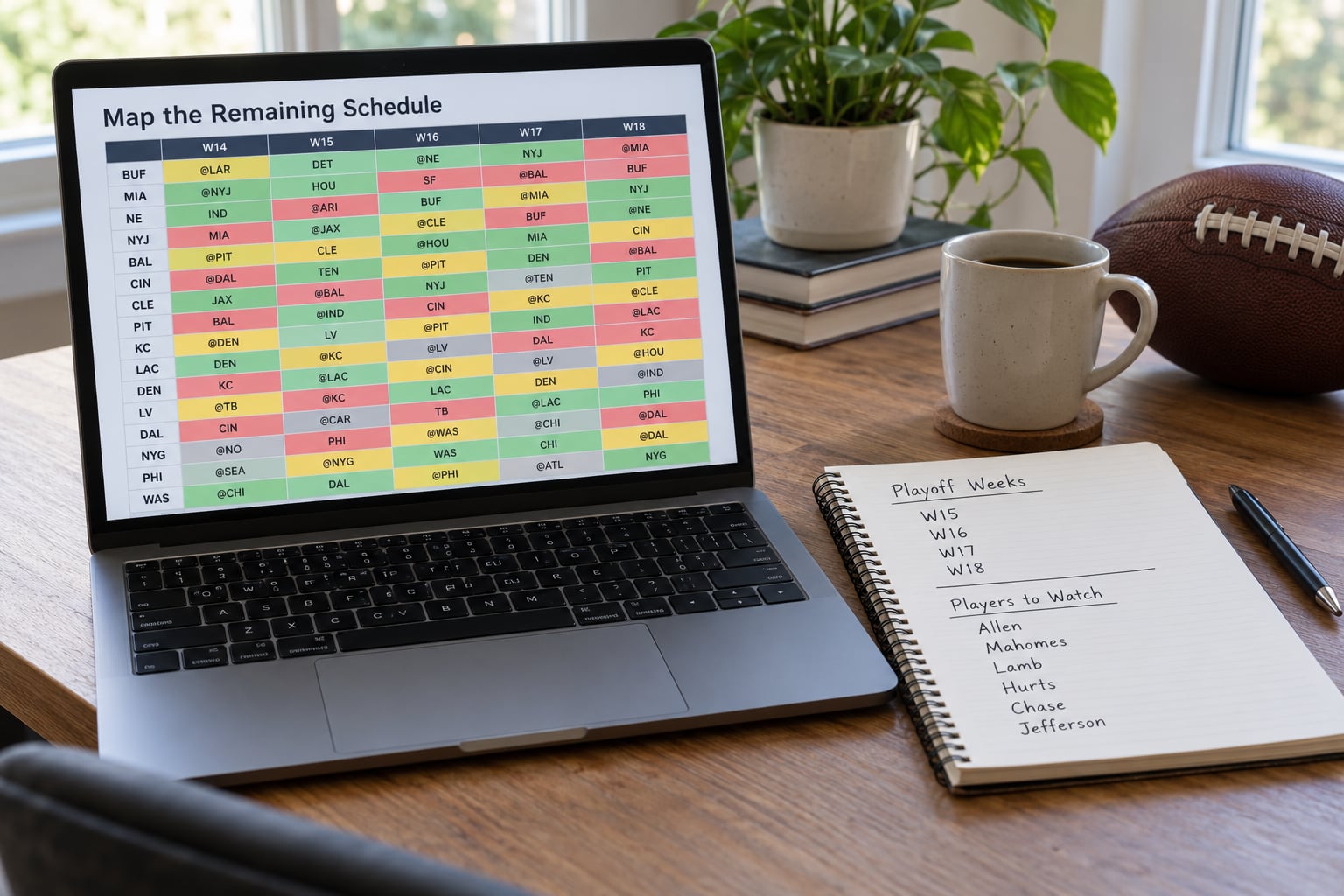
Pull the weekly opponent grid for every player on your roster and every player on a target manager’s roster, then hide everything outside your playoff weeks. What is left is the only data that should drive this trade.
Read the remaining weeks carefully, because soft runs are not always what the aggregate number suggests. Count real games, since a bye week sitting in the middle of a “soft stretch” turns it into two games and an empty week. Note home and away, and note divisional games, where the defense knows your player’s tendencies and the offense runs slower.
Check the opponent’s own situation too. A team that clinches a playoff seed before your week 15 may be playing dead, which can mean a low-volume, run-heavy script that kills your wide receiver’s targets. A team fighting for a wild card in your week 17 is throwing the ball to win.
The trap everyone misses is the inversion: a team with a comfortable regular-season slate can face a genuinely brutal window in weeks 15 through 17. Easy all year, then Carolina and San Francisco in the last three weeks. Always read the playoff columns directly rather than trusting a season-long number that is mostly describing August.
3. Separate Schedule Advantage from Player Quality
Volume beats matchup, every time, and this is where most schedule trades go wrong. A soft slate amplifies opportunity; it does not manufacture it. Before pricing any window, confirm the player is still doing the thing that made him worth owning in the first place.
For quarterbacks, a good schedule means shootout scripts and a team that still throws. For running backs, it means early goal-line work and a defense that concedes a lot to the run, and it means checking whether your starter is one injury away from a committee. For receivers, it means air yards and target share, not catches against a zone. For tight ends, it is almost always volume, and most tight ends do not have it. Defenses and kickers are streamers; a soft schedule for a defense is worth a late-round pick, not a starter.
If a trade demotes a player from starter to backup, it is a talent trade, and you should price it like one. That test kills a lot of bad offers before you send them.
4. Set a Realistic Trade Threshold
Here is the rule of thumb most managers are missing: three genuinely soft weeks are worth roughly one solid weekly starter, not an elite player. One soft week is worth a rounding error, and it should not change anything you do.
Use a trade value chart as a floor, never a verdict. The chart tells you the consensus price of the player in front of you. Your schedule premium sits on top of that consensus, and the gap between the two is exactly what a sharp league-mate wants to collect. If your premium comes from the chart rather than from your own read, you are not trading on schedule. You are just following the room.
Three things shrink the premium. A player already on your roster is worth more to you at a discount, and you should use that. A player already owned by a contender is worth less, because the price is set by a manager who needs him. And a soft window that is really two games plus a bye is not three weeks of value.
In dynasty, the same logic runs on a much longer fuse. A soft stretch in a redraft league is three weeks; in dynasty it is a quarter, and age, role and contract matter more than any of it. Same reasoning, longer window, more patience.
Run the same test in both directions before you send anything. Value what you are giving up across the playoff window, not across the full season. A running back with one soft remaining week on his schedule is a cheap acquisition if his role is stable. A running back with three soft weeks and a goal-line fumble or two is a different asset entirely, and the price difference between those two players is the actual trade.
5. Build an Offer Around Two or Three Assets
Most offers die because they ignore the other side. A package built only around what you want is a want list, and league-mates read it in one second.
Look at the target’s roster construction before you build anything. An empty tight end spot, a thin running back corps, a superflex starter on a bye-heavy stretch. Send the player they actually need, not the one who is most discussed. On r/fantasyfootball, the pattern that keeps showing up in trade threads is naming an eliminated team as the partner, because those managers have assets with no remaining use and no leverage.
One player plus a cheap thrower often beats two players of similar value, and it makes your offer look deliberate rather than desperate. Keep the package to two or three pieces. A five-player offer is not a trade, it is a data dump, and the other manager will cherry-pick it.
Anchor above your number on the first offer. You are not trying to win the negotiation on message one; you are trying to set the frame so the counteroffer lands near your real target.
Then watch what comes back and learn from it. A flat rejection usually means your premium was too thin or you missed a need. An offer that comes back close to your target tells you two things at once: the manager sees the same window you do, and he is pricing it lower. That is useful information even when the deal does not happen, because you now know whether the rest of the league has caught on yet. If several managers counter with the same logic, you are late. Go find a different window.
6. Use Recent News Without Chasing Hype
News is input, not a verdict. An injury report, a coaching change or a scheme shift should adjust your price slightly and tell you which players are about to become more or less valuable. It should never be the reason you send an offer.
The recurring failure mode is trading on last week’s box score. Most managers react to the most recent result, which is exactly why the soft-slate player is available in the first place. If his recent numbers look bad, that is already in the price, and it is not a reason to demand a discount on top.
Where news genuinely matters is Week 12 and 13, because that is when a schedule thesis can break. If a starting running back goes down in Week 13, the soft slate does not transfer to the injured player. It transfers to the handcuff, who may not be on anybody’s radar, and the player you were targeting just became a season-ending injury bet with a nice schedule attached.
7. Test the Deal and Monitor the Schedule
Before you hit send, run five checks. League rules: is this trade even legal before your deadline? Projected output: does the package out-score what you are giving up across the playoff window specifically? Role: is everyone you are acquiring still a starter for their new owner? Price: are you paying from your own model, or from a chart you read this morning? Fit: does the package address something the other manager wants?
Then keep watching. Re-pull the playoff weeks after every slate of injury news, once the trade deadline is confirmed, and one last time in the week before your playoffs begin. Owners on the trading floor are not settled in Week 10, and the slate you bought in November can be reshaped by a coaching change in December.
Common Mistakes
These are the ones that cost people their season, with the fix attached to each.
- Chasing raw schedule points. A team-level fantasy points allowed number ignores that some of those points came from a running game. Fix: look at what the opponent actually gives up by position.
- Ignoring role. Buying a backup quarterback’s great Week 16 opponent is not the same trade as buying a starter’s. Fix: confirm the role is stable before you price the window.
- Paying the premium twice. You check the playoff slate, then you check a chart that already reflects it, then you lowball. Fix: price the player at consensus, add your schedule premium deliberately, and pay more than you planned once.
- Trading a starter for a bench player in October. You will not need depth in Week 15 if you get the starter hurt in Week 9. Fix: wait until your flex and bench slots are settled before trading depth away.
- Overvaluing a defense or kicker schedule. Streaming is free. Fix: price defenses and kickers as late-round picks, never as a centerpiece.
- Ignoring the trade deadline. Some leagues lock trades before your playoff week even starts, which quietly kills the whole strategy. Fix: confirm the deadline in settings before you spend a week negotiating.
Frequently Asked Questions
How do I actually trade for a playoff schedule advantage?
Isolate your three playoff weeks, pull weekly opponent data for your roster and a target roster, and keep only the players whose slate in those weeks is meaningfully softer than their season slate. Price each one against a trade value chart, add your schedule premium, and package the result around something the other manager actually needs. Send it in weeks 9 to 12, while the window still looks obvious to you and not to them.
How much is a good playoff schedule worth in a trade?
A common working rule is that three genuinely soft weeks are worth roughly one solid weekly starter. One soft week should change nothing you do. Adjust for whether the player is already on your roster, whether a contender owns him, and whether a bye week sits inside the soft stretch. Use trade value charts as a floor, never as the final number.
Can you trade players during the playoffs in fantasy football?
In most standard leagues, no. Rosters typically lock at the start of the playoffs, which means your last chance to act is the week before your first playoff game. Some leagues keep trading open through the postseason, and a few one-and-done formats run a separate post-draft trade window. Your league settings decide this, so check them before you plan a late move.
What are the best fantasy schedules for the playoffs?
The best playoff schedules belong to players on teams whose opponents give up the most at their position across your playoff weeks. There is no fixed list worth printing, because the slate changes every year and shifts with playoff seeding. Pull the current-week data instead of trusting a team list written months ago, and weight the final playoff week more heavily than the first, since that is usually the one that decides titles.
Should I trade a starter for a player with a much better playoff slate?
Only if the gap is real, the player’s role is unchanged, and you are giving up depth you will not need. In a superflex league the calculus shifts, because a bench player with a soft slate is effectively a starter. As a general rule, do not trade a starter for a bench player in October. Wait until your roster is settled, then price the window honestly.
Where can I find player-level playoff schedule strength?
Trade value charts from FantasyPros, Sharp, Athlon and PFF all show rest-of-season and playoff-week opponents for every player, which is the closest thing to a single source. Dedicated strength of schedule sites map team slates by week, which is useful for ranking candidates but still leaves you to connect team to player yourself. The gap in most tools is that nobody publishes one ranked list of the best player-level playoff runs.
Conclusion
Write down your three playoff weeks today, then look at only those columns for every player on your roster. That single filter finds most of the value nobody else is looking at yet, and the deal is only worth making if the player’s role survives the trip to Week 15.