Sell high means trading a player at the exact moment other managers in your league value him more than his underlying numbers justify. That gap is usually created by a career game, a big news item, or a stretch of hot production, and it tends to open within a day or two of the event and shrink fast afterward.
So when to sell high on a fantasy player? Sell when the return on offer solves a real need on your roster, the player’s role is about to shrink, or both. That is the whole idea. The rest of this guide is the process for getting there without guessing, and it works the same whether you play in a redraft league, a keeper league, or a dynasty rebuild.
A word on the honest version of this: almost nobody sells a player at the mathematical top of their curve. You sell a few days early or a few days late and you live with it. What you can control is avoiding the two expensive mistakes, which are selling a star who is still ascending, and holding a declining asset because a highlight reel is running in your head.
Table of Contents
- What You Need
- Current and projected fantasy output
- Underlying usage data
- Contract and roster context
- Team situation
- League format and settings
- Replacement options
- Observed transaction prices
- Step-by-Step: When to Sell High on a Fantasy Player
- 1. Identify the peak-value window before you decide when to sell high
- 2. Check whether the recent production is repeatable
- 3. Evaluate the player’s team and opportunity
- 4. Compare current value with the future outlook
- 5. Account for league settings and roster construction
- 6. Find the strongest comparable players
- 7. Look for a clear upgrade, not only a famous name
- 8. Set a minimum value before negotiating
- 9. Sell while the market still wants the player
- When Should You Sell High? Quick Examples
- Example 1: The declining veteran in a redraft league
- Example 2: The prime-age breakout in a keeper league
- Example 3: The rookie hype window in dynasty
- Common Mistakes
- Selling after one huge game
- Waiting for the perfect window that never arrives
- Ignoring league settings
- Accepting only one player back
- Not checking injury news before you offer
- Trading without a replacement plan
- The consensus sell-high paradox
- Two practical tips worth keeping
- Frequently Asked Questions
- How soon after a big game should I sell a fantasy player?
- Should I sell high in dynasty or wait for more production?
- Is my player actually overvalued or just having a good run?
- Does age alone mean I should sell a fantasy player?
- How do I price what I get in return?
- What if nobody offers anything for my player?
- Conclusion
What You Need
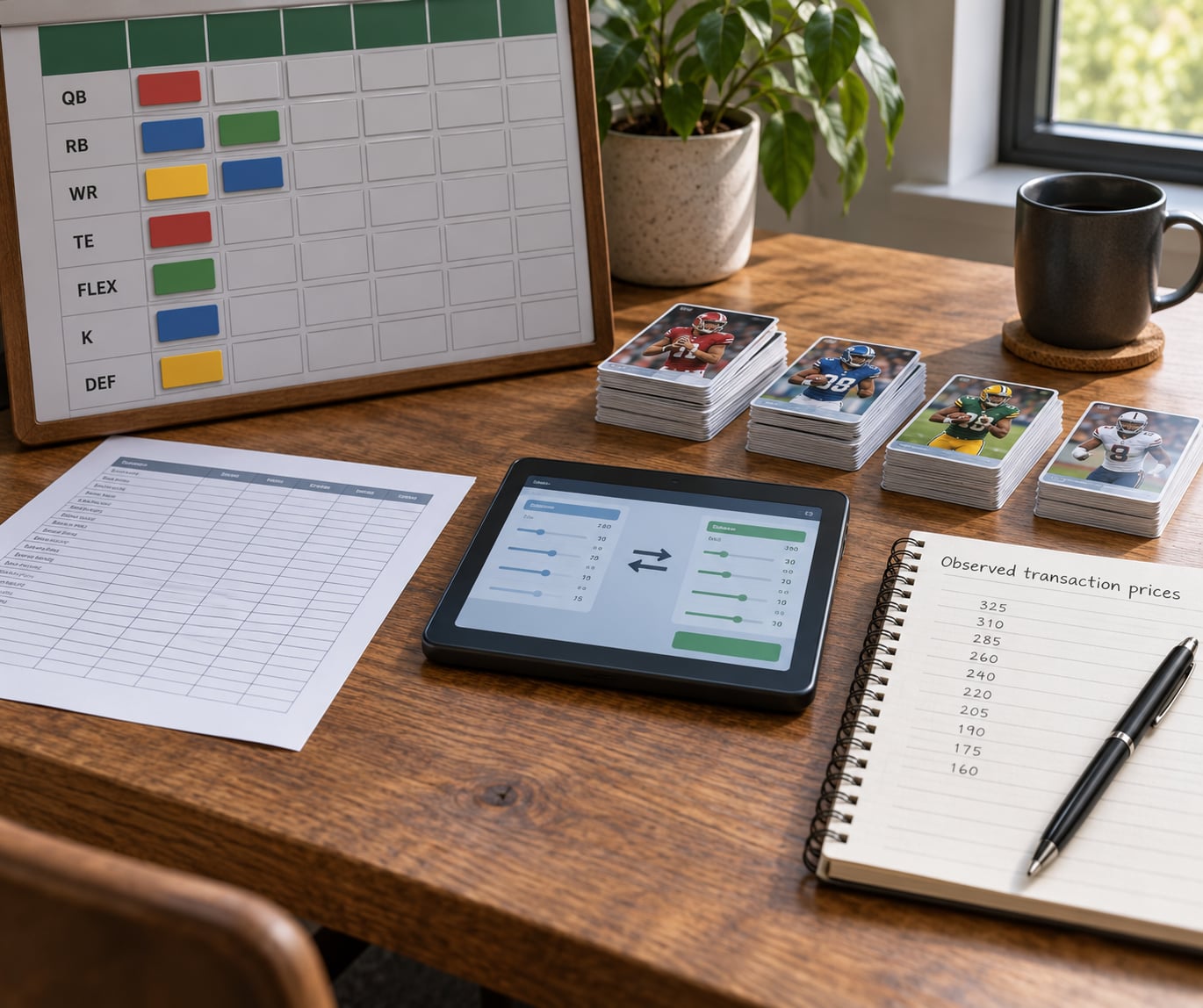
Before you judge anybody, gather seven things. Most managers only have two or three, which is why the decision usually gets made on narrative.
Current and projected fantasy output
Not just the last four weeks. You want the season line, the projection for the rest of the year, and the playoff schedule in your scoring format. A player averaging 9 points a game in PPR who has a soft run of opponents left is a different asset from one with the AFC West to go.
Underlying usage data
Snap percentage, target share, route share, carries per game, red zone touches, and for quarterbacks yards per dropback. This is the credibility layer. On fantasy forums, any sell-high argument built purely on a box score gets picked apart within a few replies, because a box score tells you what happened and not what is about to happen.
Contract and roster context
Remaining years on the contract, rookie status, age curve, and whether other teams view the player as a long-term piece. In dynasty, contract length and the draft capital behind a player drive most of the disagreement between your valuation and somebody else’s.
Team situation
New offensive coordinator, a scheme change, a quarterback change, a rebuilt offensive line, or a head coach who wants to run. Team context is where value quietly moves before the market catches up, usually in the opposite direction of last week’s box score.
League format and settings
Scoring format, roster size, bench spots, starter count at each position, number of teams, and playoff week. The same player is worth two first-round picks in one league and a throwaway in another, and you cannot price a trade until you know which league you are in.
Replacement options
What you would actually acquire for this player. If your bench has two comparable wide receivers already, the sell-high case gets much weaker, because you are giving up depth for depth. If your only usable tight end is a dud, the same player is a sell no matter what the value chart says.
Observed transaction prices
Completed trades, not listed offers. Offers tell you what people hope; completed deals tell you what the league actually clears at. If nobody in your league has traded a player like yours in eight weeks, assume the consensus value chart is not your league’s value chart.
Step-by-Step: When to Sell High on a Fantasy Player
Know when to sell high on a fantasy player by running these nine steps in order. Most sell-high mistakes happen because a manager jumps to step 9 with a name and a feeling, then works backwards to justify it.
1. Identify the peak-value window before you decide when to sell high
The peak-value window is not the week your player scored the most points. It is the stretch where expected future production is strongest relative to what managers are likely to pay today, and those two things rarely line up on the same Sunday.
Start from the event. A career game, a surprise depth chart change, a contract extension, an injury report, a change of scenery. Then work outward: how long does the market usually take to reprice this, and which direction does it move? The repricing usually arrives in the first 48 hours after a big performance, and it loses most of its extra value within about another 48 hours after that. That narrow band is the window. Sell in the middle of it rather than at either edge.
2. Check whether the recent production is repeatable
This is the step that separates a real sell from an expensive mistake, and it is where underlying data earns its keep. Pull the last four to six weeks and ask what is driving the production: volume or efficiency.
Volume is touches, targets, routes run, carries, and snap share. Efficiency is yards per carry, yards per route run, catch rate, and touchdowns. Volume tends to persist when a coach commits to a player. Efficiency regresses, and it regresses hardest for tight ends and receivers who have been living off red zone looks.
So a receiver sitting at a 30% target share with 9.0 yards per route run is a candidate for regression, while a tight end with an expanding route tree and 18 targets a game is a candidate to keep. Check the role, not the score. If snap share is dropping while the points keep coming, you are watching a declining asset with good timing, and that is precisely when the market will pay you for it.
3. Evaluate the player’s team and opportunity
Ask what the offense is going to ask him to do for the rest of the season. New play-caller, new quarterback, new offensive line, or a head coach who just said the running back is a workhorse again. Any of those can reset a player’s ceiling without resetting his floor, and the market tends to price the ceiling before the evidence arrives.
The check is simple: name three things this player is likely to do more of, or do better at, than he has been doing. If you cannot name any, you are selling on past production alone, which is the definition of chasing the box score.
4. Compare current value with the future outlook
This is the arithmetic step, and it is also where the hold zone lives. Value today should be a function of what the player gives you from here, and you need to subtract everything that is about to go away.
Run through the deductions: remaining games, aging curve, injury risk, contract status, role stability, and expected ceiling. A 31-year-old running back on the downs has almost no remaining value after the season, so his market value now is mostly pure profit for you. A 23-year-old with three years of production in front of him has a long runway, and a hot two-week stretch is weak evidence that the market has found the top.
Now check the other side of the ledger. If current market value sits below what you project the player will produce, and the underlying numbers still support the role, you are in the hold zone, not the sell zone. Sit on it. That gap closes itself as the season produces more data, and selling now leaves money on the table for no reason.
5. Account for league settings and roster construction
Same player, different league, different number. Check four things before you price anything.
Scoring format changes how much a spike is worth. In PPR, a target-heavy week moves value hard because every reception is points; in standard scoring, a comparable performance barely registers. Roster size and bench spots decide whether depth has any value at all. Positional scarcity decides whether an extra starting tight end is worth anything. Playoff format decides whether the player is a season-long asset or a six-week one.
Then look at the league itself. A league with three tight end start slots turns every healthy tight end into an asset. A league with twelve teams and thin benches makes bench players nearly worthless, which means your return package needs to be starters, not depth. Judge your trade in your league, not on a chart built from a league that does not resemble yours.
6. Find the strongest comparable players
Value charts are a starting point, not a verdict. Every one of them disagrees with every other one, because each models a slightly different version of your league, and managers who argue loudly about which calculator is right are usually arguing about something else.
The rule that works: use charts to sanity-check a number you already reached yourself, and use them in the negotiation to move the conversation off opinion. When you tell a league mate that a trade matches the consensus chart, the argument stops being about taste and starts being about a shared reference point. You will rarely win that way, but you will rarely get insulted either.
For comparables, look at completed trades in your league over the last eight weeks, not listed offers. Look at who other rebuilders have actually bought, since that tells you which player types have exit liquidity right now. And look at the buy lists circulating in chat, because a player on three buy lists is worth more than a player on one.
7. Look for a clear upgrade, not only a famous name
The return matters as much as the sale. Accepting two players for one feels good and frequently leaves you worse off, because you have converted a scarce asset into abundant depth. Decide what your roster actually needs before you send the offer.
Useful returns do one of four things: they fill a hole at a position you start, they raise your weekly ceiling, they add insurance at a position where one injury ends your season, or they give you a path to a better playoff roster. A package that does none of those is a package that looks like a win and is not one.
Trading up is also legitimate. If the player you are selling is genuinely the best asset you own and the league wants him, moving down a tier to consolidate a thin position can raise your floor for the rest of the season. The test is whether you would take the same package if the player’s value had not jumped this week. If the answer is no, you are buying hype.
8. Set a minimum value before negotiating
Write your number down before you open a chat. Not a range, a number, plus one acceptable fallback. Then compare it against what the value charts say and against what comparable players have actually cleared for in your league.
Anchor a little below fair value when you make the first offer, roughly ten to fifteen percent under, then let the counter move you. Managers on forums describe a reliable pattern: a ‘counter?’ reply is rarely a real negotiation, and is more often a way to get the other side to name a number first. Waiting for that number costs you nothing.
Also decide your walk-away point in advance, because the moment an offer comes back insulting is the moment you are most likely to accept it just to end the conversation. If nobody counters, the deal was not there. That is information, and it is the fastest way to find out that your league does not value the player the way the chart does.
9. Sell while the market still wants the player
Timing is the last step, not the first. Post your interest Tuesday or Wednesday, after waivers clear and before the emotional reaction to the weekend settles in. Managers make their best trades in the middle of the week and their worst trades on Sunday night.
When you do send the offer, lead with the return, not the player you are selling. Managers reading a message want to know what they are getting, and the seller’s framing makes them defensive before they have evaluated anything.
And do not wait for a better window that has not arrived. There is always a story that says hold one more week, and the value spike that justified the trade has usually decayed by the time that story plays out. Sell into the belief while the belief is still paying. If the player’s role genuinely stays strong afterward, you can buy him back cheaper in three weeks, which is the least painful version of selling too early.
When Should You Sell High? Quick Examples
Abstract frameworks get vague fast. These three are shaped like the trades most managers actually make, and the numbers are illustrative rather than a live recommendation.
Example 1: The declining veteran in a redraft league
The player is a 31-year-old running back with one season left on the contract, coming off the downs, with a replacement waiting behind him. The offense has moved to a committee, and his carries per game have fallen for three straight weeks.
The signals all point the same way: role downgrade, minimal remaining value after this year, and a league that overvalues the name rather than the role. In a 10-team PPR league with four bench spots, the realistic return is a low-end starter plus a pick. Sell in the same week the news breaks, not after his volume recovers, because the recovery is what the market is waiting for and it may never come.
Example 2: The prime-age breakout in a keeper league
The player is 25, drafted in the second round, and has posted four consecutive weeks of strong target share and above-average yards per route run. Production is high but repeatable, and the role is expanding rather than shrinking.
This is the hold case, and it is the one most managers get wrong. Underlying data supports the numbers rather than contradicting them, so the market has not yet overpaid. The right move is usually to hold through the hot stretch and reassess after the bye week, unless the rest of the schedule is brutal. A three-to-four week stretch of tough opponents, combined with a hot market, is where a sell makes sense even for a player whose underlying role is solid. You are collecting now for a drop in value later, and you want the return to be a young player with a real path to weekly volume.
Example 3: The rookie hype window in dynasty
The player is a first-round rookie with a huge offensive role, a crowded receiving group in the division, and an ADP that says top-10 player every year. Value spikes after a strong debut, a highlight reel, and two weeks of buzz.
In dynasty, the question is not what he does this year but what the next four years look like. A hot debut can reprice a rookie by more in a week than a veteran moves in a season. Trade into that window if the return includes a young, ascending player with a defined path to snaps, and do not accept two older names in exchange. Hype rookies are the most overpriced category in fantasy because the narrative moves faster than the role.
One pattern ties the three together. The sell is strongest when the player’s role is shrinking while his price is not, and weakest when the price and the role are moving in the same direction.
Common Mistakes
Selling after one huge game
A single 30-point game moves a value chart further than three weeks of consistent production, because most managers react to what they just watched. That reaction is the opportunity, but the correction usually arrives within two to three weeks. If you sell, sell inside that window. If you are going to wait and see whether he repeats it, wait for the repeat to happen first, because the market has already paid for it.
Waiting for the perfect window that never arrives
There is always a reason to hold one more week: a favorable schedule, an injury that will boost his value on return, a trade that might come in later. Meanwhile the spike decays. Set a date, not a feeling, and treat the date as the decision point rather than a suggestion.
Ignoring league settings
A deal that is correct in a 12-team two-division league can be nonsense in a 14-team super league with two tight end slots and a deep bench. Know your roster size, your scoring, your positional scarcity, and your playoff week before you decide what fair value looks like. This is the cheapest part of the process and it changes the answer more often than you would expect.
Accepting only one player back
One-for-one trades feel clean and are frequently lopsided, because you have turned a single asset into a single asset while changing nothing structural about your roster. Unless the incoming player is a clear tier above, ask for two pieces. A two-for-one is not only fair on paper, it also narrows the pool of owners who will accept, which is a problem you want to avoid. Work out the package that fixes your roster and lead with that.
Not checking injury news before you offer
Send an offer on a player who gets ruled out an hour later and you have given away value for free. This happens more often than anyone admits. Check the injury report before you post, again before you send, and once more before you accept, and treat any player with a soft tissue or lower-body concern as a hold until he is active.
Trading without a replacement plan
Selling is half a move. Decide what fills the gap before the trade goes through, whether that is a waiver target, a second trade, or simply accepting a thinner roster. Managers who sell and then do nothing usually end up with less value and more uncertainty than they started with.
The consensus sell-high paradox
Here is the objection that comes up in sharp leagues: if everyone can see the player is overpriced, the price already reflects it. True, and the fix is not to avoid the trade. It is to price the return for the league you are actually in rather than the consensus chart. When the obvious candidates are already priced in, the return has to come from roster need rather than from the sale itself, and rebuilding managers are usually the counterpart who has it. They consistently want youth and will overpay for a younger player with upside. That is where the exit liquidity is.
Two practical tips worth keeping
First, gauge interest before you name a price. A short note to a few owners asking whether anybody is interested, without details, tells you how many buyers exist and whether your number is realistic. Posting a player on the block without a message mostly attracts lowballs and can signal that you are desperate to move him.
Second, use charts to negotiate, never to decide. They are a shared reference point that keeps a trade from becoming an argument about taste, and they are not a substitute for reading snap counts. If you cannot justify the sale with underlying data, the chart will not save you from being wrong.
Frequently Asked Questions
How soon after a big game should I sell a fantasy player?
Within 24 to 72 hours is the practical window. Value charts and league chat both reprice a big game quickly, and the extra value usually fades over roughly the next two days. If you wait a full week, you are trading at the price the market has already adjusted to. Send the offer Tuesday or Wednesday, confirm the player is healthy, and take a good return rather than a perfect one late.
Should I sell high in dynasty or wait for more production?
In dynasty, the horizon is years rather than weeks, so a two-week hot stretch is weak evidence. Sell when the role is shrinking, the age curve is working against the player, or your rebuild needs a specific asset. Hold when target share, snap share, and snap counts are still climbing. Rookie hype is the exception that proves the rule: that window reprices faster than anything else in dynasty.
Is my player actually overvalued or just having a good run?
Compare usage with output. If carries, targets, route share, and snap percentage are flat while points keep climbing, the efficiency is doing the work and it will regress, which means sell. If usage is expanding alongside the production, the market has not finished pricing the player and holding is usually better. Underlying numbers settle this argument faster than any value chart.
Does age alone mean I should sell a fantasy player?
No. Age is an input, not a decision. A 30-year-old running back with a locked workload and two good years left is a hold in redraft and a judgement call in dynasty. A 30-year-old on the downs with no role is a sell regardless of what he did last season. Age matters most for positions where the workload curve falls fastest, and least for players whose value comes from something other than weekly volume.
How do I price what I get in return?
Price the return from your own roster out. List the players you would actually start, then find out what comparable trades have cleared for in your league over the last eight weeks rather than what people are asking for. Write your number down before you negotiate, and remember that one-for-one trades usually hide the real value, so aim for a package that fills a real hole or raises your weekly ceiling.
What if nobody offers anything for my player?
That tells you something useful: your league does not want the player at the price you imagined, so the sale was a rounding error on a chart and a fantasy inside your league. Either lower the number, improve the package you are asking for, or wait for the market to move. A player listed for six weeks with no interest is usually a rebuild asset rather than a trade asset, and the exit comes in a different shape.
Conclusion
So when to sell high on a fantasy player? Start with one comparison: the player’s remaining schedule and expected production against what the league is offering for him today. If the offer is bigger and solves a real need on your roster, sell this week. If the offer is merely bigger, hold and look again after the next two games.
Then make it a routine. Tuesday, pull the biggest movers on your league’s value chart, check the snap and target data on each one, and ask a single question: is the market outrunning the role, or the other way around. Five minutes on the players who just moved will find more sell-high chances than an entire season of reacting to box scores.