DFS lineup construction means filling a fixed roster of real athletes inside a site’s salary cap so that your lineup scores the most projected fantasy points for the type of contest you entered. The whole thing is a budget problem with scoring attached: spend well, fill every slot, and let the math decide. A beginner can build a solid lineup in about 20 minutes once you know the order to work in.
This guide walks through the process the way I would want it handed to me on day one, because most beginners skip the order and end up staring at a full player pool with no idea where to start. I’ll show you what to gather before you touch the roster, a repeatable six-part build, a complete worked example with real numbers, and the mistakes that cost beginners the most money over a season.
One thing to set up front: daily fantasy sports involve real money and real variance. Nobody wins every slate, and the process below improves your decisions, it does not guarantee a payday. Play with money you can afford to lose, and start with small entries.
Table of Contents
- What You Need Before You Build a Lineup
- Free vs Paid Tools: What You Actually Need
- DFS Terms You Will See Everywhere
- Step-by-Step: How to Build a DFS Lineup
- How to Start DFS Lineup Construction for Beginners
- Common DFS Lineup Construction Mistakes Beginners Make
- Frequently Asked Questions
- How do I set up a lineup for fantasy football?
- How does DFS fantasy work?
- When should I set my fantasy football lineup?
- Should beginners use a lineup optimizer or build by hand?
- Is stacking necessary in DFS lineup construction?
- Conclusion: What to Do on Your First Slate
What You Need Before You Build a Lineup
You need six things ready before you open the lineup editor, and none of them require a paid subscription. Have these in place and the build itself takes minutes rather than an hour.
- A player pool with salaries and projections. Every DFS site shows this on the roster page. DraftKings, FanDuel and Yahoo all list salary and projected fantasy points next to each player.
- Game and injury notes. Check the injury report and practice reports before you commit. A player sitting out changes the entire build around him.
- The schedule for the slate. Know which games are early, which are late, and where the primetime game sits. Primetime players lock last, so they are the ones you revisit.
- Scoring settings for the specific contest. The same lineup can score differently under standard, punt, double-up and showdown scoring. Read the rules of the contest you entered.
- A build type in mind. Cash game or tournament? These produce two different lineups from the same player pool, and you need to know which one you are making before you start.
- A spreadsheet or notes app. Track what you rostered each week. That log is how you find out what you keep getting wrong.
Reviewed for the 2026 season: roster formats change slightly by sport and by platform, so confirm your positions and cap on the contest entry page rather than trusting a screenshot someone posted online.
Free vs Paid Tools: What You Actually Need
Start with the free tools. The roster page, the injury news and the box score history are enough to learn the process, and paid subscriptions only speed up the parts you should be doing manually anyway.
What costs nothing: box score history from the league’s official stats site, team news and injury reports, public projections aggregators, and a free spreadsheet template for tracking your entries. If you want a second opinion on projections, sites like RotoGuru publish free daily fantasy rankings across NFL, NBA and MLB that you can line up against the site’s own numbers.
Where paid tools help later, not now: an optimizer that builds and sorts hundreds of lineups at once, and advanced ownership models. Those matter once you have a few hundred entries of your own data. Buying them in week one tends to hide a weak process rather than fix one.
DFS Terms You Will See Everywhere
Community threads throw around terms that beginner guides rarely define, and that vocabulary gap slows people down more than the strategy itself. Here is the short version in one place.
| Term | What it means | Why it matters when you build |
|---|---|---|
| Cash game | A contest judged on finishing in the top percentage of entries | You build a safe, high-probability lineup and usually enter it more than once |
| GPP | General public tournament, judged on beating the field rather than beating a payout line | You build a high-ceiling lineup with contrarian plays, because the best finish rarely comes from the most popular lineup |
| MME | Multi-entry contest, where you submit several lineups into one contest | Building several distinct lineups is the entire strategy, so diversification matters more than any single build |
| Min cash | A small percentage of your entries deliberately built worse than your ceiling, to guarantee a payout spot | Protects you in a large MME where the top spots pay little |
| Ownership | The share of other entrants projected to roster a player | High ownership means many other lineups look like yours, which limits your finishing places in a tournament |
| Chalk | Short for heavily owned players | Chalk is usually fine in a cash game and expensive in a tournament |
| Value | Projected fantasy points per 100 of salary | This is the number that tells you whether a player is worth his price |
| Exposure | How often the same player appears across your entries | A player in every entry wins once or loses everywhere, so spread them out |
| Uniques | Lineups that share no players with each other | Uniques multiply your ways to place in a big field |
| Correlation | Players whose fantasy points move together, usually teammates | One game script produces points for several teammates at once, which is the basis of stacking |
| Lineup lock | The deadline when entries become final | Prime-time games lock last, which matters more than beginners expect |
| Late swap | Switching a starter for a backup after lineup lock but before the game | A useful later skill for injury situations, and not something to chase in your first month |
Step-by-Step: How to Build a DFS Lineup
Build a DFS lineup in six steps: set your build type, research the slate, set exposure priorities, find your value plays, lock in core plays and fill the rest, then audit the final lineup. Here is the full process.
Most of the discipline here is in resisting the urge to add a player the moment you see a good projection. Work the stages in order and the roster fills itself out of leftover money and leftover positions.
- Decide cash versus tournament. Cash first if you are new, because the finish line is a percentage rather than a specific payout.
- Read the slate before the player pool. Scorelines, team notes, and which offenses are missing their first-choice receiver.
- Mark three to five high-priority players. These are plays you would build around regardless of price.
- Sort the pool by value, not projection. Projected fantasy points per 100 of salary surfaces the players worth the money.
- Place your core plays and check the cap. Add the plays from step 3, then see how much salary is left and how many roster spots remain open.
- Fill the gaps with value and stack teammates. Fill each open spot with the best remaining point-per-dollar option, then audit the whole roster.
Here is what each stage looks like in practice.
Stage 1, choose the build type. A cash build wants a floor: players with safe volume and matchups that do not depend on touchdowns. A tournament build wants a ceiling: players who can score 30 fantasy points in a game where their team is favored. The same player can be right for one and wrong for the other. If you cannot name which contest type you are entering, stop and go check the contest rules.
Stage 2, read the slate. Ten minutes here saves an hour of arguing with yourself later. Look at the game environment: pace on offense, how each defense has performed against the position you will roster at, and whether a team is likely to be playing from ahead or behind. A team projected to run out the clock in a blowout gives its slot receivers more targets and its running back fewer carries in the fourth quarter, which is exactly the kind of detail that separates a good build from a chalk one.
Stage 3, set your priorities. Write down three to five players you want to build around. Good candidates are a quarterback in a great matchup with two good receivers on the same team, or a running back with goal-line work and a weak opponent front. Keeping the list short is what makes it a priority list rather than a wish list. If you end up with eleven priorities, you have not decided anything.
Stage 4, find value. Sort the pool by projected fantasy points per 100 of salary. A player projected for 15 points at a 5,000 salary gives you 3.0 value; a player projected for 22 points at a 8,500 salary gives you about 2.6. The raw projection says the expensive player scores more, and the value column says the cheaper player scores almost as much while freeing up money elsewhere. Value is what lets you fit nine good players under the cap instead of six.
Stage 5, place the core plays. Add your priorities one at a time and watch the remaining cap after each one. This is the stage where beginners hurt themselves. Build around an expensive star first and the rest of the roster becomes scrappy leftovers, because there is not enough money left for two quality receivers. Build around the cheap pieces first and the star becomes an upgrade you can afford later.
Stage 6, fill and audit. Fill each remaining spot with the best value option still available, adding teammates of your priorities whenever the matchup supports it. Then check four things: every position is legal, the total salary is at or under the cap, you have not left yourself with no room at one position, and you have no accidental duplicates. Only then do you submit.
How to Start DFS Lineup Construction for Beginners
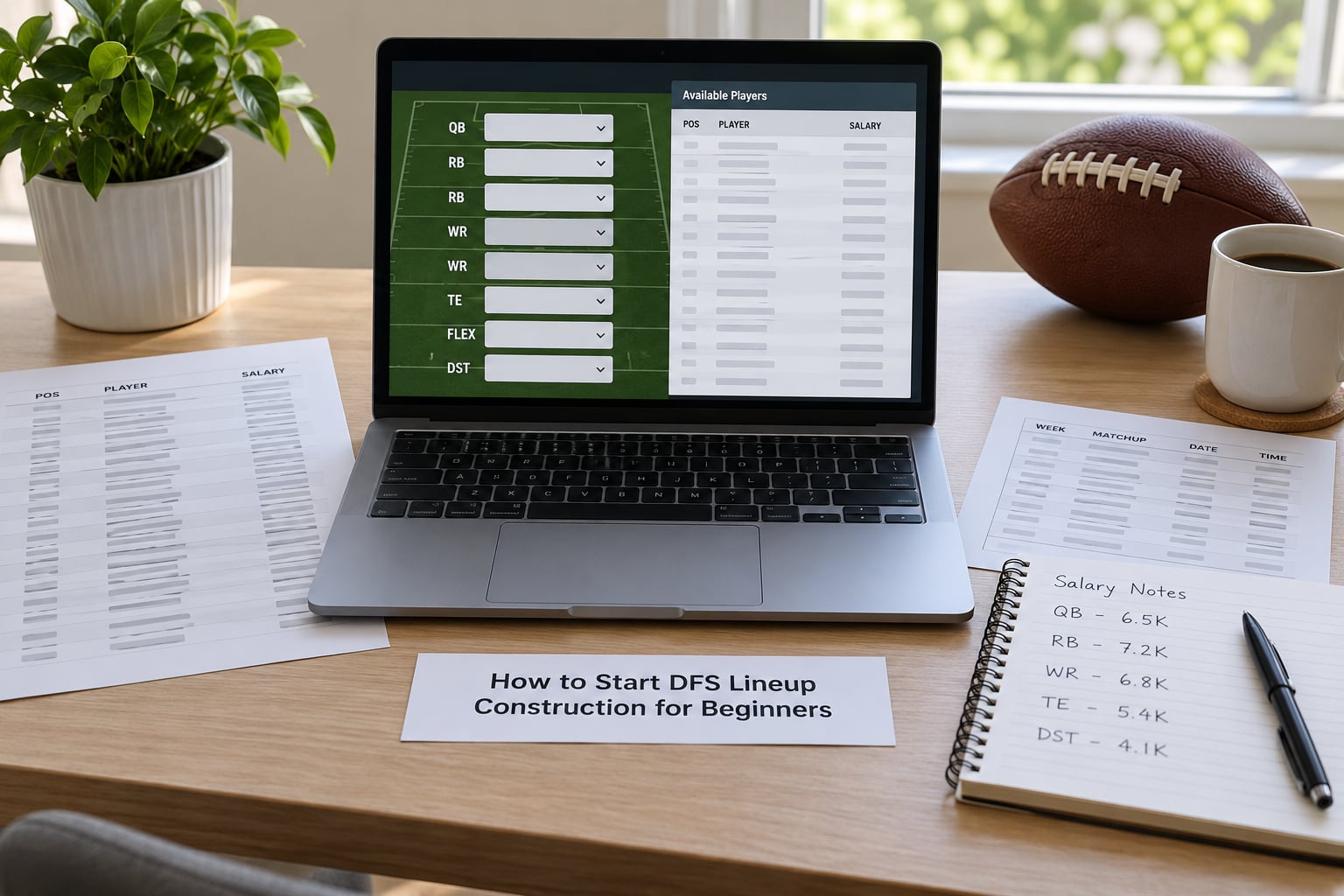
Here is the whole process on a generic nine-player NFL slate with a 50,000 salary cap. The names are invented but the arithmetic is real, because the numbers are what teach the process.
Step one, the build type: this is a cash game, so the goal is a dependable floor with one or two upside pieces, not a moonshot.
Step two, the slate: one team is a heavy favorite with a fast pace, and its star receiver is listed as questionable. The other late game features two teams that both run the ball, which usually means defensive end zone ceilings for pass rushers.
Step three, the priorities: the heavy favorite’s quarterback, his starting tight end, and one pass rusher from the late game.
| Player | Position | Salary | Projected FPTS | FPTS per 100 cap |
|---|---|---|---|---|
| Example QB (favorite offense) | QB | 8,200 | 22.6 | 2.76 |
| Example WR (same offense, cheap) | WR | 4,100 | 13.4 | 3.27 |
| Example TE (same offense) | TE | 4,600 | 12.1 | 2.63 |
| Example RB (volume back, favorable) | RB | 7,100 | 17.8 | 2.51 |
| Example WR 2 (cheap volume) | WR | 3,400 | 11.6 | 3.41 |
| Example RB 2 (backup role) | RB | 3,200 | 10.9 | 3.41 |
| Example pass rusher | Defense | 3,900 | 11.2 | 2.87 |
| Example DST | Defense | 3,000 | 9.4 | 3.13 |
| Example flex (bench RB value) | Flex | 2,800 | 8.5 | 3.04 |
Total salary: 49,700, which sits 300 under the cap. Total projected points: 117.5. The shape of the roster matters more than any individual pick: the quarterback, one receiver and the tight end all come from the same offense, so one game script produces points for three players at once.
Notice what the build did not do. It did not start with the most expensive receiver on the slate, which would have burned 11,000 of salary for a player projecting 24 points and left the rest of the roster full of 3,000-salary scrubs. It did not use six mid-salary players with no relationship to each other, which scores about as well but has no ceiling. And it left 300 unused rather than forcing a tenth player in, which is usually the right call.
After the slate resolves, the real work is the review. Write down two lines: which spots beat their projection and which missed, and whether the misses were bad luck or a bad read. Ten weeks of that log teaches you more than any article, including this one.
Common DFS Lineup Construction Mistakes Beginners Make
Nearly every avoidable loss traces back to one of seven habits. Here they are with the fix.
- Ignoring position eligibility. Putting two running backs in a roster that only has one RB spot, or using a tight end in a spot that does not accept tight ends, gets the lineup rejected before it scores anything. Fix: check eligibility in the editor’s position filter every time, even when you are sure.
- Building around one player too early. The moment you add an expensive star, every remaining pick is compromised. Fix: roster the cheap core first, then upgrade.
- Using every popular play. In a tournament, a lineup identical to half the field can only finish one place. Fix: keep one to two contrarian players per tournament entry and know which of your picks are heavily owned.
- Paying for average role changes. A player listed as a starter but with a split backfield is not a reliable source of fantasy points. Fix: check the depth chart and the beat writer’s notes, not just the position label.
- Ignoring team context. A receiver on a team that runs 60 percent of the time and trails by ten points late is a bad cash play even with a nice matchup. Fix: pair every player with a sentence about his expected game script.
- Failing to set a budget. Adding players one at a time until the editor blocks you at the end means the last two spots are random. Fix: know roughly what each position should cost before you start filling.
- Submitting without checking the slate. A late scratch or a surprise benching after you locked invalidates the read you built on. Fix: check injury news immediately before lock, and build last around the primetime game since it locks latest.
A few habits that compound over a season: enter contests you can actually evaluate, meaning small fields with clear finishing positions, and keep the same build type each week so you are comparing like with like. Track every entry in a spreadsheet with the reasoning, not just the names. And remember that DFS is a variance-heavy activity with real money involved, so a bankroll rule matters more than any single lineup trick.
Frequently Asked Questions
How do I set up a lineup for fantasy football?
Pick your contest type first, then fill each roster position from the player pool without going over the salary cap. Work from a short list of three to five players you want to build around, add the cheaper pieces first, and finish by sorting remaining options by fantasy points per 100 of salary. Check position eligibility and the cap before you submit.
How does DFS fantasy work?
You get a fixed salary budget, a set of roster positions, and a pool of players carrying both a salary and a projected fantasy point total. Fill every position, stay at or under the cap, and your lineup scores points based on what those athletes do in real games. Cash games rank you against a percentage of entries; tournaments rank you against the whole field.
When should I set my fantasy football lineup?
Before the earliest lock time on your slate, not the last minute before it. Early games lock in the afternoon, so any player in them must be set before then. Build your core lineup during the day and leave the primetime players to a final check shortly before the late games start.
Should beginners use a lineup optimizer or build by hand?
Build by hand for your first few hundred lineups. Hand-building is slower, but it forces you to learn the roster rules, the cap math and which plays you actually like. An optimizer is useful later for generating and sorting large numbers of entries in multi-entry tournaments, when you have enough of your own results to judge its output.
Is stacking necessary in DFS lineup construction?
Stacking is not required, but correlated players on the same offense tend to score together because they share a game script. In a cash game one or two teammates is usually plenty. In a tournament, stacking raises the ceiling, and pairing it with one contrarian player stops your lineup from looking like everyone else’s.
Conclusion: What to Do on Your First Slate
Pick one contest, open the roster page, and build exactly one lineup from scratch using the six stages above. Write your reasons next to each pick while you build, then review the slate afterward and note which reads were right and which were wrong. That log, repeated for ten weeks, is what turns a beginner into someone who actually knows why their lineups win or lose.