A best ball lineup stack is two or more players from the same NFL offense that you draft together on purpose, most often a quarterback with one or more of his pass catchers. Because the platform auto-starts your best lineup every week, one 40-point quarterback performance drags three or four of his teammates up with him, and the bad weeks get substituted away. This guide is about football, not baseball batting orders, and it covers the 2026 best ball formats on Underdog, DraftKings, FFPC and Drafters.
Stacking is not a rule you follow once. It is a chain of decisions that starts with your league settings and ends with a full roster that has a realistic path to a ceiling score. Here is the order I work through it, and the places where drafts most often go sideways.
Table of Contents
- What You Need to Build a Best Ball Lineup Stack
- What a best ball lineup stack actually is
- The format details that decide your construction
- The inputs to gather
- Step-by-Step: How to Build a Best Ball Lineup Stack
- 1. Confirm the league format and scoring
- 2. Find the strongest offensive game script
- 3. Choose one primary team concept
- 4. Map player roles and correlations
- 5. Select a ceiling-oriented core
- 6. Test the stack against the schedule
- 7. Build the full best ball portfolio
- Common mistakes that kill best ball stacks
- Frequently Asked Questions
- What is the best way to stack in best ball fantasy football?
- How many players should be from the same NFL team in a best ball lineup?
- Should I use a quarterback in a best ball stack?
- What is the best team concept to stack in best ball?
- How do I account for injuries when building a best ball lineup stack?
- Is it better to stack at the same position or across positions?
- Conclusion
What You Need to Build a Best Ball Lineup Stack
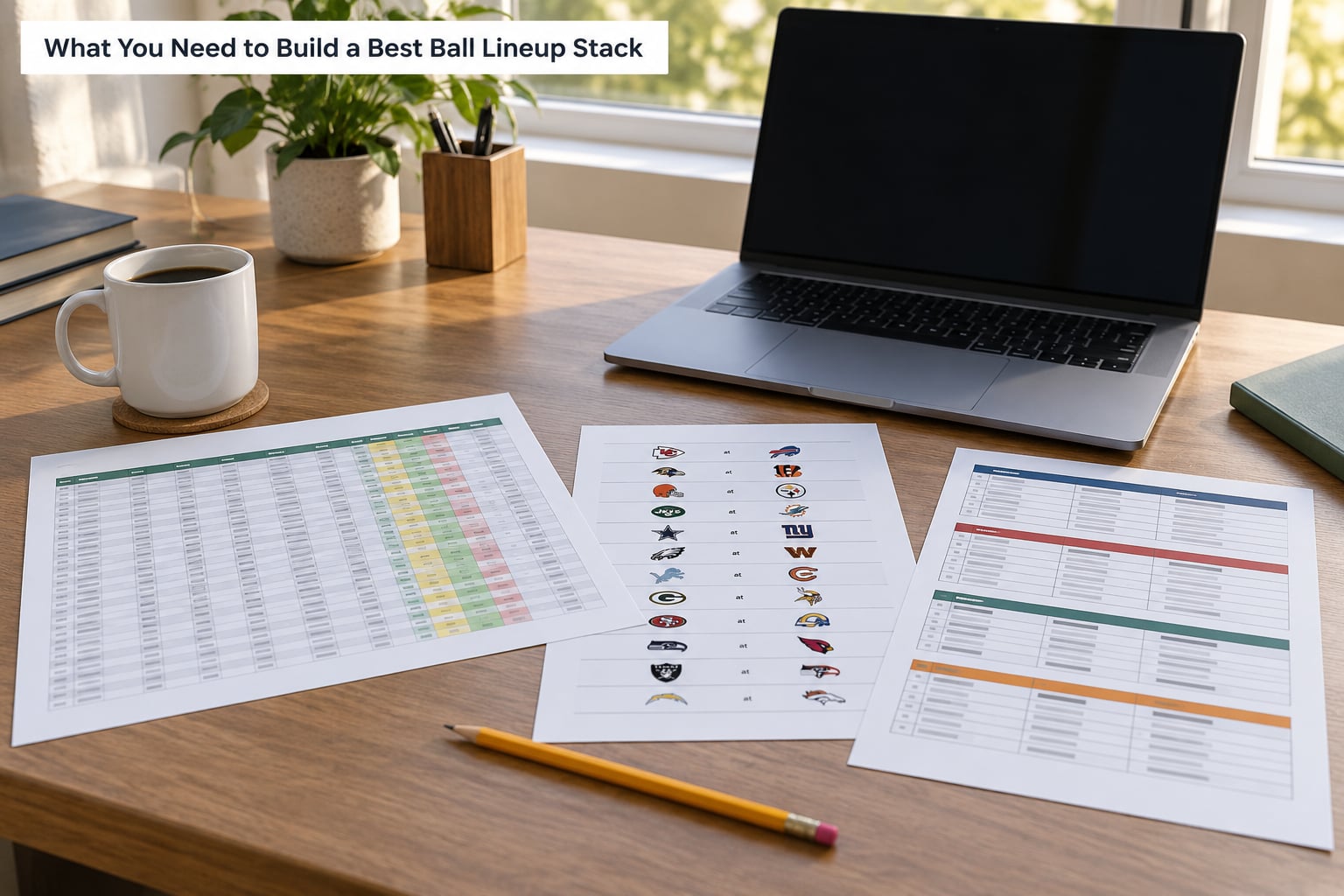
Before you look at a single player, you need four things: the format details, a projection source, a game-script shortlist, and a decision rule for how far you will reach.
What a best ball lineup stack actually is
Best ball is a draft format with no waiver wire and no in-season management. You draft a roster once, and the platform automatically starts your highest-scoring players every week against the live box scores. A stack is the deliberate pairing of teammates so their scoring opportunities move together instead of independently.
That auto-start mechanic is the whole reason stacking works. In a weekly league, three good players can have three mediocre weeks. In best ball, the platform throws the two bad weeks out the window and grades you on the weeks where the offense actually showed up.
The format details that decide your construction
Read the settings page before your first pick, because four of them change which players belong on your roster.
- Roster size and flex eligibility. FFPC standard best ball rosters include a kicker and defense, which eats two picks that could have been receivers. The FFPC best ball slim format listed on RotoBaller drops them entirely: 1 QB, 2 RB, 2 WR, 1 TE, 2 flex, 1 K, 1 D.
- How many starters. Underdog-style leagues typically roster 18 players and start the top 8. The deeper your roster, the more stacked players can sit on your bench without costing you anything.
- Scoring format. Points-per-reception rewards volume, which is exactly what a pass-heavy game script produces. Half-PPR rewards big plays. A 0.5 PPR format compresses the difference, so rushing upside carries more value and rushing backfield pairs become more viable stack partners.
- Superflex versus standard. A two-quarterback build changes everything about stacking. A backup quarterback is a real starter, so the second quarterback on a high-volume offense can be paired with that offense’s tight end and still make your lineup.
The inputs to gather
You need weekly projections, average draft position data you trust, a schedule, and depth chart notes. The most useful projection column is not the ceiling, it is the share of team passes or carries each player receives, because that is what you are stacking on.
Queue three or four players for every upcoming turn before the draft starts. On a 30-second FAST timer, people who skip the queue end up auto-drafting five quarterbacks in a row around rounds 6 through 14, and then they wonder why the roster has no passing volume in it.
Step-by-Step: How to Build a Best Ball Lineup Stack
1. Confirm the league format and scoring
Write down your roster slots, your flex rules, your scoring format and your number of starters. Then decide whether the format rewards volume or big plays, because that decides which offense you target.
A 3/6/7/2 build, two or three quarterbacks, six running backs, seven wide receivers and two tight ends, is a reasonable default. The thin version of that build wins more often when you land an elite tight end, because a stud tight end fills a lineup spot that a replacement tight end never will.
The numbers back this up. One set of Underdog data covering 36,252 teams showed two-quarterback builds winning at 7.6 percent when the first quarterback came before round 7, and 8.6 percent when the first quarterback came before round 10, against an 8.3 percent average. Your first pick at the position sets the ceiling for everything after it.
Set the position counts before you sit down, then check them at the halfway point of the draft.
| Position | Target count | Where stack players fit | Watch out for |
|---|---|---|---|
| Quarterback | 2 to 3 | One is your stack anchor, one or two are late value | Taking three quarterbacks too early |
| Running back | 5 to 7 | Backfield pair, plus a late feature back | Seven running backs leaves a thin receiving group |
| Wide receiver | 6 to 8 | Your stack core, usually 2 to 4 of the total | Underweighting the position in slim formats |
| Tight end | 2 to 3 | The quarterback’s red-zone partner | Drafting blocking tight ends early |
In a slim roster, one or two tight ends and an extra receiver are often better than a full slate, because the flex spot has to be filled by somebody who actually starts.
2. Find the strongest offensive game script
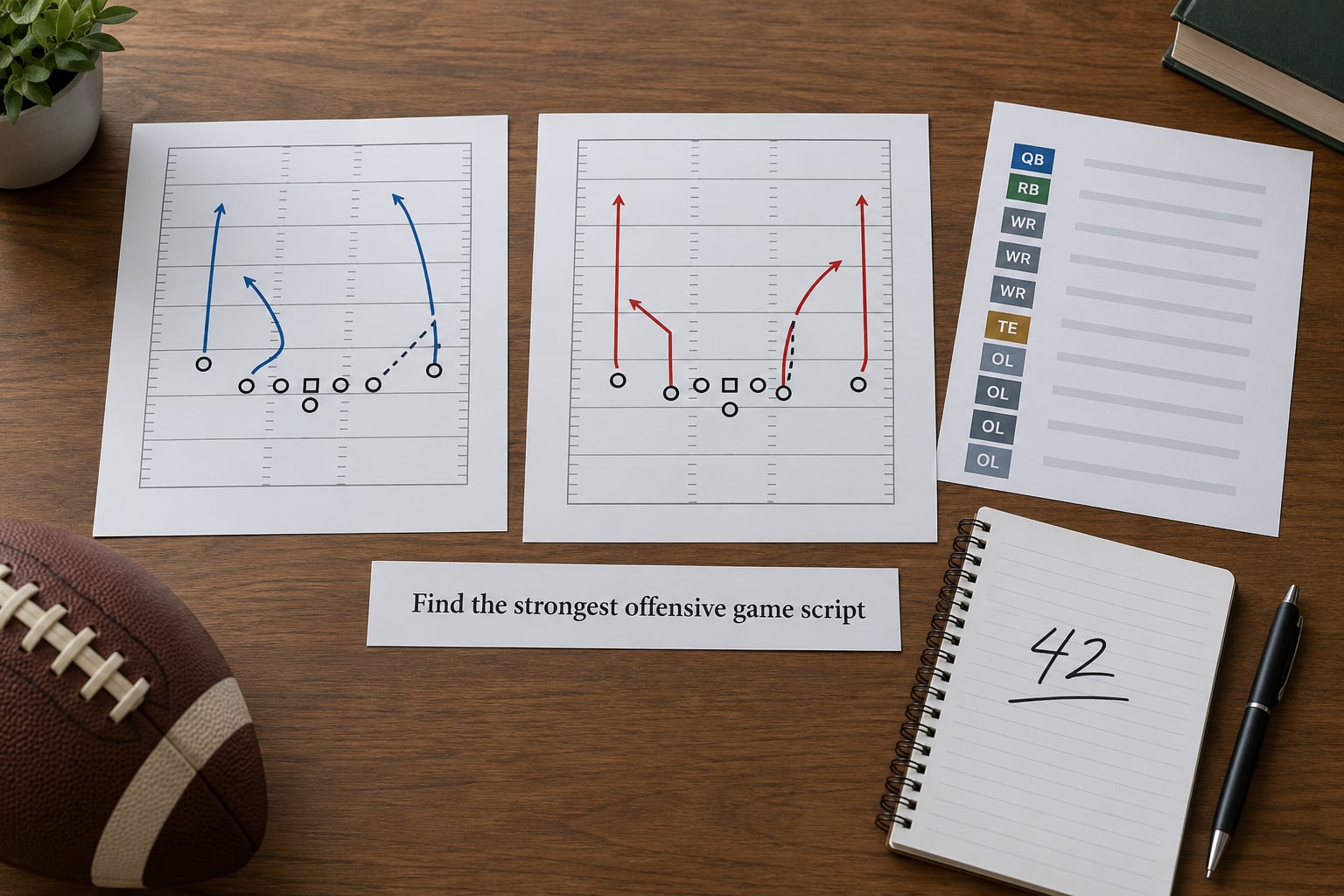
A stack needs a reason to be loud. The reason is a game script, and you find it by looking for a projected volume advantage, not a good defense to play.
Four inputs point to the right games. Team trend shows how many dropbacks or carries the offense runs when they are ahead. Expected pace tells you how fast the game should move. Injuries matter most on the defensive side, because a missing corner or edge rusher shows up in the opponent’s pass and run rates. Defensive matchup is the tiebreaker, since some pass rushers and coverage schemes suppress volume no matter who is throwing.
A check that saves drafts: after you shortlist two or three games, confirm the quarterback is actually going to start. A great script attached to a backup quarterback is not a script.
The pass-volume signal is the cleanest one. An offense that throws on roughly 65 percent of plays, with a starting quarterback healthy, gives its top receiver and its tight end a real shot at 20-plus points in a spike week. That is the game you build around.
3. Choose one primary team concept
Pick a single offensive theme for the draft and let it drive your early board, rather than picking whatever falls in front of you. A high-volume passing offense, an early-down rushing team that forces teams to play from behind, and a red-zone-heavy unit are all workable concepts.
Choose the concept that fits the format you are in. A 0.5 PPR league rewards the red-zone unit because the goal-line work is still valuable. A points-per-reception league rewards the dropback offense because targets are what the scoring settings are actually measuring.
Once the concept is set, the quarterback on that offense becomes your stack anchor. You are no longer deciding pick by pick, you are working through the offense in order.
4. Map player roles and correlations
Different pairings carry different correlation, and knowing the type tells you how much to bet on it.
| Stack type | Who it pairs | How many to draft | Main risk |
|---|---|---|---|
| Basic QB and WR | One starting quarterback with his top two receivers | 3 players from one offense | The quarterback goes down and the receivers lose their volume |
| Next-level pass catcher | One starting quarterback plus two or three pass catchers, tight end included | 4 players from one offense | Losing a player to injury, and fewer roster spots for other positions |
| Backfield pair | Two running backs from the same backfield | 2 players from one offense | A committee backfield splits the carries and both score modestly |
| Game stack | Two opposing players facing each other, for playoff weeks | 2 players from one game | One dud offensive performance ends the pair |
Quarterback and receiver correlation is the strongest pair on the board, because every pass creates a target share. Quarterback and tight end is strong when the tight end owns the red zone, and weak when he is a blocking tight end. Backfield pairs only work when one back is clearly the feature back, since a committee in a two-backfield splits the touches instead of concentrating them.
One more layer of the matchup: pick a pairing, then check the depth chart and the coverage personnel the opponent will deploy. A slot receiver facing a team that plays a lot of cover three gets a different target count than the same receiver facing press-man coverage every snap.
5. Select a ceiling-oriented core
Your core is two to four players whose individual opportunities can rise together. The rule for choosing them is upside with a floor, because you need a floor to survive the weeks when the game script does not show up.
DraftSharks makes the same point from the other direction, framing boom and bust variance as an asset in best ball, where only your best weeks count. FantasyPros publishes roster rates, the share of best ball teams that roster each player, and those rates tell you how crowded a pairing is before the draft even starts.
Where the ceiling comes from: use the projection’s target share, not the raw yardage total. A receiver with a 26 percent target share has more room to spike than a receiver projected for more yards off a lower share on a team with fewer dropbacks.
Now apply the reach rule, which is the part most drafts skip. Take a partner only when the pick costs you one round or less over his average draft position. Two rounds of reach for a stack partner is usually a good trade. Five rounds is a different bet, and it should only happen when the partner is a genuine talent the market is undervaluing, not simply a teammate of a player you like.
6. Test the stack against the schedule
Before you lock the core in, check the opponent’s defensive tendencies and recent splits, and look for a negative script. Some offenses disappear when the plan is to protect a lead, and some teams play to their disadvantage in a divisional game they expect to win.
Matchup data and game scripts are two halves of the same check. Matchup tells you whether the volume can arrive. The script tells you whether the coaching staff will let it.
Working through the opponent: look at each coverage shell, whether they press, whether they bring four to five rushers, and their splits in the first half versus the second half. Then confirm the offensive line is intact, since pass protection sets the ceiling for everything downstream.
One more filter: bye weeks. Two stack partners on the same bye week take a zero week together, which is survivable in a deep roster and painful in a slim one. Check it before you commit, not after.
7. Build the full best ball portfolio
A stack is a core, not a roster. Once the core is in, you need coverage across the other positions so a single bad week does not sink the lineup. A 2/5/7/2 build gives you two quarterbacks, five running backs, seven receivers and two tight ends, which leaves room for your three or four core players plus a late-round flyer or two.
Running back construction is the other half of this step, and it is where drafts get unbalanced. One poster on r/BestBall described taking seven running backs to buy exposure from other teams, which left the roster with only seven receivers and pushed the starters into the flex with no upside on the bench. The fix is to set your running back count before round one and defend it, because exposure gains from extra players at one position rarely pay for a thin receiving group.
The same logic applies to running back timing. The RotoViz figures behind the RotoBaller slim-roster write-up showed builds that added their second running back after round 6 finishing at 11.0 percent with six running backs and 9.9 percent with seven, above the baseline for builds that started on two early running backs.
Portfolio management comes last. Sharp Football Analysis recommends capping roster percentage at 15 percent for first- and second-round players and 25 percent for players drafted later, and showed one player falling from 50 percent exposure early in the offseason to 35 percent across 44 drafts. Those caps are not a command to avoid a player. They are a reminder that when a player is on half your entries, you have traded a real chance to win for the comfort of a common pick.
The tournament version looks like this: split your entries. Give roughly 60 percent of them a stack build, and run the rest on value and unique players so the portfolio is not 20 identical rosters. Players in a r/BestBall thread running a 2/4/10/2 build described the same instinct from the other direction, stacking both quarterbacks with their top receivers.
A useful validation check: the community benchmark for keeping a quarterback-scored lineup viable is around 25 points in a game, with 28 considered safer. If your build has two quarterbacks, you only need one to hit that number in a given week, which is part of why the multi-quarterback stack appeals to people who want more shots on goal without giving up ceiling.
Common mistakes that kill best ball stacks
Six errors show up repeatedly, and each one has a simple fix.
- Stacking players with no shared game script. Two teammates are correlated only if the offense actually has the ball. Fix: name the mechanism, targets, touches or red-zone opportunities, before you take either player.
- Reaching too far for a partner. Fix: one round over average draft position, two at the outside.
- Concentrating one offense across every entry. Fix: spread exposure across rosters and cap roster percentage.
- Stacking behind a quarterback who is already out. Fix: confirm the starter on the depth chart before you build the offense.
- Duplicating bye weeks inside a stack. Fix: check byes in the same pass where you confirm the starter.
- Over-stacking in small fields. A five-player stack is an edge in a 100,000-entry tournament and a liability in a six-entry league. Fix: scale stack size to field size, and in a small league play the best player available even if he plays for a different offense.
Frequently Asked Questions
What is the best way to stack in best ball fantasy football?
Anchor on one offense, then take the players whose volume comes from the same source. Pick a team with a clear passing or rushing volume advantage, start with the quarterback, and add two to three pass catchers who own real target share. Confirm the starter and the bye week before you commit, and only reach one round past a partner’s ADP.
How many players should be from the same NFL team in a best ball lineup?
Two to three teammates in a standard league, four in a tournament field where a spike week wins the whole entry. A basic quarterback with his top two receivers is the reliable core, and adding a third catcher raises the ceiling while cutting your roster flexibility. In a small field, keep it to two and draft the best player available at each pick.
Should I use a quarterback in a best ball stack?
Yes, the quarterback is the anchor in almost every strong stack. Passing volume flows to everyone downstream of him, so his spike week is what lifts the receivers and tight end. The risk is that his injury kills several players at once, so a build with two quarterbacks on different offenses gives you a second chance in the same week.
What is the best team concept to stack in best ball?
A high-volume passing offense is the most reliable concept, especially in points-per-reception scoring where targets drive points. Early-down rushing offenses that force opponents to play from behind are the best counterweight in half-PPR and 0.5 PPR formats, and red-zone-heavy offenses win in leagues where goal-line work still counts.
How do I account for injuries when building a best ball lineup stack?
You cannot add or drop players once the draft ends, so you build redundancy instead. Keep two quarterbacks so one bad week is not a dead week, avoid loading every stack player behind one starter, and prefer backfield pairs only when one back clearly leads the committee. Check the depth chart before the draft, because there is no waiver wire to fix a mistake later.
Is it better to stack at the same position or across positions?
Across positions, every time. A quarterback with his receivers and tight end puts four players on the same drives, and a good week lifts all of them. Two teammates at the same position share a backfield, which only works when one player is the clear feature back. Same-position exposure is best used as a portfolio split rather than as a core.
Conclusion
Start with the game script, not the player. Find the offense with a clear volume advantage, name the correlation between the quarterback and his top targets, take two to four players from that unit, then fill the rest of the roster so a single quiet week does not decide your season. Recheck the starter and the bye week every time you add a player to the core.