Best ball and redraft usually run the same scoring settings. The real difference is who chooses your lineup: in redraft you set it every week, while in best ball the platform submits your highest-scoring legal lineup and the most total season points wins.
That single mechanic changes player values, draft plans, and even how much fun the season is. Managers coming from a weekly league often assume best ball uses some exotic scoring system. It mostly doesn’t. DraftKings states outright that best ball uses the same scoring as its Classic contests, and most other platforms follow the same approach.
So if you’re wondering how best ball scoring differs from redraft, the honest answer is that the math is similar and the decisions around it are not. Here’s the breakdown.
Table of Contents
- How Best Ball Scoring Differs From Redraft at a Glance
- What Best Ball Scoring Rewards
- What Redraft Scoring Rewards
- How Best Ball Scoring Differs From Redraft in Draft Strategy
- Five core differences that change your draft board
- How Best Ball Scoring Differs From Redraft During the Season
- How Scoring Formats Affect Trades and Rosters
- Which Should You Choose?
- Frequently Asked Questions
- Is best ball scored the same as redraft?
- Do best ball leagues use PPR or half PPR?
- What is the difference between best ball and redraft?
- Why is best ball considered luck-based compared to redraft?
- Can you combine best ball and redraft scoring?
- Conclusion: Choose the Format That Matches Your Strategy
How Best Ball Scoring Differs From Redraft at a Glance
This table is the fastest way to see where the two formats split. Read across each row and the pattern is consistent: the scoring rules overlap, the management burden does not.
| Criterion | Best ball | Redraft |
|---|---|---|
| Who sets the lineup | The platform, automatically | You, before each week |
| Scoring settings | Usually PPR or half-PPR, platform dependent | Whatever your commissioner picked, PPR most often |
| In-season trades | None | Allowed and often decisive |
| Waiver wire | None | Core weekly activity |
| What wins the season | Most cumulative points | Most weekly wins, or most points in a points league |
| Roster size | Often 17 to 20 spots | Usually 16 |
| Superflex | Rare or restricted | Common in competitive leagues |
| Draft pressure | Extreme, nothing can be fixed later | High, but injuries can be patched |
| Weekly time required | Roughly ten minutes | Several hours across the week |
What Best Ball Scoring Rewards
Best ball rewards total season production, which means every big week counts no matter what happened the week before. The platform runs your roster against the scoring rules, picks the combination of players with the highest raw score that satisfies your lineup slots, and locks it in.
Take a week where one quarterback throws for 310 yards, three touchdowns and two interceptions for 24.8 fantasy points, and the other finishes with 13.2. Both are posted to the leaderboard. In a redraft league the lower-scoring quarterback is the one you sit, and his bad afternoon is exactly the kind of thing a waiver claim or a trade can repair later.
The flex slot makes the optimization visible. Say a running back goes for 22 points and a wide receiver you drafted goes for 19. The platform puts the receiver at flex and moves the running back to bench. Your team banks both big weeks. A redraft manager often plays the running back, since a flex-eligible receiver scoring 19 is merely acceptable, and leaves the extra points on the table.
Three things follow from that rule. Ceiling beats consistency, because a player with a 30-point upside gets captured on the week it happens. Stacking works, because a passing game’s touchdown counts for both the passer and the receiver. And depth beats one stud, because you cannot add anyone in October.
Byes are handled automatically too. An eligible player on bye is substituted with the highest-scoring bench player at that position, so a bad bye-week draw costs you a substitute’s week rather than an empty slot.
What Redraft Scoring Rewards
Redraft scoring rewards the decisions you make with a roster that gets rebuilt every year. Your team starts from scratch at the draft, and then you patch it all season with waiver claims, trades and lineup calls.
That changes which player traits pay. A receiver who never has a blowup but gives you 10 to 12 points reliably is genuinely valuable in redraft, because you can start him every week without thinking. In best ball that same consistency leaves points on the table, since you needed the ceiling.
Replacement-level players matter too. In redraft, a waiver pickup who slots in at 9 points a week adds real value to your record. In best ball that player never existed for you unless you drafted him, and a thin position group stays thin for 17 weeks.
Weekly wins also shape everything. Head-to-head redraft leagues reward beating a specific opponent, so floor matters more than upside, and a defense you can trust against a bad matchup is worth as much as a high ceiling.
How Best Ball Scoring Differs From Redraft in Draft Strategy
Draft priorities point in different directions because you repair nothing in best ball. That is the whole argument in one line.
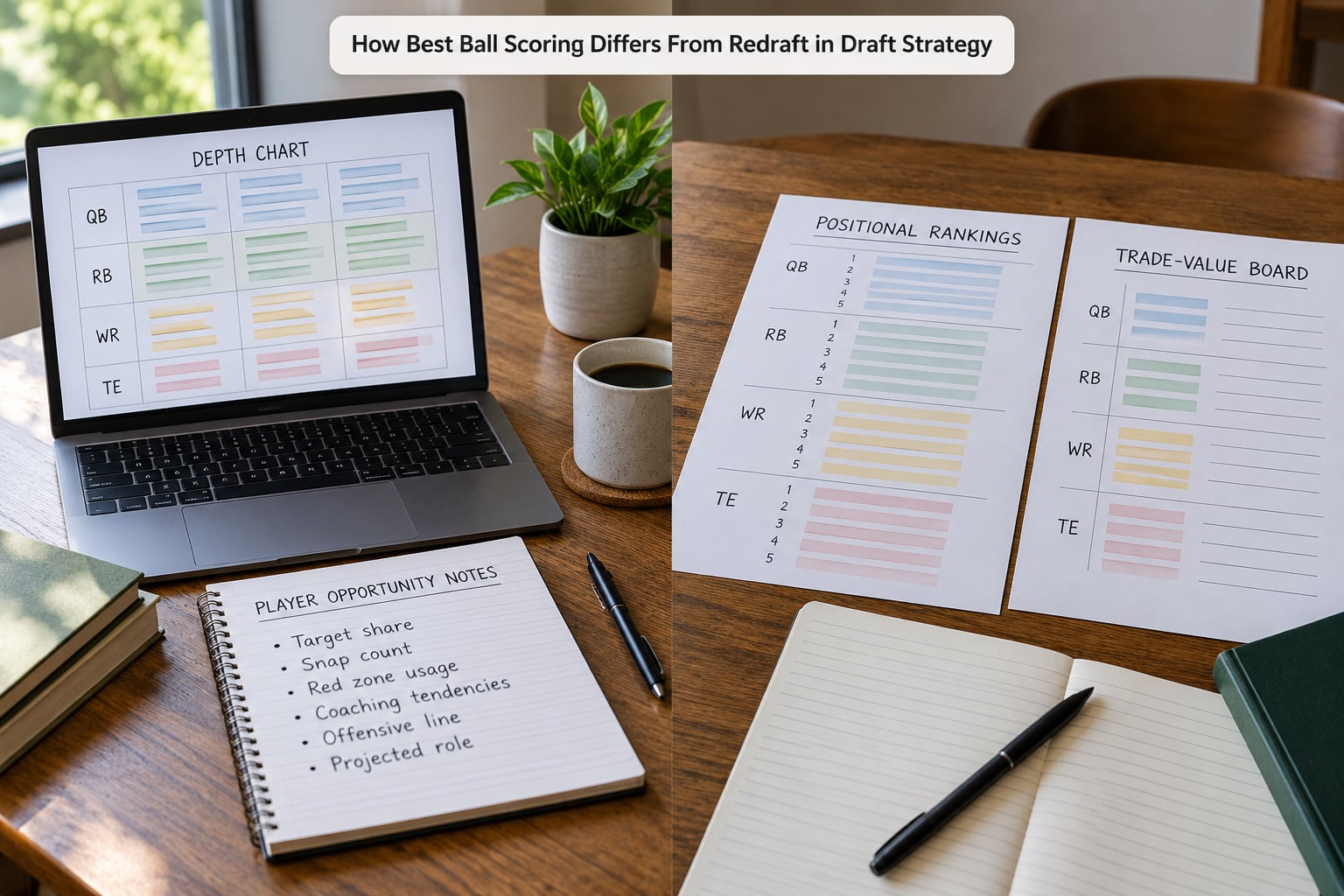
Five core differences that change your draft board
- Ceiling carries a premium. Big-play backs, touchdown-dependent receivers and volatile veterans rise on your board in best ball. The cost of a six-point week is zero, because the twenty-eight-point week still lands.
- Roster depth gets drafted on purpose. Best ball rosters often run 17 to 20 spots instead of the usual 16, and platforms like Underdog and FFPC expand position counts further. You are stocking inventory for 17 weeks, not one.
- ADP means cost control, not value. Average draft position estimates what a player will cost. In redraft you compare that cost to your ranking and take the difference. In best ball, drifting above consensus ADP is how you buy the upside that your competitors are leaving on the board.
- Byes need coverage in the roster, not on a waiver list. With three or four players on bye in a week, a thin position group turns into dead production you cannot fix.
- Position scarcity is muted early. A premium tight end on a TE-premium league such as FFPC is a great late pick, and hitting that number twice costs you nothing extra.
Redraft managers keep more of a replacement buffer. Reaching for a veteran tight end in round 10 keeps your weekly floor intact, and the player only needs to stay healthy to be useful.
One myth worth killing: best ball does not score players differently. It scores them identically and then optimizes your lineup around those points. That is why the interesting differences live in roster size, flex rules and opportunity, not in a custom point system.
How Best Ball Scoring Differs From Redraft During the Season
During the season the difference is stark. A best ball manager makes roughly one decision, at the draft, and then watches. A redraft manager makes a dozen small decisions a week and most of the league result comes from that churn.
In best ball, the only live question is whether your draft was deep enough. In-season there are no adds, no drops, no trades and no start-sit calls, so the ceiling of your season is fixed on draft night. Managers who enjoy that describe it as freeing. Managers who built an identity around waiver wire work describe it as watching a skill go unused.
Redraft inverts that. A player goes down in week 6, you claim the replacement on Tuesday and start him on Thursday. The information advantage belongs to whoever checks the news most often, which is why the luck-versus-skill argument comes up constantly in best ball circles. The honest framing is that best ball compresses variance into the draft and redraft spreads variance across 17 weeks.
Another live best ball concern is injury news. If a starter goes on the PUP list, an eligible substitute steps in automatically, so you lose a starter’s ceiling rather than a full week of production.
How Scoring Formats Affect Trades and Rosters
Trades do not exist in best ball, so the entire trade market runs on a different logic. In redraft a trade is judged by win probability this week: you give up depth for a player who fills a hole on your lineup.
In best ball, roster construction is the substitute for trading. Depth you drafted becomes the thing that covers a bye week, an injury and a slump, and the extra two to four roster spots on most platforms exist for that reason. Wide receivers and tight ends are where the extra inventory usually goes, because those are the positions most likely to have a bad week with no replacement on hand.
Redrafters who run both formats use the same ADP pool but weight it differently. A Footballguys forum thread on best ball ADP and redraft rankings makes the point that one ADP feeds both boards, and the variance between the two drafts is small. The weighting is what changes, not the source data.
Superflex shows up here too. Entrants often arrive expecting to stack two quarterbacks, then find it is a rarity in most best ball formats. In a competitive redraft league, dual-QB lineups are normal. That expectation gap is one of the most common surprises new best ball managers hit.
Which Should You Choose?
Pick based on which kind of work you actually enjoy. If you like researching, redraft rewards you with more levers. If you like a clean draft and a quiet fall, best ball is a better fit.
- Casual managers with kids or a busy season: best ball. One draft, no Sunday morning scramble, and no guilt about ignoring the league for a week.
- Managers who want to learn drafting without risk: best ball. Draft practice with a season total at the end and no chance to injure a roster through in-season tinkering.
- Competitive weekly players: redraft. Waiver priority, trade leverage and matchup research are the actual game, and best ball removes all three.
- Multi-league managers: best ball for volume, since you can enter many lineups on a large-field tournament platform, redraft for depth.
- Stats-first managers: either works. Best ball is easier to project because only the draft is uncertain, while redraft rewards deeper analysis of replacement levels and schedule.
- Dynasty-minded managers: redraft for now. Dynasty runs on multi-year asset value, and a format where you cannot trade is a poor testing ground for it.
A common setup is one redraft league plus two or three best ball entries a season. It keeps the weekly engagement while giving you a place to run ceiling-heavy builds you would never roster in a points league.
Frequently Asked Questions
Is best ball scored the same as redraft?
Usually yes. DraftKings states that best ball uses the same scoring as its Classic contests, and most other platforms follow suit with PPR or half-PPR. The difference is what happens after the points are calculated: best ball auto-optimizes your lineup and ranks teams on cumulative season points, while redraft scores the lineup you personally set.
Do best ball leagues use PPR or half PPR?
It depends on the platform. DraftKings, FFPC, BestBall10s and Drafters run full PPR, while Underdog and Yahoo best ball formats commonly use half-PPR. Since scoring is identical to a redraft league on the same platform, the scoring format is really a choice about which draft targets gain value rather than a best ball feature.
What is the difference between best ball and redraft?
Best ball is draft-only: the platform submits your highest-scoring legal lineup every week and the manager with the most season points wins. Redraft gives you a full season of weekly management, including waiver claims, trades and start-sit calls, with the title usually decided by weekly wins.
Why is best ball considered luck-based compared to redraft?
Because the outcome is set by one draft, the range of results swings much wider than in a managed league. In redraft you can respond to an injury or a slump with a waiver claim, which cuts variance week to week. In best ball every outcome traces back to draft night, so the format amplifies both good and bad draft positions.
Can you combine best ball and redraft scoring?
You can, and plenty of managers do. A league can run weekly lineup decisions with a best-ball-style cumulative points format, or you can play one redraft league alongside several best ball entries. What you cannot do is recover best ball’s automatic lineup optimization once a league is set to redraft.
Conclusion: Choose the Format That Matches Your Strategy
Start by deciding which work you enjoy. If you like research, trading and weekly lineup calls, redraft gives you seventeen chances to outsmart opponents and the scoring rewards consistency. If you would rather spend one weekend on draft prep and then relax, best ball gives you the same points with automatic lineups and no in-season decisions.
The first thing to do either way is check the platform’s scoring and roster rules before you draft. That single habit explains more player-value shifts than any projection model, and it is the difference between how best ball scoring differs from redraft in practice rather than in theory.