To scout college wide receivers for fantasy football, work in a fixed order: confirm how much of the offense the player actually owns, check the traits that survive the jump to the NFL, watch at least two full games, adjust for the competition and scheme around him, and only then project fantasy points. Stats tell you what happened. Film and context tell you whether it repeats.
Rookie receivers swing harder than any other position in fantasy. Some third-round pick out of a low-profile offense turns into a 20-ppg week 1 starter. Some consensus top-10 prospect posts 40 catches and nothing else. If you can build your own read on that spread six months before your league mates, you have an edge most managers never get.
Budget about 90 minutes per serious prospect: 15 minutes on data, 45 on film, 15 on notes, 15 on the projection. That’s the honest time cost, and it’s why most people quit scouting college receivers after a season. The process below makes it repeatable.
Table of Contents
- What You Need
- Step-by-Step: How to Scout College Wide Receivers for Fantasy
- 1. Establish the Receiver’s Role and Opportunity
- 2. Build a Trait and Release Profile
- 3. Study Game Film for Context
- 4. Check Competition, Scheme, and Teammate Context
- 5. Translate College Production Into Fantasy Projection
- 6. Create a Final Fantasy-Football Grade
- Common Mistakes
- Avoid Mistaking Production for Talent
- Avoid Ignoring Small-School and Lower-Profile Context
- Use a Balanced Prospect Board
- Frequently Asked Questions
- What college statistics matter most when scouting wide receivers for fantasy football?
- How can I identify a college wide receiver who will be a fantasy sleeper?
- Are recruiting rankings useful when scouting wide receivers for fantasy?
- How do I project a rookie wide receiver’s fantasy points?
- How should I compare receivers from the Power Five and Group of Five conferences?
- What traits best translate from college football to the NFL for fantasy purposes?
- Conclusion
What You Need
Most failed scouting attempts fail on preparation, not on judgment. Get these seven things lined up before you evaluate anyone.
- Film access. Full games, not just highlights. You need to see formations and dropbacks, not a montage of contested catches.
- Snap, route and target counts. A season’s worth per player, by game if possible, so you can see trend lines instead of totals.
- Opponent-adjusted production. Receivers who posted against top-25 defenses carry a different signal than receivers who padded totals against weak schedules.
- Athletic testing numbers. The 40-yard dash, three-cone and shuttle times, vertical and broad jumps, and a composite athletic score if you trust it. Treat these as a filter, not a grade.
- Role tracking notes. A simple column: alignment, routes run, targets, contested targets, drops, red-zone targets, touchdowns.
- Roster context. Who else is competing for targets, who is the returning starter at outside, and who is the incumbent slot receiver.
- A fixed prospect template. One page, same fields every time. Consistency is what turns your opinions into a track record you can actually review.
Everything except the film is free or cheap if you use college reference sites, combine databases and public testing numbers. The film is the part people skip, and it’s the part that carries the most signal.
Step-by-Step: How to Scout College Wide Receivers for Fantasy
1. Establish the Receiver’s Role and Opportunity
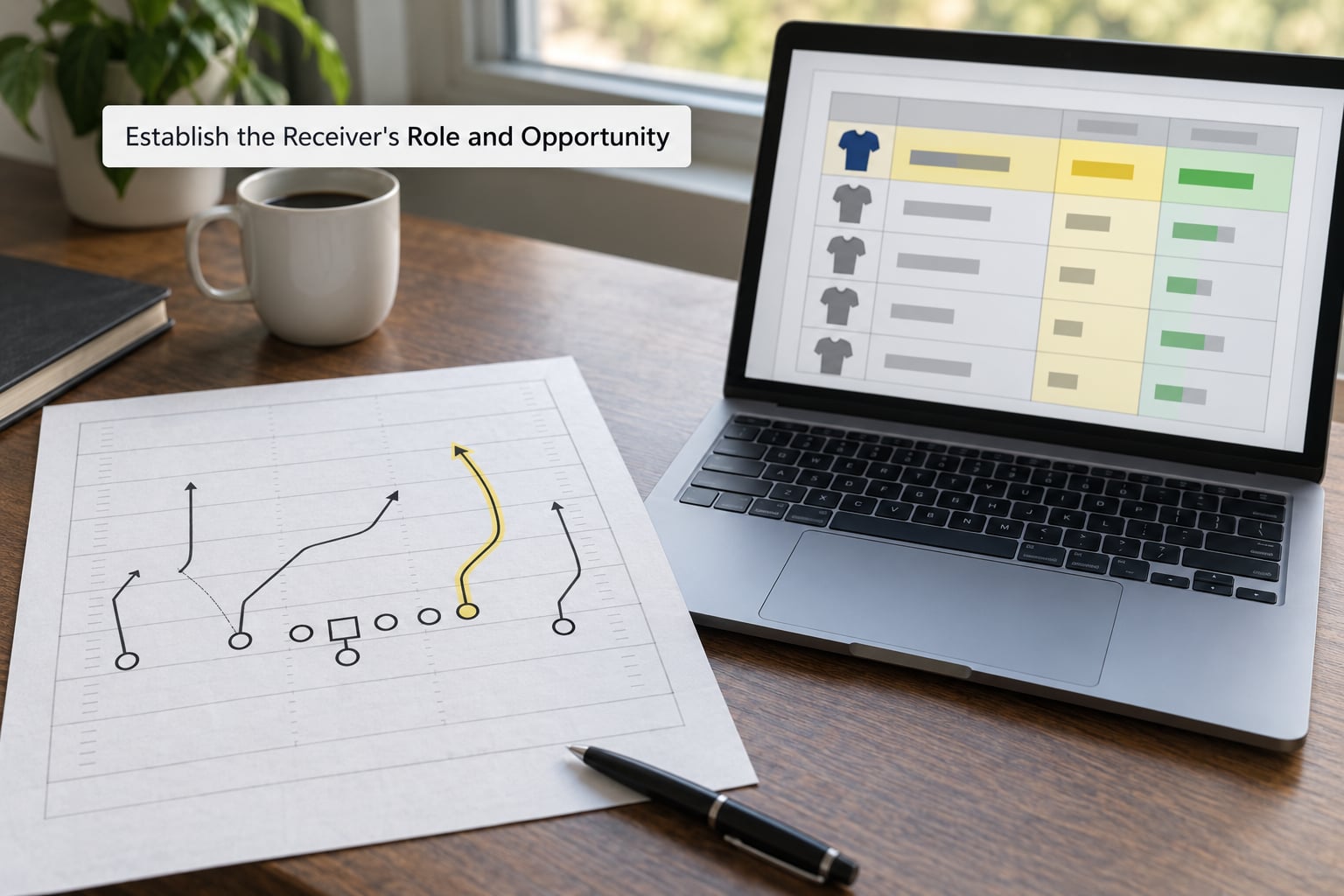
Start with volume, because volume is the only part of a receiver’s game that transfers cleanly to the NFL. Sort the player into one of four buckets: clear No. 1 target, shared target with one or two teammates, rotational piece, or small-school outlier carrying a workload his competition never saw.
Then estimate the four numbers that matter most: snaps per game, routes run, targets, and red-zone targets. A receiver averaging 9 targets a game as a true one is a completely different prospect from a vertical threat with 5 targets, regardless of which one has more highlight catches.
A quick way to check your read: compare the player’s target share on his team’s offense against his route share. If target share is well below route share, he’s running routes but not being looked for, and that gap is usually a quarterback or scheme problem rather than a talent problem. If target share is above route share, the offense is designed to find him, and that survives a coaching change more often.
You can tell this step worked if you can state the player’s role in one sentence and back it with numbers. If you can’t, you watched highlights.
2. Build a Trait and Release Profile

Traits decide the ceiling. Grade eight things separately, each with a one-word note and one piece of evidence from film, and use at least three different games so a bad weather performance doesn’t set the tone.
- Speed and acceleration. Does he win immediately off the snap, or only after the ball is in the air?
- Release against press. Watch him against physical cornerbacks, not empty third down.
- Hands. Catch the ball outside his frame, through contact, without flinching. Also count drops on easy throws.
- Body control. Does he adjust to underthrown balls, or does he give up on the play?
- Route precision. Sharp breaks at the stem, or lazy curves that let defenders recover?
- Separation. Can he win a one-on-one without contact? This is the trait that matters most in the NFL.
- Blocking willingness. Slot receivers live or die here. A pass-protection whiff gets him benched.
- Field awareness. Yards after catch, running out of bounds, awareness of the fourth down and the sideline.
Athletic testing gives you a sanity check, not a grade. A 4.48 40 with a 4.5 three-cone profile is a real separator. A 4.55 forty that comes with an elite three-cone and broad jump often means a shorter receiver with better short-area burst, which is still fantasy-relevant in PPR. If the testing and the film disagree, trust the film and note the conflict on the card.
3. Study Game Film for Context
Film is where you catch what a stat line hides. Watch two full games, one against a strong defense and one against an average one, and chart what happens before and after the snap.
Track alignment first: slot, boundary, or moving around. Then motion, pre-snap shifts, and whether the quarterback goes to him on third down or takes the checkdown. Note the coverage shell he faced, since a stat line built against man coverage behaves nothing like one built against two-high shells.
Log every contested catch, every drop, and every play where he got free downfield but the throw never came. Explosive plays matter, but count how they happen: a blown coverage, a scheme mismatch, or consistently clean separation. Only the third one repeats in the NFL.
Track quarterback chemistry as a separate note. A receiver running behind a pro-caliber passer is easier to project than a guy whose numbers came from a ball-tosser who was perfect on third down. And keep a flag for plays that look repeatable: same route from the same alignment on early downs, motion used to create a mismatch, a designed screen. Tendencies you can name are tendencies you can project.
4. Check Competition, Scheme, and Teammate Context
Nobody evaluates a receiver in a vacuum. Four adjustments separate a real prospect from a statistical mirage.
Defensive quality. A 1,000-yard season against a schedule full of bottom-30 pass defenses means less than 700 yards against top-25 units. Weight the harder games more heavily, and note when a player’s production came almost entirely against weaker opponents.
Offensive scheme. Air raid systems inflate raw volume for everyone. Pro-style, play-action, and vertical schemes better predict NFL usage because the route trees resemble what he’ll run as a pro. A slot-heavy offense also tells you something about his eventual role: he may be a chain mover rather than a deep threat.
Target competition. Count the other pass catchers on the roster and their own targets. Two players each averaging seven targets is a committee, and committees rarely produce a 15-ppg fantasy season. One player with 11 targets a game is the profile that translates.
Quarterback and supporting cast. A receiver’s efficiency partly belongs to the passer. If his quarterback posted an elite passer rating, expect some regression. Offensive line quality, play-action playmakers who steal targets, and the presence of a reliable tight end all shrink a receiver’s share.
On small-school prospects, check sample size carefully. One dominant season against four in-conference opponents is a much thinner signal than three years of dominance across a full schedule.
5. Translate College Production Into Fantasy Projection
Now the numbers get converted. Start by splitting production into volume and efficiency: targets are volume, catch rate and yards per route run are efficiency, and yards after catch is mostly scheme-driven. Project volume forward and treat efficiency conservatively, since NFL separation is harder to create than it was in college.
Use share metrics instead of raw totals where you can. College dominator rating, the share of team receiving yards a player owns, and market share for the team’s passing offense normalize for team pace and offensive quality. A dominator rating above 35% paired with a target share above 25% is a reasonable baseline filter for a real lead target. Breakout age matters too: producing as a true freshman is a meaningful signal, especially for a player whose earlier seasons were limited by a role, an injury, or a coaching change.
Strength of schedule adjustments get folded in here. Then the translation: estimate projected NFL snaps, routes run, targets, and touchdowns for year one, and convert to points under your league’s scoring. Adjust for draft position expectations too, since a team that spends a first-round pick is building the offense around the player rather than asking him to earn snaps.
Weight the metrics by scoring format. In PPR, targets and catch rate carry the most weight, so a high-volume possession receiver gains value. In standard scoring, yards per route run and touchdown rate matter more, so vertical efficiency and red-zone usage gain weight. Half-PPR sits between the two. The same player can be a sleeper in one format and a dud in another, and plenty of managers forget that until draft night.
6. Create a Final Fantasy-Football Grade
Finish on one page so the next player gets judged the same way. Every card carries: role in one sentence, projected rookie-year target range, ceiling scenario with its weekly point total, floor scenario with its weekly point total, the two or three bust factors that would sink it, two NFL comparables at the same skill level and draft slot, a draft range, and your confidence level from one to five.
Write the ceiling and floor explicitly. A player with a 6-ppg floor and a 15-ppg ceiling is worth a mid-round pick; a player with a 4-ppg floor and a 16-ppg ceiling is worth an earlier one if the opportunity is real. Bust factors should be concrete: two catches on a bad quarterback, a hamstring that cost three weeks, no clear No. 1 status behind a returning starter.
Then track the call. Save the card with the date, and revisit it after the draft and again a year later. Nothing improves a scouting process faster than a hit-and-miss log you can read back.
Common Mistakes
Avoid Mistaking Production for Talent
The most expensive error in college receiver scouting is grading talent off a stat line that belonged to the offense. A receiver running the nation’s top passing attack will post elite numbers on route volume alone, even with mediocre separation.
The correction is mechanical: before writing any talent note, ask how many of his targets came on designed plays, how many were third-down verticals, and how often he beat his defender rather than the coverage. If his production holds up when you strip out scheme-assisted plays, the grade is real. If it collapses, you were grading the offense. Recalibrate and rewrite the card, because a first impression that goes unchallenged is what ends up in your draft slot.
Avoid Ignoring Small-School and Lower-Profile Context
Small-school production gets dismissed out of habit, and that habit costs leagues plenty of late-round value. A dominant receiver at an FCS program can face weaker competition, but he also does it with inflated numbers and a shorter sample of what a top defense looks like.
Evaluate rather than assume. Check whether he played a full schedule, whether he dominated against the best team on that schedule, whether his quarterback was accurate, and whether his body type tested out at the combine. Then compare his workout and his tape to receivers who came from major programs at similar draft slots. The right outcome is neither automatic upgrade nor automatic dismissal, it’s a documented comparison.
Use a Balanced Prospect Board
A board built on one input is a hobby, not a strategy. Sorting by dominator rating alone, or by forty time alone, gives you a list that ignores opportunity, and opportunity is what fantasy scoring actually pays for.
Build the board with four columns: current production, translateable traits, projected opportunity, and risk. That way a high-upside player with a bad supporting cast and a modest projection sits where he belongs instead of at the top because his highlights were good. The ranking that emerges reflects fantasy value rather than hype, and it holds up better when you have to defend a pick three months later.
Frequently Asked Questions
What college statistics matter most when scouting wide receivers for fantasy football?
Target share, dominator rating, catch rate, yards per route run, and red-zone targets matter most because they normalize for team pace and offensive quality. Raw receiving yards does not, since it rewards the fastest offense on the schedule. Weight share metrics heavily, then adjust efficiency metrics down for the easier separation that exists in college compared with the NFL.
How can I identify a college wide receiver who will be a fantasy sleeper?
Look for a lead target who did not get drafted high, especially one with a projectable role, a positive breakout profile, and testing that holds up on film. Cross-check target share against route share to confirm the offense actually goes to him, and check that his supporting cast will not absorb targets next season. A mid-round prospect with genuine No. 1 opportunity is the classic sleeper shape.
Are recruiting rankings useful when scouting wide receivers for fantasy?
Recruiting rankings describe pedigree, not fantasy value. They correlate loosely with athletic ceiling but tell you nothing about opportunity, role, or scheme fit. Treat them as a tiebreaker when two players look identical on film and data, and ignore them entirely when making the final call between a high-volume prospect and a lower-ranked high-upside one.
How do I project a rookie wide receiver’s fantasy points?
Estimate rookie snaps, routes run, targets, and touchdowns from role and depth chart, then apply your scoring format. Adjust targets down for rookie inefficiency and target competition, and adjust touchdowns for red-zone usage rather than total touchdowns. Draft position sets expectations too, since first-round picks are usually built into the offense rather than left to earn snaps.
How should I compare receivers from the Power Five and Group of Five conferences?
Normalize the numbers before you compare them. G5 stat lines are inflated by weaker defenses and by quarterbacks facing slower coverage, so discount the raw totals and reward players who dominated their best opponents. Look for smaller margins between the testing numbers of the two prospects, since testing is the only genuinely level field across conferences.
What traits best translate from college football to the NFL for fantasy purposes?
Separation, hands, route precision, and acceleration translate best because they work against NFL-caliber coverage every week. Blocking willingness matters for slot receivers, who must stay on the field. Raw size and testing times translate the least, since the advantage shrinks once every starter runs 4.4 or better and the ball arrives faster.
Conclusion
The whole process collapses into one habit: judge volume first, talent second, context always. If you follow that order, your college receiver grades get better every season without any extra hours.
Start today with one receiver you have not evaluated yet. Chart his snaps, routes, targets and red-zone usage for two games, watch both games in full, write his trait card, and finish with a ceiling, a floor, and two named bust risks. Do that five times before your league’s rookie draft and you will already know more about those prospects than most of your league mates will.