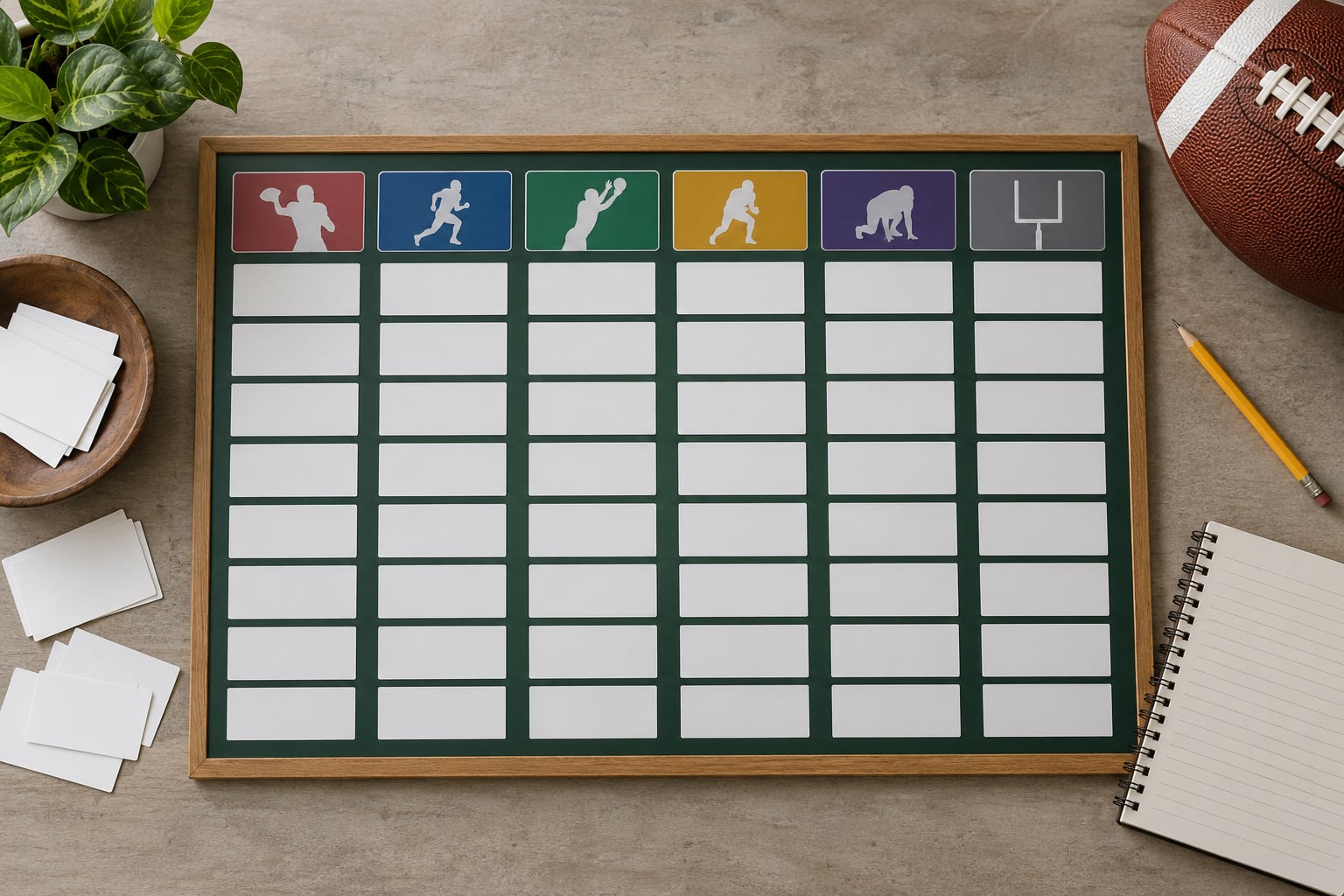
To draft IDP leagues for beginners, you take your individual defensive players in roughly rounds four through six, not in round one, and you value them in this order: edge rusher, defensive tackle, linebacker, safety, then cornerback. The order only holds because of one thing: your league’s scoring settings decide it. Read those first, and the rest of the draft runs itself.
Most first-year IDP managers get two things wrong. They draft a defensive player on reputation in round two, then spend the back half of the draft chasing players who cannot stay on a field. Or they punt all twelve rounds on offense and open their first week with a starting lineup full of holes and two defenders.
This guide walks the whole process: what to gather before your draft, the seven steps that get you to a usable roster, the mistakes that cost first-year managers their season, and straight answers to the five questions every beginner asks. It stays evergreen, so it works whether you are joining a league that already exists or building your own.
Table of Contents
- What You Need
- Your league settings, opened and read
- Two sources, not one
- A draft board with a notes column
- The scoring settings comparison, in one table
- Step-by-Step: How to Draft IDP Leagues for Beginners
- 1. Set the Right League Rules Before Drafting
- 2. Learn the Defensive Positions and Scoring Roles
- 3. Build a Player Pool Around Tiers
- 4. Target Scheme and Rotation Trends
- 5. Use IDP Draft Strategy for Each Round
- 6. Construct a Balanced Starting Roster
- 7. Make Adjustments During the Draft
- Common Mistakes
- Frequently Asked Questions
- Should beginners draft IDP players early?
- Which IDP positions are easiest for beginners to draft?
- How many defensive players should a beginner start each week?
- Is it better to draft linebackers or defensive backs first?
- Are IDP leagues harder for beginners than standard fantasy football?
- Bottom Line
What You Need
You need four things before your draft: your own league settings, a scoring read, two sources of player information, and a draft board with a notes column. None of them cost money, and all four are things you can finish in an evening.
Your league settings, opened and read
Open the league page on your host platform — ESPN, Yahoo, Sleeper, Fantrax, MyFantasyLeague — and find the scoring settings. Not someone else’s league. Yours. Then write down six numbers: how much a solo tackle is worth, how much an assist is worth, what a sack pays, what an interception pays, what a pass breakup pays, and whether forced fumbles and fumble recoveries count separately or as one category.
Also count your defensive lineup slots and note which positions they require. A league that requires one DL, one LB and one DB is a different draft from one with four flex defensive spots. Settings drive everything downstream, and a ten-minute read now saves you from a ruined August.
Updated for 2026, and checked against what current platform settings actually offer.
Two sources, not one
Use one projections source for a baseline and one news source for reality. Projections tell you what a role is worth. News tells you whether the role exists — a coaching change, a scheme switch, a holdout, a free agent signing.
Forum consensus in r/FFCommish and r/DynastyFFIDP is blunt on this: users distrust sites that funnel them to a paid draft tool instead of explaining the reasoning, and they trust scheme transparency more than any number. If you can say which defensive coordinator runs a team and what front he prefers, you already know more about that defense than most of the field.
A draft board with a notes column
Build a board grouped by position rather than by overall rank, and give every player a one-line note. Something like “edge, three-down, off-ball on third down” or “box safety, limited snaps, no role upside”. The note is what you read at pick number 47 when you have thirty seconds. Names and ranks you can re-check; a written role note saves you from the panic pick.
The scoring settings comparison, in one table
This is the table that decides your draft board. Three scoring flavors dominate IDP leagues, and each one promotes a different set of players.
| Scoring style | What it rewards | Positions that gain value | Positions that lose value | Draft effect |
|---|---|---|---|---|
| Tackle-weighted | Solo and assisted tackles, occasionally tackles for loss | Middle linebackers in 4-3 fronts, box safeties | Cornerbacks, pass rushers who do not finish sacks | Wait until the middle rounds for defense |
| Big-play-weighted | Sacks, interceptions, forced fumbles, fumble recoveries, defensive touchdowns | Edge rushers, ball-playing safeties, cornerbacks who bet on interceptions | Off-ball linebackers, non-pass-rush defensive tackles | Take an elite rusher early, around round three |
| Big three | Sacks, interceptions and tackles for loss weighted several times a solo tackle | Three-down linebackers, edge rushers, safeties who hit in coverage | Pure tackle accumulators who generate no big plays | Balance: first IDP around round four or five |
Big three scoring means your league counts three categories — sacks, interceptions, and tackles for loss — at a much higher rate than routine tackles. It exists because tackle-only scoring flattens the defensive field. Commissioners on the forums who have tested it report that big plays should be worth three times a solo tackle or more, otherwise one defender quietly outscores your entire offense while everyone else collects participation trophies.
One more scoring caveat worth knowing: tackles are not an official NFL statistic. Statkeepers disagree about who gets credit for a shared tackle, which is why your league’s assist value can swing a whole season’s outcome. If your league awards a full point for a shared tackle, your linebackers are worth more than any projection sheet claims. If assists pay a third of a point, discount every “110 tackle” label you see in a ranking.
Step-by-Step: How to Draft IDP Leagues for Beginners
Seven steps, in order. The first three happen days before your draft; the last four happen with the clock running.
1. Set the Right League Rules Before Drafting
Beginners should build a league where defensive points are understandable and sustainable, and that means choosing settings that keep one defender from running away with a title.
For scoring, big three is the most forgiving starting point. It rewards real production without inflating the value of a single injury-prone pass rusher. Tackles for loss, sacks and interceptions all score, assists are usually worth a fraction of a solo tackle, and no single category dominates the leaderboard.
For roster slots, three or four defensive starters beats one. A league that starts a single IDP is far too easy, because your whole league needs one weekly starter out of the deepest pool in the sport, and the top two or three available defenders every week will get taken. Three required slots — one DL, one LB, one DB — with a fourth flex spot is the standard beginner build. The flex spot matters because it lets you start your best scorer regardless of position on a week when a position group goes cold.
Check one more thing before you commit: how your host platform classifies players at the position. Whether an edge rusher sits under DL or under LB changes his value in your specific league, and this is raised constantly in the Football Guys forum because it breaks people who drafted on generic rankings.
2. Learn the Defensive Positions and Scoring Roles
Five positions carry almost all IDP fantasy value, and each one scores through a different mechanism. Beginners who can name what a player does on a given snap can predict his stat line without opening a projection sheet.
Edge rusher. Often listed as defensive end, sometimes as outside linebacker depending on your platform. Lines up with the outside shoulder, rushes the passer, and scores through sacks, tackles for loss and pressures. The premium position of any IDP draft.
Defensive tackle. The interior defensive lineman who occupies guards and centers, eats blocks and rarely sees sacks. Their floor is tackles for loss, and in a 4-3 front they get plenty of chances at them. Scored correctly, a productive interior lineman is a quiet weekly 6 to 9 points.
Linebacker. Two distinct fantasy profiles hide under one name. The off-ball middle linebacker in a 4-3 plays on every snap and racks up volume tackles — the default, reliable IDP pick. The three-down linebacker plays on first and second down, blitzes, and covers, which adds sacks and turnovers to the tackle total. Both exist, and you need to know which one is on your board before you rank him.
Safety. The box safety plays near the line and makes tackles. The free safety plays deep and collects interceptions and pass breakups. Slot and nickel safeties do a bit of both, which is why the green dot role described below is so valued.
Cornerback. Coverage first, stats second. A shutdown corner can hold receivers to almost nothing and still post a fantasy season that makes you want to close the app.
3. Build a Player Pool Around Tiers
Beginners should tier their pool by role and expected scoring range, not by reputation. Reputation is what put you in trouble.
Build four tiers per position. Tier one is your two or three best weekly scorers at that position — draft these early and without hesitation. Tier two is your solid starters, the guys whose floor is six to eight points a week. Tier three is your rotational and situational players, drafted late for depth. Tier four is your deep fliers: rookies, players on a new scheme, players whose role changed in the offseason.
Two rules for tiering without stats software. First, count snaps, not reputation. A defender who played under 50 percent of snaps last year is not a starter, whatever his ceiling. Second, check the coaching tree — a new defensive coordinator usually means new roles for everyone on that defense, and new roles are where tier-four fliers come from.
When you tier, ask one question per player: if this player’s name were removed from the rankings, would his role still produce the same points? If the answer is yes, draft the role. If the answer is no, you are drafting a name.
4. Target Scheme and Rotation Trends
Scheme explains weekly opportunity better than any projection, and you can read most of it without advanced statistics.
First, know your front. In a 4-3, a middle linebacker is likely on the field every snap, which is why 4-3 MIKEs dominate tackle-leader lists year after year. In a 3-4, the front is the star and off-ball linebackers often come off the field on obvious passing downs, so their tackle totals fall while their pass-rush chances rise.
Second, count the defensive backs. Most teams now put at least five defensive backs on the field at starter-level snaps across a game, which makes the defensive back pool the deepest and safest place for a beginner to draft from. It also means the third stringer’s role shrinks, so depth charts at the bottom of the roster are less reliable there than anywhere.
Third, look for the green dot. That is the player whose helmet carries a dot meaning he is the last defensive back in, the nickel or slot defender, usually on third and fourth downs. Forum advice treats cheap green dots as the most accessible value in an early round, because the role is stable, snaps are guaranteed and the draft price rarely reflects it.
Fourth, check team pace. A team that runs 70 plays a game gives its defense more snaps, more tackles and more chances at a turnover. A team that plays from behind every week removes the grind-it-out running plays that generate clean tackle opportunities. If a defender plays on the slower of two teams, adjust your expectations before the draft, not in October.
Last, watch the rotation. A coordinator who plays eight defensive linemen on a regular rotation splits tackles for loss across more bodies. Role stability is worth more than raw talent in IDP, and it is the cheapest edge available to a first-year manager.
5. Use IDP Draft Strategy for Each Round
Take offense seriously through the first three rounds, take your first real IDP in rounds four to six, and let depth fall to you after that. That is the default; your league settings and your league-mates’ habits are what move it.
Here is the round-by-round plan a beginner can actually run on a phone.
| Round | Offensive target | IDP target | What to avoid |
|---|---|---|---|
| 1 | Your best available offensive player | None unless the board is absurdly thin | Reaching two rounds for a linebacker |
| 2 | Running back or workhorse receiver | None | Drafting a second linebacker to be safe |
| 3 | Best receiver or tight end still available | Elite edge rusher if your scoring is big-play weighted | Any defensive tackle before round four |
| 4 | Flex player with weekly upside | First IDP: edge rusher or three-down linebacker | Cornerbacks |
| 5 | Second running back or your best remaining receiver | First linebacker, ideally a three-down one | Taking a second linebacker out of nerves |
| 6 | Quarterback | Safety, box or slot, with a defined weekly role | Rookies with no defined role |
| 7 | Tight end or flex offense | Defensive tackle in a 4-3 front | Passengers on bad offenses |
| 8 | Best remaining offensive player | Second edge or second safety | Reach picks on the offensive side to avoid defense |
| 9 | Hand-off pick | Third defensive starter to lock your lineup | Starting a fourth defensive pick over a flex offense player |
| 10 | Kicker and best available offense | Sleepers and rookies with defined roles | Cornerbacks outside the double digits |
| 11 | Backup quarterbacks and deep receivers | Deep defensive depth and cheap green dots | Do not leave a required defensive slot unfilled |
| 12 | Hand-off pick | Hand-off pick, but only if a required slot is empty | Drafting your kicker in round twelve |
One real example to calibrate the timeline: in a competitive Football Guys IDP league, the first linebacker went in the early part of round seven in one season, and eleven linebackers were gone by the end of round nine. That gap is the whole lesson. You can be patient and still arrive at round nine with nothing, because the moment the run starts it usually does not stop.
That is the trigger to act early. If two linebackers go in a round and you have none, take your best remaining linebacker right now rather than hoping the next three rounds behave. Getting in front of the run is more important than landing the perfect player inside it.
6. Construct a Balanced Starting Roster
Balanced does not mean equal. It means you can field a legal lineup in week one without punting a position, and that your bench can absorb one injury without a waiver scramble.
Across a full roster, aim for a shape like this: three or four defensive linemen, three linebackers, three or four defensive backs, and a full offensive group with flex spots doing the work. That gives you one starting edge rusher, one starting defensive tackle, one starting linebacker and one starting defensive back out of the box, plus enough depth that a bye week or a season-ending injury does not end your playoff run.
Handle bench depth with a simple rule: never leave a required lineup slot with an empty eligible player on your roster. That is the difference between a bad week and an automatic zero, and it costs you one late-round defensive pick you were probably drafting anyway.
On kickers, take them with your second-to-last pick and treat them as a formality. They do not interact with IDP strategy in any meaningful way, and the pick costs you nothing you need.
7. Make Adjustments During the Draft
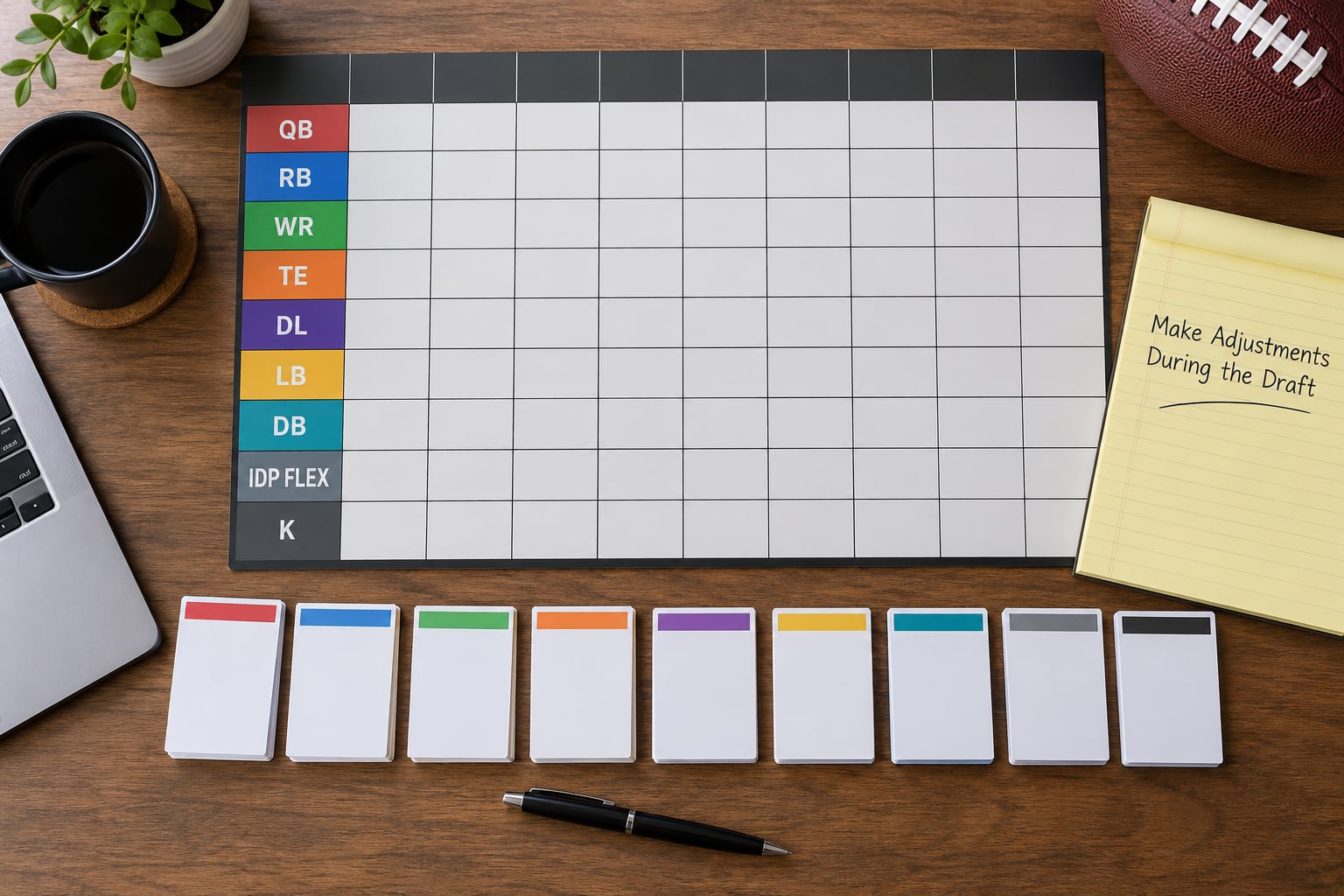
Every draft plan breaks. These are the fallbacks that keep a first-year roster usable.
If your pick gets skipped, treat it as a gift of information. Skipped picks at pick 5.01 and 7.03 usually mean somebody is drafting on a board you have not read. Re-examine your board at that moment instead of finishing it before the draft.
If a position run starts, get in front of it rather than behind it. Four linebackers taken in two rounds means your three-down linebacker target is gone; pivot to edge rusher, where depth runs deeper and the weekly ceiling is higher.
If your league-mates draft no defense all draft, the format is different from what you planned for. Take a defensive player earlier than your board says and accept a slightly worse player. Five opponents punting on defense means your first-round defensive pick is a value pick, not a reach.
And if you end up with two linebackers before round seven, the fix is roster management, not panic. Start the better one weekly, keep the second on your bench as injury cover, and go get safeties and defensive linemen on the wire every week. The Football Guys forum and the Fantasy Sharks board both fill with the same panicked first-year question — what happens if I have no defense after the draft — and the answer is always the same: the waiver wire fixes defensive holes in a standard league, and it will fix yours too.
Common Mistakes
Six errors account for most ruined first-year IDP seasons. Each one has a straightforward correction.
Drafting two linebackers in the first four rounds. Linebackers look appealing because their floors are visible, and that is exactly the trap. Three owners doing the same math take four of them before the fifth round. Correct it by capping yourself at one linebacker in the first six rounds, no matter how good the second one looks.
Reaching for cornerbacks early. The best corner in football can be your worst IDP pick, and the two are not the same thing. A shutdown corner allowed almost nothing all season and finished with three fantasy-relevant interceptions. Wait until the double-digit rounds, and treat cornerbacks as bench filler rather than starters.
Drafting on generic advice instead of your own scoring. Every published blueprint is written for some league’s settings, usually not yours. If a guide says take a defensive tackle in round three and your league pays nothing for tackles for loss, that pick is a wasted round. Read your settings, then adjust any advice that assumes a different one.
Accepting a single defensive slot. A one-slot IDP league asks one starter out of the deepest pool in fantasy football, which makes the weekly decision trivial and the standings meaningless. If you are creating the league, require three positions and add a flex. If you joined one, treat it as a weekly reason to check the wire rather than a reason to quit.
Ignoring bench depth. Six defensive players on a roster sounds excessive in a standard league. In IDP it is exactly right, because injuries and bye weeks hit your starters twice as often. Draft the seventh defender before you think you need one.
Drafting to names rather than roles. A coordinator switch can turn a twelve-tackle linebacker into a two-tackle reserve in a single offseason. Before you rank anyone, ask what the player’s job is on first down, and only then look at their stat line from last year.
A few closing habits. Verify your league settings the night before the draft, not the morning of. Keep your board grouped by position so a position run is visible at a glance. And decide your first defensive round in advance, because that is the one decision that actually determines your lineup in week one.
Frequently Asked Questions
Should beginners draft IDP players early?
Usually not. In a standard IDP league, most managers take their first individual defensive player in rounds four through six, because offensive scarcity drives value in the early rounds. Go earlier if your scoring is big-play weighted, if a genuine edge rusher is falling, or if your league mates have started drafting defense. Punting on defense for six straight rounds is the bigger risk, so if you reach round seven without a defender, take your best available one immediately.
Which IDP positions are easiest for beginners to draft?
Safeties and edge rushers. Most teams deploy at least five defensive backs at starter-level snaps, so the safety pool is deep and the roles are stable, and the premium is the clear-cut production you need most in your first season. Edge rushers score through sacks, tackles for loss and pressures, which is easier to project than a coverage-dependent stat line. Start there, then add linebackers once you understand three-down versus off-ball roles.
How many defensive players should a beginner start each week?
Three to four, with one from each position group where possible. A single defensive slot makes the weekly decision trivial and hands the league to whoever owns the best available defender. One defensive lineman, one linebacker and one defensive back guarantees a legal lineup, and a fourth flex spot lets you start whichever defender actually scored that week. A flex spot matters most in a big-play scoring league, when one player can carry a week on sacks alone.
Is it better to draft linebackers or defensive backs first?
Linebackers first if your league scores tackles, because the off-ball middle linebacker in a 4-3 front plays nearly every snap and produces the most reliable weekly floor. Defensive backs first if your scoring is big-play weighted, since ball-playing safeties and slot corners have the higher ceiling through interceptions. Safeties are the sensible compromise because they bridge both, which is why most beginner draft boards feature a safety before round six.
Are IDP leagues harder for beginners than standard fantasy football?
They add difficulty, mostly in the draft rather than the weekly grind. Offensive roles are widely understood, while defensive roles vary by scheme, front and coordinator, and eligibility rules differ by platform for edge rushers. The weekly side is manageable once you build a routine of checking snap counts and your own scoring. The single most useful habit is reading your league settings before every draft, because they decide nearly everything else.
Bottom Line
Open your league settings tonight and write down the six scoring numbers before you open a rankings page. That single habit removes most of the mistakes in this guide, because your scoring tells you whether your first defensive pick belongs in round three or round six, and which positions are worth owning at all.
Everything after that is simple execution: offense through three, a real IDP in four through six, one linebacker only in the early rounds, and enough defensive depth that a bye week does not wreck your week. Get in front of a linebacker run rather than behind it, and treat the waiver wire as part of the draft, not a repair shop.
Draft to the role, not to the name. In IDP, that habit alone keeps you out of the season’s worst draft stories.