
Ties in fantasy football get broken by a short, ordered list of rules your league picked before the season started. The usual sequence is head-to-head record, then total points scored, then division record, then fewest points allowed, and finally a virtual coin flip. Knowing how fantasy football tiebreakers work matters most in the last two weeks, when a single stat decides who is in the postseason.
The part that trips people up is that the order is not universal. Your commissioner may have put a custom rule first, your platform may handle playoff games differently from regular-season standings, and a stat correction filed on a Wednesday can rewrite the whole thing.
Table of Contents
- What Are Fantasy Football Tiebreakers?
- How Do Fantasy Football Points Ties Get Broken?
- How Fantasy Football Tiebreakers Are Ranked
- What Do Common Fantasy Football Tiebreaker Stats Mean?
- How Are Common Tiebreaker Stats Calculated?
- How Do League Scoring Settings Change Tiebreakers?
- How Do You Break a Tie Between Two Fantasy Teams?
- Why Do Fantasy Football Tiebreakers Cause Confusion?
- Frequently Asked Questions
- Can I change a fantasy football league’s tiebreaker rules after the season starts?
- What happens if a team has zero points during a fantasy football tiebreaker season?
- How do tiebreakers work in head-to-head fantasy football leagues?
- What happens when two teams are tied after every tiebreaker rule?
- When should I check my fantasy football tiebreakers before kickoff?
- Conclusion: Check Your League Rules Before Kickoff
What Are Fantasy Football Tiebreakers?
A fantasy football tiebreaker is a rule that compares two teams with identical records and produces a winner. Without one, both teams simply stay level, and nobody gets a clean seed or a clean answer after a playoff game.
Tiebreakers get used in three places: setting the regular-season standings, seeding the playoff bracket, and settling an individual playoff game that finishes level.
That last one catches people. In a head-to-head league, two teams can finish a playoff week with the exact same score, and the tiebreaker rules decide who advances. In a points-scoring league, the same rules only decide the order of the standings table.
It helps to know which kind of league you are in. A total-points league ranks everyone by cumulative points scored across the year, so ties are common enough that a tiebreaker list is standard. A head-to-head league plays a weekly matchup, so a tie can send two teams into the playoffs with identical records and identical seeds.
How Do Fantasy Football Points Ties Get Broken?
Ties are resolved by walking an ordered list of rules from top to bottom. The first rule that separates the teams ends the process, and every rule below it never gets used. That is why the order matters more than the individual stats.
Here is the standard chain most leagues end up with.
- Head-to-head record among the tied teams
- Points For, meaning total points scored on the season
- Intradivisional record, meaning your record against teams in your own division
- Points Against, meaning fewest points conceded on the season
- Bench points or another custom stat
- Virtual coin flip
Here is the same list with the calculation and a number for each.
| Tiebreaker | How it is calculated | Which value wins | Example |
|---|---|---|---|
| Head-to-head record | Combined record in matchups between the tied teams | Higher record | 2-1 head-to-head beats 1-2 |
| Points For | Sum of every starter’s weekly points for the regular season | Higher total | 1,842.15 over 1,801.40 |
| Intradivisional record | Record against the four teams in your division | Higher record | 3-1 over 2-2 |
| Points Against | Total points conceded to opponents all season | Lower total | 1,455.20 over 1,502.80 |
| Strength of schedule | Quality of the opponents you beat | Higher value | Seven playoff teams beaten |
| Bench points | Points from players who did not start | Higher total | 212.4 over 180.9 |
| Virtual coin flip | Random draw by the platform | Whichever team draws higher | 0.62 against 0.38 |
How Fantasy Football Tiebreakers Are Ranked
Every rule in that table has a direction, and reading it wrong is the single most common mistake. Points For and head-to-head reward a higher number. Points Against rewards a lower number, because conceding fewer points is the better season.
The ranking comes from your league settings screen, not from the platform. A commissioner who wants points against ahead of head-to-head simply moves it up, and the platform obliges. Public leagues rarely let anyone change anything, so they use whatever the platform shipped as a default.
When every rule produces another tie, the list is exhausted and the platform moves to whatever it has left, almost always the virtual coin flip. There is no clever fallback after that, and no hidden stat that gets pulled out of a database at the last second.
One more detail catches people with three or more tied teams. The list does not run once and hand out every seed. It runs, one seed gets assigned, then the process restarts with only the remaining tied teams. The head-to-head record is recalculated inside that smaller group, which means a team can win or lose head-to-head depending on who else is still in the group.
What Do Common Fantasy Football Tiebreaker Stats Mean?
Head-to-head record means your record in direct matchups against the other tied teams. It is the most intuitive tiebreaker and the one most leagues put first. It only works cleanly when the tied teams played each other the same number of times, which is not always true in an uneven schedule.
Points For, sometimes written PF, is your cumulative regular-season points scored. It is the most popular tiebreaker with points-scoring leagues because it rewards consistent scoring rather than lucky weekly results. Its weakness is obvious once you say it out loud: it hands playoff spots to the strongest team in the league, which many managers dislike.
Points Against, or PA, is your cumulative points conceded. Lower wins. It works as a rough stand-in for schedule difficulty, since the teams that scored the least against you were the hardest ones to play. It punishes leagues where one manager drew a soft schedule.
Intradivisional record is your record against the other teams in your own division. It is the clearest divider of all because every team in a division plays the same opponents, so the comparison is fair by construction. In a league with no divisions, it simply does not exist.
Strength of schedule measures the difficulty of the teams you beat, and strength of victory measures how good those beaten teams were. Rare leagues use these because they need something beyond raw volume, and the real NFL tiebreaking procedure uses them too.
Bench points counts what your non-starters produced. It is a common custom addition because it rewards depth and punishes shallow rosters, and it is genuinely useful in leagues that start a lot of low-end players.
How Are Common Tiebreaker Stats Calculated?
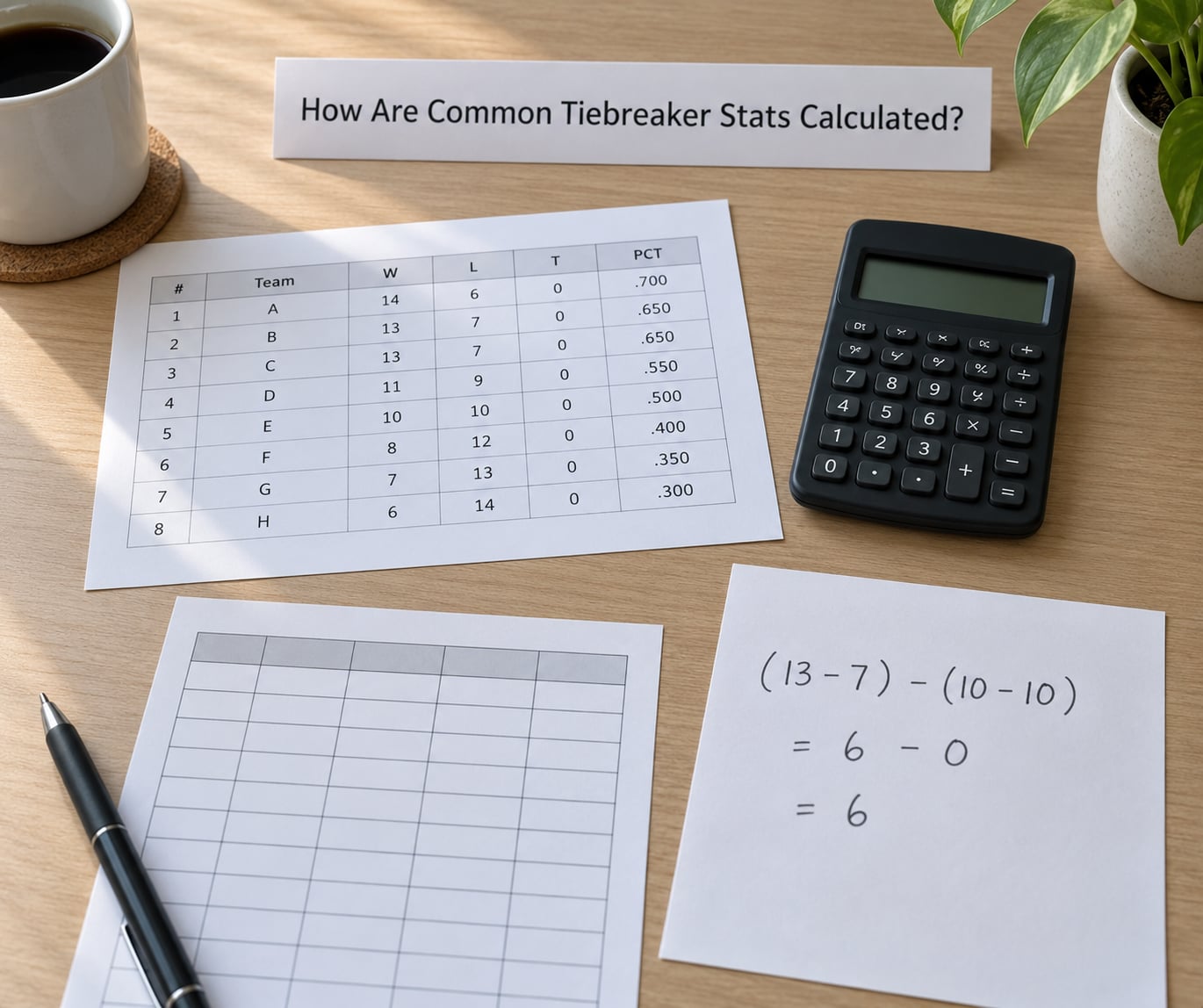
Almost every tiebreaker stat counts regular-season weeks only. Playoff weeks are excluded, so a team cannot bank extra tiebreaker points by going deep into a bracket. This catches new managers who count their final week totals.
Only players who were rostered and eligible count. If a player was on your roster for part of the season, the points from his time on your roster count. Points he scored for a different team, or before he reached your roster, do not. Traded players are split the same way, which is why a mid-season trade can quietly change a tiebreaker result.
Stat corrections are the part nobody plans for. Leagues normally settle the week first, run the tiebreaker, and assign seeds. A correction filed afterward can change a weekly score, which changes a season total, which can flip a tie. Most platforms recalculate standings after corrections and let the new result stand, but a commissioner can override that decision. If one lands on you, message your league immediately rather than assuming the app is right.
Manual adjustments work the same way. A commissioner can add or remove points for an injury, a stat that was never scored, or a roster mistake, and that adjustment feeds straight into any tiebreaker stat built on points.
How Do League Scoring Settings Change Tiebreakers?
Scoring format changes the numbers before any rule runs. A points-per-reception league produces different totals than a standard league, which means the points For gap between two tied teams is a different size under each format. Comparing a number you saw on one platform against a total from another platform never works.
Roster settings change which stats exist. Leagues that start a quarterback and two flex spots can generate larger passing totals, so a passing yardage tiebreaker rewards those teams disproportionately. Leagues that require full four-slate lineups produce bench points whether the commissioner wants them or not, because someone has to sit.
Divisions and conferences decide whether intradivisional and conference records are even available as tiebreakers. A 10-team league with two divisions gives you intradivisional. A 12-team league without them does not, and that rule quietly disappears from the list.
Weekly matchup structure decides whether head-to-head is usable. If every team plays every other team once, head-to-head comparisons between two tied teams are clean. With an unbalanced schedule, two teams may have played twice and two others never met, and the platform either ignores the stat or restricts it to common opponents.
Playoff game ties follow a separate rule set from regular-season ties. Most platforms offer a choice between higher seed wins and best regular-season record against your opponent, and some add a head-to-head category. On Yahoo, for instance, the playoff tiebreaker options include higher seed wins, best regular season record versus opponent, head-to-head categories, and head-to-head points, with higher seed as the fallback when those tie.
The honest answer is that exact settings belong to your league. Read your own settings page rather than assuming one platform’s defaults apply everywhere.
How Do You Break a Tie Between Two Fantasy Teams?
Here is a redraft scenario with a real shape to it. Two teams, Gridiron Grabs and Fourth and Inches, both finish 9-4 with 1,842.15 total points each. The standings table shows them level, and now the tiebreaker list runs.
Step 1, head-to-head. Gridiron Grabs went 2-1 against Fourth and Inches across the season. They are separated immediately, and nothing below this line gets used. Fourth and Inches finishes sixth instead of fifth and misses the last wild card spot.
That is the clean case. Now make it messy and change one thing: Gridiron Grabs played Fourth and Inches twice, but their division schedules were unbalanced, so a third meeting never happened. Several platforms treat that head-to-head record as unusable. The list moves to step 2, points For, and both teams are tied at 1,842.15 again.
Step 2, points For. Dead even. Step 3, intradivisional. Gridiron Grabs is 3-1 in the division, Fourth and Inches is 2-2, so Gridiron Grabs wins there.
Try another version where both are 3-1 in the division and level on points. Step 4, points against breaks it: Gridiron Grabs conceded 1,455.20 and Fourth and Inches conceded 1,502.80, and the lower number wins.
If both of those match too, many private leagues add a custom rule such as bench points, total team touchdowns, or points scored by players on the bench. Gridiron Grabs leads on bench points at 212.4 against 180.9 and takes the spot. Only if every custom rule ties does the platform run the virtual coin flip, and that draw is a genuine coin flip with no further argument available.
Playoff game ties work the same way with a narrower list. If a semifinal ends 132.40 to 132.40, most leagues resolve it with the higher seed advancing, or with the better regular-season record against that specific opponent. Under higher seed wins, the four seed beats the five seed and nobody checks a stat at all.
Why Do Fantasy Football Tiebreakers Cause Confusion?
Assuming the default. Plenty of managers spend a season assuming head-to-head is first because that is what most public leagues use, then discover their private league put points For first.
Reading points against as a higher-is-better stat. It is the reverse, and getting it backwards means a manager argues for the wrong team.
Counting all-time totals. Multi-year leagues accumulate numbers that have nothing to do with the current season. Confirm your league counts this season only before you start quoting a career total in a group chat.
Trusting head-to-head when games played were unequal. Forum discussions show this over and over: managers lose a playoff spot on points For after winning the head-to-head, because the platform discarded an unequal head-to-head record as invalid.
Missing the regular-season versus playoff distinction. A tie in the standings and a tie in a playoff week use different rules, and plenty of arguments come from treating them as one process.
Ignoring stat corrections. A correction filed after the matchup ends can move a total that decided a seed, and nobody notices because the standings page looks unchanged.
Forgetting that decimal scoring removes the whole problem. Leagues that score receptions and yards to one decimal place produce very few exact ties. Managers who switched to decimal scoring report that it eliminates nearly all ties, which means tiebreakers become a formality rather than a weekly argument. If your commissioner is still setting up a new league, that is the single most useful setting to change.
Frequently Asked Questions
Can I change a fantasy football league’s tiebreaker rules after the season starts?
Usually yes in a private league, and usually no in a public one. Most platforms let a commissioner reorder tiebreakers from the league settings page at any point, including mid-season. The risk is changing the order after results have started favoring one team, which is the fastest way to start an argument in your league chat. Agree on the order at the draft, post it in the league, and leave it alone.
What happens if a team has zero points during a fantasy football tiebreaker season?
A zero-point season is not disqualified and it is not specially penalised. On a points For tiebreaker the team simply has the lowest total and loses that tiebreaker. On points against, a zero-point team has the best total in the league and would win that tiebreaker outright. This is the clearest example of why reading the stat direction matters before you argue.
How do tiebreakers work in head-to-head fantasy football leagues?
In a head-to-head league they settle two things: the playoff seed when two teams finish with identical records, and an individual playoff game that ends level. Leagues that play two games per week often use points against as the primary playoff tiebreaker, while weekly leagues more often use head-to-head record or total season points. The exact chain is set in your league settings.
What happens when two teams are tied after every tiebreaker rule?
The platform runs its final fallback, which on nearly every site is a virtual coin flip. The draw happens automatically and both teams get a record showing the random outcome. Nothing is recalculated or reconsidered afterward, and a commissioner cannot normally overrule the draw. Some private leagues replace it with a manual tiebreaker such as a playoff game played head-to-head.
When should I check my fantasy football tiebreakers before kickoff?
In the first week, before any results exist, while nothing is at stake and nobody can accuse you of moving the goalposts. Write down the ordered list, note which stats reward a higher number and which reward a lower one, and confirm the league counts regular-season weeks only. Screenshot the settings page. Five minutes in week one prevents an entire argument in week fourteen.
Conclusion: Check Your League Rules Before Kickoff
Open your league settings this week and read the tiebreaker list top to bottom. Write the order down, mark which stats reward a higher number and which reward a lower one, and confirm your league counts regular-season weeks only. Screenshot the page so the answer is settled before anyone needs it.
If your league keeps producing ties, turn on decimal scoring before next season. That one setting removes most of the arguments this guide exists to explain.