
Here is the short version of how individual defensive player scoring works: each defender on your roster is scored separately, and every solo tackle, assisted tackle, sack, interception and forced fumble they record is logged by your platform and converted into points using the scoring settings your commissioner chose. Because those settings differ from league to league and platform to platform, the same game can produce two very different fantasy totals.
I have run IDP leagues for years, and the thing that catches new managers out is how much of the scoring lives in a settings menu nobody thinks to open. Draft rankings assume a scoring system, but most published rankings assume one particular set of defaults that a lot of leagues never used.
Table of Contents
- What Does Individual Defensive Player Scoring Mean?
- How Are Individual Defensive Statistics Scored?
- How Individual Defensive Player Scoring Works in Practice
- Why Do Defensive Scoring Settings Differ by League?
- How Do Major Fantasy Platforms Compare?
- How Should You Evaluate a Defensive Player for Your League?
- Frequently Asked Questions
- How is IDP scored?
- How does defensive player scoring work in fantasy football?
- What are the scoring settings for IDP fantasy football?
- What are the default scoring settings for ESPN fantasy football?
- What position is best for IDP?
- Is it possible for a defender to score a goal in fantasy football?
- Conclusion
What Does Individual Defensive Player Scoring Mean?
Individual defensive player scoring means each defender is your own scoring unit. A safety patrol linebacker, a pass-rushing defensive end and a shutdown corner each compete for points on their own, rather than sharing the output of a D/ST unit.
That is the first fork in the road, because there are three common ways to score defense in fantasy football. Team defense scoring (D/ST) awards points for the combined unit, so one bad week from your starting corner can sink a good week from your edge rusher. Individual scoring treats every player separately. Position-group scoring splits defense into DL, LB and DB, which keeps the structure familiar while still paying individual players.
Individual defensive player scoring works by taking a handful of counting statistics and assigning each one a fixed point value in your league settings. Solo tackles form the volume base almost everywhere, while rarer high-impact plays carry several times as many points.
How Are Individual Defensive Statistics Scored?
Individual defensive scoring is built from roughly a dozen stat categories. The exact points are entirely a league choice, so the values below are illustrative examples of commonly used settings rather than a universal rulebook.
A solo tackle is worth 1 point in most individual defensive player scoring setups, and an assisted tackle is worth 0.5 points. A sack is usually worth 2 points, an interception 3 points, a forced fumble 2 points, a fumble recovery 2 points, a defensive touchdown 6 points, a pass defended 1 point, a safety 2 to 10 points depending on the league, a blocked kick 3 points and a tackle for loss 1 point.
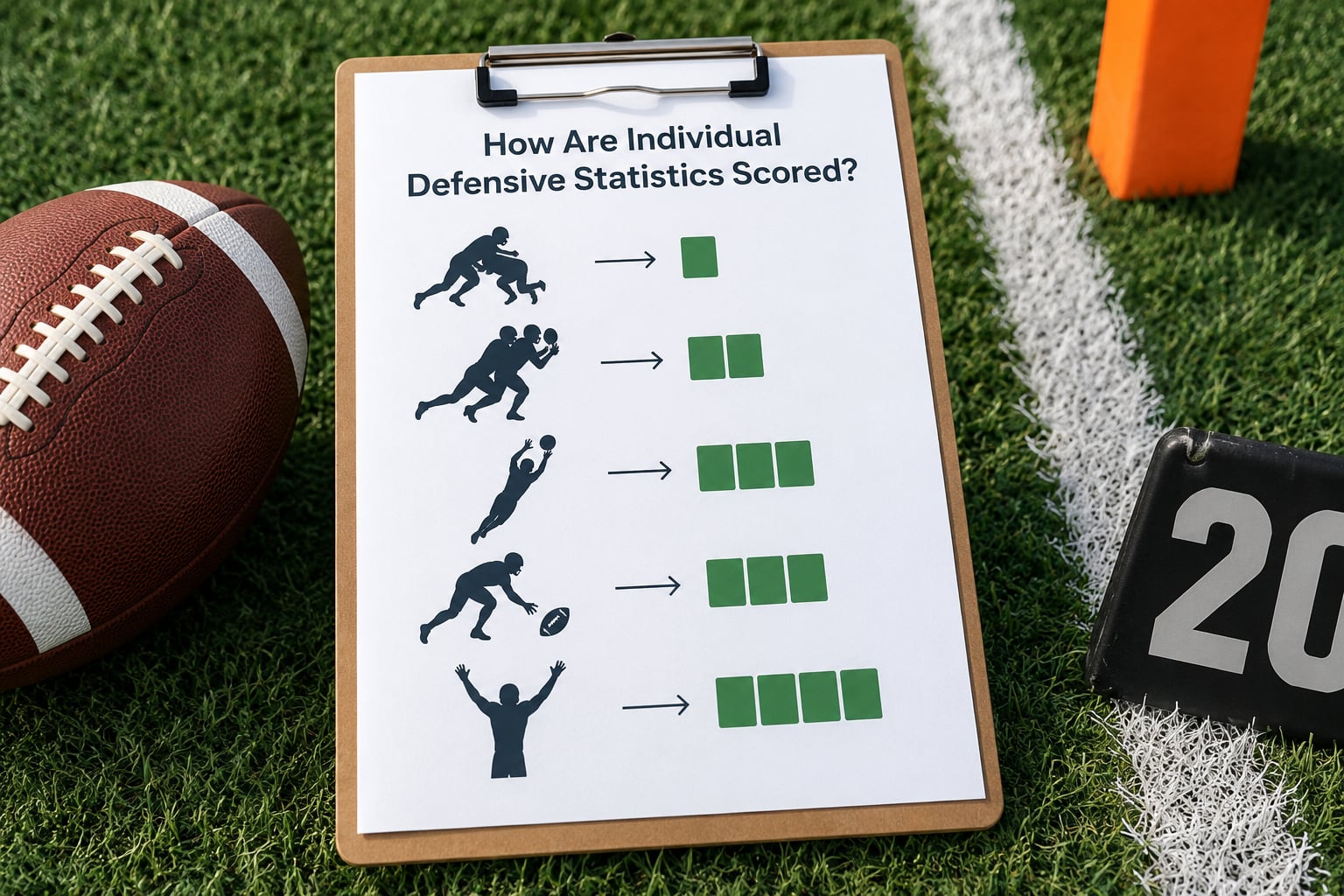
The table below shows one widely circulated set of values. Swap any of them for your league’s numbers and your player values change with them.
| Defensive statistic | Illustrative points | How often it happens |
|---|---|---|
| Solo tackle | 1 | Several times per game |
| Assisted tackle | 0.5 | Several times per game |
| Tackle for loss | 1 | Close to once per game |
| Pass defended | 1 | Around one per game for a starting corner |
| Sack | 2 | Rare for a double-digit total in a season |
| Forced fumble | 2 | Season-long handful for most defenders |
| Fumble recovery | 2 | Season-long handful for most defenders |
| Interception | 3 | Zero to a few per season |
| Blocked kick | 3 | Rare across a whole league |
| Defensive touchdown | 6 | Once or twice per season league-wide |
| Safety | 2 to 10 | A handful of players per season |
Notice the shape of it. Tackles dominate the volume and everything else dominates the ceiling. A defender who posts three solo tackles and an assist walks away with 3.5 points in the example set, which is a perfectly average week. Add a sack and an interception and the same player jumps to 8.5 points, which wins a matchup. Most weeks in IDP are decided by that second column of rare plays, not by tackle volume.
One question comes up constantly in the IDP communities: does a sack also score as a tackle? The answer depends on the platform’s stat-capture rules, not on your settings menu. Some systems tally a recorded sack as a tackle event in addition to crediting sack points, and others credit only the sack. That single line of the scoring engine can add up to eight points across a season for an edge rusher, so it is worth confirming rather than assuming.
How Individual Defensive Player Scoring Works in Practice
Here is one stat line scored under three common settings sets to show the swing. Our fictional linebacker finishes a Sunday with 6 solo tackles, 2 assisted tackles, 1 sack, 1 interception, 1 forced fumble and 1 defensive touchdown.
Under a balanced set that pays 1 point per solo tackle, 0.5 per assist, 2 per sack, 3 per interception, 2 per forced fumble and 6 per touchdown, the total is 20.5 points. Under a tackle-heavy set that doubles tackles to 1.5 and assists to 1, and trims interceptions to 2, the total is 22 points. Under a turnover-heavy set that pays 4 for an interception, 3 for a forced fumble and 8 for a touchdown, the same week is worth 27 points.
Same player, same game, 6.5 points of difference. That gap matters most when you are deciding a start at the IDP flex spot on a Sunday afternoon, and it matters most in dynasty, where one season of a different distribution can shift a player’s long-term value for years.
Why Do Defensive Scoring Settings Differ by League?
Scoring settings differ because every commissioner is balancing a different league. Someone running 12 IDP starters needs defense to be worth a modest slice of the total. Someone running two IDP flex spots needs defense to be volatile enough to create weekly decisions. The same point values cannot serve both.
The settings that actually move player values:
- Solo versus assisted tackles. The gap between 1 and 0.5 is standard, but plenty of leagues pay 1.5 and 1. Linebackers benefit most, since they lead the league in assisted tackles.
- Whether sacks count for defensive ends and linebackers. Every league scores sacks somewhere, but the value varies wildly. A league paying 4 per sack turns edge rushers into first-round picks.
- Interceptions. A common setting is 3 points, while turnover-heavy leagues push toward 4 to 5.
- Whether assists count at all. Some competitive settings set assists to zero to force a higher solo ratio.
- Defensive touchdowns and safeties. A league that pays 8 for a safety rewards the players most likely to produce one.
- Return yards. Adding points per interception return yard rewards ball-hawking defensive backs over linebackers.
- Games played. Some settings award points per games started, which rewards availability and heavily discounts injuries.
- Tackle bonuses. A threshold such as 8 or 10 tackles pays a bonus, which shifts the payoff from the defensive backfield to the box.
- Per-team versus per-player scoring. Some platforms and schemes pool defensive points per team rather than crediting each player separately.
The recurring complaint in commissioner discussions is that default settings overvalue linebackers and undervalue defensive linemen and defensive backs. Linebackers rack up tackles because their position puts them near the ball, while defensive linemen generate almost no tackle volume despite generating pressure. Defensive backs get few chances at volume too.
There is a catch-22 hiding in defensive back scoring that nobody fully resolves. A corner who is so good that quarterbacks avoid throwing at him gets fewer passes defended, fewer chances at an interception and fewer tackles. Shutdown corners are structurally undervalued by volume-based scoring.
How Do Major Fantasy Platforms Compare?
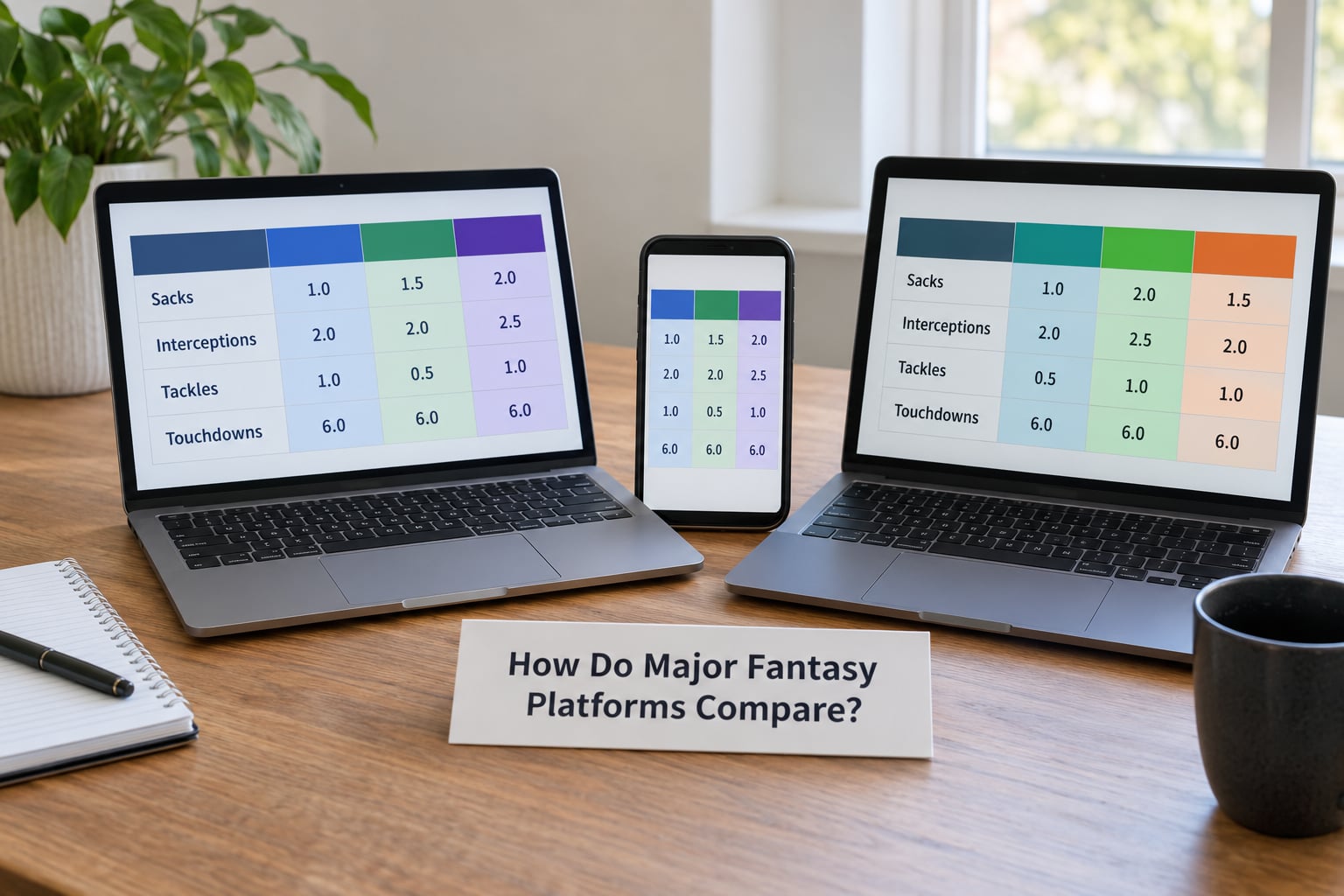
Platforms differ in philosophy more than in any single number. ESPN and Yahoo Fantasy both ship with fixed preset scoring options and let you build a custom system, so most of their leagues end up on a fairly standard points framework. Sleeper treats scoring as fully configurable from the league settings page, which is why so many custom IDP tables in circulation come from Sleeper leagues. Fantrax and MyFantasyLeague both support custom scoring with position-specific overrides, which is how you end up with a defensive end worth more per sack than a linebacker in the same league.
FantasyPros is not a league host, but it is where most managers go to pull scoring-adjusted rankings, and its projection tools let you feed in the point values your league actually uses.
The honest advice here: do not trust any article that quotes a platform default without a date attached. Defaults get rebalanced, and a page written a few seasons ago may describe a system no longer in use. Open your league settings, read the actual values, and work from those.
How Should You Evaluate a Defensive Player for Your League?
Evaluating a defensive player for your own league takes five steps, in this order.
Audit the settings first. Pull the full point table before you look at a single player. If you draft before this step, you are drafting someone else’s idea of your league.
Count scoring opportunities, not just past production. A defender who played 80 percent of snaps will get the tackle volume. A defender with 900 snaps but no passes thrown his way may not. Snap counts, position and defensive scheme tell you what the opportunity is before the box score does.
Separate consistent players from turnover-dependent ones. A defender averaging a sack and an interception a game has a lovely ceiling and a brutal floor. In redraft, high-variance defenders are good flex pieces. In dynasty, they are frustrating unless the scoring rewards turnovers heavily.
Weight by position once you know your settings. If assists are worth less, cornerbacks lose value. If sacks pay 4 points, defensive ends gain. The rankings you download assume somebody else’s values, so adjust the tiers to fit yours.
Adjust for format. In redraft, games played matter enormously because a mid-season injury costs you the rest of the season. In keeper leagues, young linebackers on their rookie contract window are the whole game. In dynasty, multi-year IDP scoring averages tell a different story than last year’s stats, and a scoring change mid-league changes how you value everyone on your roster.
One practical habit pays off more than anything else: recalculate your own top-20 scoring defenders at the halfway point of the season. Look at who is actually outperforming your settings rather than who is on the published rankings, and adjust your waiver priorities from there.
Frequently Asked Questions
How is IDP scored?
IDP scoring assigns points to each individual defensive player on your roster for solo and assisted tackles, sacks, interceptions, forced fumbles, fumble recoveries, tackles for loss, passes defended, safeties and defensive touchdowns. Each event is worth a fixed number of points set in your league settings, and the values differ from league to league.
How does defensive player scoring work in fantasy football?
Defensive player scoring works by converting logged statistics into points through your league’s scoring table. A solo tackle is commonly worth 1 point and an assist 0.5, a sack around 2, an interception around 3, a forced fumble around 2 and a defensive touchdown around 6. The total is added to your weekly score, and every player is scored separately rather than as one unit.
What are the scoring settings for IDP fantasy football?
Common IDP settings assign 1 point per solo tackle, 0.5 per assisted tackle, 2 per sack, 3 per interception, 2 per forced fumble, 2 per fumble recovery, 1 per pass defended, 1 per tackle for loss, 3 per blocked kick, 6 per defensive touchdown and 2 to 10 per safety. These are starting points, not fixed rules, and plenty of commissioners raise tackle values or sack values to suit their league size.
What are the default scoring settings for ESPN fantasy football?
ESPN offers preset scoring formats and lets commissioners build a custom points system, with the most common community settings following the standard 1 point solo tackle, 0.5 assist, 2 sack and 3 interception framework. Defaults have changed over time, so check the current scoring settings page in your own league rather than relying on an older guide.
What position is best for IDP?
Linebacker is usually the highest-scoring IDP position under standard settings because of tackle volume, and defensive end is the best high-ceiling position because sacks are worth several points each. Defensive back scoring depends entirely on your settings: cornerbacks gain in leagues that pay well for passes defended and interceptions, and lose in leagues that ignore them.
Is it possible for a defender to score a goal in fantasy football?
No defender kicks field goals, so there is no goal-scoring stat to earn. The closest defensive equivalent is a safety, which several leagues score highly because it is so rare. Blocked kicks and pick six plays are the other big rare events, and leagues that reward them hand a chunk of the season to whoever gets one.
Conclusion
Individual defensive player scoring is simple mechanics with a complicated surface: each defender is scored separately, tackle volume carries the floor, and rare big plays carry the ceiling. Two managers in the same format can end up with very different results because their point values are not the same.
So check four things, in this order. Your platform’s current scoring settings, not a guide’s version of them. Then the player’s position, since it determines opportunity. Then scoring opportunities per game rather than raw totals. Then games played, because availability decides how much of that opportunity you actually collect.
Updated for 2026 as scoring defaults shift from season to season.