Most dynasty rookie drafts are decided in the weeks before draft night, not on the clock itself. The managers who do well know their league settings cold, grade every position with the same attention, and decide in advance what they will take at pick three and pick nine. That whole process takes about five to eight focused hours spread across two months.
Rankings are the easy part. The harder work is figuring out what your third pick is worth in a four-round rookie draft, which late-round tight ends have a real path to Year 2, and what you would give up to move from ninth to sixth. If you learn how to prepare for a rookie draft in dynasty in that order, the draft itself becomes the easy part.
Table of Contents
- What You Need Before You Research a Single Player
- Step-by-Step: How to Prepare for a Rookie Draft in Dynasty
- 1. Review Your Dynasty League Rules
- 2. Build a Position-Aware Prospect Pool
- 3. Evaluate Each Player for Dynasty Upside
- 4. Create Tiers and Replacement-Level Targets
- 5. Map Your Strategy to League Demand
- 6. Prepare for Values, Trades, and Draft-Day Adjustments
- 7. Run One Final Mock Draft to Prepare for Draft Day
- Common Mistakes in Rookie Draft Preparation
- Frequently Asked Questions
- How early should I start preparing for a dynasty rookie draft?
- Should I always take the best player available in a dynasty rookie draft?
- How many players should I research before a dynasty draft?
- What is the best way to handle positional runs during a rookie draft?
- Should I trade down or trade up in a dynasty rookie draft?
- How do you value quarterbacks and running backs differently in dynasty?
- Conclusion: Start With Settings, Then Build Your Board
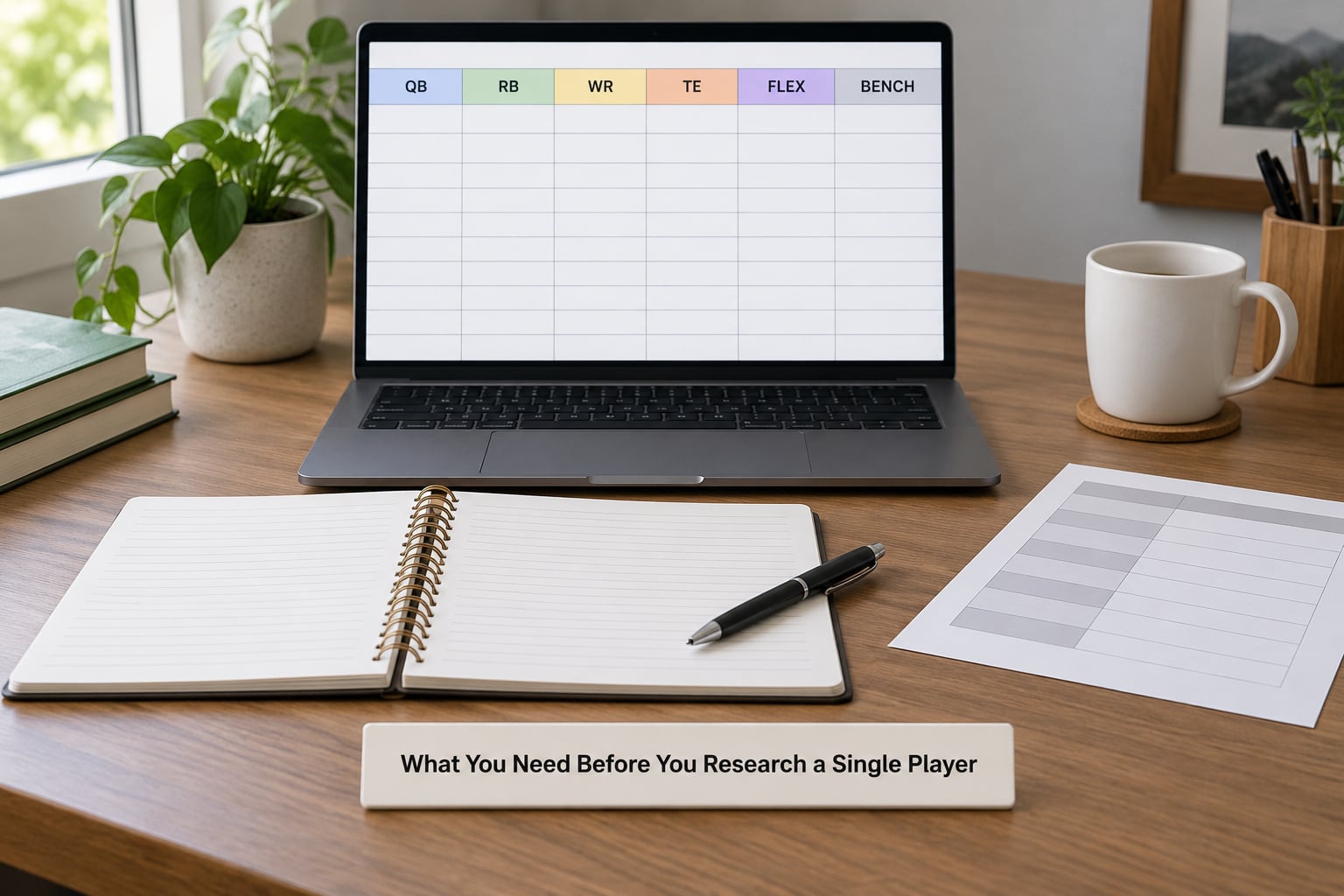
What You Need Before You Research a Single Player
You need four things before the research phase starts: your league’s real settings, player data from more than one source, somewhere to keep your own grades, and a pick-value chart that matches your draft format. Without them you will spend draft night arguing with yourself.
- Your league settings export. Screenshot the roster rules, starting lineup count, scoring format, taxi squad size, IR slots, and the number of rookie draft rounds. Sleeper and MyFantasyLeague give commissioners most of these knobs; ESPN and Yahoo give you far fewer, so know which constraints you cannot change.
- Two or three independent rankings. Never build on one list. FantasyPros aggregates the big consensus names, Dynasty Nerds and Football Guys skew toward the long view, and a single sharp analyst sometimes sees what the crowd misses.
- A place to keep grades. A spreadsheet column, a shared doc, a notebook. Mine is a simple sheet: player, position, role, ceiling, floor, my pick value, and a note on the landing spot.
- A pick-value chart. The Jimmy Johnson chart and the Fitzgerald-Spielberger chart are the two most widely used. Pick one, print it, and use the same one all season so your trade math stays consistent.
- Your league-mates’ history. Who hoards first-rounders, who trades every year, who drafted the last three rookies in the same position. Public ADP tells you what the average fantasy football player does. Your league’s history tells you what these twelve people will actually do.
- Trade calculator access. Use it as a reference, not an oracle. DynastyProcess and KeepTradeCut give you a market number so you can tell when someone is asking a fair price and when they are not.
Step-by-Step: How to Prepare for a Rookie Draft in Dynasty
Preparation moves in one direction. League rules set the value of every pick, the value of every pick shapes which players you care about, and only then do you build tiers and a draft-day plan. Managers who start with player rankings and check settings later usually draft a great player into a spot that does not help them.
1. Review Your Dynasty League Rules
Read your league settings before you read a single player profile, because the same prospect is worth a different pick in almost every league.
Roster size and starting slots decide how many rookies you will realistically use. In a 16-team league starting eight, only the best three or four rookies from your draft will ever see a meaningful snap. In a superflex league the entire board reshapes, because every starting quarterback outside the top tier is a live pick and rookie QBs carry a price tag nobody expects.
Scoring changes what you keep too. Points-per-reception leagues reward volume receivers, and a low-scoring rushing format makes a committee back more valuable than one workhorse. Taxi squads matter more than most managers expect: if a rookie must stay on your roster for a season before it counts, you cannot stash five fliers without burning a slot, so your deep rounds should be picks you would be willing to actually roster.
Finally, note how draft position gets set. Reverse standings, a lottery, random assignment, or a champion-last rule each produce a different shape of board. Most rookie drafts run three to five rounds, and the managers who do best treat the round count as fixed reality rather than something they wish were longer.
2. Build a Position-Aware Prospect Pool
Sort the class by position before you rank a single player, because dynasty value is set by scarcity inside a position far more than by raw talent.
Separate quarterbacks, running backs, receivers, tight ends, offensive linemen, defensive players, and specialists into their own lists. In IDP leagues, corners and linebackers carry real value while kickers are nearly free agents on most waivers, which inverts the board from a non-IDP league. In non-IDP leagues, defensive rookies are usually stashes rather than starts, so you can afford to wait.
On offense, treat wide receiver and tight end as scarcity positions and running back as a position where volume is the whole argument. A rookie running back drafted behind two blockers is a different prospect than the same player drafted behind five. Draft slot changes production, so keep a note on offensive line strength behind every prospect you like.
3. Evaluate Each Player for Dynasty Upside
Use the same checklist on every player so your grades are comparable: college role, athletic profile, competition level, injury history, landing spot, and realistic fantasy ceiling.
College production tells you what the player did, not what the NFL will ask him to do. The players who translate usually owned a defined slice of the offense, and they won it against a defense good enough to test them. Breakout age matters too, since a 23-year-old who dominated is far more likely to hold a role than a 21-year-old who flashed for three games.
Landing spot is the swing factor in dynasty, and it is knowable. A rookie behind an established starter with three years left on his contract is a different investment than one inheriting the job outright. Check the depth chart, the incumbent’s contract, and the offensive coordinator’s history of leaning on one player.
Finish each grade with a one-sentence ceiling and floor. If you cannot describe the realistic best case, you do not understand the player well enough to own him for six years.
4. Create Tiers and Replacement-Level Targets
Turn your grades into tiers, then mark the exact pick where each tier ends, because a tier without a boundary does nothing when a board surprises you.
Group players by realistic outcome rather than by exact rank. A first tier of two or three players you would happily take at any point in round one, a second tier of names worth reaching slightly for, then clusters that all produce roughly the same fantasy value. That last group is the most valuable part of the list, since those players are interchangeable and you can take whichever falls.
Set a replacement-level target for each position. Ask yourself which player you would accept if every better option at that position disappears. On most boards that is a mid-round receiver, a fourth-round tight end, and a late-round offensive lineman who started thirteen games. Once you name those replacements, a run at one position stops being an emergency.
5. Map Your Strategy to League Demand
Draft for talent and trade for need, because needs in a rookie draft are almost always manufactured by other managers reacting to earlier picks.
The core idea is simple. Take the best player on your board according to your own grades, then use trades to fix the roster shape. The corollary is that early in a rookie draft nobody has a real need, because no one knows yet who will be available later.
You can still anticipate demand. Read the early rounds of every mock and note which positions run early. If three quarterbacks go in the first eight picks of a superflex league, the fourth quarterback on the board will fall much further than consensus suggests, and a team missing receivers will be looking for a trade partner. That is when your replacement-level target at wide receiver turns into real value.
Balance the approach by pick number. Early picks should follow your tiers exactly. Late picks should be filled with players you would roster anyway, because the opportunity cost of a mistake drops as the draft runs out.
6. Prepare for Values, Trades, and Draft-Day Adjustments
Decide your trade rules before you sit down, so a fast board cannot talk you into a deal you would not make on Tuesday.
Write down three things. First, the price at which you would move up, usually meaning one pick inside your original range plus a player you still want. Second, the number of picks that makes trading back worth it, which is usually adding two picks even after giving up your original slot. Third, the specific players you would send out, so an offer is a list and not a mood.
Rebuilders should be open to stacking picks and future first-rounders, since extra selections compound better than one mid player. Contenders do better holding rookies young and cheap and dealing a proven veteran later in the season for a similar return. Both approaches work. Mixing them in the same draft usually produces neither.
Then plan for a panic pick. Most bad decisions at a rookie draft happen in the ninety seconds after your target receiver goes off the board one pick early. Know in advance which two players you would take instead, and hold yourself to that list.
7. Run One Final Mock Draft to Prepare for Draft Day
Run one mock with real rules and real timers, then stop, because extra mocks mostly add volume rather than preparation.
Simulate your actual draft order, the real round count, and a two-minute clock on your picks. Use a dynasty mock simulator rather than a redraft mock, since the board shapes differently when you already own a roster.
What you are testing is your reactions, not your rankings. Watch for the moment a run at your position starts and note how you plan to respond. Watch for a trade offer you did not see coming and write down what you would have said. One mock that reveals two blind spots is worth more than ten that only confirm what you already believed.
Common Mistakes in Rookie Draft Preparation
Almost every avoidable loss at a rookie draft comes from one of a handful of repeated errors. Each has a straightforward fix.
Drafting on a single consensus list. One ranking is a starting point, not an answer. Fix: blend at least three sources and give extra weight to the player who appears high on lists your league reads and nowhere else.
Ignoring league settings until pick one. A superflex league and a 16-team non-IDP league value the same rookie class completely differently. Fix: re-read settings whenever a trade moves you into a different window, because they never change and everyone forgets them.
Treating every early pick as a need pick. Reaching for the third tight end because your roster is thin at the position gives away three rounds of value. Fix: name two players at every position you would take at any pick, and only draft need when the value is close.
Trading up on emotion. The panic after your target falls one spot is the most expensive moment in fantasy football. Fix: set a maximum price in writing before the draft and hold to it even when you are annoyed.
Valuing future picks at par with current ones. A future first-rounder usually equals more than a current mid pick, not less. Fix: use one chart for every valuation so you never argue with yourself mid-trade.
Running too many mocks. Twenty mocks feel productive and change nothing, because you already know what your rankings say. Fix: one late mock with a clock, then spend the saved time writing trade rules.
Drafting position scarcity you cannot use. Taking a fifth tight end because everyone else is doing it wastes a pick even if the player hits. Fix: count your actual starting slots before reacting to a run.
Skipping the post-draft plan. The draft ends and the real work begins. Fix: book fifteen minutes after the draft to check free agent injury news, cut obvious fliers, and note which two players you want to revisit on the waiver wire.
A few final preparation habits pay off more than hours of extra research. Print your tier list and pick chart on one page, keep it beside you during the draft, and mark each pick as you go so you always know what is still available. Save league-mate draft history somewhere you can reach in seconds. And decide your trade limits before the clock starts, because good decisions made fast beat perfect decisions made after everyone else has picked.
Frequently Asked Questions
How early should I start preparing for a dynasty rookie draft?
Start about six weeks before the NFL Draft. The combine, the pro day workouts, and the draft itself all change player profiles, and much of the dynasty value comes from landing spots that are only known afterward. Use the first month for film and grades, the second for landing spots, tiers, and trade rules, then finish with one timed mock.
Should I always take the best player available in a dynasty rookie draft?
Most of the time, yes, especially early. Best player available keeps you flexible when other managers reveal their needs through their picks. The exception is when your roster has a genuine gap and two comparable players remain at your position, in which case taking the one who fills it costs almost nothing in value.
How many players should I research before a dynasty draft?
Deep research beats wide research. Twelve to twenty players with real grades beat a hundred names skimmed from a list, because your backup plan only works if you actually know the player. Cover every position in the first round plus two or three deeper names at each scarce position, then use consensus lists to fill the gaps.
What is the best way to handle positional runs during a rookie draft?
Never panic. Before the draft, name the pick where each position becomes acceptable to you. When a run starts, check whether you are still above that mark. If you are, take the best remaining player on your board. If you have dropped below it, only then move, and move through a trade rather than a panic reach.
Should I trade down or trade up in a dynasty rookie draft?
Rebuilders benefit from trading down, since two or three extra picks usually compound into more value than one better slot. Contenders gain less by moving and risk a lot, so holding is reasonable. Trade up only when you have a named target, a written price, and confidence he reaches the slot you need.
How do you value quarterbacks and running backs differently in dynasty?
Quarterbacks are valued on projected opportunity, which in a superflex league means a rookie taken behind a starter is often worthless. Running backs are valued on volume and offensive line quality, not on talent alone. If a rookie back loses the job behind him in the same draft, his long-term value collapses immediately.
Conclusion: Start With Settings, Then Build Your Board
Preparation for a rookie draft in dynasty is a sequence, not a mood. Read the settings, sort the class by position, grade players with the same checklist, turn the grades into tiers with named boundaries, set trade limits in writing, and rehearse once with a clock.
Start tonight with the smallest of those tasks: open your league settings, write down your roster size, starting slots, scoring, taxi rules, and round count, then list your real starting needs. Everything after that gets easier.