
How landing spot affects a rookie’s fantasy value comes down to four channels: how many points that offense produces, how many of those points are actually available to him, who is throwing him the ball, and whether the coaching staff will actually use him. A great spot raises his ceiling and lowers his variance. It does not hand him touches.
There is a fight in every dynasty league about whether landing spot matters. Some managers say it decides everything. Others say it is noise for anyone who is genuinely good. Both are partly right, and the reconciliation is simple: spot quality scales with how much talent you already believe the rookie has. For a blue-chip prospect, the spot is a tiebreaker. For a Day 3 pick, the spot is the whole thesis.
Managers in r/DynastyFF tend to land in the same place once you phrase it that way. One recurring comment on rookie film threads goes roughly: talented enough that I do not care about landing spot, but I start worrying about it for day 3 talent. That is the crossover, and it is the spine of everything below.
Table of Contents
- How Landing Spot Affects a Rookie’s Fantasy Value
- What Makes a Good Fantasy Football Landing Spot?
- How Much Does Quarterback Quality Matter?
- How Do Team Schemes Change a Rookie’s Role?
- Which Landing Spots Create Fantasy Football Upside?
- Which Landing Spots Limit a Rookie’s Fantasy Value?
- How Do You Adjust Projections for a Rookie’s Team?
- When to Validate the Spot In Season
- Talent versus landing spot: where the crossover sits
- How Landing Spot Affects a Rookie’s Fantasy Value in Dynasty Leagues
- Frequently Asked Questions
- How much does landing spot affect a rookie’s fantasy value?
- Does landing spot or talent matter more for rookies?
- Which position benefits most from a good landing spot?
- What is a goal-line vulture and why does it hurt rookie running backs?
- How do I project a rookie’s year one workload?
- Is an empty depth chart the same thing as a great landing spot?
- Conclusion
How Landing Spot Affects a Rookie’s Fantasy Value
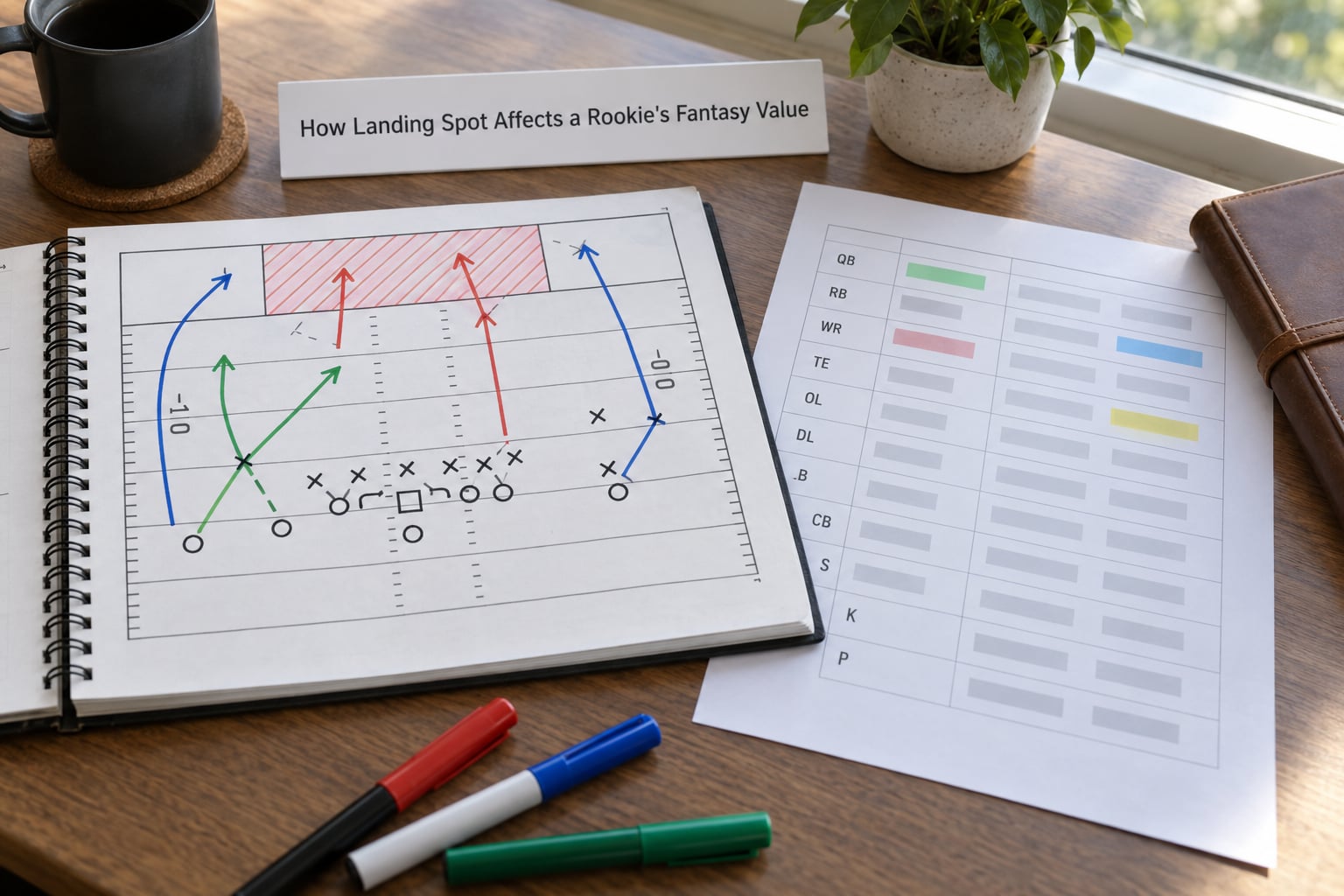
A landing spot is not a team name. It is a set of conditions: the implied team total of the offense, the number of competitors standing in front of him, the quality and tendencies of the quarterback, and the implied level of organizational intent. Judge a rookie on those four things and you get a repeatable answer. Judge him on a vibe about a franchise and you get noise.
The framework most managers converge on has three factors. Offensive environment is the volume of points the offense can produce. Touch and target competition is how much of that volume survives the incumbents standing in front of him. Draft capital is the signal that the team intends to build around him. Drop one of the three and the other two stop carrying as much weight, which is why a great offensive environment attached to a crowded chart still produces a quiet rookie season.
Draft factor, why it matters, fantasy impact:
| Draft factor | Why it matters | Fantasy impact |
|---|---|---|
| Implied team total | More total points to distribute across the offense | Sets the ceiling for every player on that unit |
| Run-to-pass split | Determines how volume is divided between rushes and passes | High run teams shrink pass-catcher opportunity |
| Target share available | Vacated targets from departed starters are real | Strongest single predictor of rookie WR volume |
| Goal-line and red-zone work | Touches inside 20 are worth far more than touches at the 30 | Separates RB1 from RB2 and RB3 roles |
| Quarterback quality | Better accuracy and pocket stability raise expected efficiency | Largest hidden swing factor for all pass-catchers |
| Quarterback scramble rate | Mobile quarterbacks remove carries from the running back | Caps rookie RB ceiling, especially in goal-line spots |
| Offensive line quality | Run blocking sets the floor on rushing efficiency | Quiet multiplier that rarely shows in landing spot grades |
| Depth chart competition | Number of veterans ahead of him decides the opportunity available | Empty chart is not automatically a large workload |
| Coaching continuity | Stable schemes repeat; new systems change roles yearly | Raises year-to-year variance for rookies specifically |
| Draft capital | Early picks signal commitment, Day 3 picks signal a flyer | Best single predictor of multi-year opportunity |
The mistake most managers make with this framework is treating it as absolute. It is relative. A team that runs the ball 45 times a game and throws 25 passes is a wonderful spot for a second-round receiver and a bad one for a fifth-round tight end who needs volume to matter. A committee backfield on a pass-heavy team can hand a late pick 200 touches a year. The same destination produces opposite conclusions depending on who is walking there.
What Makes a Good Fantasy Football Landing Spot?
A good landing spot gives a rookie a repeatable reason to be on the field. Most of the time that comes down to six things, and you can score any team on them in about ten minutes.
- A quarterback who throws a lot. Volume first, accuracy second. A high-volume passer stretches the target pool.
- An early-down rushing role. First and second down carries are where yardage accumulates.
- Clear separation from the returner. If he lines up wide alone against a corner, he will get targets.
- A real goal-line role. Worth checking who actually scores from the four, not who is listed as the starter.
- A functional offensive line. Nothing else works if runs die at the line of scrimmage.
- Stable coaching. The same play-caller in year two usually means the same role in year two.
Score each one from zero to two and add them up. Twelve is a spot that deserves a bump. Six is average. Under six and the rookie is competing for scraps, no matter how good the franchise looks on paper.
This is also the practical answer to how landing spot affects a rookie’s fantasy value when you are comparing two prospects with the same talent grade. You are not comparing two teams, you are comparing two scores on the same six questions.
How Much Does Quarterback Quality Matter?
Quarterback quality is the most underrated variable in landing spot analysis, and for tight ends it is close to the whole story. A rookie tight end catching passes from a quarterback who throws 30 times a game with a strong pushdown is a different player than one catching 20 passes from a quarterback who completes 60 percent and throws away half his deep shots.
Four quarterback traits matter most. Completion rate on ordinary throws sets the floor. Throwing volume sets the ceiling. Pocket stability decides whether a route concept survives long enough to produce points. And tendency matters more than people think: some quarterbacks are structurally forced to check down to the running back or tight end on third down, and that alone can make a mid-round tight end a top-12 option.
Then there is the scramble rate, and with it the goal-line vulture. A goal-line vulture is a quarterback who takes carries at the goal line instead of handing off, usually when the defense sits back. Quarterbacks like that quietly delete a chunk of a rookie running back’s red-zone ceiling, and it is the single most mispriced detail on most rookie running back landing spot lists. When you grade a spot, check the quarterback’s rushing attempts inside 20 before you grade anything else about the backfield.
Quarterback changes are landing spots too. If a team hands the keys to a rookie or a low-volume passer, every pass-catcher’s projection drops before a single route is run. That is why post-draft quarterback moves move receiver values in July.
How Do Team Schemes Change a Rookie’s Role?
Scheme decides what a spot is made of. The same depth chart produces wildly different workloads depending on how the play is designed.
A spread offense that throws on 65 percent of snaps can end up with five receivers each seeing nine targets. Motion-heavy systems pre-post motion create favorable leverage and inflate air yards for the player who wins the free screen. Vertical passing games concentrate targets on two or three players and leave the rest dependent on a single target share redistribution. Committee backfields hand carries to three or four backs, usually with the starter getting the first and last series of the game. Traditional run-heavy schemes give a rookie an early-down job but almost nothing in the red zone.
Three hypotheticals show the mechanics. A rookie slot receiver on a motion-heavy team playing inside a two-minute-heavy offense may see 130 targets because he is the hot read on nearly every third down. A rookie running back on the same offense might see 140 carries because that staff uses an RB3 as the primary early-down back on rest snaps, which is a genuine workload with weekly volatility attached. A rookie tight end on a play-action team with a quarterback who never throws before the line of scrimmage gets set up to score touchdowns and finish with 45 receptions. That is not a fluke usage pattern, and it is visible in the play-action count alone.
Route participation is the cleanest early signal. A rookie running 90 percent of routes is in a real role even before he has a target. A rookie at 55 percent of routes on third down is a situational piece, and situational pieces are hard to project week to week.
Which Landing Spots Create Fantasy Football Upside?
Upside comes from combinations, not from any single factor. The setups that historically produce breakouts share a handful of traits.
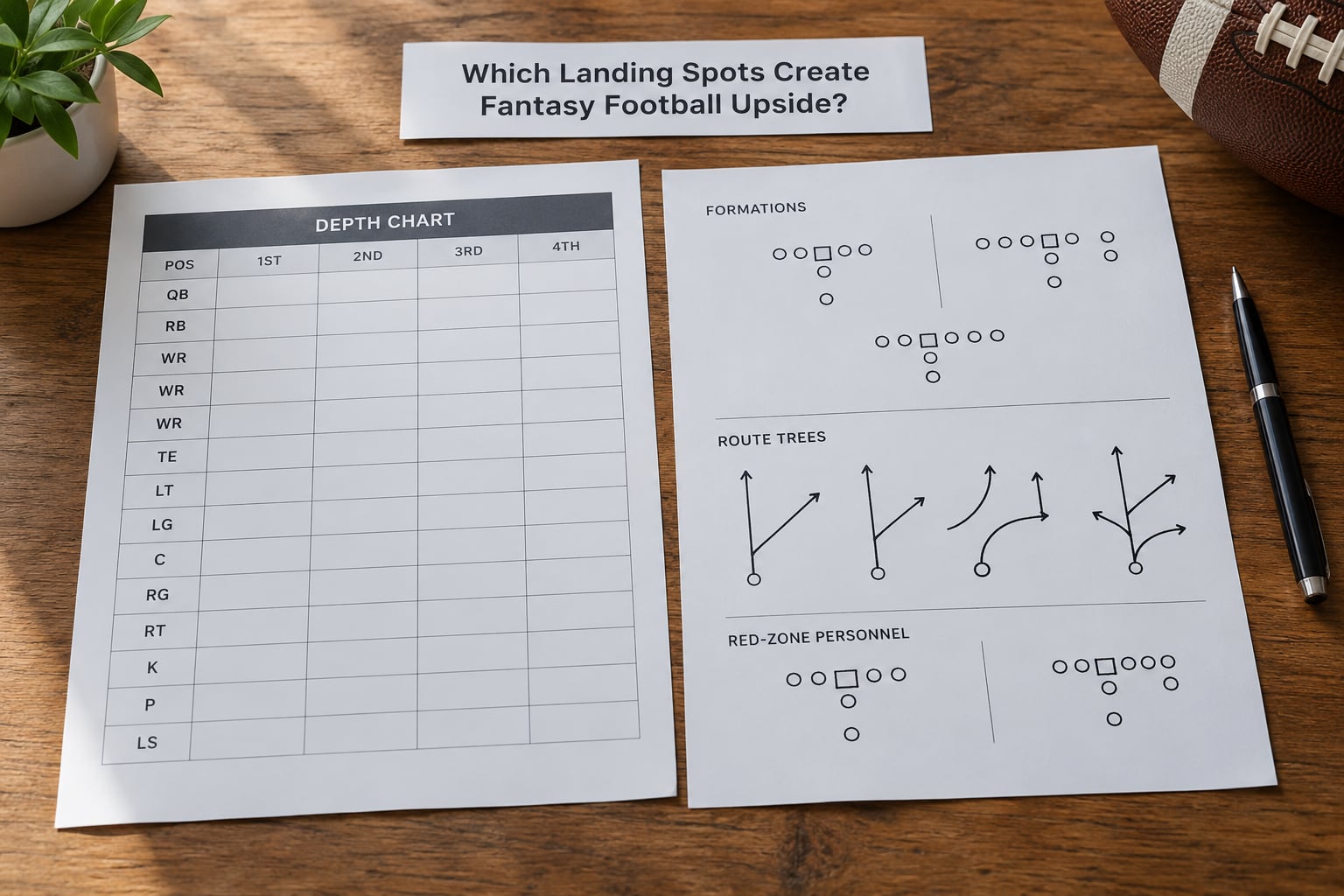
- A genuinely open job, meaning no incumbent the team is committed to.
- Early-down touches for running backs, which are more repeatable than goal-line work.
- A target pool large enough that one player can take a quarter of it.
- A quarterback who has already shown he will use that specific role.
- Real goal-line involvement for a back or tight end.
- Weak divisional competition, which matters more in dynasty formats than redraft.
- Coaching and offensive line continuity in the year the rookie arrives.
Now separate that from a good story. A great landing spot narrative usually contains one true fact and two assumptions. The true fact is the play-caller’s history. The assumptions are that the veteran ahead of him will be gone and that the rookie will be ready in September. Every draft, one of those assumptions is wrong, and the ones that get punished most are the early-breakout hopes for players who were not on the field much a year earlier.
Genuine upside and a compelling headline look identical in April. They diverge in the first three weeks, which is when target share and air yards settle the argument.
Which Landing Spots Limit a Rookie’s Fantasy Value?
The constrained spots have their own pattern, and it is not obvious from a team record. Look for these:
- A crowded committee where three players share one role.
- Low projected snap share, usually below 60 percent for a skill player.
- A quarterback coming off an inefficient or turnover-heavy season.
- An offensive line that ranked in the bottom ten in run blocking last year.
- A divisional rival that already owns the same role profile.
- An offense that structurally avoids the area of field where this player lines up.
- A starter under contract whose job the team has no incentive to vacate.
An empty depth chart is the trap in a good landing spot. Nobody ahead of you on the roster can also mean nobody was re-signed there, the veterans left because the position was a mess, and the plan is a committee rather than a job. Check the contract and the departure reason before you treat the vacancy as opportunity.
When a spot is constrained, adjust the projection instead of deleting the player. Cut the volume assumption by 15 percent and the red-zone assumption by half, keep the player on your depth chart, and let the season reveal the rest. Dropping a rookie entirely because of one bad factor is how good prospects end up on your waivers in October.
How Do You Adjust Projections for a Rookie’s Team?
Here is the repeatable version. It takes about ten minutes per player and it keeps your numbers consistent across a board of 40 rookies.
- Set the baseline. Estimate touches or targets with no team context, using your standard rookie curve.
- Apply the environment modifier. Adjust for implied team total, run-to-pass split and the quarterback’s tendencies.
- Apply the competition modifier. Subtract the share going to players ahead of him, using the share those players actually held, not their reputation.
- Inspect the red zone. Count the team’s goal-line snaps and identify who finishes them.
- Check the line. If the offensive line was bad last year, discount efficiency before volume.
- Compare against rookie benchmarks. Sanity-check the result against what rookies at that draft slot have actually averaged.
- Compare against price. If your projection matches his ADP, there is no value. Edge lives in the gap.
Worked example: a rookie wide receiver drafted into a top-10 offense with 500 pass attempts, a quarterback who throws 38 times a game, and an open slot after the leading receiver left. Baseline says 70 targets. Environment adds fifteen, competition subtracts nothing, the red zone looks neutral. That lands near 85 targets, which is a top-15 season in most drafts. Now move that same player to a bottom-12 offense with 400 attempts and a quarterback who completes 59 percent: baseline 70, environment minus eighteen, no red zone role, and the projection falls under 50. Same player, same talent grade, roughly 40 targets apart. That gap is exactly what landing spot analysis is supposed to capture.
When to Validate the Spot In Season
A landing spot thesis is a prediction, and predictions get falsified by data you can actually see. Four measurements settle most arguments by Week 3.
- Snap share. Compare the rookie’s share to his projection, not to the veteran’s.
- Target share on third down. This is where quarterbacks make or break a rookie’s weekly ceiling.
- Air yards per route run. High share with low air yards means he is being used as a checkdown filler, which scores points but caps the ceiling.
- Early-down carry percentage. If a rookie running back has no first-down touches, the role is not what the landing spot promised.
Adjust at the end of Week 3, not Week 1. Three games of small samples will make you wrong in both directions, and managers who re-rank rookies after every Sunday end up chasing noise.
Talent versus landing spot: where the crossover sits
Set the talent grade and the spot score side by side and the rule is nearly mechanical. Top-of-class talent plus a mediocre spot still produces a usable rookie, because the talent eventually overwhelms a temporary situation. Mediocre talent plus an elite spot produces a role player with a hot four-game stretch. The dangerous combination is elite talent in an elite spot, because the market prices it immediately and leaves nothing for you.
The practical implication: on Day 3 picks, weight the spot at roughly 70 percent and the talent grade at 30 percent. On first-round picks, flip that. I have watched managers apply a single ratio to a 40-player rookie board and then wonder why their Day 3 hits keep landing on their waiver wire.
How Landing Spot Affects a Rookie’s Fantasy Value in Dynasty Leagues
Dynasty changes the question from how many points will he score this year to how many seasons of usable production remain. That shifts the weight toward stability and away from a single year’s implied team total.
In redraft, a pass-heavy team with a crowded receiving chart can be the flier spot, because next season’s draft removes everyone. In dynasty, that same crowded chart is a liability, because incumbents stay. The long-term variables that deserve more weight than they get are offensive coordinator continuity, offensive line trajectory, age of the players ahead of him, and contract commitment at the position.
Best ball is where landing spot analysis has the highest return and the lowest effort. In a best ball rookie draft you pay for optionality, not for a season. A Day 3 tight end on a team with an open red-zone role costs almost nothing and occasionally produces a 15-point-per-game year, which is exactly the distribution you want to own cheaply.
Format, what a good landing spot looks like, what a bad one looks like:
| Format | Good spot looks like | Bad spot looks like |
|---|---|---|
| Redraft | High-volume offense, open role, no incumbent holding the job | Crowded committee on a slow, run-heavy team |
| Best ball | Late pick with an open red-zone role and cheap price | Any pick where the opportunity cost is your best player |
| Dynasty | Stable coordinator, young depth chart ahead of him, improving line | Two veterans ahead of him on multi-year contracts |
Redraft is the most forgiving format of the three, because the roster turns over every year and a crowded chart stops mattering sooner. Dynasty is the least forgiving, because a bad spot compounds: a bad coordinator leaves, a bad line stays bad, and the player ahead of him has no incentive to lose his job. Best ball sits between them and rewards the cheapest possible shots at a defined role.
One practical note on timing. Dynasty rookie drafts happen before the NFL draft, so you are evaluating a landing spot that does not exist yet. That is why pre-draft dynasty landing spot work focuses on destinations rather than teams: which franchises have the need, the coaching fit and a scheme that historically produces the role.
Frequently Asked Questions
How much does landing spot affect a rookie’s fantasy value?
Landing spot is one of the two strongest predictors of rookie fantasy value, alongside talent. For non-elite prospects and Day 3 picks it is frequently the dominant factor, because it decides touches, targets and red-zone looks. For a top-of-class prospect it is closer to a tiebreaker. Judge it by offensive volume, depth chart competition, quarterback quality and draft capital, not by franchise reputation.
Does landing spot or talent matter more for rookies?
Talent matters more for early picks, landing spot matters more for late picks. A first-round pick has enough talent to survive one bad season of opportunity, while a fifth-round pick almost never does. If you are drafting on Day 3, weight the landing spot near 70 percent and the talent grade near 30 percent, then reverse those weights for the top of your board.
Which position benefits most from a good landing spot?
Tight end, by a wide margin, because volume for the position is almost entirely created by scheme rather than talent. Running back landing spots swing the largest absolute point totals, but a bad line or a goal-line vulture quarterbacks can erase the volume. Wide receiver sits in between, with quarterback quality carrying most of the weight. Quarterback rookies are the least landing-spot sensitive.
What is a goal-line vulture and why does it hurt rookie running backs?
A goal-line vulture is a quarterback who takes carries at the goal line instead of handing off, usually when the defense expects a run and sits back. Those attempts are worth more than ordinary carries, so losing several per game removes the highest-value part of a rookie back’s workload. Check a quarterback’s attempts inside 20 before grading any backfield landing spot.
How do I project a rookie’s year one workload?
Start with your standard rookie curve, then apply modifiers for offensive volume, depth chart competition and red-zone usage. Sanity-check the result against what rookies at that draft slot have actually averaged rather than against a veteran equivalent. If your projection lands exactly on his average draft position, the market has already priced the spot and there is no edge left.
Is an empty depth chart the same thing as a great landing spot?
No, and this is the most common trap in rookie analysis. An empty chart can mean the job is open, or it can mean the veterans left because the position was a mess and the plan is a committee. Check whether the starter is still under contract and why the previous incumbents departed. A vacated role with organizational commitment behind it is opportunity; a vacancy without commitment is just depth.
Conclusion
Start with the role, not the franchise. Name the job the rookie is expected to hold, count the realistic touches or targets that job produces, and only then adjust for offensive volume, competition, quarterback tendencies and long-term stability. Landing spot analysis matters most exactly where talent analysis is weakest, which is why it moves values most in April at the end of the draft and again in training camp when roles get clearer. Get the role right and most of the rest takes care of itself.