A dynasty orphan team takeover is the process of adopting a team its previous manager walked away from. You inherit the roster, the draft picks, the roster spots, and usually the league dues already paid, then decide whether to rebuild, reload, or compete with what you were handed. The mechanics take about ten minutes on Sleeper, Fantrax, MyLeague, ESPN, or FFPC. The hard part is the season that follows.
Here is the part that should make you slow down. A Sleeper-based analysis posted in r/fantasyfootballadvice, built on 6,916 dynasty roster-seasons where the owner changed from year to year, found that new orphan owners completed trades about 6.3% below market value in their first season. Returning managers came out at +1.9%. New owners also made a median of four trades versus three.
The gap survived the obvious excuses. After matching teams on roster strength, new owners were still about 6.2% below market while returning owners sat near +3.2%. Managers with ten or more prior trades still went under by roughly 4.1% in their takeover season. And in the 3,457 cases where the same person also traded in another league that year, they did roughly three percentage points worse in the league they had just taken over.
So this guide is about how to run a dynasty orphan team takeover as a deliberate process rather than a reaction to a roster that looks nothing like yours. Budget a full weekend for the audit, then treat trading as a short, rationed activity instead of a weekly habit. Most of the improvement comes from doing less, earlier and on purpose.
Table of Contents
- What You Need
- Step-by-Step: How to Run a Dynasty Orphan Team Takeover
- 1. Audit the inherited roster and league rules
- 2. Set the team’s competitive direction
- 3. Identify core assets and weak links on a dynasty orphan roster
- 4. Plan trades, waiver claims, and draft picks
- 5. Build the first-season roster strategy
- 6. Reassess after the first two months
- Common Mistakes
- Tearing everything down on day one
- Overvaluing aging stars
- Ignoring league settings
- Trading away draft capital too early
- Changing everything without a written plan
- Believing you cannot tank without consequences
- Frequently Asked Questions
- Should I rebuild an orphan dynasty team immediately?
- How do I value players on a newly inherited dynasty roster?
- What is the best first move after taking over an orphan team?
- Should I keep aging stars or trade them for younger players?
- How do I handle an orphan roster with many injuries or declining players?
- How often should I reassess an orphan team takeover plan?
- Conclusion
What You Need

Before you touch a single player, gather five things. Skipping this prep is how first-season owners end up making three impulsive swaps in week two.
- League rules and settings. Roster size, taxi or IR slots, flex construction, scoring format, trade deadline dates, whether the league uses a slow draft or auction, and how standings ties break. Scoring changes everything: a tight end league makes a 20-year-old blocker worth real money, a 2-point league barely values running backs at all.
- Any notes the previous manager left. Sleeper and Fantrax both carry a team notes field. Even one line about a player’s off-field situation is worth more than a week of your own guessing.
- A player valuation source. Use a dynasty-specific valuation or projection set, not a redraft site. Dynasty values weight age, contract length, and the rookie class far more heavily.
- Your own draft capital list. Write down every pick you hold for the next three years before you value it in a trade. People discount future picks because they feel abstract, not because they’re worthless.
- A written walk-away price for each sellable asset. Decide the minimum acceptable return before any offer arrives, in writing, where you’ll see it.
A spreadsheet or a dedicated dynasty platform handles the rest. One tab per position with age, contract, and value columns is enough. If your league platform has trade history, turn it on now so you can see what this league has actually paid for similar packages before you negotiate.
If you haven’t checked the bylaws, do that too. Several questions need answers before you adopt: does the dues payment carry over, what happens if multiple orphans appear at once, and is there anything in the rules about rebuilding. Rules that look trivial in January can settle arguments in September.
Step-by-Step: How to Run a Dynasty Orphan Team Takeover
1. Audit the inherited roster and league rules
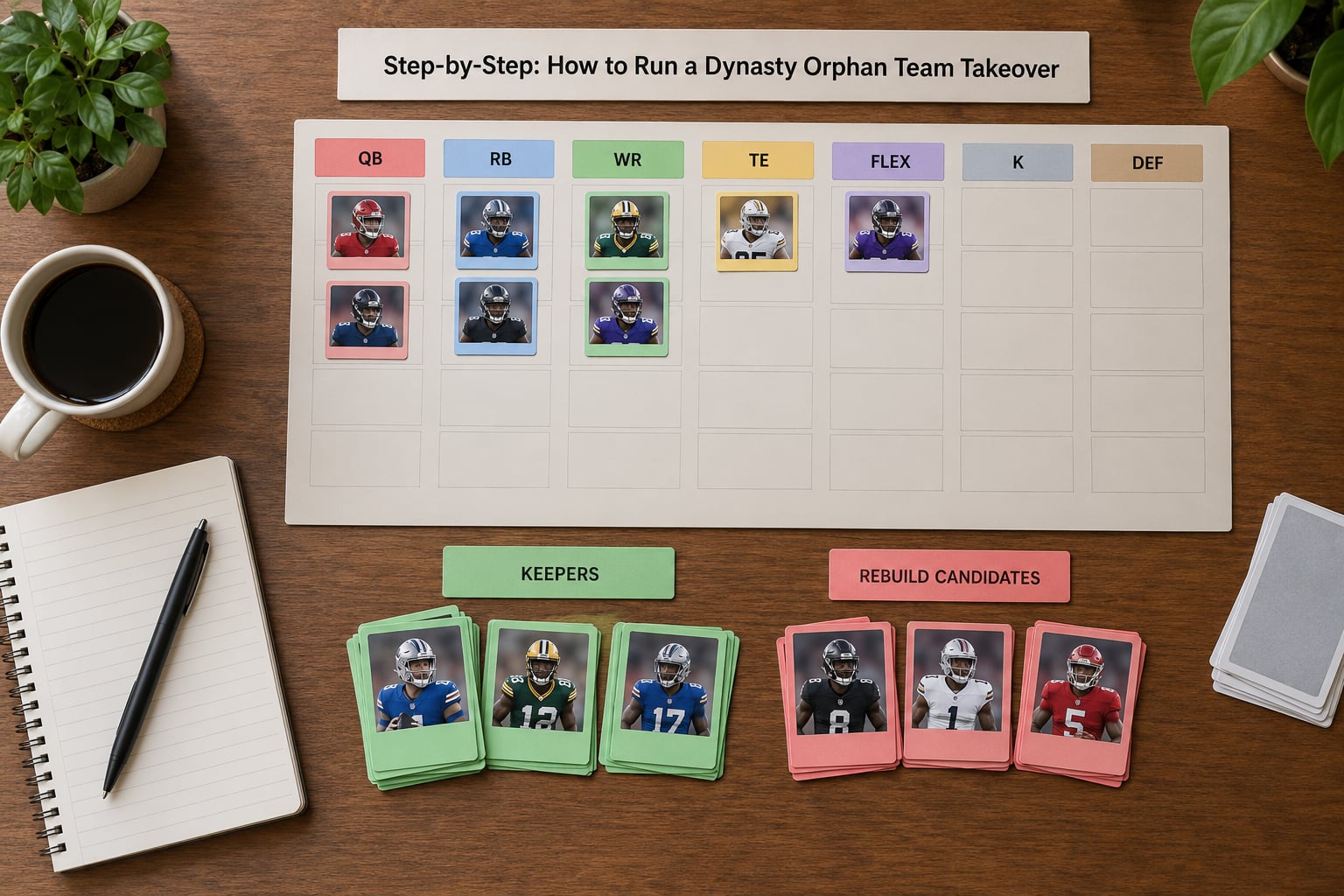
Give every player one row: position, age, contract years remaining, current dynasty value, and a one-word note on role. Do the same for every draft pick you inherited, including future years. The point is not to decide anything yet, it is to replace the vague feeling that this team is bad with an actual list you can sort.
Sort that list by age and mark anything past the rough thresholds where a position’s value curve turns down: running backs around 25, receivers around 27, quarterbacks around 34. Those are guides rather than rules, and position scarcity in your league will shift them, but they give you a fast first cut at sell candidates.
2. Set the team’s competitive direction
Pick one of three directions and write it at the top of your spreadsheet: compete now, rebuild, or retool. Retool means you keep the young core and replace everything around it. Choosing is the step; most of the damage comes from running all three at once.
Match the direction to your timeline and your league’s trade market. A rebuild in a 12-team league where four owners are also rebuilding has almost no buyers, because everyone wants the same thing you do.
Contend. Fits a top-12 roster with two or three players under 25 worth building on. Timeline: win inside two seasons. Trade posture: buy depth and youth, sell aging veterans at peak value.
Retool. Fits one or two keepers, little else, and usable draft capital. Timeline: competitive in three to five seasons. Trade posture: sell spare parts for picks, refuse to sell the core.
Rebuild. Fits a roster with no player under 24 and no first-round picks this cycle. Timeline: four to six seasons. Trade posture: fire sale, then stay quiet through the trade window.
The rookie draft is your real deadline. A rebuild that starts in 2026 and targets a top-three finish by the following rookie draft has two full cycles of incoming classes; one that starts a year late has one. Set your target finish against the draft board, not against a calendar.
3. Identify core assets and weak links on a dynasty orphan roster
Sort the audit into three columns: keep, sell, and depth. Keep means you’d build the next three seasons around that player. Depth means a cheap body at a position you already have two of. Everything else is a trade candidate, and you should be able to say why for each one.
Two habits make this faster. First, judge upside rather than last year’s stat line, since the previous manager’s lineup choices tell you very little about a player’s ceiling. Second, price by scarcity in your league: the only starting tight end on a roster is worth more than the thirty-fourth receiver, regardless of either one’s raw projection.
Watch for the shallow-roster trap that comes up constantly in takeover threads on r/DynastyFFTradeAdvice. Owners inherit one star and a pile of replacement-level players, then assume the fix is trading the star. Usually the star is the only reason anyone will respond to your messages at all. Fix depth with waiver claims and free agents first, and trade the star only if you know exactly what you are replacing it with.
4. Plan trades, waiver claims, and draft picks
Use this order, and do not reorder it. Waivers and free agents come first because they cost nothing but attention. Draft picks come next, because they are the currency you will need later. Player trades come last, because they are the only category where you can lose real value in a single message.
On trades, the takeover-season data points one way: new owners traded more often and got worse results. Practical rules that follow from it:
- Cap yourself at two completed player trades before week four. The rest of your moves should be picks.
- Avoid one-for-one player swaps. In that dataset they were the worst format by a wide margin, at roughly 9.3% below market for new owners, because both sides negotiate on gut feeling with no anchor.
- Get at least two bidders on anything expensive before you agree to a deal. In small leagues the market is thin and the first offer is rarely the best one.
- Trade back from the top of your draft board when you need picks. Moving from 1.01 to 1.04 plus a second often gets you more total capital than selling players would.
- Write your minimum return down before you reply. Without a number, the silence after an offer becomes pressure.
5. Build the first-season roster strategy
Turn the direction into a lineup, a bench plan, and a development plan. If you are rebuilding, the honest goal is a roster that gets better rather than one that finishes sixth this year, and it helps to say that out loud so you don’t abandon the plan in October.
Fill your starting lineup with the players you intend to keep, even if that means accepting a down season. Then define a role for every bench player: one backup at your most fragile position, one upside stash from the rookie class, one low-cost lottery ticket from the waiver wire. Rosters fail when everyone is a “flex stash” and nobody is actually a starter.
On draft capital, resist stacking three future seconds into one deal to buy a player with two good years left. The received player depreciates faster than the picks you gave up, which is how inherited teams end up barren two years later.
6. Reassess after the first two months
Set a checkpoint for the end of week eight and treat it like a scheduled meeting rather than a mood. Look at four things: whether your keepers are performing as expected, whether injuries changed the age profile of your roster, whether your draft picks are worth more or less than when you acquired them, and whether your actual position matches the direction you wrote down in step two.
If the gap between your plan and your results is mostly player performance, do nothing. That is the correct response, and it is the one new owners resist hardest. If the gap is structural, meaning you hold no young players and no usable picks, then accelerate rather than extend the timeline, because every season of delay costs a rookie class.
The evidence on patience is encouraging. Among the takeover owners in that dataset who stayed and traded again the next year, median results improved from -5.9% in the takeover season to +1.1% the following year. Year one is a rough patch, not a permanent condition.
Common Mistakes
Tearing everything down on day one
Dropping a full roster because it looks foreign is the most common first-week impulse, and it usually produces an empty team with no assets. Fix: only sell what your written audit marked as a sell candidate. Give the undecided players a full season before you price them.
Overvaluing aging stars
An older player has real value, but it is value that decays, and it is the part of your roster most likely to be overpriced by you and correctly priced by everyone else. Fix: sell aging stars at the peak of their price, which is usually earlier than it feels comfortable, and take picks rather than players when you can.
Ignoring league settings
Roster size, flex spots, and scoring format decide what a player is worth in your league and in no other. Fix: before you trade, check who else in your league needs the position you are selling, and price for that scarcity rather than for the national consensus.
Trading away draft capital too early
Future picks feel small, especially when you have three of them. They are also the only assets a rebuilding team can still convert into young players. Fix: keep at least one first-round-equivalent pick per season until your roster has at least three players under 24.
Changing everything without a written plan
Serial fiddling looks productive and produces chaos. Fix: a one-page plan with a direction, a trade cap, and a walk-away price per asset. When a trade does not fit those three lines, you already know the answer without thinking about it.
Believing you cannot tank without consequences
Deliberate losing is common in dynasty and often written into the bylaws, but rules vary and the penalty can be a forfeit or a forced trade. Fix: read the bylaws before the season starts and ask the commissioner directly. If the rules say nothing, get the answer in writing. There is also a practical limit, since some platforms and leagues treat repeated extreme lineups as a conduct issue.
Frequently Asked Questions
Should I rebuild an orphan dynasty team immediately?
No. Rebuild when you have no player under 24, no first-round pick this cycle, and a clear date in mind for when the rebuild ends. If even one of those is missing, a retool usually serves you better because it keeps a usable core while you accumulate picks. Decide the direction in writing before your first trade, then give the plan two full seasons before abandoning it.
How do I value players on a newly inherited dynasty roster?
Judge on dynasty projections rather than last season’s stat line, then weight age, contract years, and positional scarcity in your league. Past 25 at running back, 27 at receiver, or 34 at quarterback, most players are worth more as trade currency than as contributors. Check what your league has historically paid for comparable players in its own trade history before you accept any offer.
What is the best first move after taking over an orphan team?
Write your roster audit before doing anything else, then claim the best available waiver wire players. That costs nothing and covers the depth problems most inherited rosters have. Resist your first trade offer for at least a week, because takeover-season data shows new owners trade more often and do worse than returning managers.
Should I keep aging stars or trade them for younger players?
Usually trade, and do it earlier than feels comfortable. Aging production is real value that shrinks every season, and your league mates price it correctly even when you overrate it. Take draft picks or genuinely young players rather than one-for-one swaps of older names, since those simple swaps produce the worst results in takeover-season data.
How do I handle an orphan roster with many injuries or declining players?
Stop adding to it first. Claim replacements on the waiver wire and replace declining players with the best available prospect on your board rather than trading for another established name. Only convert draft capital into players once you have at least three healthy players under 24, because a roster that keeps accumulating veterans without youth never becomes competitive.
How often should I reassess an orphan team takeover plan?
Twice a season is usually enough: once around week eight and once during the offseason after your rookie draft. Weekly reassessment turns into tinkering, and tinkering is how first-season owners lose value. Between checkpoints, limit yourself to waiver claims and roster maintenance so that trades stay rare, deliberate events.
Conclusion
A dynasty orphan team takeover works when you treat it as a documented process instead of a rescue job. Document the league rules, audit every player and pick, choose rebuild or reload before you trade anything, and then ration your moves.
If you do only four things this week, make them these: read the bylaws, finish the roster audit, set a walk-away price for each sellable player, and cap yourself at two player trades before week four. The owners who thrive on inherited teams are rarely the ones who moved fastest in their first season. They were the ones who did the paperwork first.