A slow auction draft runs asynchronously over days or weeks instead of one long live session, and handling one well comes down to three things: fixed nomination and bid windows, a written maximum bid for every player you care about, and a hard end date even if some roster spots are still open. Here is how to handle a slow auction draft so it finishes in a couple of weeks instead of dragging into the season.
A slow auction draft is an auction-format fantasy draft that runs asynchronously over days or weeks. Owners are assigned nomination windows, each nominated player stays open for bidding until its timer expires, and the highest bid when the clock runs out wins him. Nobody has to be online at the same time as anyone else.
Prep takes about twenty minutes before the draft opens. The hard part is not the mechanics, it is resisting the urge to renegotiate your prices every time a league mate surprises you.
- Decide your nomination window and bid window in hours, then hold the line on them.
- Multiply roster spots by the window length to know how long the draft actually runs.
- Write a maximum bid for every player on your board before the first nomination.
- Nominate early and often, including expensive players you do not want.
- Re-run your values between windows, not every hour.
- Set a draft end date with an auto-pick rule behind it.
Table of Contents
- What You Need
- How to Handle a Slow Auction Draft Step by Step
- Set a bidding plan before the slow auction draft starts
- Create clear player tiers and budget bands
- Use a nomination strategy that keeps managers engaged
- Know when to bid below your maximum
- Set a time limit and restart the auction rhythm
- Common Mistakes
- Frequently Asked Questions
- How long should each auction draft pick take?
- What is the best way to speed up a slow fantasy football auction?
- Should I bid on every player I like during a slow auction?
- How do I set a maximum bid in an auction draft?
- What should I do if other league managers keep nominating low-value players?
- Can a commissioner change auction draft rules during the draft?
- Conclusion
What You Need

Before the first nomination, you need four things settled: the league settings, a budget sheet, a ranking sheet, and a personal bid limit for each target.
- League settings. How long is each nomination window, how long is each bid window, does the timer reset on every new bid, and can more than one player be nominated at once.
- Nomination procedure. Do windows rotate manager by manager, or is nomination open to anyone whose turn it is? Some platforms let you nominate at any point in your window, which changes how early you can attack.
- Budget tracking. A shared sheet everyone can see, or your own private one. Visible budgets produce more bidding wars, which is useful to know before you set your prices.
- Ranking sheet with max bids. Every player gets an auction price and a hard ceiling. No ceiling means every bid is a fresh negotiation.
- Roster needs. Your lineup format and roster construction settled in advance, so you know whether the 20th running back is a target or a wasted dollar.
A 12-team Sleeper startup with 28 roster spots stretched to roughly three months in one r/DynastyFF thread, and the complaint came down to window length and default settings rather than bad drafting. Same format, same owner count, different window settings, different season.
How to Handle a Slow Auction Draft Step by Step
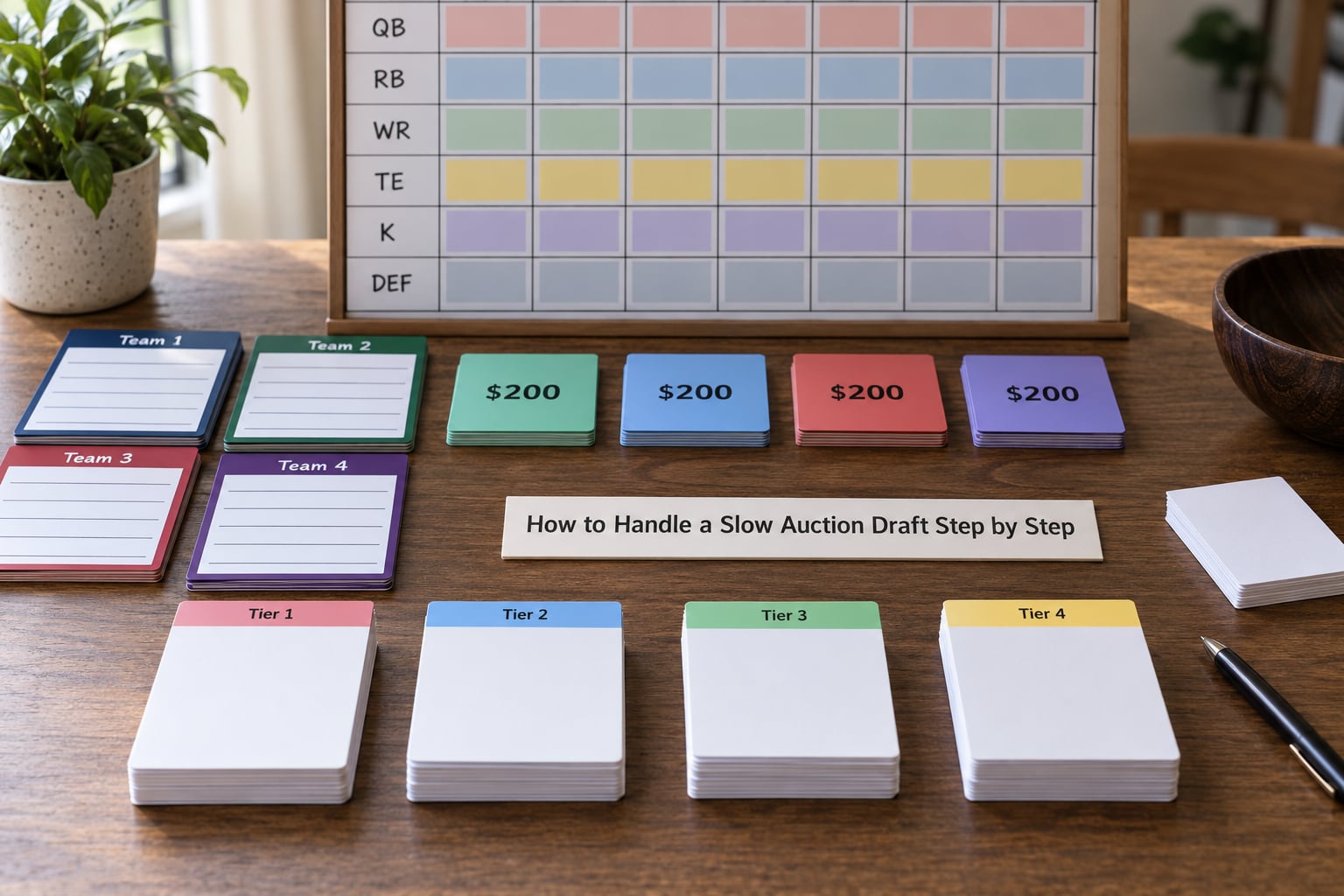
Work through these in order before the draft opens and most of the pacing problems disappear on their own.
Set a bidding plan before the slow auction draft starts
Assign every player on your board three numbers: an auction price, a stretch price, and a maximum bid. The auction price is what you expect to pay. The stretch price is what you will pay to lock a guy in before your window closes. The maximum bid is the line you do not cross, no matter what.
Then set fallback targets for each of your picks. If you lose the running back you wanted, which two players do you bid on instead? Managers with fallbacks move in about ten seconds. Managers without them sit and think, and that pause is what drags a draft out.
Write the plan down where you will see it. A spreadsheet column labelled “max” is worth more than a number you remember.
Create clear player tiers and budget bands
Group your board into tiers and give each tier a budget band. Premium names, mid-tier names that still start, and depth that fills out a bench. Then decide in advance which positions you will pay down. Quarterbacks and tight ends usually cost a rounding error in auction leagues, and spending 5 to 10 percent of your budget at those positions is what lets you outbid rivals on running backs.
Split your budget into three piles: a premium pile for the two or three players you actually want, an affordable pile for the bulk of your roster, and a reserve you do not touch until the draft is three quarters done. Most slow drafts do not fail from spending too little. They fail from a manager blowing the whole budget on a bidding war in week one.
Use a nomination strategy that keeps managers engaged
Nominate the player you want most, as early as you can. That is not a rule, it is just efficient. But the sharper move is nominating an expensive player you have no intention of buying, because it burns your league mates’ money early and shrinks the field of teams with cash left when the players you care about go up.
Follow starting running backs with their handcuffs. Nobody wants the backup, so the bid stops at one increment and the pair comes cheap. It is the most repeated piece of auction advice in the r/fantasyfootball threads, and it works because the price of the handcuff falls straight into your budget.
Avoid burning your nomination on a cheap player nobody wants. It feels productive because it is fast, and it slows the draft down more than a contested bid does.
Know when to bid below your maximum
The whole point of a maximum bid is that you occasionally stop bidding. Once a player passes your ceiling, stop. Chasing one step past your number turns a good price into a bad one, and it is the single most common way managers blow a slow draft budget.
Redirect the money instead. If a wide receiver goes for more than you planned, ask which position you are now overpaying for, and fix that in your next two bids. Every auction has value breaks, players whose price drops off a cliff when a tier ends. That drop is where the savings show up.
With proxy bidding available, set the proxy instead of babysitting the clock. Owners on MyFantasyLeague have drafted there specifically for that reason and imported the rosters elsewhere afterward.
Set a time limit and restart the auction rhythm
Total draft length is roughly your roster spots multiplied by your nomination window, because your team takes one pick per window. Work it out before kickoff and share the number with the league.
| League type | Roster spots | Nomination window | Rough calendar length |
|---|---|---|---|
| 10-team redraft | 16 | 24 hours | about 2 weeks |
| 12-team redraft | 20 | 12 hours | about 10 days |
| 16-team dynasty startup | 25 | 12 hours | about 2 weeks |
| 12-team dynasty startup | 28 | 12 hours | about 2 weeks |
| Vacation-proof dynasty | 28 | 6 hours plus auto-pick | about 1 week |
If your league is drifting past that, say something at the halfway mark rather than at the end. Three moves work, in order: shorten the nomination window, turn on auto-nominate so nobody has to wait on a silent manager, then set a hard end date with automatic picks filling anything left over.
Watch for the pattern that kills most async drafts: a nomination nobody bids on. If two consecutive nominations clear at the minimum, the league has lost the plot and needs a new cadence rather than more patience.
Common Mistakes
Bidding on every player you like. You will not win them all, and every unnecessary bid trains the league to bid you up later. Fix: bid only inside your pre-written range.
Spending in the first week. Slow drafts give everyone time to watch your budget. Managers who dump 40 percent of their budget in the first few days get targeted for the rest of the draft. Fix: hold the reserve pile until later windows.
Ignoring value replacements. If you plan to draft three quarterbacks, you need to know what the sixth and seventh quarterbacks cost before you bid on the first one. Fix: price your depth before you price your stars.
Renegotiating mid-pick. Bidding against yourself when a timer is running is the most common self-inflicted wound. Fix: place the bid that represents your maximum, then walk away from the screen.
Leaving the pace problem unaddressed. Waiting until the draft is already a month old to complain produces silence, not agreement. Fix: raise it at the halfway point with a specific number attached.
Letting rankings go stale, or refreshing them constantly. Values from week one do not survive training camp and injury news. Values updated hourly are worse. Fix: re-rank between nomination windows, roughly once a week.
One habit covers most of the rest: check in on a schedule. Owners who log in every morning bid faster than owners who check in once a week, and the slow draft rewards the owners who show up.
Frequently Asked Questions
How long should each auction draft pick take?
Set your nomination window between 6 and 24 hours and your bid window well below it, usually 2 to 4 hours. A 12-team league with 20 roster spots on a 12-hour nomination window finishes in roughly 10 days. Anything longer than 24 hours per nomination and you are drafting into your regular season.
What is the best way to speed up a slow fantasy football auction?
Shorten the nomination window first, then turn on auto-nominate, then set a hard draft end date with automatic picks. Speed comes from removing wait time, not from bidding faster. Tell the league the new pace at the halfway mark, with a specific number, because vague complaints get ignored.
Should I bid on every player I like during a slow auction?
No. Bid only inside the maximum you wrote down before the draft. Every unnecessary bid tells the league how deep your wallet goes, and in a slow auction that information gets used against you over the following weeks. Losing a player above your ceiling is cheap. Overpaying twice is not.
How do I set a maximum bid in an auction draft?
Price every player on your board before the first nomination, using last season’s real winning bids rather than generic ADP, then subtract roughly 10 percent. That number is your maximum. Re-rank between nomination windows if injury news moves a player, but never raise a ceiling mid-draft just because the bidding got hot.
What should I do if other league managers keep nominating low-value players?
Nominate high over them. Put a premium player up for bid, the one you would pay real money for, because it forces a bidding war that drains cash and makes cheap nominations look pointless. If two nominations clear at the minimum in a row, propose a batch of simultaneous nominations or a shorter window.
Can a commissioner change auction draft rules during the draft?
Yes, most platforms let a commissioner change window lengths, nomination settings and end dates mid-draft, and it is normal to do so when the pace breaks down. Avoid changing budgets or roster spots once bids are on the table. Announce any change in the league chat with a reason and an effective date.
Conclusion
Before your next slow auction draft, build the ranking sheet, write a maximum bid next to every player, split your budget into three piles, and work out your calendar length from roster spots times window hours. Nominate early, drain the league’s money with players you do not want, and stop bidding the moment a price passes your line.
If the draft is already stalling, shorten the window at the halfway mark rather than at the end. Start with a written plan instead of an improvised bidding approach, and most of the pacing problems never show up.