If you have ever wondered how a salary cap fantasy league works, the short version is this: every manager gets the same fixed budget, then buys players one at a time in a live auction. One manager nominates a player, everyone bids, the highest bid wins him, and that price comes out of the winner’s budget. Roster spots get filled by price, not by draft position.
Below is the format explained from the ground up: which rules a league has to set, how the auction and budget math work, where contracts come in, and how to spread your money so you don’t end the draft broke with three empty spots.
Table of Contents
- How a Salary Cap Fantasy League Works
- Where the format comes from
- The Basic Salary Cap Fantasy Football Rules
- How a salary cap fantasy league handles empty roster spots
- How the Auction and Player Budgets Work
- The sequence of a single auction round
- Working out your remaining cap
- Why you should reserve money early
- How Player Contracts and Salary Cap Leagues Differ
- How to Build a Balanced Roster
- Common Salary Cap Fantasy League Mistakes
- Spending the whole budget in the first hour
- Leaving nothing for your defense, kicker or bench
- Buying the name instead of the production
- Bidding on the sleeper everyone else wants
- Ignoring the settings you signed up for
- Treating a leftover budget as a win
- Frequently Asked Questions
- How does a salary cap fantasy football league work?
- What is a good salary cap for a fantasy football auction league?
- Do auction draft budgets carry over to the season?
- How do I join an existing salary cap league?
- Should I spend my whole budget during an auction draft?
- Is salary cap better than a snake draft for beginners?
- Conclusion
How a Salary Cap Fantasy League Works
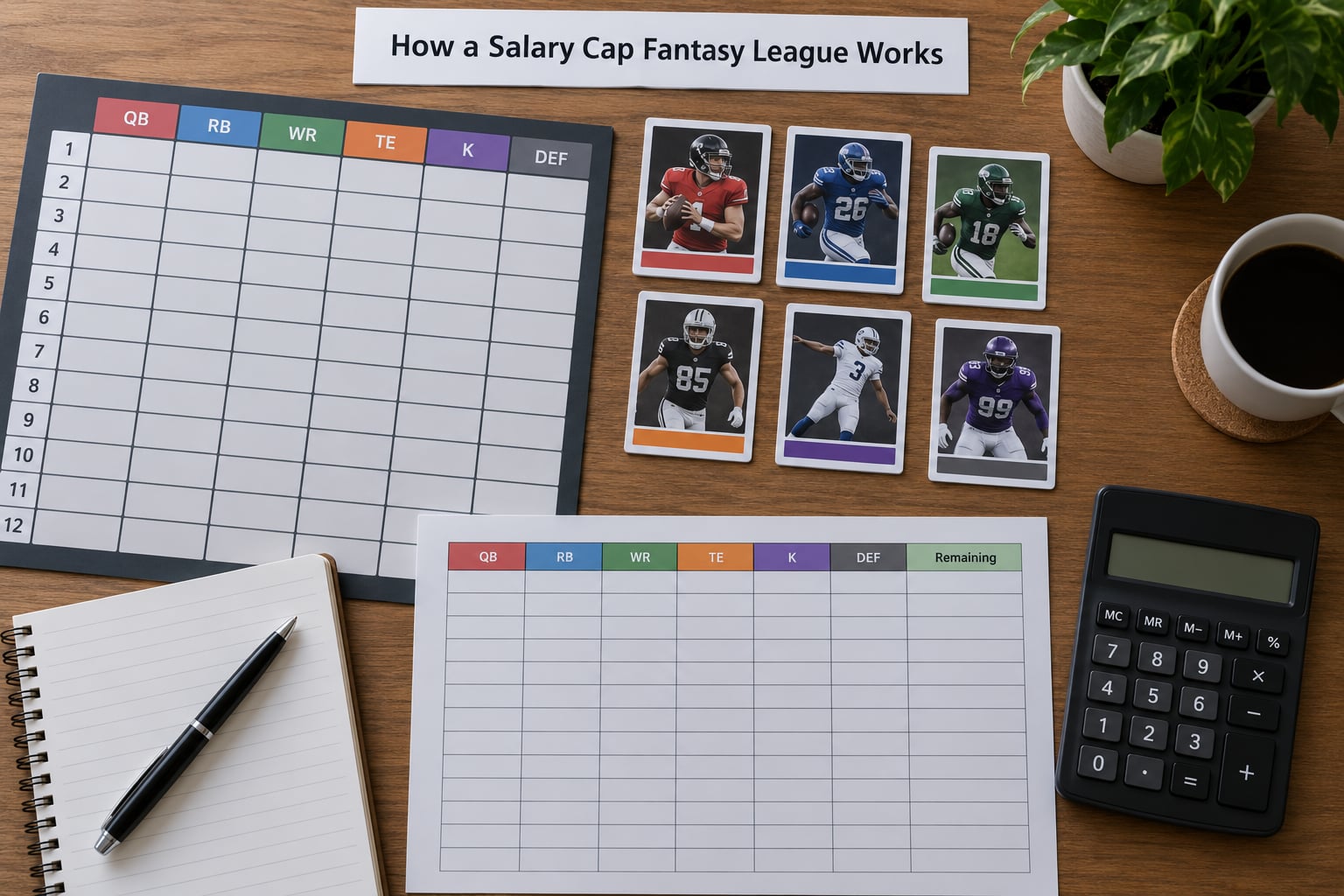
In a salary cap league, your team is built through a sequential auction instead of fixed rounds. Managers take turns putting an available player on the block, everyone else submits bids until only one manager is still in, and that manager’s winning bid is deducted from their cap space. The cycle repeats until every roster is full, then the league switches to in-season mode.
Three consequences follow from that, and they shape everything else in this guide. First, your draft slot means nothing. Second, every player is available to everyone at all times, so the strongest roster usually goes to whoever priced the auction best. Third, money is the only currency, and it is gone once you spend it.
Where the format comes from
Fantasy football auction drafts were built to mirror how NFL front offices actually operate. A real team has a fixed salary cap, it can sign any available player, and it pays whatever the market dictates rather than accepting whatever falls to it on draft night. The salary cap fantasy league copies that structure, which is why dynasty and keeper formats lean on it so heavily.
Before digital platforms, auction drafts happened in person, often with a group of managers shouting bids across a table. Interfaces like ESPN, Yahoo, Sleeper, Fantrax and MyLeague now handle the bidding, the budget tracking and the timestamps, so the social chaos is gone but the math is exactly the same.
The Basic Salary Cap Fantasy Football Rules
Every league has a settings page, and the settings decide how much of the strategy above even matters. A 16-player roster with a 200-dollar budget plays very differently from a 30-player roster with a 500-dollar budget. Get these decisions right before you study any auction strategy.
| Setting | What it decides | Common choice |
|---|---|---|
| League cap | The fantasy dollar total every team starts with | 200 for 12-16 team redraft, 300-500 for deep or two-point leagues |
| Roster size | Total players you must sign at the draft | 16 starters plus bench, or 16 total on most public leagues |
| Starting lineup | How many of your roster players score each week | 1 QB, 2 RB, 3 WR, 1 TE, 1 D/ST, 1 K, plus FLEX |
| Reserve and IR slots | Where injured or benched players sit | 2-4 bench spots, 1-2 IR spots |
| Scoring | How points are produced from your signings | PPR rewards receptions, standard rewards efficiency |
| Auction length | Clock time per nomination and per bid | 30-45 seconds per nomination, 10-20 per bid |
| Contract periods | Whether salaries last one season or several | One season in redraft, multi-year in dynasty |
| Cap reset | Whether the cap renews every season | Resets in redraft, grows or holds in dynasty |
Scoring deserves more attention than it gets. In a points-per-reception league, a receiver targeted on 20 short passes is worth far more than the same receiver in a standard-scoring league, and prices at your draft table reflect that. Read the scoring settings before you build your value sheet, not after.
How a salary cap fantasy league handles empty roster spots
Most platforms charge you a minimum salary for any roster spot you leave unfilled, commonly one dollar per empty slot, which comes out of your cap and shows up as a dead line in your weekly lineup. Some leagues also drop you below a minimum total number of players. Know your league’s rule here, because it is the one penalty that hits managers who hoarded budget and then ran out of eligible players.
How the Auction and Player Budgets Work
The auction itself is mechanical once you understand it. A manager nominates an available player, the room has a set window to submit competing offers, and when the window closes the highest offer wins. The winning salary is subtracted immediately, and the player is locked to that roster.
The sequence of a single auction round
Each round of the draft follows the same order, and knowing it removes most of the confusion for a first-time auction manager.
- The nominator puts one player on the block and names a starting price, which is usually the minimum bid of one dollar.
- Every manager submits a competing offer during the bid window, either through the app or by clicking up in an in-person league.
- Each new offer must beat the current high bid by the league’s minimum increment, which is commonly one dollar or a fraction of one.
- The window closes and the last manager in wins the player at that final price.
- The winning salary is deducted from that manager’s cap space and the next nominator goes up.
Nomination order rotates between managers, and many platforms let you pass. Passing means someone else nominates instead, which is a useful way to avoid spending cap on players you do not want.
Working out your remaining cap
Cap space is simple subtraction: starting budget minus every winning bid. With a 200-dollar cap, signing three players at 34, 26 and 17 leaves you at 123. Most managers track this on a spreadsheet with one column per roster spot, because trying to hold the whole number in your head during a fast auction is how people end up with no budget for a kicker in round nine.
Two rules trip up first-timers more than anything else. Minimum bids are usually one dollar, so you can nominate a player you genuinely want at the floor and let other managers decide they want him. And unused budget does not carry over: money left when the draft ends is gone, so cap space has a deadline that only exists during those few hours.
Why you should reserve money early
Managers who blow their budget in the first hour usually end up buying replacement-level players late, or worse, leaving spots empty. Set aside enough for your starting defense, kicker and a bench player or two before you get into bidding wars on skill positions.
A practical rule is to treat roughly two-thirds of your budget as the ceiling for your skill positions and hold the rest back. On a 200-dollar cap, that means skill players come out of a budget near 130 and the rest funds D/ST, kicker, bench depth and the injury replacements you will certainly need.
How Player Contracts and Salary Cap Leagues Differ
A redraft salary cap league keeps things short: you sign players for one season, the cap resets, and every manager rebuilds from zero. Dynasty salary cap leagues carry the same auction mechanics but add contracts, and that changes the strategy completely.
In a contract league, the money you pay is tied to a player for a number of years rather than expiring at season’s end. The core distinction managers get wrong is that contract money and cap money are not always the same pot. League rules vary widely here, so check your specific platform’s documentation, but the common setups look like this.
- Multi-year contracts. A signing can be structured across two or three seasons, with the salary and the contract length set separately. A cheap long deal for a young player is usually worth more than a large one-season salary.
- Annual raises. Contract salaries often rise a fixed percentage each year, and some leagues let you designate one player per year for a smaller raise as a reward for a good season.
- Keepers and retention. Instead of re-auctioning a player you love, you keep him for a contract cost. Some formats charge cap money for keepers, others count only against contract space, which is why two leagues with identical settings can play so differently.
- Cap growth. Dynasty caps usually rise a few dollars a year to reflect the same idea as real league salary caps, though some increase faster than others.
The practical goal in a contract league is not to win the auction. It is to acquire young talent cheaply and cheaply for long, so you can keep building while veterans come off your books. Paying a premium for a 33-year-old is a common rookie mistake because the market bids up the name, not the remaining years.
How to Build a Balanced Roster
Roster construction in an auction is a budget allocation problem. You decide in advance roughly how much each unit gets, then try to fill those units at or below your numbers. Here is one worked split for a 16-player roster on a 200-dollar cap, which you can scale to whatever cap your league uses.
| Unit | Roster spots | Target spend |
|---|---|---|
| Quarterbacks | 2 | 36 |
| Running backs | 4 | 56 |
| Wide receivers | 4 | 54 |
| Tight ends | 2 | 18 |
| Defense and special teams | 2 | 8 |
| Kicker | 1 | 3 |
| Bench, FLEX and IR depth | 2 | 25 |
| Total | 16 | 200 |
Three ideas make those numbers work. Positional scarcity means the pool of reliable starters runs out before you think it does, so the last starting tight end costs far more than the first. Depth matters more than talent at the low end, because a bench player’s job is replacing the guy above him on bye weeks or on the injury report. Replacement value is the floor price: never pay more for a player than the cheapest equivalent option on the board.
Streaming defenses and kickers is the biggest budget saver in the format. Because those spots can be filled from the waiver wire every week, spending a large share of your cap on them is wasted money. Buy cheap bodies, then improve the unit weekly.
Finally, price your own values before the draft rather than trusting the recommended auction value printed in the app. Each platform’s defaults are built on its own projections and its own user base, and they can disagree sharply. In the same draft, ESPN’s recommended price for a top quarterback often sits well above what Yahoo or Sleeper suggests, and rookie prices move the most of all. Build your own sheet from last season’s points, your scoring settings and a tier structure, and treat the app number as one opinion among several.
Common Salary Cap Fantasy League Mistakes
Most auction disasters come from money management, not football knowledge. These are the ones I see repeat year after year.
Spending the whole budget in the first hour
Early prices are inflated because the best players are on the board and everyone wants them. Bidding wars on a player you value at 38 and losing them at 60 does not just cost 60, it costs you the 60 you needed elsewhere. Set a personal maximum before you nominate and walk away when you hit it.
Leaving nothing for your defense, kicker or bench
This is how rosters end up with empty spots. Empty slots cost a minimum salary on most platforms and leave you short a player in a week when it matters most. Reserve that money first, then bid with what is left.
Buying the name instead of the production
Every league has a few players whose auction price reflects reputation rather than expected output. Veteran runners with declining roles are the classic case, because they keep going just above value year after year.
Bidding on the sleeper everyone else wants
The breakout candidates in your league are usually the same ones in every other auction league, which means they are already overpriced. Look for value one tier below the consensus pick, where prices have not caught up yet.
Ignoring the settings you signed up for
Budget sizes, minimum salaries, roster rules and scoring all change what a fair price looks like. Read the settings page once before the draft, and read your league’s specific rules on unused cap space and empty spots. They are not standard across platforms.
Treating a leftover budget as a win
Money left at the end of the draft does not roll into the season. Unused budget is simply lost, so finishing with 30 dollars in hand means 30 dollars of value you never captured.
Frequently Asked Questions
How does a salary cap fantasy football league work?
Every manager starts with the same fantasy dollar budget and builds a roster through a live auction. Managers take turns nominating an available player, everyone submits competing offers until only one remains, and the winning bid is deducted from that manager’s budget. The draft ends when all rosters are full, and unused budget does not carry into the season.
What is a good salary cap for a fantasy football auction league?
Two hundred is the standard starting point for a 12 to 16 team redraft league. Deeper rosters, two-point scoring and leagues that run through the playoffs generally need more, with 300 to 500 common for 20-plus player rosters. The number itself matters less than consistency: every manager must start with the same budget for the format to be fair.
Do auction draft budgets carry over to the season?
No. On most platforms, budget you did not spend at the draft is simply gone once the auction ends. This is the rule that surprises new managers most, since leftover money feels like a resource. Some custom league settings allow a carry, so check your league’s specific rules before you plan around it.
How do I join an existing salary cap league?
You need an invite from the commissioner or the league’s join code. Each platform handles this differently, but the flow is usually the same: create a free account, enter the league code from your invite, choose your team name and roster preferences, and confirm you understand the budget and settings. Public leagues can also be searched by format on the platform’s league browser.
Should I spend my whole budget during an auction draft?
You need to spend most of it, since unused money disappears, but not all of it. Reserve enough early to cover your defense, kicker and bench spots, then bid on skill players with what remains. A practical guideline is to cap skill position spending at roughly two-thirds of your budget and hold the rest for depth.
Is salary cap better than a snake draft for beginners?
Salary cap removes draft position luck entirely, since every player is available to everyone and you control which ones you buy. That makes outcomes depend on your valuation and budget discipline rather than your seat in the draft order. It is a steeper format to learn than a snake draft, but most managers become comfortable within two auctions.
Conclusion
Start with the settings page, not with a strategy guide. Confirm the cap, roster size and scoring, then write down your per-unit budget targets before the draft starts and treat leftover cap as money you have already wasted. The managers who enjoy this format most are the ones who treat the auction like a budget meeting rather than a race to the best player on the board.