To write a fantasy football weekly recap, open with the final score, name the week’s biggest story in one line, then move through your lineup, the bench, and the waiver wire before closing with three things to do next week. The whole thing takes 30 to 40 minutes once you have a template, and it is the only thing most of your league will read all season.
A recap is not a box score with sentences glued on. It is the one artifact that keeps a league talking between games, and the fastest way to make yours better is to give it the same structure every single week so people know where to look. Fixed sections also make it skimmable on a phone, which is where it will actually be read.
Below is the process I use, plus the template, the tone rules, and the mistakes that make commissioners quit writing recaps by week 6.
Table of Contents
- What You Need
- Step-by-Step: How to Write a Fantasy Football Weekly Recap
- 1. Start With the Final Score and Biggest Story
- 2. Review Your Starting Lineup
- 3. Explain the Bench and Waiver-Wire Impact
- 4. Turn the Week Into a League Lesson
- 5. Add Context Without Excusing the Result
- 6. Set the Priority List for Next Week
- Common Mistakes
- Frequently Asked Questions
- How long should a fantasy football weekly recap be?
- Should a weekly recap include every player on my roster?
- How do I write a recap when I lose because of injuries?
- What statistics should I include in a fantasy football weekly recap?
- How should I explain bad luck without making excuses?
- Conclusion
What You Need
A recap only works if the facts underneath it are right, so gather the raw material before you write a single sentence. Most of it lives in your league platform, and the rest comes from public stat pages.
- Final scores and standings — every team’s score, the updated standings table, and the playoff picture if the race is tight.
- Start and sit notes — who you started, who you sat, and why. Pull these before you look at the results, or hindsight will rewrite your reasoning.
- Player statlines — the top performers and the guys who hurt you, not a full dump of all 32 players.
- Injury updates — what happened, when it happened, and who picked up the snaps.
- Waiver wire activity — claims, drops, and any trades that went through.
- Roster moves — add and drop activity, including the guys who left your league entirely.
- League history and running jokes — last season’s disaster, the owner’s nickname, the punishment nobody wants to do. This is what separates your recap from an auto-generated digest.
- Week statistics — league-wide scoring averages, so a big score gets context.
Most of that takes ten minutes. Save the previous week’s recap in the same document every time, because a season of them becomes a season book later.
Step-by-Step: How to Write a Fantasy Football Weekly Recap
1. Start With the Final Score and Biggest Story
Lead with the number and the headline in the first two sentences. A recap that opens with a warm-up paragraph gets skimmed past; one that opens with the score gets read.
Then pick the single story the week actually turned on. It is usually one of three things: a lineup decision that worked or blew up, an injury nobody planned for, or a waiver claim that carried a game. State it in one sentence and use it as the spine for everything after.
Fictional example: “Week 9 ended 112-104, and the whole thing came down to my running back on a 10-point Thursday night game against a kicker who scored 21.” That sentence tells the reader what the recap is about before they commit to reading it.
2. Review Your Starting Lineup
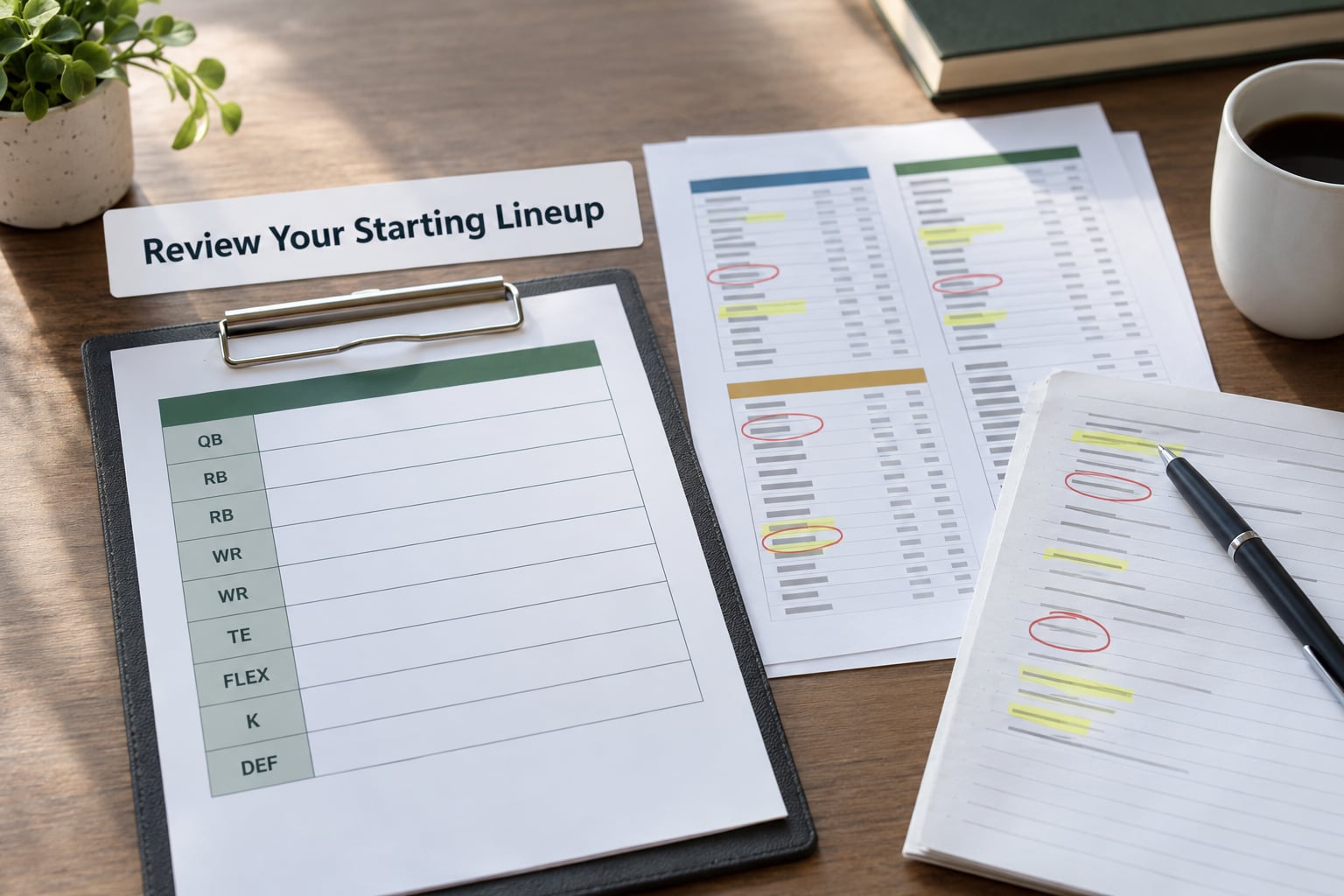
Sort your starters into four buckets so the recap stays readable: who carried the week, who changed roles, who surprised you with volume, and who disappointed. Give each bucket two or three names, not the full lineup.
The part most people skip is separating the start decision from the outcome. A call can be right even when the player puts up 6 points. “I started him because the injury reports had him limited to 60 percent of snaps, and that’s exactly what he got” is a better recap line than either bragging or groaning.
Fictional example: “I benched my tight end for the third straight week and it cost me nothing, which tells me more about my league rivals than it does about me.”
3. Explain the Bench and Waiver-Wire Impact
The bench is where recaps usually go silent, and it’s the section owners care about most. Name who sat on your roster, what they did on the field, and whether a claim or swap would have changed the score.
Be honest about replacements. A waiver wire pickup that produced a solid week matters more than a starter who went quiet, and saying so out loud is what makes people read the rest of the recap. Then credit the moves that paid off across the league, because those are the reads that separate active managers from ones who set their roster in September.
Fictional example: “Two teams streamed their kicker after a late scratch and both outscored me. That’s on me for treating the last flex spot like a formality.”
4. Turn the Week Into a League Lesson
One week of results is a story, but it’s only useful if it points somewhere. Connect the score to a decision: the trade you should have made, the matchup you should have planned around, the kicker strategy that keeps costing you in year four, or the bye-week coverage you don’t have.
Keep it to one lesson. Two lessons in a weekly recap means neither lands, and the paragraph starts sounding like a lecture nobody asked for. A single concrete line — the specific thing you or the league should do differently — is worth more than three paragraphs of general strategy.
5. Add Context Without Excusing the Result
Bad luck and bad decisions feel identical on a scoreboard, and a recap that treats them the same teaches you nothing. Name the excuse, then name the decision that created the room for it.
Injuries, a brutal schedule, and a couple of 6-pointers are real and worth one sentence each. After that, keep ownership. “I lost because of injuries” and “I lost because I started three players I knew were risky and hoped for the best” are both descriptions of a loss, and only one of them is honest.
Fictional example: “Two of my scoring starters left early with injuries. That’s the honest headline. The real story is that I had nobody on the bench, which I’ve now fixed twice.”
6. Set the Priority List for Next Week
End with action items, not a sign-off. Three specific things is the sweet spot: one lineup decision to make before kickoff, one player or matchup to monitor, and one waiver priority.
This is the section that makes people come back next week. A recap that only describes the past is a diary; one that hands the reader a short to-do list becomes part of how they manage their team. Fictional example: “Before Sunday: kicker is a coin flip, so take the one with a home game. Monitor the two receivers sharing a slot. First waiver priority is whoever plays the 30th-ranked pass defense.”
Common Mistakes
Nearly every weak recap I have read fails for one of the same reasons. These are quick to fix.
Recapping every player. A stat dump is not a recap. Owners want the six names that mattered and the reason, not all 32 with their projections.
Writing an excuse instead of a recap. A paragraph explaining why you deserve better points is the fastest way to lose the room. State the excuse in a sentence, then move to what changed.
Ignoring the bench. If your recap never mentions who you sat, it reads like it was written without looking at your own roster.
Vague conclusions. “Good luck next week” tells the reader nothing. Three concrete actions do.
Copying scoreboard text. Pasted league stats read like spam. The data is your raw material, not your content.
Treating luck like process. A win built on three lucky bounces is not a repeatable strategy. Say which one it was, in writing, so you don’t build the wrong lesson on it.
Publishing into the void. Post Tuesday morning, not Sunday night. Nobody is checking the league at 11 p.m. on a Monday, and a recap nobody opens feels like wasted effort.
Frequently Asked Questions
How long should a fantasy football weekly recap be?
Aim for 400 to 700 words in a league of 10 to 14 teams. That works out to roughly 30 to 50 words per matchup plus a short opener and a look-ahead. Treat 800 words as a hard ceiling for anything posted in a group chat, because walls of text get closed on a phone. In a 6-team or 2-player league, 250 to 350 words is plenty.
Should a weekly recap include every player on my roster?
No. Cover the players who changed the result: your top two or three scorers, the biggest disappointment, anyone whose role shifted, and anyone sitting on your bench who would have helped. Naming all 32 players turns the recap into a stat sheet nobody finishes reading. If a player produced a completely ordinary week, leave them out and save the space for the waiver wire.
How do I write a recap when I lose because of injuries?
Give the injuries one clear sentence each, with the timing, then pivot to what you can control. Say whether you had a replacement on the bench, whether you drafted that position thin, and whether you should fix the roster before kickoff. Owners respond well to honest bad luck, but not to a full paragraph defending a result they already saw. Accountability and accuracy are not opposites.
What statistics should I include in a fantasy football weekly recap?
Keep it to five categories: final scores, the top scorer in the league, your best and worst performers, the waiver claims that mattered, and the updated standings or playoff picture. Big scores need context, so compare them against your league average before calling one dominant. Skip projections and advanced metrics unless your league specifically talks in those terms.
How should I explain bad luck without making excuses?
Name the bad luck, attribute it to something external and verifiable, then take responsibility for the part that was your decision. Two sentences work best: one for what happened, one for what you will do about it. A recap that only accepts blame reads as false modesty, and one that only accepts excuses reads as a complaint. Splitting it into luck and process keeps you credible in both cases.
Conclusion
A good recap is short, structured, and finishes with homework. Open with the final score and the week’s biggest story, walk through the lineup and the bench, name one lesson, split luck from process honestly, and close with three specific actions for next week. Keep the same sections every week so readers build the habit of opening it. Then save it, because a season of recaps is worth more than any single one of them.