A short clock means your league gives you 10, 15, 30 or 60 seconds per pick and the platform makes your selection for you the second the timer hits zero. Handling one comes down to four things: a position priority sheet finished before draft day, a hard cap on how long you think per pick, a three-tier player board, and an auto-pick queue that cannot wreck your roster. Total draft length is simply total picks multiplied by seconds per pick.
It takes maybe twenty minutes of prep to get right. Skip the prep and a thirty-second draft turns into thirty seconds of panic every round, which is where unbalanced rosters come from. Two quarterbacks, three tight ends, no kicker.
Table of Contents
- What You Need
- How Long a Short-Clock Draft Actually Takes
- Pick-Time Settings by Platform
- Step-by-Step: How to Handle a Draft With a Short Clock
- Set Your Draft Clock Rules
- Build a Position Priority List
- Use a Three-Tier Player Board
- Make Fast but Value-Based Picks
- Adjust When Your Plan Breaks
- Common Mistakes
- Frequently Asked Questions
- What happens if the draft clock runs out?
- How many seconds per pick should my fantasy draft have?
- How do I change my draft timer?
- Is autodraft a good strategy?
- How do I pause a fantasy draft?
- Should I draft my positional needs first or take best player available?
- Conclusion
What You Need
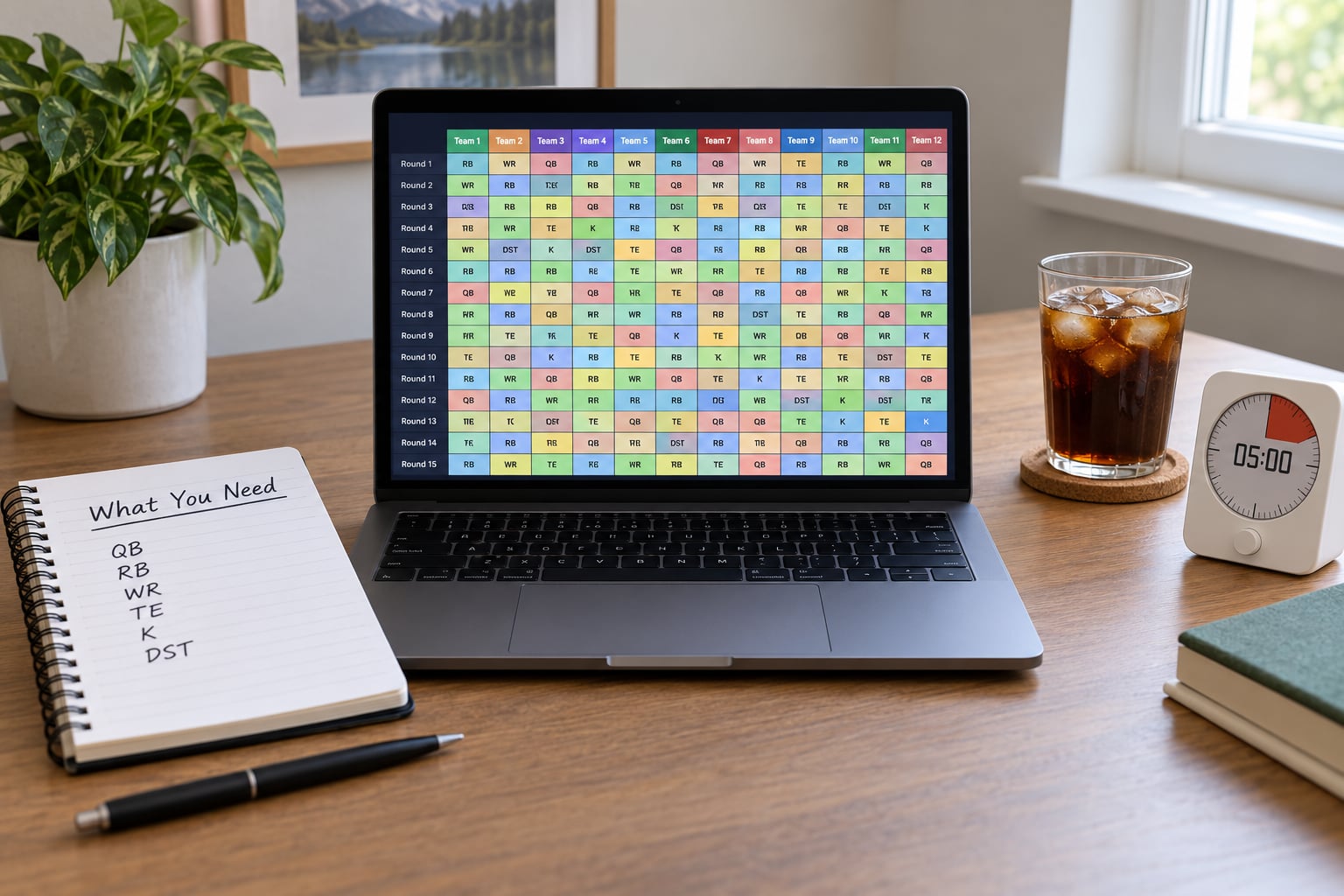
Four things, and three of them are built before your league’s draft room opens.
First, the draft board on the device you will actually use. FantasyPros runs a big pre-draft mock on a laptop; ESPN, Sleeper, Yahoo, Fantrax and FanDraft each have their own board. Know which one you will have open at 8:50pm on draft night, because setting up a new interface mid-draft is how people lose two minutes per pick.
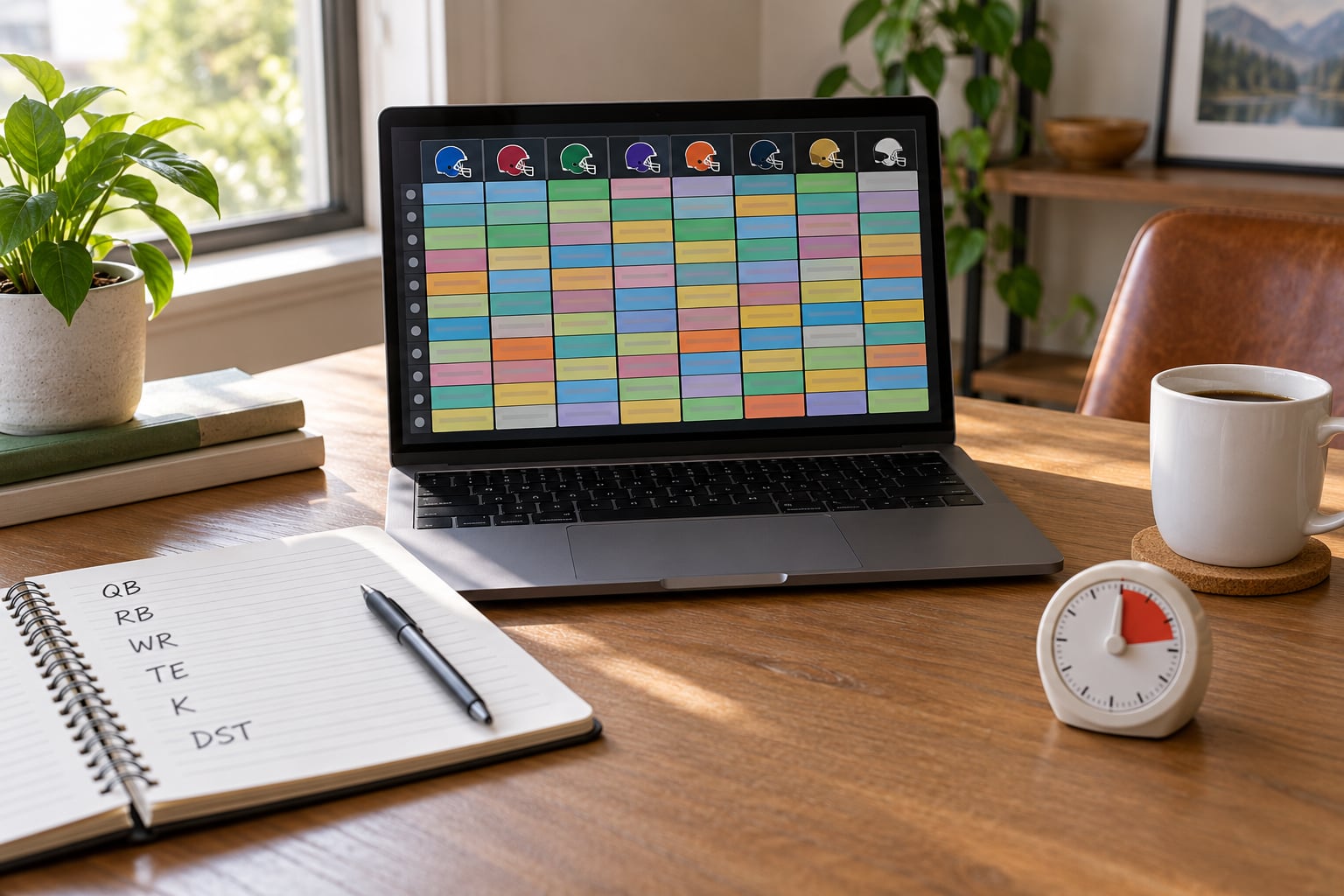
Second, a one-page priority sheet with your positions in ranked order and two or three named players at each spot. Handwritten works fine. What matters is that the decision has already been made somewhere other than your head at 8:23pm.
Third, tiers rather than a flat player list. Grouping 200 guys into eight or ten tiers turns one huge question into a small one: which tier am I drafting from right now?
Fourth, an auto-pick queue loaded with players you would actually take. Every major platform lets you queue names in advance, and that queue is what the system uses when your timer expires. Left empty or filled with a half-thought list, it is the single biggest cause of bad fast-draft teams.
Also useful: a phone with notifications on as a backup device, a timer app if your platform’s clock is hard to see, and a clear rule for yourself about how many seconds you are allowed to deliberate.
How Long a Short-Clock Draft Actually Takes
The whole-draft length is one multiplication. Take the number of teams multiplied by the number of rounds to get total picks, then multiply that by the seconds per pick. That is your ceiling if every owner uses the full clock, which nobody does, so treat it as a maximum rather than a promise.
| League size | Rounds | Total picks | At 30 seconds | At 60 seconds |
|---|---|---|---|---|
| 10 teams | 16 | 160 | 80 minutes | 2 hours 40 minutes |
| 12 teams | 16 | 192 | 96 minutes | 3 hours 12 minutes |
| 14 teams | 16 | 224 | 1 hour 52 minutes | 3 hours 44 minutes |
| 16 teams | 16 | 256 | 2 hours 8 minutes | 4 hours 16 minutes |
Those ceilings assume everyone burns the clock. Most leagues finish well inside them, which is exactly why owners grumble that their six-hour live draft dragged for three hours anyway: pick time is a ceiling, not a floor.
Pick-Time Settings by Platform
If you are the commissioner, the setting usually lives in league settings and is usually yours alone to change. ESPN lets you set pick time from 15 seconds all the way up to 24 hours for slow drafts, with 60 to 90 seconds the most common setting for live drafts. Sleeper, Yahoo and Fantrax all expose a pick timer in the same league settings area, and on every one of those platforms the commissioner owns it once the draft is created.
| Platform | Where the setting lives | Who controls it | Changeable once the draft starts? |
|---|---|---|---|
| ESPN | League settings, draft settings | Commissioner | Yes, in most cases |
| Sleeper | League settings, draft settings | Commissioner | Yes |
| Yahoo | League settings, draft settings | Commissioner | Yes |
| Fantrax | League settings, draft settings | Commissioner | Yes |
| FanDraft | SETTINGS, including When Clock Hits Zero | Commissioner | Yes |
One FanDraft trap worth repeating: the platform does not send a notification when it becomes your turn. In a slow draft that gets people auto-picked without noticing.
What happens when the timer runs out is entirely down to the league’s clock-expiry setting, and this is the question most short-clock leagues never sort out beforehand.
| Platform | What happens at zero | How you control it |
|---|---|---|
| ESPN | Auto-picks for you | Commissioner sets pick time; queue drives the pick |
| Sleeper | Auto-picks from your queue | Load the queue before the draft |
| Yahoo | Auto-picks for you | Queue drives the selection |
| Fantrax | Auto-picks for you | Queue drives the selection |
| FanDraft | Auto-pick, or nothing at all | SETTINGS, When Clock Hits Zero, then Nothing Happens |
Step-by-Step: How to Handle a Draft With a Short Clock
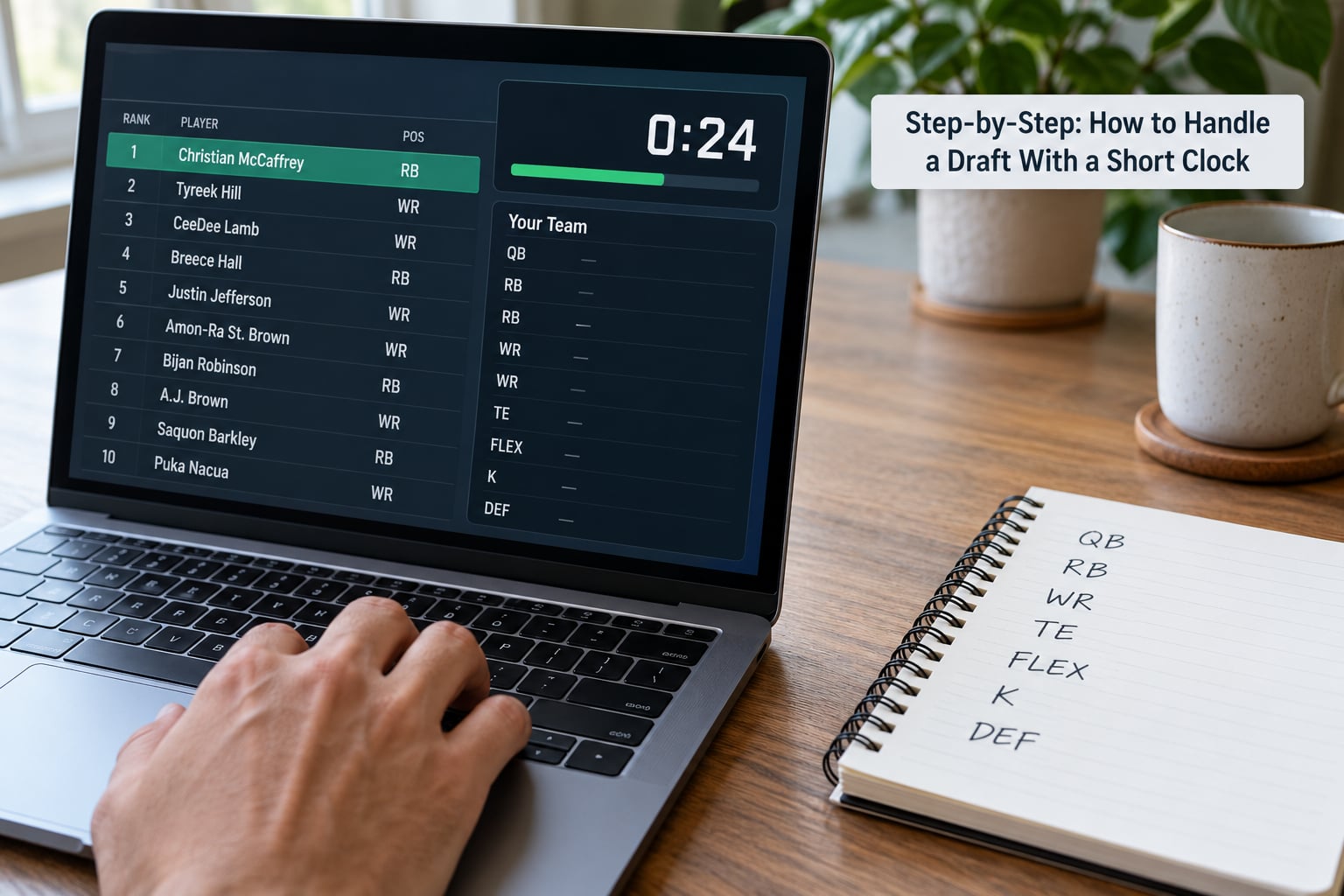
Set Your Draft Clock Rules
Give yourself a per-pick budget of about two-thirds of the time you are given. On a thirty-second clock that is twenty seconds of thinking; on a fifteen-second clock it is ten. Write the number on the sheet next to your priorities so you can see it without thinking about it.
Then split your effort by round. Early rounds deserve the most time because talent runs out and the board shape sets your ceiling. Middle rounds should be brisk: take the best player available at a position you still need. Late rounds past your last meaningful starter should take about two seconds each, and that is not laziness, it is correct.
Decide now which picks get real deliberation and which get snap decisions. My rule is that the pick right after a big run at your target position always gets extra attention, because that is the one place where you have a real choice to make.
Build a Position Priority List
Rank your positions before the draft and put the list somewhere you can see from your seat. Build it from four inputs: scarcity at your draft slot, your league’s roster construction, your scoring format, and replacement level. A PPR league makes running backs scarce in a way standard scoring never does, because receiving work has value that the rushing column cannot show.
Attach two or three specific names to each position so a surprise pick at the top does not start a search. If your first choice at a position is gone, you have a next name ready. Without one, you re-open every projection and lose the entire clock.
Handling a draft with a short clock really comes down to that list existing in writing before the first pick. A priority sheet turns a twenty-second decision into a three-second lookup.
Use a Three-Tier Player Board
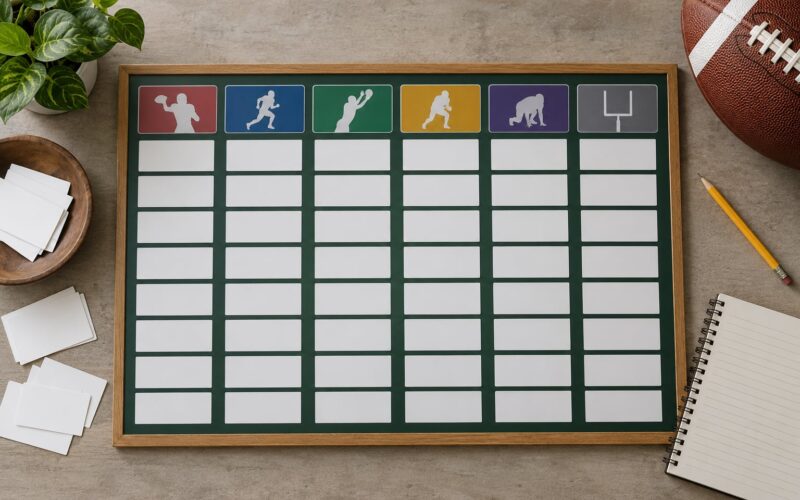
Split your board into three buckets: must-have targets you will take early at any reasonable price, preferred values you take when they fall to you, and late-round flyers you grab in the final two rounds without thinking. That split is what stops you from re-ranking 200 players every time the clock starts.
Keep the tiers small. A must-have bucket of eight to twelve names is plenty for the first four rounds of most leagues. Everything else goes in the middle bucket sorted by position and average draft position, so when a tier two wide receiver is sitting there at 9.03 you can find him in a second.
The third bucket is the one people skip and regret skipping. Naming your three to five flyers in advance stops the last two rounds from becoming a coin flip, and it costs nothing.
Make Fast but Value-Based Picks
Use one repeatable comparison whenever you have more than one candidate, and stick to it. Check positional scarcity first, then opportunity, then age, then roster fit. That order matters: scarcity beats raw projection because a player going in round two is worth less than the same projection sitting in round six.
Do not overvalue tiny projection differences. A three-point gap in weekly points is noise, and treating it as signal is what pushes people into reaches. Value over replacement is the number that should move you, not a fifth decimal place.
On a thirty-second clock I do exactly this: glance at scarcity, glance at the board shape, make the pick. Roughly ten seconds, start to finish. If two players are within a few picks of each other in average draft position, take the one at the position you need and move on.
Adjust When Your Plan Breaks
Something always goes wrong. A run takes three tight ends in two rounds, someone reaches three rounds early, or your own priority gets reshaped by a bad injury report. The recovery is to fall back to the replacement level you wrote down before the draft, not to chase the guy who just went.
When a weak position appears in the middle rounds, do not solve it with a panic reach. Take the best player available, keep drafting, and address it with the undrafted player list later. A roster with balanced positions and late-round flyers usually beats a roster with three early-round tight ends.
If your own timer expires, treat the damage as done rather than compounding it. Look at who got auto-picked, note whether your queue can be improved, and move on with the next round. Rebuilding your whole board after a bad pick is how one mistake becomes two.
Common Mistakes
Drafting your board as if you had an hour. The fix is the two-thirds rule. Twenty-second thinking on a thirty-second clock leaves room for the pick to actually register, and it stops you from getting skipped by a pick you had finished three seconds earlier.
Leaving the auto-pick queue empty or lazy. Queued picks are your picks, just made by the machine. Fill it with names you would actually take in that slot, in order, and re-check it every round or two.
Ignoring positional scarcity. When three players at one position fly by in a round, that position is now the cheapest thing on the board relative to its value. Under a short clock this is harder to notice because you are not reading the whole board.
Reaching to avoid a later round. A fast draft tempts you to jump on anyone who looks safe. Reach two full rounds early and you have paid a real price for a feeling.
Spending your deliberation on positions that do not matter yet. Your kicker in round nine has never once changed a season. Save the seconds for the running back tier.
Picking during lunch, a commute or a work call. The single most common cause of a bad auto-pick is not a bad league setting, it is somebody drafting from a parking lot. If you cannot give the draft twenty honest minutes, take the picks you can take and queue the rest properly.
Two habits help more than the rest: keep a running note of who fell to you unexpectedly, because those are your waiver-wire and trade assets later. And check your queue before every round rather than only at the start, since positions run out of names faster than you expect.
Frequently Asked Questions
What happens if the draft clock runs out?
On ESPN, Sleeper, Yahoo and Fantrax, the platform auto-picks for you the moment your timer expires, taking the top available player from your pre-set queue. FanDraft gives you a choice: it can auto-pick, or you can set When Clock Hits Zero to Nothing Happens so the pick simply stays open until you act. Check that setting before draft day rather than after your first queued selection shows up on your roster.
How many seconds per pick should my fantasy draft have?
For a standard live redraft, 30 to 60 seconds per pick is the range most leagues settle on, and 60 to 90 seconds is common on ESPN for live drafts. Go below 30 seconds only if the league is large, the scoring is simple, or everyone is a competent drafter. Very fast clocks push the outcome toward draft position and pre-built tiers rather than in-the-moment decisions.
How do I change my draft timer?
The commissioner changes it, in league settings under draft settings. ESPN allows pick times from 15 seconds up to 24 hours for slow drafts. Sleeper, Yahoo and Fantrax all expose a pick timer in the same settings area, and FanDraft keeps its options under SETTINGS. On most platforms you can adjust the timer after the draft has started, which matters when the league turns out to be moving far faster than everyone expected.
Is autodraft a good strategy?
Autodraft on its own produces unbalanced rosters, most often two quarterbacks or a pile of tight ends, because it follows a positional order rather than your league’s construction. Used as a backstop it works well, which is why the queue matters: fill it with names you would take, in order, and it stops being a failure mode and becomes a safety net for the round where you are at dinner.
How do I pause a fantasy draft?
Every major platform has a pause control that the commissioner can trigger from the draft room, and FanDraft exposes a pause button directly as well. Pausing is the cleanest fix when a league cannot assemble at the scheduled time, since it stops the timer entirely rather than letting it run against whoever is on the clock. Tell the league in your group chat before you pause, because nobody notices a stopped clock.
Should I draft my positional needs first or take best player available?
Under a short clock, best player available wins most rounds because you have no time to weigh reach against need, and reaching costs more than the fit is worth. Use your priority list as the tiebreaker rather than the rule: when two players are close in value, take the one at the position you need. Save the strict needs-first approach for the first round or two of a league where scarcity is genuinely extreme.
Conclusion
Handling a draft with a short clock comes down to four moves, and all of them happen before draft night. Finish your position priority sheet with names attached. Cap your thinking at two-thirds of the clock and spend most of it in the early rounds. Tier the board so a pick is a lookup rather than a search. Load the auto-pick queue with players you would actually take, and let the timer expire honestly rather than scrambling.