
To set a fair fantasy league entry structure, you agree in writing on four things before anyone drafts: who is playing, what each person pays in, how the prize money is split, and which rules stay locked once the season starts. Everything else — scoring, roster size, waiver style — sits underneath those four decisions.
The whole job takes about an hour, and most of that hour is writing things down. Disputes in a friend league almost never come from bad scoring settings. They come from an entry fee nobody clearly agreed to, a payout split that lived only in a group chat, and a rule that changed the week it became inconvenient.
If you have ever had to settle a disagreement over who paid, who quit, or who deserved the consolation spot, this is the guide to run through before you send the invite. It works for a casual Sunday group and for a group that wants a real season-long commitment.
Table of Contents
- What You Need
- Step-by-Step: Setting a Fair Entry Structure
- 1. Define the league format and competition level
- 2. Set the total league budget and entry fee
- 3. Decide how winners and payouts are determined
- 4. Write the scoring and roster rules
- 5. Use a fair funding and payment schedule
- 6. Get approval before the draft and record the agreement
- Common Mistakes
- Frequently Asked Questions
- What is the fairest way to collect entry fees in a fantasy football league?
- How should a fantasy league split the prize money among winners?
- How do you handle ties in a fantasy football league?
- Should entry fees be refunded if a league manager drops out?
- How do you make a free fantasy football league fair for everyone?
- When should a commissioner collect entry fees before the draft?
- Conclusion
What You Need
You need a short written document and a few decisions made before the platform invite goes out. If you try to settle these in the chat thread after the draft, you will get opinions instead of agreement.
Here is what a commissioner should prepare:
- A participant list. Names, contact details, and how many teams you are actually filling. Ten or twelve teams is the usual sweet spot for a home league; below eight, talent gets thin and one owner can hoard the waiver wire.
- A league format decision. Redraft, dynasty, keeper, or best ball. This choice drives roster size, draft type, and how long the league lasts, so it comes before the money.
- A budget figure. The total amount the group is willing to put into prizes plus whatever shared costs exist — a draft night dinner, a trophy, a charity donation.
- A platform choice. ESPN, Yahoo, Sleeper, the NFL Fantasy app, or MyFantasyLeague. Each handles commissions and payouts differently.
- A payout method decision. Who holds the money, how it moves, and when it has to move by.
- Scoring and roster preferences. At least a rough lean — half-PPR or points per reception, one flex or a Superflex, kicker and defense included or not.
- A shared rules document. One copy that everyone agrees to. This is the actual artifact; everything else on this list feeds into it.
Step-by-Step: Setting a Fair Entry Structure
Work through these six steps in order. Each one locks a decision that the next step depends on, so skipping ahead is what creates the arguments you are trying to avoid.
1. Define the league format and competition level

Start by naming the format and how serious it is, because both change how big the roster is and how long the league runs. A redraft league resets every year and suits groups that want a fresh start. A keeper league carries a few players forward and fits groups that like attachment to a roster. A dynasty league plays across multiple seasons and needs a much larger roster and an auction budget instead of a snake draft. Best ball suits groups that want to draft once, pick weekly lineups without the stress, and never manage a waiver wire.
Then be honest about competitiveness. A group of eight experienced managers will happily run Superflex, IDP scoring, and a third-round reversal. A group with three first-timers will get buried under that, and the honest reason they leave after year two is that the league stopped feeling like a game and started feeling like homework.
You should be able to say in one sentence who this league is for. Something like a twelve-team redraft league, half-PPR, one flex spot, for a group of six returning managers and four friends who have never played before is a real decision. Twelve-team league, best settings available is not.
2. Set the total league budget and entry fee
Divide the approved budget by the intended number of teams, and that number is the entry fee. Twelve teams putting in fifty dollars each makes a six-hundred-dollar prize pool with nothing left over, which is the cleanest setup there is.
Most home leagues land somewhere between ten and two hundred dollars per team, and the number matters far less than three things: that the prize pool is round enough to split cleanly, that the fee is small enough that nobody agonises over it, and that it is high enough that people actually manage their lineups.
Now handle the group with uneven skill. This is the question commissioners ask most and answer least. You have three workable options:
- Flat fee. Everyone pays the same. Simple, and the honest choice when skill gaps are small.
- Tiered fee by commitment. A higher fee for managers who say they will manage every week, a lower one for social entries. This rewards engagement, not talent, which is the fairer thing to reward.
- Stakes-free league. No entry fee at all, with a trophy, a group dinner, or last-place punishment instead of money. Plenty of good leagues run this way and lose none of their competitiveness.
What does not work is quietly charging the better managers less, or charging the weaker ones more to level the field. Both feel like handicapping in the wrong direction. If you genuinely have one manager who has won three straight seasons, fix it in the format — a second flex spot, a handicap in the standings, or a tiered fee tied to commitment — not in the invoice.
3. Decide how winners and payouts are determined
Write down exactly how many managers get paid, who gets what, and when the money moves. Most disputes are not about the amount, they are about a tie nobody planned for.
Cover these five things explicitly:
- Number of paid positions. For a twelve-team league, paying the top two, the top three, or the top four are all reasonable. Say which.
- The split. Fifty-thirty-twenty on a three-place payout is the common choice. Top-heavy splits like sixty-twenty-fifteen feel generous at the top and sting at the bottom.
- Ties at a paid position. Tie the entry fees back and let the tied managers split that place. It costs nobody anything extra and it ends the argument instantly.
- Season awards. Most leagues pay a weekly high score or two. Decide now whether those are separate pots or funded out of the main pool, because a surprise weekly prize from the main pool is how a six-hundred-dollar pool quietly becomes five hundred.
- Timing. Payout within a set window after the championship, with a hard date.
One more money decision belongs here: whether entry fees are pure stakes or whether the commissioner takes a commission to cover the draft dinner or a trophy. Either is fine. Leaving it unstated is what causes resentment, because one manager assumed the money was all prize money and another had already spent it on food.
4. Write the scoring and roster rules
Document the settings that decide who wins, in plain language, so a first-time manager can read them once and compete. Scoring preferences decide whether a league rewards passing or rushing, and that choice drives everything else in this step.
Points per reception scoring rewards volume and makes wide receivers genuinely valuable. Half-PPR sits between standard scoring and full points per reception and is the most common compromise in home leagues. Standard scoring is fine for a group that wants the game to look like football.
On rosters, decide and write down: how many starters and how many bench spots, whether there is one flex or a Superflex eligible for quarterbacks, whether kicker and defense are included or replaced by individual defensive players, how many injured reserve and taxi squad spots exist, and whether players can be declared eligible at multiple positions. Those last two quietly decide how deep your waiver claims go.
Then the acquisition rules, because they shape retention more than most managers expect:
- Waivers. Free agent acquisition budgets, where every manager starts with the same budget and bids against everyone, spread players more evenly across a league than priority-based waivers. Priority waivers reward whoever has the worst record, which punishes the best manager for being the best manager.
- Acquisition limits. Some leagues cap free agent pickups early in the season, or charge a small fee per add after a threshold, to slow add-drop churn. It is a small rule with a real effect on weekly parity.
- Trade rules. A trade deadline, whether trades need a league vote, and whether the deal must be fair in the commissioner’s judgment. Pick one and write it down.
- Playoff structure. How many teams make the playoffs, whether there are byes, and how seeds are set. If schedule luck bothers you, score each playoff week against the league median rather than a single opponent, or give the highest remaining scorer a playoff spot.
5. Use a fair funding and payment schedule
Collect the money on a schedule with a deadline that falls before the draft, not after. A fee collected three days into the season looks like a fee nobody intended to pay.
A workable schedule: state the amount and the deadline fourteen days out, take payment through a method that leaves a record everyone can see, and confirm receipt to the group in writing the same day. A shared spreadsheet with a name, an amount, and a date is enough. Venmo, a bank transfer, or any payment method with a timestamp works; cash handed over in a bar does not.
Then decide the policy for the two situations that always come up. What happens if someone does not pay by the deadline — the standard answer is they do not get a team, or their slot goes to the next person on the waitlist. And what happens if someone drops out mid-season, which is its own answer and the subject of the next step’s document.
Whatever you choose, say the same thing to everyone in the same message. Uneven enforcement is the fastest way to make a fair entry structure feel unfair.
6. Get approval before the draft and record the agreement
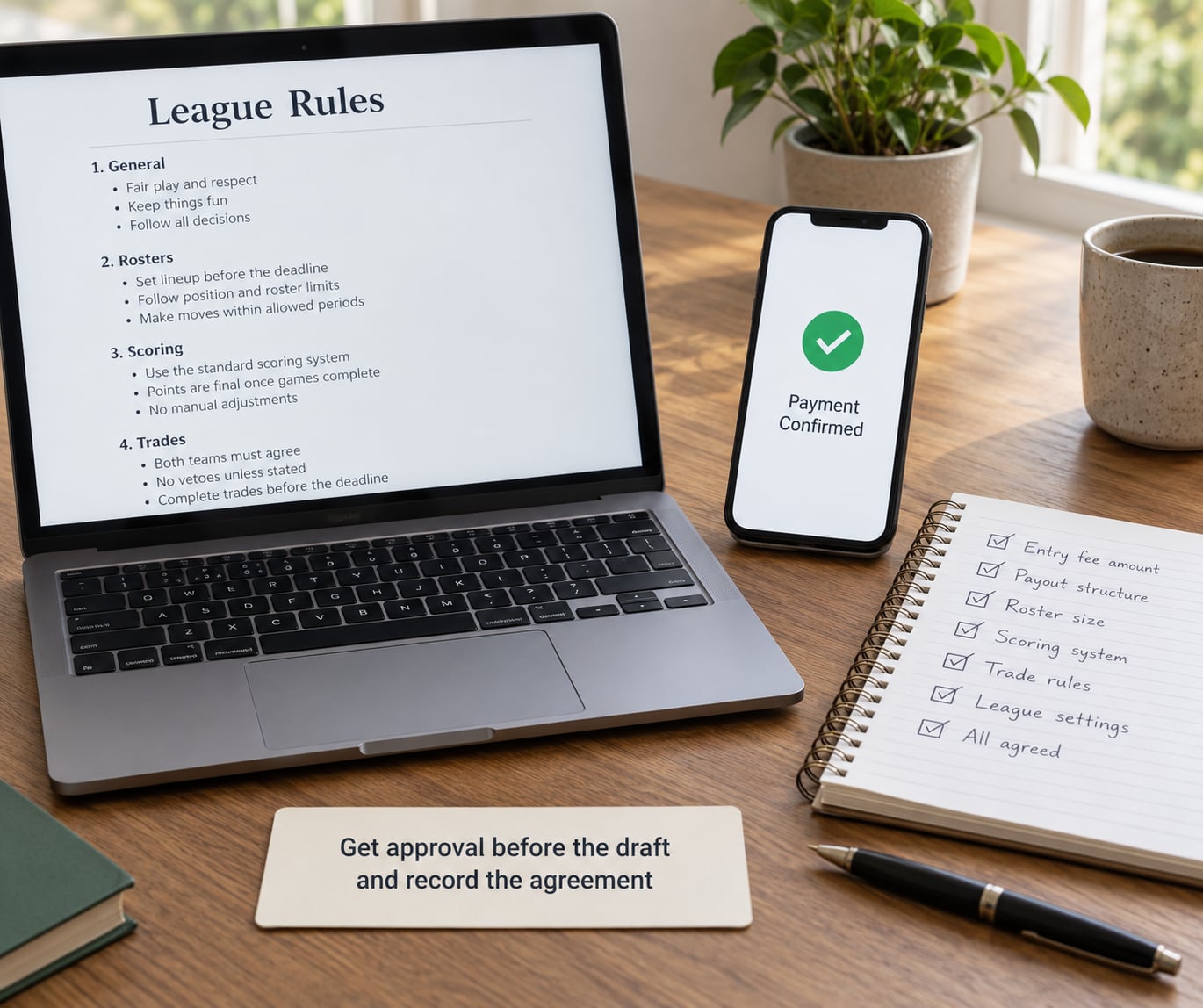
This is the step that actually prevents disputes, and it takes ten minutes. Send the final terms to everyone before you create the league. Not a summary, not a screenshot of settings — the document.
Ask each person to reply with a short written acknowledgment: I have read the rules and I agree to them. That single reply is the difference between a constitution and a suggestion. It costs nothing and it settles almost every mid-season argument, because the objection was never really about the rule, it was about never having agreed to it.
Keep one canonical copy that everyone can reach during the season, and make it the only version that counts. Screenshot the final league settings and attach them to the same document, so the settings in the platform and the rules people agreed to are visibly the same thing.
Then lock the settings. Nothing about roster size, scoring, or waiver rules changes after the first week unless the whole group votes on it in writing and the change is recorded in the document.
Common Mistakes
The mistakes that make an entry structure feel unfair are almost all about vagueness, timing, and enforcement. Each one has a straight correction.
- Vague payout rules. Winner gets the money, nothing more. Write the number of paid places, the exact split, and what happens to a tied place. Correction: put the split in the document as a single sentence and have everyone acknowledge it.
- Changing settings after money has been collected. Once fees are in the pool, changes to roster size or scoring change what people paid for. Correction: freeze settings at the draft and route any proposed change through a written vote with a two-thirds majority.
- Unequal entry fees with no stated reason. Correction: if fees differ, the reason must be written down and tied to something the group can verify, such as commitment level. Never talent.
- Hidden costs. A commission taken for a trophy or a dinner that nobody was told about. Correction: state the commission rate and what it covers in the same document as the payout split.
- No tie policy. Correction: split the tied place’s fee and move on. Write it before you need it.
- Relying on informal messages. Correction: one canonical document, one link, acknowledged in writing by everyone before the draft.
- Collecting fees late. Correction: a deadline at least a week before the draft, and a stated consequence for missing it that is applied to everyone equally.
- No dropout policy. Correction: decide in advance whether a dropped manager’s fee is refunded, rolled into the pot, or forfeited, and who inherits their team — usually the last-place manager or the next person on the waitlist.
Two smaller habits pay off well. Name a co-commissioner or a dispute contact so you are never the only judge in your own case, and run a fifteen-minute settings vote before the season instead of a chat thread during it.
Frequently Asked Questions
What is the fairest way to collect entry fees in a fantasy football league?
Use one payment method that leaves a timestamp everyone can see, set a deadline at least a week before the draft, and track every payment in a shared sheet with a name, amount, and date. Confirm each payment to the whole group in writing the same day. Apply the same rule to everyone without exception, since uneven enforcement is what makes a fair structure feel unfair.
How should a fantasy league split the prize money among winners?
For a twelve-team league, paying the top three with a fifty-thirty-twenty split is the most common and least contentious choice. Top-heavy splits feel generous to the champion and sting at the bottom. Fund any weekly high-score prizes from a separate small pot rather than the main pool, and write the payout deadline into the rules document before the season starts.
How do you handle ties in a fantasy football league?
Decide the tie policy before it matters, not during championship week. The standard answer is to split the entry fees for the tied place, so a tie for second with two tied managers shares the second-place money rather than rolling a coin. Publish the rule alongside the payout split and acknowledge it with the rest of the terms before the draft.
Should entry fees be refunded if a league manager drops out?
It depends on when they leave. A manager who drops before the draft and after paying usually gets refunded or has their slot and fee transferred to the next person on the waitlist. A manager who drops mid-season usually forfeits the fee, since the league ran without them. Write this rule down in advance and apply it the same way to everyone.
How do you make a free fantasy football league fair for everyone?
Drop the money and pay attention to format instead. Use an even number of teams with byes in the playoffs, score playoff weeks against the league median to blunt schedule luck, and give waivers to everybody through free agent acquisition budgets rather than priority order. Adding a trophy, a draft dinner, or a last-place punishment keeps the stakes without any cash changing hands.
When should a commissioner collect entry fees before the draft?
Set the deadline at least seven days before draft time, ideally two weeks out for a first season, and confirm receipt the same day. Fees collected after the draft remove the manager’s money from the decision about whether to play, and late payment tends to collect precisely from the people who were already drifting. A written acknowledgment of the terms should come before or alongside the payment.
Conclusion
A fair entry structure is not complicated, it is just written down before it matters. Name the format, total the budget, divide it into an entry fee, decide the payout split and the tie rule, document the settings, set a payment deadline, and get a written acknowledgment from everyone before the draft.
Put those seven items in one document, send it to the group, and ask each person to reply confirming the terms. That single habit does more for how fair your league feels than any scoring tweak ever will.