
Standings are a receipt for games you already played. Power rankings are a guess about how strong a roster is right now, built by adjusting those results for schedule, home field and luck. Knowing how power rankings differ from standings is the difference between reading your league app and actually understanding it.
I have spent more seasons than I care to admit staring at two columns sitting right next to each other in the same app, telling opposite stories about the same team. One of them is a scoreboard. The other is an opinion with math attached.
Here is the version that saves you arguments: use standings for what is true about your league right now, and use power rankings for what is about to happen. Neither one replaces the other, and treating them as the same thing is the most common mistake I see in weekly chats.
Table of Contents
- How Power Rankings Differ from Standings at a Glance
- What Do Fantasy Football Standings Measure?
- What Do Fantasy Football Power Rankings Measure?
- Why Can Standings and Power Rankings Disagree?
- Schedule strength
- Luck and variance
- Home field advantage
- Roster changes and scoring format
- Standings vs. Power Rankings: Which Should You Trust?
- Which Should You Choose?
- Frequently Asked Questions
- Are power rankings the same as fantasy football standings?
- Why does my team have a good record but a low power ranking?
- Are power rankings better than standings for the fantasy playoffs?
- Should I use power rankings for waivers and trades?
- Can a team with a losing record be a good power-ranked team?
- How often should I check fantasy football power rankings?
- Conclusion
How Power Rankings Differ from Standings at a Glance
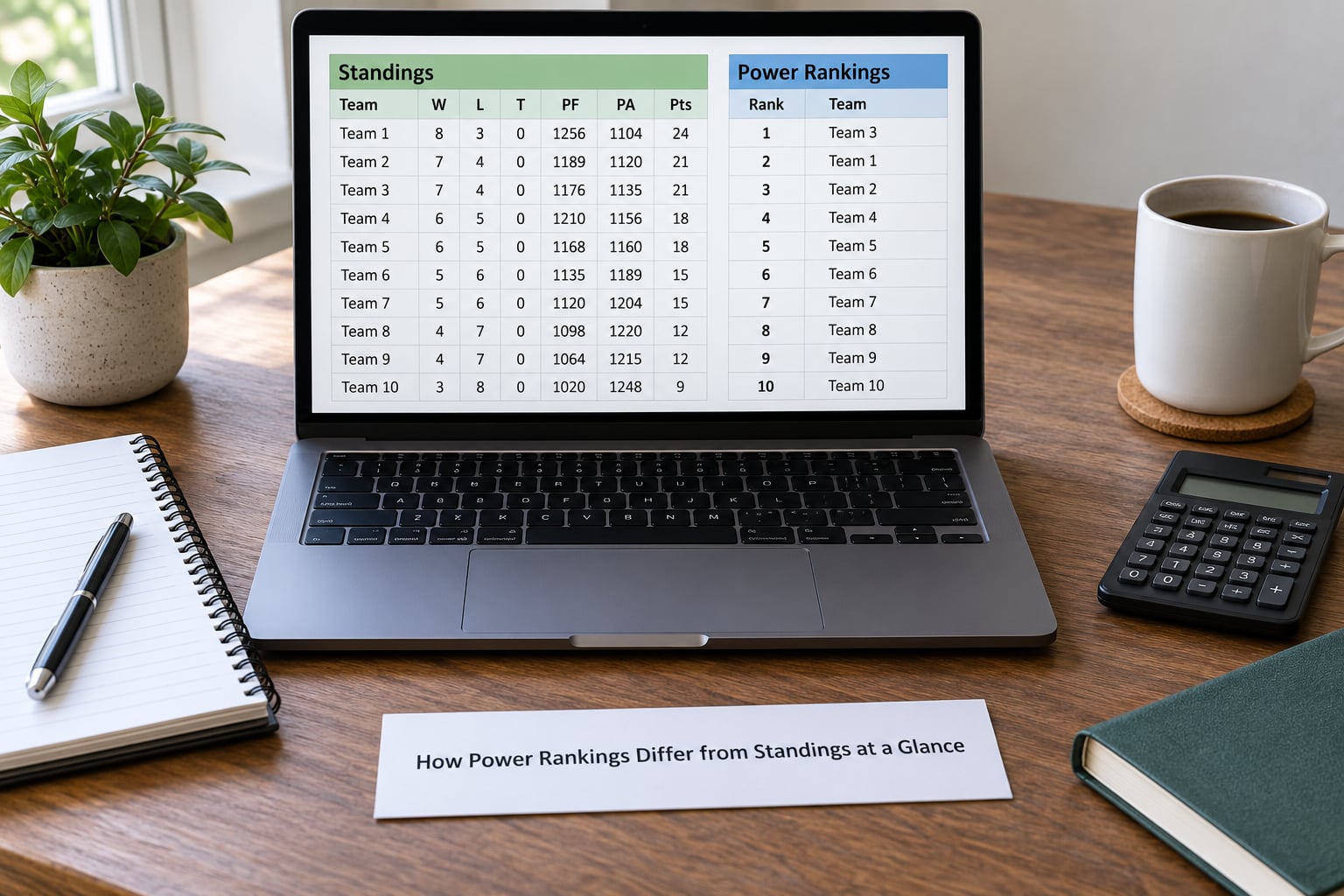
The cleanest way to see how power rankings differ from standings is to line them up next to each other and ask one question of each row: is this counting, or is this estimating?
| Criterion | Standings | Power Rankings |
|---|---|---|
| What it measures | Completed games and their outcomes | Estimated current or expected team strength |
| Time horizon | Backward-looking, from Week 1 to now | Mostly forward-looking, sometimes blended |
| Schedule adjustment | None, every win counts the same | Usually weights opponent quality |
| Home field | Counted as a normal win or loss | Often modeled and neutralized |
| Luck | Baked in fully | Largely smoothed out or regressed toward the mean |
| Subjectivity | None, the math is fixed by league rules | Range from pure opinion to pure formula |
| Update cadence | Once a week after games | Weekly at most, sometimes daily |
| Best use | Tiebreakers, playoff seeds, trash talk | Waivers, trades, playoff odds, start-sit calls |
| Worst use | Predicting future weeks | Deciding who wins a division this season |
One row does most of the work. A win against a historically bad opponent and a win against a contender produce the same mark in your standings. In almost any power ranking they produce different numbers.
What Do Fantasy Football Standings Measure?
Standings add up what already happened. Every game your team played produced a final score, that score produced a win or a loss, and those results stack into a record.
Most apps also show PF and PA, the points for and points against totals. Those are pure accumulation too. They tell you that your team averaged 96 fantasy points a game and gave up 88, which is useful, but it says nothing about who you played to get there.
Here is the trap that catches everyone. Suppose two teams are both 4-2. Team A beat a rebuild and a lottery ticket team, lost to two playoff-bound rosters, and has a plus-40 point differential. Team B ran through the softest schedule in the league, went 4-2, and has a plus-3 differential. In standings they are identical. In every power ranking worth reading, Team A sits well above Team B.
Standings also decide things, and that is their real job. Division winner, wild card seed, tiebreakers on head-to-head record, points against, or points scored, depending on your league settings. Whatever wins your tiebreaker is the number that actually matters on the last week of the season.
What Do Fantasy Football Power Rankings Measure?
A power ranking is an estimate of how good a roster or team is, usually expressed as a position on a scale from 1 to the number of teams in the league. The number itself means little without knowing who produced it and how.
How are power rankings determined? Three routes cover almost everything you will see.
- Panel vote. A group of writers ranks every team 1 through 32 each week and the rankings are averaged. High subjectivity, high familiarity, no fixed formula.
- Formula. Point differential, opponent-adjusted win percentage and home field weighting, sometimes run through several iterations so each team is scored against a league average that itself depends on everyone else.
- App algorithm. The Power Rankings column built into your fantasy platform, which usually rates team quality relative to the league average rather than to opponents.
The formula approach is the most transparent. One well-known community version of it, discussed at length on r/nfl, caps point differential, adjusts by opponent win percentage while excluding the team’s own record, adds home and away weighting, gives every team one fake win and one fake loss to shrink small-sample noise, then recurses the whole thing five or six times before averaging the ranks. That kind of build tells you exactly what is being measured.
A ranking number is also closer to a probability than a record. When a site has a team at number 4, the honest translation is that the publisher thinks this team is more likely to win a neutral-site game than the team at number 17. It is not a claim about how many games that team will finish with.
Why Can Standings and Power Rankings Disagree?
Four things push the two lists apart, and you will see all four in the same league.
Schedule strength
Standings treat every opponent as identical. Power rankings do not. A team that never played above .500 can sit at the bottom of the standings and near the top of a quality ranking, which is why strength of schedule gets published as its own column everywhere from the NFL to dynasty leagues.
Luck and variance
A tight red zone game that ends on a fourth-down stop is a coin flip, and the coin landed your way. Over four weeks, most of a record is variance wearing a helmet. Power rankings shrink that noise deliberately; standings keep every bit of it.
Home field advantage
Home teams win more than road teams, and some do it by more than others. A neutral-field rating removes that edge before comparing teams, while your standings log every home win as a full point no matter how much the venue mattered.
Roster changes and scoring format
Standings react to results and lag reality when a starting quarterback goes down mid-season. Power rankings built on underlying efficiency can move ahead of the results. Scoring format matters too, because a PPR league rewards volume in a way a standard scoring league does not, and two teams can look identical in record while playing completely different games.
One more distortion is structural: division winners auto-qualify in many formats. A weak division can hand a 9-7 team a playoff berth while an 11-5 team in a brutal division sits at home watching. Standings and seeding reward that, and no power ranking ever will.
Standings vs. Power Rankings: Which Should You Trust?
Trust depends on the decision in front of you, not on which number feels more official.
For weekly lineup calls, lean on the power ranking side of the ledger. If your star running back faces the league’s worst run defense and sits at number 3 in quality rankings, that is a start. His 90-point week still shows up in your standings afterward.
For playoff preparation, you need both. Your standings tell you the seed math that decides who plays whom, and the tiebreaker rules that will settle a tie. A power ranking tells you whether the team holding that seed can realistically win three straight games in January.
For the waiver wire, power rankings carry more signal. A player on a losing team with an efficient offense is a pickup. A player on a 12-0 team that keeps losing the fantasy points battle is not, no matter how easy the real schedule has been.
For trades in a dynasty league, use the power ranking to judge assets and the standings to judge the other manager’s season. A team sitting at 6-8 still holds real players, and they still have value.
Which Should You Choose?
If you play redraft and care about this week’s lineup, use power rankings as your primary read and check the standings only for tiebreakers and league settings. Formula-based rankings with a published methodology deserve the most weight, panel votes deserve some skepticism, and an app column is a rough signal, not gospel.
If you play dynasty, invert the balance. Standings describe one season that is almost over. Power rankings describe the next three, which is the only timeline that matters to you.
Early in the season, trust neither. In Weeks 1 through 4, a four-game record carries almost no information about team quality, and any ranking built on it is mostly noise with a confident tone. Check back around Week 6, when there is finally enough of a sample to argue from.
And check the methodology before you check the order. A list that moves a team nine spots in a week without saying why is telling you about the writer’s mood, not about football.
Frequently Asked Questions
Are power rankings the same as fantasy football standings?
No. Standings are a tally of completed games: wins, losses, points for and points against, all counted equally regardless of opponent. Power rankings are an estimate of how strong a team is, adjusting for schedule difficulty, home field and variance. A team can sit at 4-2 in the standings and fourth in power rankings at the same time, and both numbers are correct.
Why does my team have a good record but a low power ranking?
Usually because of schedule and luck rather than talent. A soft slate, a few lucky coin-flip finishes and a few favorable tiebreakers can produce a strong record without an efficient offense. Check your points against per game and your opponent-adjusted numbers. If both look weak, the power ranking is telling you the record was inflated.
Are power rankings better than standings for the fantasy playoffs?
Standings decide the playoff picture itself, since seeds and tiebreakers determine who plays whom. Power rankings are better for forecasting whether a team can win those games. Use standings for the bracket and your league’s tiebreaker rules, then use power rankings to judge the strength of the teams you would have to beat in January.
Should I use power rankings for waivers and trades?
Yes, mostly. Underlying strength signals are more useful than results, especially for players on teams with losing records but improving efficiency. Just confirm the ranking is formula-based and published with its methodology. Panel-vote rankings are opinion dressed up in a list, and a huge weekly jump is usually a signal to wait a week.
Can a team with a losing record be a good power-ranked team?
Frequently, yes. A 2-2 team that played two playoff-bound opponents outranks a 4-0 team that only faced rebuilding rosters. Losing records also cluster in weak divisions where division winners auto-qualify, so standings reward the path of least resistance. A power ranking strips schedule out and shows the underlying gap.
How often should I check fantasy football power rankings?
Once a week, right after games are scored, is plenty for redraft. Weekly movement on a formula ranking is small, and daily checking just invites you to react to headlines. In dynasty, monthly is often enough because rosters change slowly compared to weekly lineups. The exception is injuries, where a formula ranking that reacts to real news is worth a second look the same day.
Conclusion
Standings measure what happened. Power rankings estimate how good a team is right now, after schedule, home field and luck are factored out. That is the whole difference, and it explains every time the two columns in your app tell a different story.
Start with your standings, because they tell you the seed you need and the tiebreaker that might decide your season. Then pull up a formula-based power ranking before setting your lineup, chasing waivers or evaluating a trade. Ignore both for the first month of the season, and read the methodology before you read the order.