The way to bid in an auction without overpaying is boring and mechanical: you write a maximum price next to every player on your sheet before draft night, and you never bid a cent above it. That is the whole system. Everything else — reading your league mates, watching tiers, conserving money for the late round — is in service of obeying that one number when the room gets loud.
This is about fantasy football auction drafts, where a manager nominates a player and every manager bids until the highest offer wins. A generic search for this question pulls up property auctions and online general merchandise auctions, so if that is what you searched for, this page is about draft rooms, not houses. If you are here for the real estate kind, none of it applies.
Auction draft strategy is built on one uncomfortable fact: your draft position protects nothing. The manager who picks sixth can be cleaned out in three bidding wars and finish the draft scraping for one-dollar players. A manager who loses four early bids but keeps their budget walks into the last round with money to spend, and one-dollar players are exactly where most of a league’s value hides.
Table of Contents
- What You Need
- Step-by-Step
- 1. Know the auction format and your league rules before you value anyone
- 2. Rank players by auction value, not draft position
- 3. Set a maximum bid before the auction starts
- 4. Watch the first few bids for useful information
- 5. Bid only when the price fits your replacement plan
- 6. Use competition, not pressure, to push your bid
- 7. Reset your budget after every selection
- Common Mistakes
- Frequently Asked Questions
- How do I know when to stop bidding on a player in a fantasy football auction?
- Should I bid on players who are not on my draft board in an auction?
- How do I set a maximum bid for a player in an auction league?
- What bidding strategy works when several teams want the same player?
- How do I recover after overpaying early in an auction draft?
- What is the 15 minute rule in an auction?
- Conclusion
What You Need
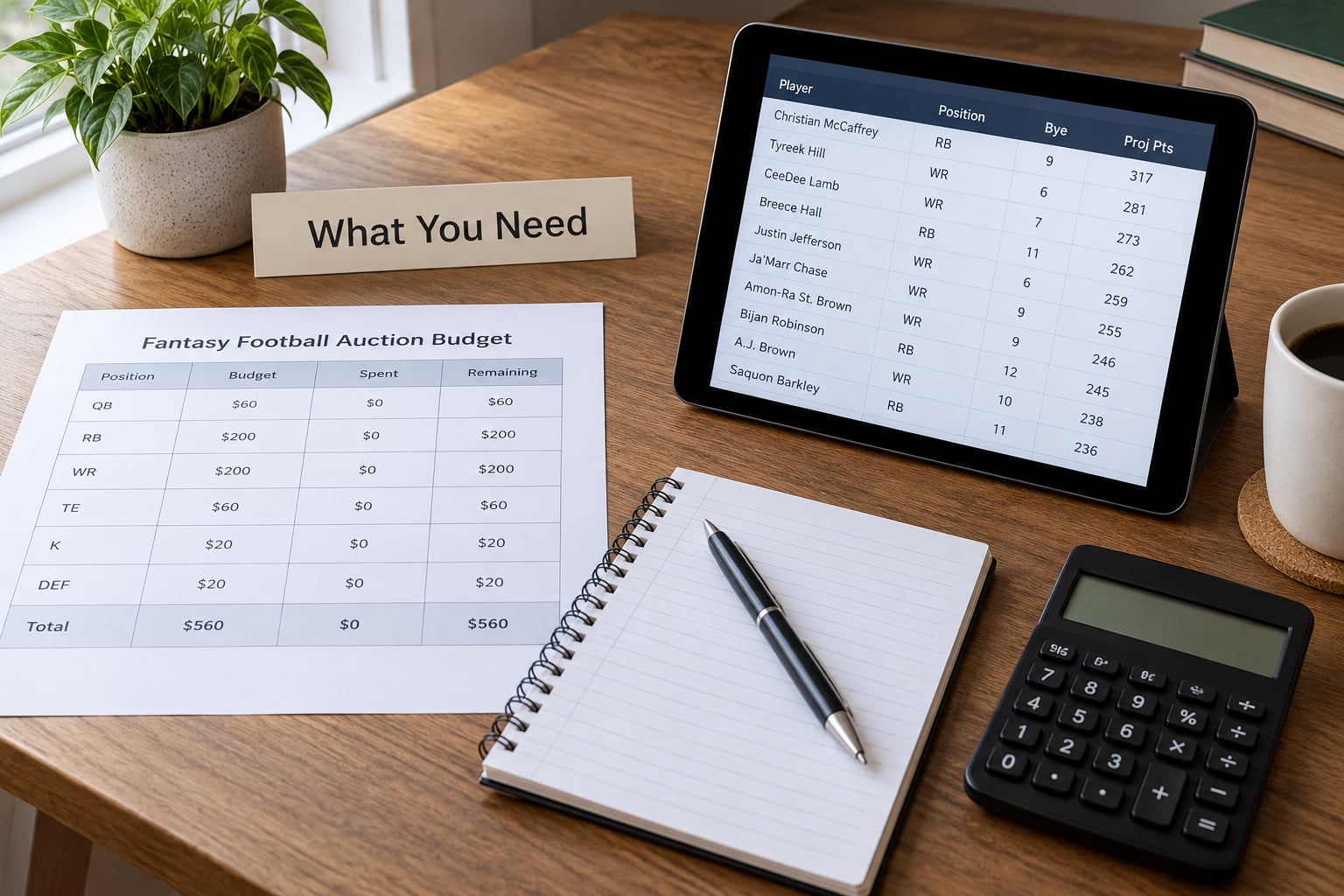
You need four things before auction night, and none of them are complicated. Miss any one of them and the bidding gets away from you, because there is no pause once the auctioneer starts calling bids.
- A player valuation method. Projected points per game, what you would pay at a given point total, or a simple tier break you trust. Pick one and apply it to every player, including the ones you will never bid on.
- A budget sheet with your draft stake divided up. Your total money, a column per roster slot, and a running remaining figure you update after every single selection.
- Your league settings in writing. Roster size, starting lineup spots, budget, number of teams, nomination order, and whether it is a superflex, 2QB, or guillotine format.
- A draft board in a second device. A laptop or tablet running your league platform, plus a separate calculator app. You will not be able to do this math on one screen while also bidding.
Add a notebook for tracking what actually sells. The prices you observe in your own league are more useful to you than any published consensus value, because consensus values are built from other leagues that do not draft like yours.
Step-by-Step
1. Know the auction format and your league rules before you value anyone
Roster size, lineup spots, budget, and team count change what every player is worth. In a 16-team league with 20-dollar increments, the same running back who is a 30-dollar buy in one room is a 50-dollar buy in a 10-team room with a shallow bench. In superflex or 2QB formats, your second quarterback line item is often bigger than your entire kicker allocation, and drafting as if it does not exist is how you get cleaned out by three dollars.
Know whether ties go to the earlier nominator or the earlier bid, because that decides whether you bid one extra increment just to win a contested price. If it is a guillotine or chopped league, the per-player math changes completely: one mistake ends your season, so a bid that is only 5 percent under your ceiling is no longer an acceptable risk.
2. Rank players by auction value, not draft position
Average draft position tells you what order a snake-draft manager would take someone. It tells you nothing about what the room will pay. An ADP of 25 in a 12-team league is a research consensus about a slot in a round, not a dollar number.
Translate your research into a price. Start from projected points per game, decide what you are willing to pay per point in your league’s budget structure, then sanity-check the result against scarcity. A tight end who is the only startable option on four teams is worth more than his projection alone suggests. A running back with three equivalent backups left on the board is worth less.
Then make the numbers add up. If your top thirty players are worth more in total than your entire draft stake, something is wrong, and it is usually that you valued every player as if you had to win them. Adjust until the sheet totals roughly your budget. A sheet that does not add up is a sheet you will abandon mid-draft.
3. Set a maximum bid before the auction starts
Write your walk-away price beside every player, and write it in a column of its own so nothing else can bleed into it. This number is your last bid, not your opening bid, and it is not a number you negotiate with yourself when the bidding speeds up.
Your ceiling is not arbitrary. It is your value multiplied by the factor your league actually demands — higher in superflex and keeper formats where the money supply is squeezed, lower in a deep 16-team league with 25 dollars per player. Do the inflation adjustment once and apply it everywhere, rather than remembering it in the heat of a bidding war.
4. Watch the first few bids for useful information
The first three or four selections tell you more than any cheat sheet. You learn the increment, which of your league mates actually bids rather than waiting, and roughly how aggressive the room is.
You do not bid outside your plan to gather this. Pick a player who sits mid-tier on your sheet, bid your planned price, and take the information as a free byproduct. People who nominate and bid on names that are not on their board to shop around are the reason rooms get expensive.
5. Bid only when the price fits your replacement plan
Before you raise a hand, know who you take instead. If you have your third-best tight end at an 11-dollar ceiling and the bidding is at 24, you let it go, and you are not irrational — you are preserving the difference between 24 dollars for a mid-tier tight end and 24 dollars split across a running back and a wide receiver who both project better than he does.
The replacement plan is the real test. If you cannot name the alternative, you do not have a valuation problem, you have a wanting problem, and wanting is what makes managers regret a bid all week.
6. Use competition, not pressure, to push your bid
Set the threshold, bid one predictable increment at a time, and stop the instant another manager reaches your ceiling. That is the controlled response: two managers competing means price discovery, and if your number is your number, competing above it is donating money to the rest of the room.
The most common failure is bidding against yourself. Some managers keep raising their own offer out of momentum, or out of politeness to a league mate, and end up paying a price nobody else wanted. Nobody has ever regretted being the second-highest bidder in an auction draft.
When the price passes your max, you drop out completely and you do not come back. Managers routinely talk themselves into one extra bid after they said they were done, and that single increment is the difference between a disciplined draft and a ruined one. Forum threads are full of managers who describe losing control of exactly one bid and thinking about it for months.
7. Reset your budget after every selection
Subtract the winning price from your remaining figure immediately and re-check your positional caps. Most overpaying cascades are arithmetic failures: a manager spends 60 dollars on a player early, then discovers three rounds later that they have no money for their own running backs, and starts bidding on replacement names out of necessity instead of value.
Positional scarcity also updates constantly. If every starting tight end in your league has gone for 30-plus, your 12-dollar streaming tight end plan just became a 25-dollar one, and you need to know that before the slot arrives, not during.
| Position group | 100-dollar auction | 200-dollar auction | 500-dollar auction |
|---|---|---|---|
| Quarterbacks | 13 | 28 | 72 |
| Running backs | 20 | 42 | 108 |
| Wide receivers | 22 | 46 | 120 |
| Tight ends | 8 | 18 | 44 |
| Flex and bench depth | 24 | 48 | 120 |
| Kicker and defense | 3 | 6 | 14 |
| Unspent reserve | 10 | 12 | 22 |
A useful split for a 200-dollar auction, and a reasonable starting shape for 100 and 500. Figures are averages, not targets. In superflex and 2QB formats, move another 10 to 15 percent out of flex depth and into quarterbacks. Keep a real reserve, because money you have not spent in the middle of a draft is worth more than money you spend early on a name you wanted.
Common Mistakes
These are the errors that cost auction managers the most, and each one has a plain fix.
Bidding above a limit you never wrote down. Managers say they had a max in mind, and nobody can remember what it was. Fix: put the number in writing beside the player before draft night, not in your head.
Falling in love with a tier’s last name. This is the tier-bottom trap and it is the single most common way auction drafts get expensive. The first player in a tier goes for about the tier average. Each subsequent name in that tier costs more than the last, because the same group of managers all decided they wanted the last available player at that level. The last name in a tier is priced like the first name in the next tier up, and that is an automatic overpay. Fix: when you reach the last player in any tier, drop your ceiling by 20 percent and treat the difference as savings.
Going in wanting specific stars. If your plan starts with two named players at fixed prices, everything else you do is negotiating from a weak position, and those two bids usually set your ceiling for you. Fix: draft for roster construction and let the stars come to you at prices you have already decided are reasonable.
Ignoring the budget for the positions you still need. Panic-buying at the running back spot three rounds after overspending at wide receiver is how rosters end up with four tight ends and no defense. Fix: keep the positional caps visible on the same screen as your bidding, and check them after every pick.
Treating every available name as a must-have. A roster spot filled by a streaming option is worth less than a roster spot filled by a player you bought right. Fix: only bid above your cap when the player genuinely outranks your alternative, not because he is the best one left in that position.
Bidding on yesterday’s values. In keeper and dynasty leagues, money removed from the money supply by keepers raises every other price. Fix: sum the keeper values before draft day and expect roughly a proportional bump. In a 200-dollar league with 60 dollars in keeper cost, cut your per-player numbers by about 20 percent. If your price expectations ignore that, you will be bidding all night below your own valuation.
Spending out of social pressure. Someone in the room bid once, and now a quiet manager matches them out of manners. Fix: bid only in response to a price that matters to your plan, and decide in advance that one increment is your entire willingness to escalate.
One more that comes up constantly: nominating players specifically to drain an opponent’s budget. It is legal, and it is a real tactic, and it is also why a widely shared auction thread blew up with one manager nominating a running back sixth overall at 1 dollar and watching it sell for 60, with the winner calling it dirty play. My view is that nominations should be spent on players who would plausibly clear value, not as a targeted attack. If your nomination is designed purely to hurt one specific manager, expect it to cost you the room’s goodwill for the rest of the draft.
Frequently Asked Questions
How do I know when to stop bidding on a player in a fantasy football auction?
Stop the moment the price reaches the maximum you wrote beside that player before the draft started. If you did not write one down, use a simple rule: never bid more than the value of the best player still available at the same position. Once the price passes that number, the money you keep is worth more than the marginal upgrade, because the same dollars buy more value later on a full board.
Should I bid on players who are not on my draft board in an auction?
Generally no. Bidding off-board is how managers end up owning four players they never planned for and a roster with no running back. Bid off-board only in two cases: when your league uses a nomination order where you must nominate before you can bid, or when a genuine sleeper is mispriced and you have an open positional slot with budget behind it. Otherwise, an unplanned bid is an unplanned expense.
How do I set a maximum bid for a player in an auction league?
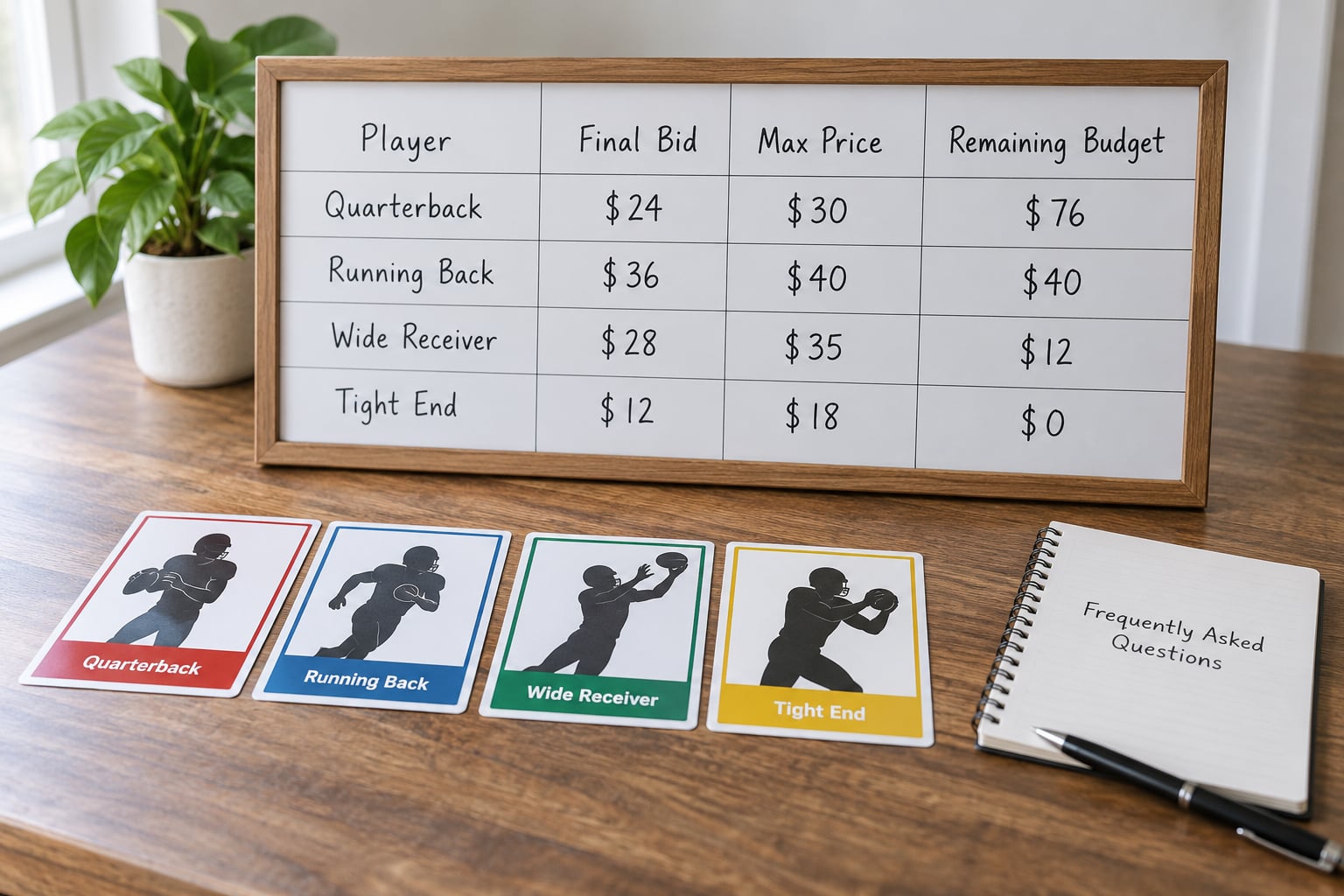
Take your projected points, multiply by what you are willing to pay per point in your league’s budget structure, then adjust for scarcity and for money supply. Add a sixth column to your sheet labelled max price and fill it in for every player before draft night, including the ones you expect to win cheaply. The number is your last bid, not your first, and you never raise it in the moment.
What bidding strategy works when several teams want the same player?
Treat competition as information rather than pressure. Decide your threshold in advance, bid one predictable increment at a time, and never bid twice in a row without the price having moved. If another manager reaches your maximum, you drop out immediately and name your replacement to yourself before the auctioneer moves on. Two teams wanting one player is normal and healthy; it only becomes a problem when you are the second-highest bidder.
How do I recover after overpaying early in an auction draft?
Stop bidding immediately and write down your remaining money per roster slot before the next nomination. Then fill the gaps with cheap upside rather than mid-tier safety, because a full roster of low-cost upside players can still win a season. After the draft, look for a trade that moves your most expensive player to a team with a need at that position. The overpay is done; what matters is how many productive slots you have left.
What is the 15 minute rule in an auction?
The 15 minute rule is a real estate auction practice, not a fantasy football one. It has no equivalent in a fantasy auction draft, where a nominated player can be bought immediately and the clock is the league platform’s timer rather than any house rule. If you searched it while looking for fantasy football bidding strategy, the rules that matter in your league are the bid increment, the tie-break setting, and your own maximum price.
Conclusion
Knowing how to bid in an auction without overpaying comes down to preparation you finish before the auctioneer starts calling. Value every player in dollars, split your budget by roster slot, and write a maximum price next to each name. Then bid in controlled increments, drop out the second the price reaches that number, and recalculate your remaining budget after every selection.
Start smaller than that if you like: pick one player, set your max, and defend it through the entire draft. If you hold that one number, the rest of the draft takes care of itself. If you do not, no amount of drafting cleverness will save the budget you gave away on a bid you had already decided to stop at.
Updated for 2026.