
Setting up fantasy football scoring for high-scoring games comes down to five decisions: pick a reception format, set fractional yardage, price touchdowns, add a small number of bonuses, and subtract points for mistakes. Most leagues take about 30 minutes to configure once you have the point table written down in front of you, and the whole job is finished before your draft.
The reason to do this properly is that scoring is the one rule in a fantasy league that quietly shapes everything else. It decides which players are worth drafting, which roster spot is hardest to fill, and whether your weekly games are close or decided by Tuesday night.
Table of Contents
- What You Need
- Step-by-Step: How to Set Up Fantasy Football Scoring for High Scoring Games
- Choose a high-scoring baseline
- Add bonuses for meaningful production
- Set limits and deductions
- Test your fantasy football scoring settings on real game styles
- Entering these values on each platform
- Document and publish the final rules
- Common mistakes
- Common Mistakes and Fixes
- Frequently Asked Questions
- What scoring format produces the most fantasy football points?
- Should I use passing bonuses in a high-scoring league?
- How do I prevent quarterbacks from dominating an auto-scoring league?
- What is the best way to test fantasy football scoring settings?
- How should defensive and special teams points be scored?
- Can I change fantasy football scoring after draft day?
- Conclusion
What You Need
You need four things before you touch the settings menu, and none of them cost money.
- The platform and league type. ESPN, Yahoo, Sleeper, and MyFantasyLeague all expose a scoring menu, but each one names things differently and some gate options behind a paid tier.
- Your position list and roster size. Scoring cannot be finalized until you know whether you run one tight end, two, or a superflex spot. A high-scoring league almost always wants superflex, and that changes how you price quarterbacks.
- A bonus shortlist. Decide which three to five milestone bonuses you actually want before you open the menu, because every bonus you add changes weekly totals.
- A way to test. Either a throwaway league on the same platform or a simple spreadsheet. Testing against real games is the only way to catch a scoring table that inflates one position and starves another.
Keep a copy of your final point table somewhere you can paste it into a message. League members who never see the scoring table are the ones who complain about it in week six.
Step-by-Step: How to Set Up Fantasy Football Scoring for High Scoring Games
Choose a high-scoring baseline
The baseline is everything that scores on a routine play. Get this right and bonuses become seasoning rather than the meal.
Start with reception value. One point per reception, or full PPR, is the single biggest reason high-scoring leagues exist, because it rewards volume players who never find the end zone. Half-PPR at 0.5 per reception is the middle path, and it suits leagues where managers still draft on touchdown upside.
Then set yardage with fractional scoring on. Fractional scoring simply means a category pays a decimal rate, such as 0.1 points per rushing yard or 0.04 per passing yard, so a 13-yard run pays 1.3 instead of rounding to 1. That rounding is invisible in a standard league and obvious in a high one, where a full roster of fractional categories can swing a matchup by 10 points.
| Category | Setting | Points |
|---|---|---|
| Passing | Per passing yard (fractional) | 0.04 |
| Passing | Passing touchdown | 4 |
| Passing | Two-point conversion | 2 |
| Rushing | Per rushing yard (fractional) | 0.1 |
| Rushing | Rushing touchdown | 6 |
| Receiving | Per reception | 1 (or 0.5 for half-PPR) |
| Receiving | Per receiving yard (fractional) | 0.1 |
| Receiving | Receiving touchdown | 6 |
| Kicking | Field goal under 50 yards | 3 |
| Kicking | Field goal 50 yards or more | 4 |
| Kicking | Extra point | 1 |
| D/ST | Sack | 4 |
| D/ST | Interception | 4 |
| D/ST | Safety | 6 |
| D/ST | Points allowed: 0 | 10 |
| D/ST | Points allowed: 1 to 6 | 6 |
| D/ST | Points allowed: 7 to 13 | 3 |
| D/ST | Points allowed: 14 to 17 | 1 |
| D/ST | Points allowed: 18 or more | 0 |
Notice that passing touchdowns are worth 4 here while every other touchdown is worth 6. That one adjustment is the cheapest way to stop quarterbacks from running away with a league, and it costs nothing in total points because it only shifts value between positions.
Do not leave kickers and defenses on default settings in a high-scoring league. If a kicker can score 10 in a good week while your first-round wideout scores 9, that roster spot is dead weight and everyone will know it. Distance tiers for field goals plus points-allowed tiers for defenses usually pull both positions up into a usable weekly range.
Add bonuses for meaningful production
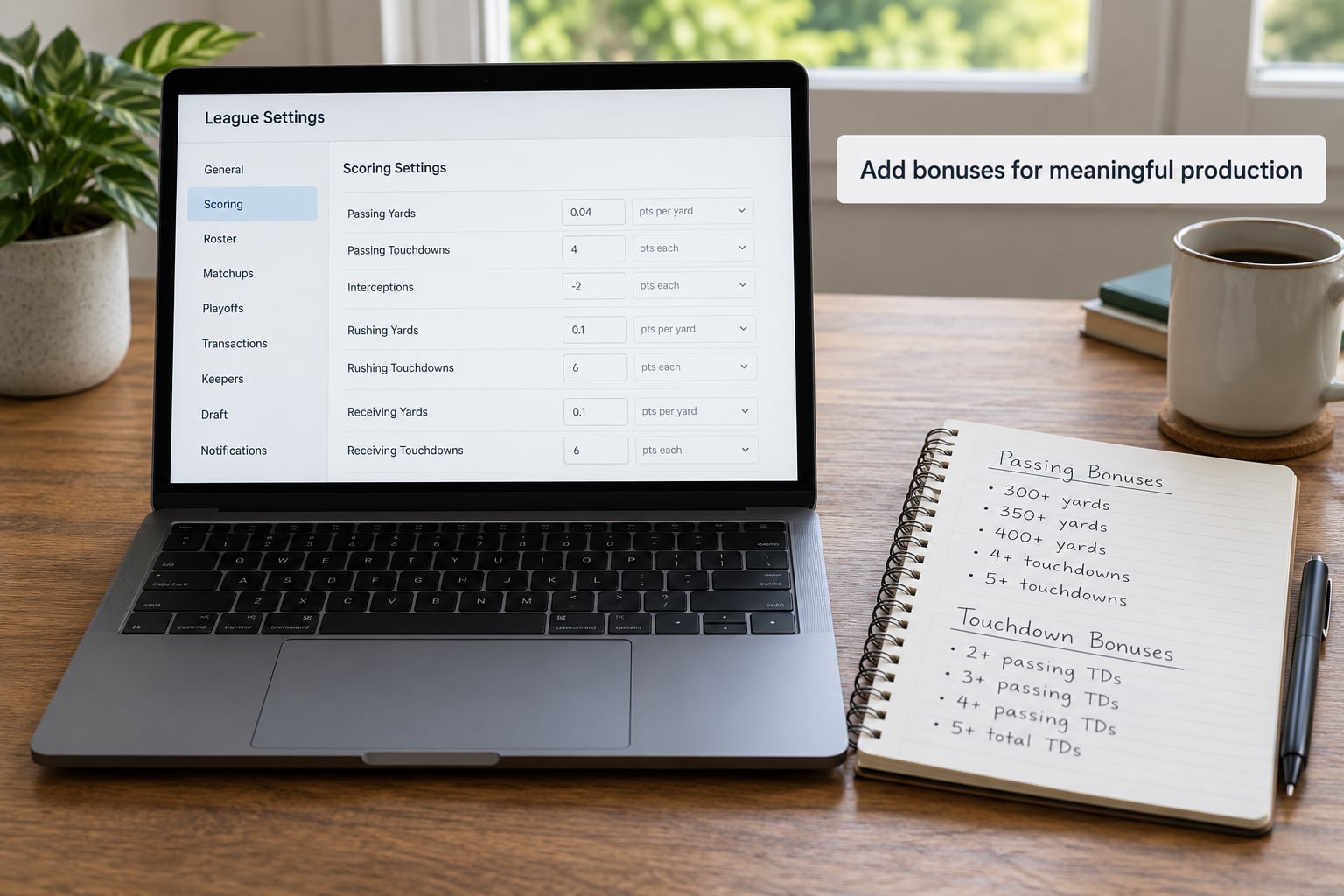
Bonuses should reward elite production, not ordinary volume. The test I use is simple: if a bonus fires in more than about one game per week across a league, it is not a bonus, it is a hidden pay raise.
| Bonus | Suggested value | Verdict |
|---|---|---|
| 100 rushing or receiving yards | +3 | Add it. Rare enough to feel special. |
| 200 rushing or receiving yards | +5 | Add it for leagues that want weekly volatility. |
| 300 passing yards | +3 | Add it. It offsets a 4-point passing touchdown. |
| 400 passing yards | +5 | Optional. Basically a season-ender when it happens. |
| Passing touchdown of 40 yards or more | +1 to +3 | Add it. Rewards the deep shot. |
| Every 5 passes completed | +1 | Skip it. Quarterbacks hit it most weeks anyway. |
| Any bonus under 50 receiving yards | +1 | Skip it. That fires constantly. |
Bonus thresholds are also where leagues start arguing with each other, so decide the rule before the first one fires. The standard complaint is that 100 yards is worth 5 points while 99 is worth nothing, and there is no setting that avoids that edge. What you can do is state in advance that bonuses are exact-threshold, not a scale, so nobody expects a partial award.
Two bonus types are worth a second look because they change how you draft rather than how a game feels. Return yards credited to individual players instead of only to the defense unit turn return specialists into draftable assets. And a layered reception bonus, such as +1 for each reception over 20 yards and +3 for a reception over 40 yards, rewards big-play volume without paying every target hog.
Set limits and deductions
Set limits and deductions before you test, not after. Adding deductions changes every total, so a table you tested without them is a table you have not tested.
A scoring system with no negative points rewards bad quarterback play, because an interception still generates yardage and completion stats. Without deductions, the worst decisions in football can still produce a usable fantasy week.
- Interception thrown: minus 2 points. Three per game is enough punishment without gutting a quarterback who threw for 350 yards.
- Fumble lost, offensive: minus 2 points, and apply the same deduction to individual defensive players who lose the ball.
- Missed field goal: minus 1 point. Missed extra point: minus 1 point. This is what makes the kicker a real position instead of a roster filler.
- Two-point conversion failed: no deduction on most platforms, so state that rule explicitly in your charter if it matters to you.
- Defense points-allowed tiers: set zero-point thresholds so a shredded unit scores literally nothing rather than a token amount that keeps a roster spot alive.
Pick yards-allowed tiers for defenses or points-allowed tiers, not both. Running two overlapping penalty systems on the same unit means the last two tiers of a bad game quietly cancel the first, and nobody remembers the settings that produced the score.
Test your fantasy football scoring settings on real game styles
Back-test the table against a completed week. Take every starter on the highest-scoring roster in your league and score that week by hand under your new settings. It takes about ten minutes and it is the only way to know what your league will actually average.
| Format | Typical weekly team total | A 200-point week means |
|---|---|---|
| Standard (non-PPR) | roughly 85 to 110 | League-record territory |
| Half-PPR | roughly 100 to 130 | An exceptional season-best week |
| Full PPR | roughly 115 to 150 | A top-percentage week |
| PPR with bonuses and 3-point passing touchdowns | roughly 130 to 175 | Close to the weekly ceiling |
So is 200 fantasy points a lot? In a standard league it is a season nobody forgets. In a full PPR league it is a very good week, and in a bonus-heavy league it is close to the best a lineup can produce.
Here is one lineup, scored four ways. The quarterback throws for 300 yards, 3 touchdowns, and 1 interception. The wideout catches 9 passes for 120 yards and a touchdown. The kicker makes 3 field goals, including one from 50 yards, and 2 extra points. The defense records 1 sack and allows 10 points.
| Format | QB | WR | K | D/ST | Total |
|---|---|---|---|---|---|
| Standard, 6-point passing TD | 16.0 | 18.0 | 12.0 | 7.0 | 53.0 |
| Half-PPR, 4-point passing TD | 22.0 | 22.5 | 12.0 | 7.0 | 63.5 |
| Full PPR, 4-point passing TD, 300-yard bonus | 25.0 | 27.0 | 12.0 | 7.0 | 71.0 |
| PPR at 0.05 per passing yard, 3-point passing TD, volume bonuses | 28.0 | 30.0 | 12.0 | 7.0 | 77.0 |
That table is the whole argument for high scoring. The same four players swing from 53 points to 77 points depending on settings alone, which is the difference between a routine week and one that decides a playoff race.
Entering these values on each platform
Every major platform exposes the same categories under a different name, and menu labels shift between seasons, so check the current help page before you rely on a path below. The order of operations is the same everywhere: open league settings, find the scoring section, edit one category at a time, and save at the end rather than category by category.
- ESPN. Open the league, then League Settings, then Scoring and Settings. League Manager leagues let you set a decimal value for every category and enable bonuses; public leagues are locked to the platform’s standard or PPR presets. ESPN also recalculates every completed week when you change a value, so test on a League Manager league before you touch the real one.
- Yahoo. League, then Settings, then Scoring and Rules. Yahoo breaks the values into passing, rushing, receiving, kicking, and defense tabs with a bonus section at the bottom of each. Rules save from the same page, so finish all the tabs before leaving it.
- Sleeper. League, then Settings, then Scoring Settings. Sleeper keeps bonuses in their own menu and roster settings in another, so a bonus you add there will not appear in the main scoring list until you look for it in the right place.
- MyFantasyLeague. League home, then the league’s Edit menu, then Scoring Rules. Bonus thresholds sit under their own settings area, and MyFantasyLeague is the platform most likely to need you to re-check the ladder after a season because it does not always migrate custom values forward.
If your platform does not offer a category the table needs, write the rule into the charter anyway and score it by hand for tiebreakers. A league that documents an unwinnable nuance is in better shape than one that silently skips it.
Document and publish the final rules

Write the final table into a league charter before the draft. Every category, every bonus threshold, every deduction, and the exact tiebreaker order, all in one place.
Then do the part most commissioners skip: send the charter to the league and ask for objections with a deadline that falls a few days before the draft. A league that ratifies its scoring settings together has almost no argument later. A league where the commissioner just decides has an argument every time the standings look wrong.
One warning belongs in that charter. On ESPN League Manager leagues, changing scoring settings recalculates every prior week retroactively, so a mid-season adjustment can rewrite results that have already happened. Yahoo, Sleeper, and MyFantasyLeague differ on this, so check your platform’s documentation and write down which rule you are under before anyone accuses you of rigging.
Common mistakes
The fastest way to flatten a high-scoring league is to inflate volume without paying anyone else. The fixes are listed below, and each one is a settings change rather than a rule you have to argue about weekly.
Common Mistakes and Fixes
Overvaluing raw passing yards. Passing yards are the most volatile category in football, so paying them well plus full passing touchdown value makes one position untouchable. Fix: 0.04 to 0.05 per passing yard with passing touchdowns at 3 or 4.
Making bonuses too easy to earn. A bonus that fires most weeks stops being a bonus and becomes part of the baseline nobody accounts for. Fix: set thresholds you would expect to see roughly once every two to four weeks.
Ignoring defensive and special teams scoring. If a defense can only score through rare turnovers, the D/ST slot is a dead roster spot in a high-scoring league. Fix: points-allowed tiers starting at 10 for a shutout, plus 4 per sack and 4 per interception.
Failing to define zero-point thresholds. Without an explicit zero, a fantasy defense that allows 45 points still picks up a point or two somewhere and rewards bad lineups. Fix: state the top tier as zero in the charter so nobody has to guess.
Changing settings after the draft. This is the fastest route to a league-wide trust problem, and on some platforms it silently rewrites completed weeks. Fix: lock scoring before the draft and treat any later change as an amendment that needs a league vote.
Losing positional scarcity. High scoring does not have to flatten draft positions. If your roster has a superflex spot, quarterbacks get scarce again because you need a starter-quality backup. That single roster change offsets a lot of passing value.
Rushing and receiving touchdowns at 6 while passing sits at 6 too. Keep passing lower than every other touchdown value. It is a small number that does more for balance than any bonus you can add.
Forgetting to publish the table. Managers who have not read the scoring settings will assume the settings were built to help someone else. Fix: paste the table into the league chat, the group thread, and your league notes.
One more habit worth building in: after week four, check whether your league average sits above or below the range you targeted. If every week is a blowout, drop one bonus or tighten the defense tiers. If totals are flat, a half-point bump to receptions fixes it faster than anything else.
Frequently Asked Questions
What scoring format produces the most fantasy football points?
Full points-per-reception with fractional yardage and bonuses produces the highest weekly totals. A nine-player lineup in a typical PPR league lands around 115 to 150 points, and bonus-heavy settings push that toward 175. Non-PPR leagues usually sit between 85 and 110. The format matters less than the combination, though: PPR alone without bonuses is rarely as high as standard scoring with a generous bonus table.
Should I use passing bonuses in a high-scoring league?
Yes, and the reason is balance rather than inflation. Bonuses like 300 passing yards or a 40-yard passing touchdown offset the lower passing touchdown value that keeps quarterbacks from dominating. Without them, the only way to restrain quarterbacks is to cut yardage points, which flattens the passing game everywhere. Two bonuses are usually enough.
How do I prevent quarterbacks from dominating an auto-scoring league?
Drop passing touchdowns to 4 while keeping rush and receive touchdowns at 6, and hold passing yardage to 0.04 or 0.05 per yard. Add a passing-yard bonus or two so top quarterbacks still have a ceiling. A superflex roster spot also helps, since it makes you roster two quarterbacks and raises the cost of owning one.
What is the best way to test fantasy football scoring settings?
Score one completed week by hand before you commit. Pick the highest-scoring lineup from last season, write out every stat, and total it under your proposed settings. Compare the result to the weekly range for that format. Doing this twice, once on a high-scoring week and once on a low one, tells you more than any setting list.
How should defensive and special teams points be scored?
Use points-allowed tiers rather than yards-allowed tiers, because points allowed match the outcome fans care about. A common ladder is 10 for zero points allowed, 6 for one to six, 3 for seven to thirteen, 1 for fourteen to seventeen, and 0 for eighteen or more. Add 4 per sack, 4 per interception, and 2 per blocked kick so the unit has weekly upside.
Can I change fantasy football scoring after draft day?
Technically yes on most platforms, but it needs a league vote and a written amendment. Be aware that ESPN League Manager leagues recalculate every prior week when you change scoring, so completed results can shift. Sleeper, Yahoo, and MyFantasyLeague behave differently. Publish the change and its effective date to the whole league before you touch the settings.
Conclusion
Start by deciding what a good week should look like in your league, then build backward from there. Set the baseline values, add three bonuses you would actually enjoy watching, subtract points for turnovers and missed kicks, score one real week by hand, and only then publish the table to the league.
Lock that charter before draft day. Everything after the draft is harder to fix and easier to argue about.