A rookie mock draft is a simulated draft in which analysts project which incoming NFL rookies will be selected, and at which pick, in your league’s rookie draft. Reading one for fantasy purposes means treating it as a sample of opinion rather than a forecast: check the date and author, cross-check three independent boards, read ranges instead of a single slot, and trace every pick back to the on-field role that produces fantasy points.
Budget 20 to 30 minutes per mock once you have a system, and expect to re-run it after every meaningful injury report, combine result, or coaching change. A mock is not a prediction. It is a snapshot of what informed people believed on a given day, and most of the value comes from comparing snapshots against each other.
Table of Contents
- What You Need
- Step-by-Step: How to Read a Rookie Mock Draft for Fantasy Purposes
- Check the Mock’s Date, Author, and Purpose Before Anything Else
- Separate Consensus From a Consensus Mistake
- Read Ranges Instead of One Exact Slot
- Connect Draft Position to Fantasy Value
- Identify the Analyst’s Hidden Assumptions
- Weigh Scarcity Without Overvaluing It
- Track Outliers and Late-Round Disagreement
- Convert the Board into a Draft Plan
- Common Mistakes
- Treating the First Round as an Exact Ceiling
- Reading Rankings Without League Context
- Using One Inflated Projection
- Frequently Asked Questions
- What is the most useful part of a rookie mock draft for fantasy football?
- Should I follow the highest rookie mock-draft projection?
- How many mocks should I compare before drafting?
- What is a reasonable rookie draft range instead of an exact slot?
- How do league format and scoring change a rookie mock’s meaning?
- Conclusion
What You Need
You need three current rookie rankings from sources that do not share a data provider, plus the actual format details of your league. Everything after that is just disciplined reading.

- Three independent rankings. Independent means different authors and different underlying models. Three write-ups that all trace back to one consensus sheet are one opinion printed three times.
- Your league settings. Number of rounds, roster size, superflex or single-QB, tight end premium or standard, and your scoring. The same mock means two different things in two leagues.
- Roster context. Whether you are competing now or building a rebuild, how many roster spots you must fill, and which positions are already thin. A reach is only a reach relative to need.
- A working grasp of scarcity. You do not need a full positional scarcity model, just a sense of which positions usually run out of usable players and at what pick.
- A tracking sheet. One row per player, columns for early range, median projection, number of sources, role assumption, and your own notes. If it is not written down, you will re-derive the same conclusion badly three weeks later.
A running log matters more than any single mock. Managers who keep one can see their own bias, because the same disagreement that looked obvious in August looks completely different in October.
Step-by-Step: How to Read a Rookie Mock Draft for Fantasy Purposes
Follow these eight steps in order, then run the sequence again as draft-day news reshapes roles and boards. The order matters: skipping ahead to the picks you already like is how people end up defending a reach they never stress-tested.
Check the Mock’s Date, Author, and Purpose Before Anything Else
A mock’s date tells you what information the author had. An early pre-season board written before the combine assumes rookies translate their college roles one-to-one; a board updated after a starting quarterback changes is working from a genuinely different opportunity model.
Concretely: imagine a board from February that projects a receiver as a clear day-three target because his college quarterback threw for high volume. The same site publishes a revision in late March after the quarterback departs and the offense installs a run-first scheme. The player name is identical, the pick is nearly identical, and the meaning has flipped. The first board describes talent, the second describes opportunity, and only the second one is worth drafting on.
Also read the stated purpose. A mock published to argue that tight end is undervalued is built to make that case, and you can see it in the run.
Separate Consensus From a Consensus Mistake
Consensus is only informative when the sources are independent. Pull up at least three rankings and check whether they agree because they analyzed the same underlying projections or because they analyzed each other.
Build a small frequency table instead of trusting a vibe. For each player, record the early round of his range, the median projection across sources, and how many distinct sources land inside that range. A player with a median of 1.05 and eight sources is a genuinely established expectation. A player with a median of 1.05 and three sources, all citing the same newsletter, is a single opinion with a fan club.
This is the single highest-value habit in the whole process. Consensus that everyone copied is the failure mode that produces identical rosters across your league.
Read Ranges Instead of One Exact Slot
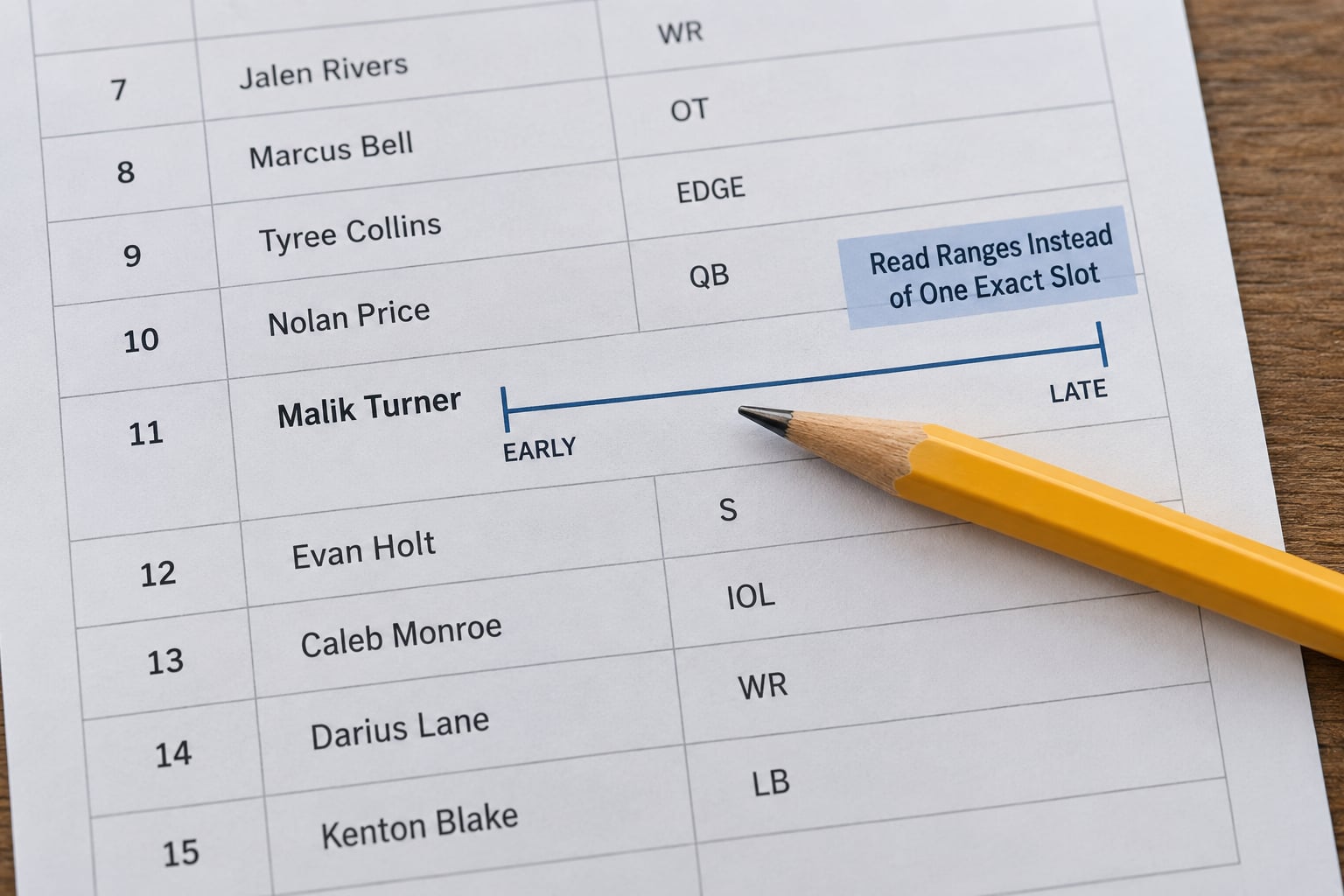
Almost nobody is ever right about one exact pick, so a mock that gives you 1.04 as a clean fact is overstating its own precision. Read the range and treat the middle as your working expectation.
To calculate it, take the earliest slot any credible source gives him and the latest, then find the midpoint. That midpoint is your median projection, and the spread is your uncertainty. A player projected anywhere from 1.02 to 1.09 has an expected slot near 1.05 and a floor that is still elite. A player projected from 1.07 to 2.04 has the same midpoint and a completely different risk profile, because the low end means he could fall twenty picks.
Late-round targets behave the same way. Two players both projected as fourth-round fliers differ enormously if one is a projected day-two pick on a thin roster and the other is a crowded depth chart. The range tells you how much you should care about the exact slot.
The real edge is in the disagreement itself. A player whose median sits at 1.04 but whose sources split between 1.01 and 2.02 is telling you that analysts disagree about his role, which is a question worth answering yourself before draft night rather than after.
Connect Draft Position to Fantasy Value
NFL draft position is an input, not an outcome. Thirty picks earlier usually means more opportunity, but opportunity is only fantasy value once you know what the player will actually do with it.
Trace five things for every player in the first two rounds: projected targets per game, projected share of the position’s snaps, the depth chart he enters, who is throwing to him, and whether the offense is built to feature him. A receiver drafted 1.07 into an offense with an established volume target has a different weekly ceiling than a receiver drafted 1.07 onto a roster where he is the third option behind two veterans.
Contrast the two common justifications for an early pick. One is a high-volume offensive role: clear separation, guaranteed snaps, a stable quarterback. The other is athletic upside on a roster that has not yet declared a hierarchy, which usually means a committee and weekly target randomness. Both can be correct drafts. They carry different risk, and only one of them is a repeatable fantasy floor.
Identify the Analyst’s Hidden Assumptions
Two analysts can use identical statistics and disagree completely, because statistics sit on top of assumptions about playing time, injuries, team scheme, supporting casts, and player development. Those assumptions are usually unstated.
Learn to spot the load-bearing ones. Does the author assume the prospect’s college role transfers unchanged? That assumption produces high estimates for players leaving pro-style offenses for weaker units. Does the author assume the current starting job stays open? That assumption is why boards shift so violently after a free-agent signing.
When you find the assumption, you can decide whether you accept it. That is a far better position than deciding whether you like a player.
Weigh Scarcity Without Overvaluing It
Scarcity explains why a run happens, but a run in one mock is not a law. When four tight ends go in a row, it usually means the mock’s own author believes the position is thin, not that the universe requires four tight ends.
Compare two positions in the same mock. A scarce premium position, where only two or three players project above a usable threshold, will produce a visible early run and probably hold its prices even when your league disagrees. A deep position in the third round, where fifteen players are interchangeable, produces a run that evaporates the moment two other boards skip it. Weight the first and fade the second.
Round-one consensus ranges are the one place where scarcity is usually worth respecting, because those players have multiple independent routes to being taken early.
Track Outliers and Late-Round Disagreement
An outlier is information, not a value. When one board has a player far above or far below where the rest of the field sits, write down the projection and go find the reason for it. Often the author has access to scheme information you do not. Occasionally the author simply got it wrong.
A practical cheat sheet: pick the highest projection you find that at least three sources disagree with, and the lowest, and put both in a monitoring list with a note about what would confirm or kill each one. These are the cheapest research prompts available, because someone already did the work and told you the answer. You just have to find out why they think it.
Late-round disagreement deserves the same treatment. Third and fourth-round projections are usually the least confident numbers on any board, and the swing between two sources there can be fifteen picks wide.
Convert the Board into a Draft Plan
A mock is finished when it produces a plan, not when you have read it. Four outputs matter: your tiers, your fade list, your target price for each name, and a contingency for the pick you did not expect.
Build tiers from your frequency table, grouping players whose ranges overlap by more than they differ. Set a target price at the top of each range, not the bottom, so a mild run does not steal a player you would have happily taken two slots later. Write a fade list of names where the consensus range is narrow but your own role read is worse, and decide in advance what would change your mind.
Then split the plan by format. In a redraft league with a short horizon, players projected inside the first two rounds are worth acquiring at a real cost. In a superflex league, the same board matters much less because quarterbacks never run out. In a dynasty rebuild, spend the second round on the player whose path to a 150-game career is shortest, not the one with the best rookie ceiling.
Writing how to read a rookie mock draft for fantasy purposes down as tiers, prices, and fades is what separates a manager with information from a manager with opinions.
Common Mistakes
Three errors produce most of the bad reads, and each has a specific correction. A short update routine closes the loop.
Treating the First Round as an Exact Ceiling
A consensus first-round range is useful, but a promise it is not. Board movement of several slots inside one round is normal and often caused by nothing more than an injury report.
Correct it by pre-committing to the whole range. If your target is projected 1.02 to 1.07, take him at 1.07 without rethinking your board. The moment you decide a 1.06 projection is a sign to panic and reach, you have started drafting on mood. If his range rises later, so does your price. That is the response, and it is a cheap one.
Reading Rankings Without League Context
The same mock produces different boards in different leagues. Superflex leagues push quarterback runs deep into the second and third rounds. Tight end premium leagues reward a tight end who projects as a top-ten option at 2.05 far more than a standard-scoring league does. Best ball and long-horizon dynasty formats tolerate rookie busts that a short-horizon redraft league cannot.
Correct it by translating before you compare. Take the pick, then ask what your specific replacement level is at that position in your own format. If a mock says your target is the sixth tight end taken and you already own four tight ends, the pick is not valuable at that number, regardless of consensus.
Using One Inflated Projection
An exceptional ceiling does not offset uncertain opportunity unless it fits a strategy you are actually playing. A player projected 1.01 on one board, off the board entirely on the other two, and slated behind a veteran is a lottery ticket.
Correct it by requiring a match between the ceiling and your plan. If you are building assets in a rebuild and the player has a path to a long career, take the flier in the second round. If you need a 15-point-per-week contributor this season, ignore the ceiling entirely. Lottery tickets are only useful to people holding lottery money.
Two habits finish the job. First, mark your sheet with the date and the single piece of news that would most change each major player’s range, so you know what to check on draft morning. Second, keep a decision log where you record why you took each pick. Reading your own log after a league is the fastest way to find out whether your reads are getting better or your results are just getting luckier.
Frequently Asked Questions
What is the most useful part of a rookie mock draft for fantasy football?
The most useful part is the disagreement between sources, not the picks themselves. When three independent boards put a player in the same range, you learn little. When one board is far off consensus, someone has either found information or made an assumption worth investigating. Both outcomes tell you what to research next, which is more valuable than any single projected slot.
Should I follow the highest rookie mock-draft projection?
Only if you can explain why it is different. A high projection that comes from an unstated assumption about playing time is noise, and chasing it is how managers reach at 1.03 for a player their own research says is the third option on his depth chart. Use the high projection as a research prompt, then decide whether the underlying role holds up in your league’s format.
How many mocks should I compare before drafting?
Three independent sources is the practical minimum, and more helps once you reach the third and fourth rounds where boards scatter most. Spend less time on the first round, where sources mostly agree, and more on late-round names, where projections can swing fifteen picks wide. Comparing four or five boards is plenty if you are recording ranges rather than reading picks.
What is a reasonable rookie draft range instead of an exact slot?
Most credible sources agree on the first round within a few slots, so a three to seven pick spread is normal there and should not worry you. In the second round, expect closer to eight. By the fourth round, two honest sources can differ by fifteen picks or more, and you should treat that player as undrafted rather than projected. The wider the range, the less the exact slot should drive your price.
How do league format and scoring change a rookie mock’s meaning?
Format changes which positions have value, not which players are talented. Superflex leagues keep quarterbacks available well into the third round, standard leagues let a quarterback go at 2.03 without hurting you. Tight end premium scoring makes a top-ten tight end at 2.05 worth more than a third-round receiver. Recompute the value of every pick in your own settings before you treat any consensus board as your board.
Conclusion
Start by pulling three independent mocks from the current cycle and recording, for every player inside the first two rounds, the earliest slot, the median slot, and how many sources back it. Then write down the role assumption behind each pick so you know which ones collapse if a quarterback or a coaching staff changes.
From there, build your tiers, set target prices at the top of each range, and decide in advance which names you will fade. Re-run the whole sequence after the combine, after the NFL draft when landing spots become known, and in the week before your own rookie draft. Managers on forum boards like r/DynastyFF and r/fantasyfootball repeatedly describe the same pattern: the picks that felt obvious in August are the ones that need re-reading in September.
A mock will not tell you who to take. It will tell you what most informed people believed, how strongly they believed it, and where they disagree. That is enough to build a plan, as long as you do the reading yourself.