Trading back in a rookie draft is simple once you do the math before the draft starts: decide which pick you want to land on, put a value on the pick you’re giving up, then offer it to the managers behind you for two or more selections that add up to slightly more than you gave away. Give yourself 20 minutes of prep beforehand and the conversation takes two minutes during the live draft.
I’ve watched a lot of league managers leave early-round value on the board because they treat the draft like a lineup of set menus. There is no set menu. Picks are currency, and the whole point of a trade-back is that a later pick plus extras usually outproduces the guy you’d have taken at the earlier slot — especially in a class where your targets are bunched into the same tier.
The rest of this guide walks through what to gather, how to set your maximum price, how to build an offer that doesn’t insult anyone, and what to say when they counter.
Table of Contents
- What You Need
- Your exact draft position
- League settings that change the math
- A pick value baseline
- Your tier-based rankings
- A list of who is picking behind you
- How to Trade Back in a Rookie Draft Step by Step
- Set Your Target and Maximum Price
- Build a Fair Trade-Back Offer
- Negotiate and Close the Trade
- Common Mistakes
- Frequently Asked Questions
- What compensation should I ask for when trading down from 1.02 to 1.05?
- How do I value future draft picks in a dynasty league?
- Is trading up ever the right move in a rookie draft?
- When is the best time to negotiate a rookie draft trade-back?
- How many extra picks can I realistically collect?
- Can I trade back in a rookie draft if my league trades are restricted?
- Conclusion
What You Need
You cannot value a trade-back without knowing what you’re trading and who wants it. Gather these five things first, and the rest of the process runs itself.
Your exact draft position
Note the pick number in your league, not the NFL draft. In a 12-team league you picking second is 2.02, and that number is the only reference every other manager will use in the chat.
League settings that change the math
Roster size, taxi squad limits, superflex versus 1QB, and how many future picks you’re allowed to trade all change what a trade-back is worth. In a 10-team superflex league, quarterbacks go early and push the receivers you want down the board, which makes trading down more valuable for you. In a 16-team 1QB league with four taxi slots, extra picks become dead weight fast, because you cannot stash all of them.
A pick value baseline
Use any dynasty trade value chart or pick value calculator as a starting reference, then adjust. Charts built from startup ADP undervalue rookie picks in strong classes and overvalue them in weak ones, so the chart is your floor, not your verdict.
Your tier-based rankings
Write your tier-based rankings before you negotiate, not during. The tier you are willing to reach into is the real constraint on the trade, and if you don’t know where your tiers break before the offer goes out, you’ll negotiate against yourself.
A list of who is picking behind you
Scan the draft order and flag the two or three managers most likely to want to move up: rebuilders with old, deep rosters, and contenders whose top target is likely still on the board at your pick. Those are your trade partners.
Keep that tier list and your draft position in one place, because you will reference both in every conversation that follows.
How to Trade Back in a Rookie Draft Step by Step
Here’s the whole process in order. It works in redraft leagues too, where a pick is worth roughly half what it’s worth in dynasty because you only get one year out of it.
Set Your Target and Maximum Price
Write down two numbers before you message anyone: the latest pick you will accept, and the maximum extra value you’ll give up to get it.
Work backwards from your tiers rather than forwards from the board. If your top three targets all sit inside one tier and the fourth target is a tier below, your goal is to land anywhere inside that top tier. Trading 1.02 down to 1.07 keeps you in the tier but adds two or three chances at the sleeper who goes right after it.
Then price the trade. Take your current pick’s value from the chart, take the target pick’s value, and the difference is what you need in return. Add roughly 15 percent for the extra pick itself, since each additional selection is worth more than its raw share of the round.
Set the walk-away price in writing. Most bad trades happen because the manager who proposed the trade gets excited and keeps raising their own number in their head.
Build a Fair Trade-Back Offer
A trade-back package usually mixes current picks, future picks, and occasionally a proven player if you’re a contender dealing with a rebuilder. Keep it to two or three pieces, because packages that sprawl past four pieces are the ones that get misread.
These are shapes that work in most 12-team drafts, using a chart where 1.02 is worth about 60 points:
| Pick you hold | Aim for | Reasoning |
|---|---|---|
| 1.02 | 1.06 plus next year 1.12 | Stays inside the top tier and adds a future shot |
| 1.05 | 1.09 plus this year 2.03 | Three extra picks into the mid-rounds where sleepers live |
| 1.08 | 1.10 plus 2.01 | Classic rebuild trade; the second-round pick is nearly free value |
| 2.01 | 2.03 plus 3.01 | Trades a mid-round pick for two shots in one deal |
Adjust for scarcity. The last pick in a round is worth far more than the pick right before it, and the difference grows in leagues that hand out extra roster spots or in classes where nobody falls off after a certain pick.
Discount future picks before you send the offer. The common convention is about 15 percent per year out: a pick next year is worth roughly 85 percent of the same pick this year, the year after about 72 percent, and the year after that around 61 percent. Apply that and your package stops looking greedy.
If you’re a contender with a pick in the back half of round one, adding a proven player works well against a rebuilder who has no use for a name he can’t roster. Just be clear that you’re buying a floor, not a ceiling.
Negotiate and Close the Trade
Send offers before the draft when you can. Managers are calmer, they have time to check the chart, and nobody has to make a decision in ninety seconds.
If you have to negotiate live, send the offer right after your pick before the next selection gets made. The window between one pick and the next is when people actually read messages.
Keep the language plain. Something like this works fine:
“Hey, I’ve got 1.02 and my tiers run through the top six picks. If you’re looking to move up, I’d consider 1.06 plus next year’s early first for it. Let me know either way, I’m good to draft from here.”
That message names the pick, names the return, states your reasoning in one line, and leaves the other manager an easy out. Offers that explain themselves get answered; offers that read like a math problem get ignored.
When a counter comes back, split the difference or walk. If your counter lands inside the maximum price you set, take it. If it needs a fourth piece added to make the math work, that is the market telling you the trade-back was priced wrong, and you’re better off drafting from where you are.
Two warning signs to watch for: a manager who won’t name a specific return package, only a vague sense of value, and anyone who wants to settle after they’ve already taken the pick they were asking you for. In most platforms a trade can’t be undone once it’s on the clock, so confirm the pick order updates before you click accept.
Common Mistakes
- Treating every first-round pick the same. The gap between 1.02 and 1.08 is small on a chart and large in a deep class. Check where the tier drops in this specific rookie class before you decide your floor.
- Making the first offer too aggressive. Anchoring high makes people disengage rather than negotiate. Open at a fair-to-slightly-generous number and let them improve your package for you.
- Ignoring your league’s trade rules. Some platforms cap the number of future picks or block trading during the live draft entirely. Check the settings before you build a package that can’t be submitted.
- Trading without a deadline. Post a deadline and stick to it. Without one, conversations drift, the draft moves, and you end up holding the pick you tried to move.
- Collecting more picks than you can roster. Taxi squad limits and roster spots decide how many selections are actually useful. Ten extra picks across three years means most of them sit unused, which throws away the whole point of the move.
- Failing to document the deal. Send the accepted terms in the league chat as a summary. It costs nothing and it settles arguments six months from now when one manager remembers it differently.
One habit worth keeping: after every accepted trade-back, write down why you made it in one line. A few leagues in, you’ll see whether your own reasons were sound, which is the only trade evaluation that actually improves your results.
Frequently Asked Questions
What compensation should I ask for when trading down from 1.02 to 1.05?
On a standard chart, moving from 1.02 to 1.05 costs roughly 15 to 20 percent of the pick’s value, so ask for a current pick plus a future selection. A 1.06 plus next year’s early first round is the usual ask. If the manager wants the later pick more badly than you want the earlier one, expect to add a second-round pick or a mid-round throw-in to close it.
How do I value future draft picks in a dynasty league?
Most dynasty managers discount a pick about 15 percent for each year out. That makes next year’s pick worth roughly 85 percent of this year’s, the following year about 72 percent, and the year after around 61 percent. Apply that before you build any package, then adjust for class strength, since a strong upcoming draft makes older picks worth more than the formula suggests.
Is trading up ever the right move in a rookie draft?
Yes, in two situations. If you have several picks clustered together and one clear tier-one target available slightly earlier, buying up consolidates your shots at the best player in the class. The other is a league where one specific player is projected far above everyone else at that spot. Trading up is a bet on one player, so keep the package small.
When is the best time to negotiate a rookie draft trade-back?
Two to three days before the draft is the sweet spot. Managers have time to check the chart, nobody is rushed, and you can talk to more than one person. If you wait until draft night, send offers in the gap right after your own pick and give a short deadline so the other manager has to decide before the next selection.
How many extra picks can I realistically collect?
Count your roster spots first. With four taxi squad slots, three picks stashed across upcoming years is usually the practical ceiling before you start clogging. In a superflex league you can justify more because quarterbacks stay on rosters longer, but past roughly five extra picks you are holding inventory you will not roster for years.
Can I trade back in a rookie draft if my league trades are restricted?
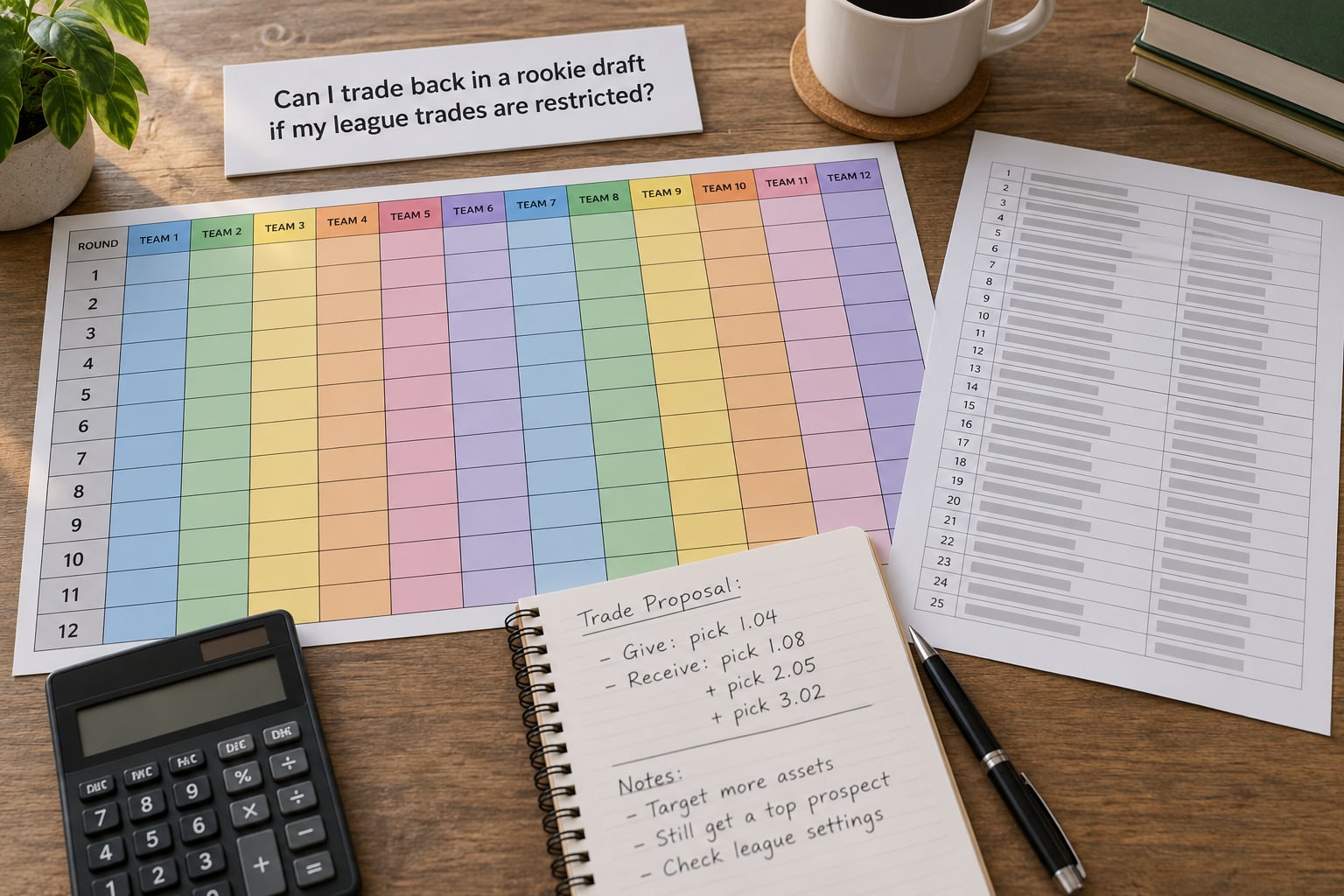
Check three settings: whether trades are allowed during the live draft, how many future picks can be included, and whether rookies are eligible for immediate stashing. Some platforms also lock completed trades after a deadline. If in-draft trades are blocked, negotiate everything before the draft and have every agreement entered and accepted in advance.
Conclusion
Start tonight: pull up the draft order, write down the latest pick you’ll accept, and price it on a chart. Message the two managers most likely to want your selection, name the pick and the return in one message, and give yourself a deadline before the draft so you’re not still negotiating at the one-minute mark of round one.