Short answer: it moves your board a little, mostly through draft position, and it should never move it by more than that. How the NFL combine affects fantasy draft value is a question about sequence, not measurement. Testing nudges a prospect’s projected draft slot, the draft slot moves rookie ADP, and rookie ADP moves what you pay in a rookie or best ball draft. Testing itself changes nothing about expected fantasy points.
I have rebuilt rookie boards every February since the dynasty rookie draft became the main event in my league, and the thing that keeps managers wrong is not the numbers. It is how much authority they hand a single session in Indianapolis. Let me walk through what each drill actually measures, what it is worth at each position, and how to convert a headline into a measured board move.
Table of Contents
- How the NFL Combine Affects Fantasy Draft Value on Your Board
- Do NFL Combine Numbers Actually Matter for Fantasy Football?
- What Combine Metrics Actually Predict (and What They Don’t)
- The 40-yard dash and explosive testing
- Why Testing Results Are Not the Same as Fantasy Production
- How to Interpret the 40-Yard Dash and Explosive Testing
- How Interviews Reveal Role and Usage Signals
- How Medical Updates Affect Injury Risk and Draft Price
- Position-by-Position Combine Value Changes
- Rookie Versus Veteran Combine Reactions
- How to Adjust Your Fantasy Rankings After the Combine
- Common Combine Conclusions Fantasy Drafters Should Avoid
- Frequently Asked Questions
- Does the NFL Combine actually matter?
- What is the average number of 225-pound bench reps for an NFL player?
- What was Tom Brady’s 40 yard speed?
- Should I draft a player with a slow 40-yard dash?
- Which combine tests matter most for running backs?
- How do I use the combine in my dynasty rookie draft?
- Conclusion
How the NFL Combine Affects Fantasy Draft Value on Your Board
Yes, combine results matter, but only as one input that reshapes draft expectations and therefore rookie pick value. A fast 40 or a strong shuttle nudges a player’s projected draft slot up. A projected slot up lifts rookie ADP. A lifted ADP changes what you bid in a best ball rookie draft. That chain is the whole mechanism, and it is worth keeping in your head instead of pretending testing reveals fantasy talent.
Now the concession. Combine measurables have a real talent to generate headlines that outrun the underlying evidence. A spectacular testing session can push a player two draft positions earlier than his film supports, and that gap is exactly where value hides.
Here is how a single result should translate. Suppose a wide receiver you had ranked eleventh on your rookie board runs a 4.42 and posts a 10-yard split in the mid-1.7s. If his film grade was solid and his landing spot is unchanged, a move of one to three spots up is defensible. A move of eight spots is a different bet, and it is one you are making on a forty-yard sprint, not on route precision or a quarterback who actually throws him the ball.
The draft is the filter that matters most. Testing changes how high a player goes, and draft position is one of the strongest public predictors of how much opportunity a rookie receives. Your rookie board is effectively a pricing sheet for opportunity, so anything that moves opportunity should move your board. Anything that does not move opportunity, such as a bench press total, should stay where it was.
Do NFL Combine Numbers Actually Matter for Fantasy Football?
They matter most for the players where athletic profile is the question. For a receiver competing for slot snaps in a spread offense, a fast 40 and a sharp three-cone are real evidence about separation and short-area burst, and in PPR that evidence is worth something. For a quarterback, for an offensive lineman, or for a tight end whose value comes from red zone work, testing tells you very little about weekly volume.
The other place testing matters is health and availability. A prospect who does not run a full workout, or who has a published injury history that emerges in February, has changed your expected number of games. Fantasy production is games played times points per game, so availability adjustments are the highest-value change you can make in February.
Managers in the r/DynastyFF combine threads treat testing as the first real reordering event of the offseason, arriving right after the initial rookie big boards go up. That instinct is right. February testing is when you should refresh, and it is not when you should rebuild.
What Combine Metrics Actually Predict (and What They Don’t)
Every drill at the combine is a proxy for something, and no drill is a proxy for fantasy production. The useful question for each one is: what physical trait does this stand in for, and how well does that trait map onto a fantasy-relevant skill?
The 40-yard dash and explosive testing
The 40 measures straight-line acceleration and top speed over 40 yards, and it is the most publicised number of the week. It says something real about first-step burst, which matters for receivers in space and for defensive backs who must cover that burst. It says almost nothing about route running quality, hands, or whether a quarterback looks a player over.
The jump tests work differently. The standing long jump measures lower-body power from a static start, which correlates loosely with the ability to elevate at the catch point. The vertical jump measures fingertip reach with a running approach, so it is the more informative of the two for receivers. Neither one predicts whether a player gains a contested catch.
The shuttle and the three-cone measure change of direction. A player who runs a fast shuttle relative to his straight-line speed is showing short-area quickness, which is the physical basis for slot work and for screens. The three-cone adds a lateral cut to a longer change of direction and tends to expose players who are fast in a straight line and awkward in open space.
The bench press measures upper-body strength in isolation. For offensive linemen it is one of the better predictors of how a player holds up against pass rush. For a running back, a receiver, or a tight end, it tells you very little about fantasy value. RotoBaller put it bluntly in their measurables piece: for most skill positions the bench press is close to worthless information. The people debating rep counts on television every February are arguing about the wrong number.
Height, weight, arm length and hand size are body measurements. Hand size in particular gets treated as destiny, and it is not. A large hand helps a receiver catch a ball on a contested attempt, but catch rate also depends on where the quarterback aims, how often the player is actually targeted, and whether the play design produces a contested situation in the first place.
| Drill | What it measures | Strong | Average | Weak | Fantasy relevance by position |
|---|---|---|---|---|---|
| 40-yard dash | Straight-line acceleration and speed | 4.40-4.48 (WR) | 4.50-4.60 (WR) | 4.70+ (WR) | High for WR and DB, medium for RB and TE, low for QB |
| 20-yard shuttle | Short-area acceleration and hip turn | Under 4.30 | 4.30-4.50 | 4.55+ | High for slot-heavy WR and DB, low for TE |
| Three-cone | Longer change of direction and lateral cut | Under 7.00 | 7.00-7.30 | 7.35+ | Medium for WR and LB, low for RB |
| Standing long jump | Static lower-body power | Over 40 inches | 34-40 inches | Under 34 inches | Medium for TE and RB, low elsewhere |
| Vertical jump | Fingertip reach with running approach | Over 38 inches | 33-38 inches | Under 33 inches | Medium for WR and TE, low for RB |
| 225-pound bench press | Upper-body strength in isolation | Over 25 reps | 18-25 reps | Under 18 reps | High for OL, low for every skill position |
| Arm length and hand size | Catch-point reach and body profile | Per position norms | Per position norms | Per position norms | Medium for WR and TE, none for QB or OL |
Those ranges are position-specific on purpose. A 4.60 is a problem for a receiver expected to win a vertical route and irrelevant for a tight end whose team uses him as a move-the-chains blocker. Compare every number against the position group, never against all 300-plus prospects in the building.
Why Testing Results Are Not the Same as Fantasy Production
Athleticism produces a highlight reel. Fantasy points come from volume: targets, touches, red zone looks, and the number of games played. The bridge between the two is opportunity, and opportunity is set by a depth chart and a coaching staff, not by a shuttle drill.
The counter-examples are the reason to be skeptical. Cooper Kupp ran a 4.61 at the combine and became the most productive wide receiver in the league a few seasons later, because a team built its entire passing game around him. Antonio Brown ran a 4.56 and posted the worst broad jump in his class, then produced three straight 1,000-yard seasons. Terrell Suggs had one of the more decorated testing sessions of his draft year and went on to a Hall of Fame career.
The reverse case exists too. Vontaze Burfict was one of the most physically gifted linebackers ever to test and never became a meaningful fantasy producer in a normal week. Marquise Goodwin produced a record-setting sprint at the combine and never turned it into a durable NFL role. Those are not exceptions written to mock the testing; they are the base rate showing through.
The draft examples make the same point from the other direction. Joe Burrow’s officially timed 40 sat in the 4.8s and it changed nothing about how evaluators treated his arm. Jared Goff’s testing was unremarkable, and he still went in the top ten. D.K. Metcalf posted poor agility testing that pushed him out of the first round, and his combination of speed and scheme fit still produced a star. Meanwhile Plaxico Burress and Anquan Boldin were never combine stories at all, and both became franchise receivers.
PlayerProfiler publishes combine winners and riser lists every February and they are useful reads for volume. What they measure is market movement, which is a real input for a best ball league where you are buying a projection rather than a career.
How to Interpret the 40-Yard Dash and Explosive Testing
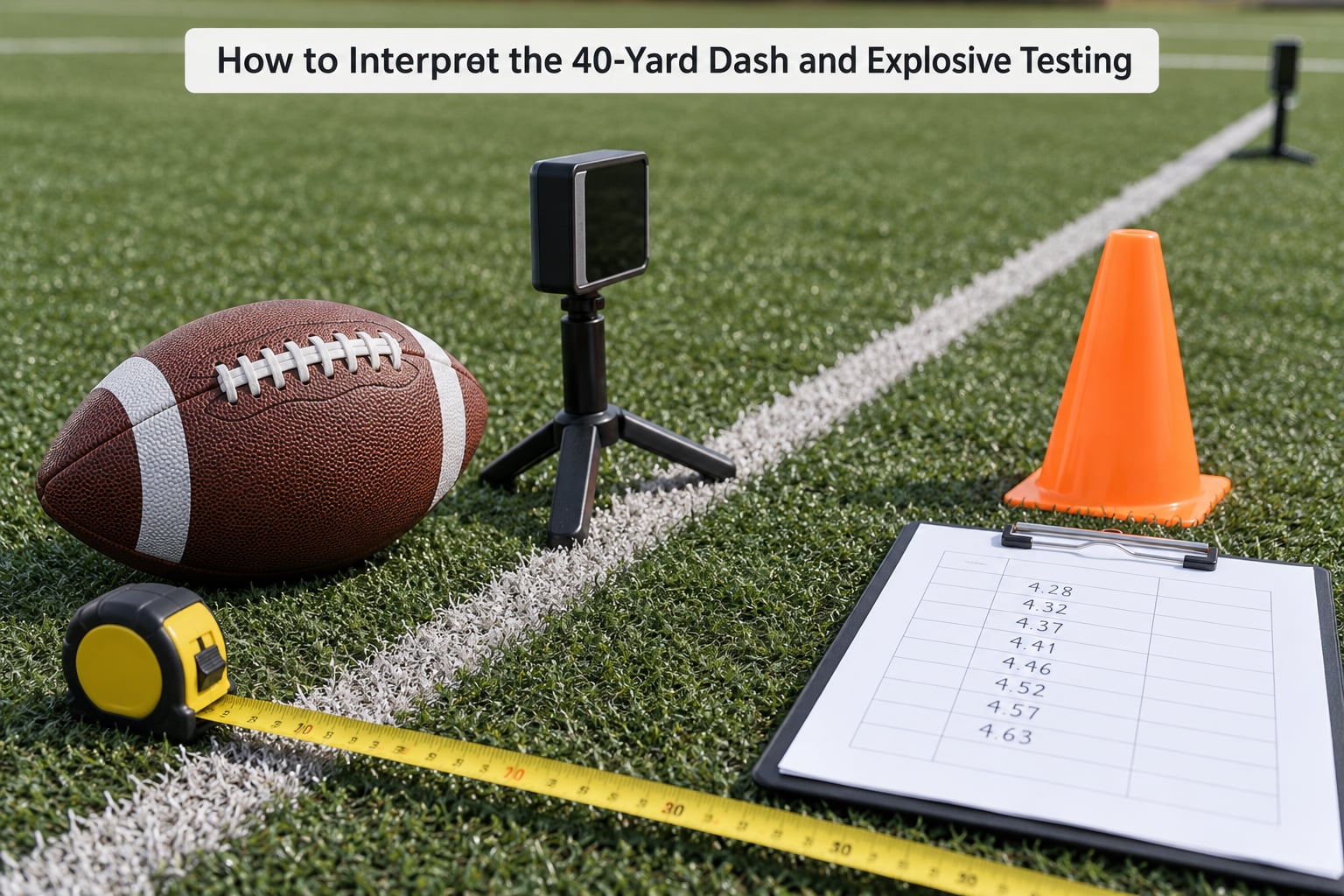
The first rule is that faster is only better up to the point where the position stops rewarding speed. Elite receivers overwhelmingly cluster in a tight band rather than racing toward ever lower times, which is why chasing a sub-4.40 number is a trap. The extra two hundredths buys you almost nothing once you are already fast enough to separate on the release.
Here is the threshold ladder I use at wide receiver. A 4.40 to 4.48 with a matching short-area profile means the player has a real claim to a boundary or slot role. A 4.50 to 4.55 is fine when the player wins with route precision, size, or hands, and it is the single most common NFL profile. A 4.60 to 4.65 means the player needs a scheme that creates separation for him rather than one that asks him to create it, which is a real constraint on draft slot and therefore on opportunity. A 4.70 or slower is a red flag that demands elite route running or unusual size to overcome.
Second, watch the split rather than just the total. The 10-yard split isolates acceleration, and a fast split with a slow 40 often signals a player who is explosive but lacks top-end speed. That profile suits a receiver who lives on slants and underneath routes, and it is a mismatch for a team that needs a downfield threat.
Third, context the attempt. Prospect days run in waves, weather moves around indoors, and a player who tries four times is telling you something different from a player who runs once and walks off. The Harvard Sports Analysis Collective theory thread that circulates in r/DynastyFF makes the same point from the other side: a timed sprint is a measurement of one attempt on one day under unfamiliar conditions, and it is not a physiological ceiling.
How Interviews Reveal Role and Usage Signals
Testing tells you what a player can do for forty seconds. Interviews tell you what the team intends to do with him, and intent is the variable that actually drives opportunity.
The signals worth listening for are specific. When a coach describes a rookie as a primary target, or frames a backfield as a committee with defined roles, you are getting information about the distribution of touches. When a quarterback says he has been working with a receiver on timing and chemistry, that is a report about the passing game tree rather than a compliment.
Negative signals hide in the same answers. Generic praise that could be pasted onto any player is a signal that the player is not yet central to the plan. Talking points about special teams contribution are usually a polite way of saying the offensive role is still unsettled. And a prospect who answers everything with team-first platitudes is managing expectations rather than setting them.
The r/DynastyFF users are consistent on this: treat interview reads as one input alongside film and testing, and let the volume of consistent signals rather than a single quote drive the board change. Polished answers are not guarantees. They are the cheapest data of the week, and they deserve the smallest adjustment on your board.
How Medical Updates Affect Injury Risk and Draft Price
In February, health news outranks every performance number on the sheet. A prospect who does not test in full, or who has a published medical concern, has changed your expected games, and games are the first term in the production equation.
Separate soft-tissue issues from structural ones. A hamstring or ankle problem from college is a duration and recurrence question, and those are recurring risk adjustments rather than automatic disqualifications. An ACL, a fracture, or a shoulder reconstruction is a different category entirely, because it changes both the timeline and the long-term asset profile that dynasty leagues are buying.
Opt-outs deserve their own category. Many prospects skip individual events for injury reasons or for team-mandated rest, and a skipped bench press is frequently nothing. A skipped full workout is worth investigating, because it usually means something the player or the medical staff is protecting.
Frame the adjustment as risk, not diagnosis. Increase the games-played assumption’s uncertainty, widen your range of outcomes, and price the uncertainty into your board rather than deleting a player on a report you read once. If you want a second opinion on a specific injury history, a physician is the right source, not a fantasy forum post. And if a headline about a health concern appears before the combine, wait for the actual medical update before changing anything material.
Position-by-Position Combine Value Changes
Weight the drills differently depending on how the position actually scores in your league. The table below is the version I keep next to my rookie board.
| Position | High-weight drills | Medium weight | Low weight | What actually moves fantasy value |
|---|---|---|---|---|
| Quarterback | None consistently | Height, arm length, movement | 40-yard dash, jumps, bench | Scheme, supporting cast, turnover profile, durability |
| Running back | Burst and agility for committee roles | Power, build, catching | Vertical jump, bench press | Touch share, goal-line work, offensive line, pass-catching role |
| Wide receiver | 40-yard dash, shuttle, three-cone, vertical | Arm length, hand size | Bench press, standing long jump | Target share, slot work, quarterback quality, route tree |
| Tight end | Size and catch-point reach | Standing long jump, vertical | 40-yard dash, shuttle | Red zone targets, blocking involvement, tight end friendliness of the offense |
| Offensive lineman | Bench press, arm length, frame | Explosive testing for guards | 40-yard dash, agility | Run blocking grade, pass protection fit, tackle type |
| Edge and line defender | 40-yard dash, three-cone, power | Vertical jump, build | Bench press | Role as a pass rusher or run defender, IDL usage |
| Cornerback | 40-yard dash, shuttle, three-cone | Arm length | Bench press, standing long jump | Coverage role, slot rate, ball production on interceptions |
Quarterbacks are the clearest case for mostly ignoring the numbers. Arm length and height raise a floor on how awkward throws become, and that is genuinely useful. Nothing else on the sheet predicts completion rate or rushing attempts, so do not let a good 40 move a quarterback up your board.
Running backs are the most frequently misused position. A fast 40 helps a back who is going to be used in space, and bench press numbers are noise. Touch share and goal-line work are what determine the ceiling, and both come from the offensive line and the coaching staff’s commitment.
Wide receivers are where testing earns its keep, because the skills that produce separation are the skills the drills measure. In PPR formats the lean is even further toward agility, since points come from receptions and short-area bursts rather than from downfield milestones.
Tight ends and offensive linemen get the least attention and the least benefit from February testing. A tight end’s red zone volume comes from the scheme. A guard’s fantasy value comes from the run blocking grade, which is not published in Indianapolis.
Rookie Versus Veteran Combine Reactions
Weight the week very differently depending on who is testing. A rookie prospect is arriving with no NFL production data, so testing is one of the few objective signals available before the draft. That is precisely why the week produces such large board swings on unproven players.
A veteran is in the opposite position. There are already three to eight seasons of snap counts, target shares, and injury history for that player. A training camp measurement does not overwrite that record, and if a veteran shows up with a slower time, it is most likely a change in conditioning priorities or an aging curve rather than a change in ability.
This distinction is the one that separates measured updates from board destruction. Rookie moves should be larger and more speculative, because you are pricing an unknown opportunity. Veteran moves should be tiny or nonexistent, because you are adjusting an estimate built on real data. A dynasty manager who gives a veteran free-agent signing a two-round bump on a good workout has confused a pro day with a career.
Dynasty and redraft also diverge here. Dynasty rookie drafts buy a long-term asset, where durability, positional scarcity and development curve matter more than the rookie season. A combine result that raises draft slot helps both formats, but a result that raises rookie-year volume helps redraft more. Decide which board you are moving before you decide how far to move it.
How to Adjust Your Fantasy Rankings After the Combine
Use the same five steps every February so that one loud testing session cannot rewrite an entire board.
Step one: verify the number against the official source rather than a screenshot, and note whether the player took multiple attempts or skipped the event. An unofficial time is worth less than a published one.
Step two: compare the result against position-adjusted benchmarks, not against the whole prospect group. Read the same drill on the three or four comparable players at that position this year.
Step three: name the variable the result touches. Does it change expected draft slot, expected snap share, expected targets, or expected games played? If you cannot name it in one sentence, do not move the player.
Step four: make a measured change and log it. For a rookie on a dynasty board, one to three spots is a defensible response to a strong full workout. Anything larger needs a second source, such as a pro day performance or a confirmed role in the interview session.
Step five: record your confidence so you can revisit it. Marking a riser as high or low confidence keeps the whole class from drifting in one direction during a single week of headlines.
A worked example. Before the combine, a wide receiver sits at rookie pick 1.07 with a slot-heavy projection and a film grade of average. He runs 4.48, posts a 4.28 shuttle, and mentions in interviews that he has been splitting reps with the incumbent outside. That touches two variables: draft slot, because athletic testing supports a first-round grade, and slot share, because a rotation comment implies a defined role. The measured move is 1.07 to 1.02, confidence marked medium, and the note records both reasons. A hypothetical receiver who runs well but says nothing about his role and whose film grade is poor moves 1.12 to 1.09, because only one variable changed.
Common Combine Conclusions Fantasy Drafters Should Avoid
Ranking prospects solely by 40-yard dash time. Speed is one trait among many, and the position norms are narrow. A 4.48 does not outrank route quality.
Assuming every workout gain transfers to Sunday. Testing is a controlled environment on one day. Form, adrenaline, and unfamiliar surroundings all move the numbers in both directions.
Treating reported injuries as settled facts. Headlines arrive before evaluations. Price the uncertainty, and wait for the medical update before changing a projection.
Changing an entire board after one interview. One coach saying a player is a day one starter is a data point, not a season forecast. Consistency across sources is what earns a tier move.
Treating a skipped bench press as a character issue. It is usually a hand, shoulder, or team decision and carries no fantasy information for skill positions.
Paying for a headline. The most expensive reach on a rookie board is buying a player two rounds earlier than the film supports because a testing session felt exciting.
Reading current-class trends as player-specific trends. Testing environments, timing systems, and training norms shift from year to year, so the comparison that matters is this player’s numbers against this class.
Frequently Asked Questions
Does the NFL Combine actually matter?
It matters as a directional input, not a verdict. Strong testing nudges a player’s projected draft slot up, which lifts rookie ADP, which changes what you bid in a rookie or best ball draft. Testing does not change expected fantasy points, because points come from targets, touches and games played, all of which are set by a depth chart and a coaching staff.
What is the average number of 225-pound bench reps for an NFL player?
Most rostered players land somewhere in the high teens to mid-twenties, with guards and interior offensive linemen often posting the strongest totals and defensive backs frequently sitting lower. Position group matters more than the raw number, and for receivers, running backs and tight ends the rep count carries almost no fantasy value beyond a general durability signal.
What was Tom Brady’s 40 yard speed?
Brady’s officially timed sprint at the 2000 Combine came in around the five-second range, slow by wide receiver standards and unremarkable by any objective measure of athleticism. His career is the clearest possible argument that testing measures physical traits, not football talent or the endurance required to play twenty seasons at a high level.
Should I draft a player with a slow 40-yard dash?
Yes, if the rest of the evidence holds up. A 4.60 to 4.65 at wide receiver is a constraint rather than a disqualifier, and it matters most when the scheme requires the player to win separation vertically. A 4.70 or slower demands elite route running or unusual size. Cooper Kupp and Antonio Brown both proved the slow time can coexist with an elite career.
Which combine tests matter most for running backs?
Burst and short-area agility matter most, since committee backfields reward a back who can pass a checkdown and turn a screen into yards. The bench press tells you almost nothing about fantasy value. Touch share, goal-line work and offensive line quality are what set a running back’s ceiling, and none of those are measured in Indianapolis.
How do I use the combine in my dynasty rookie draft?
Treat it as one input inside a probability model rather than a verdict. Verify the number, compare it against position-adjusted benchmarks, name the variable it changes such as draft slot or expected games, then move the player one to three spots for a rookie and record your confidence. Larger moves need a second source of confirmation.
Conclusion
How the NFL Combine affects fantasy draft value through one narrow channel: it changes how high a player is projected to go, and that changes rookie opportunity pricing. Everything else about testing is evidence about traits, not about weekly volume.
So do three things before you rebuild anything. Verify the numbers against official results, compare each one against position benchmarks rather than the whole prospect field, and change only the assumption the result actually touches. If you cannot name that assumption, the result belongs in your notes and not on your board.