
A dynasty taxi squad is a small set of extra roster spots that sit outside your active roster and hold developmental players, usually rookies and second-year guys, who do not score points until you promote them. The promotion is one-way: once a taxi player moves up, they can never go back down. That single mechanic is how dynasty taxi squads work, and understanding it changes how you run a rebuild.
- What it is: extra roster spots outside the active roster, working like an NFL practice squad for your fantasy team.
- Typical size: three to five spots, most often three on Sleeper.
- Who qualifies: depends on your league — commonly rookies and second-year players, sometimes anyone under a set number of NFL games.
- Scoring: taxi players do not score until promoted.
- The catch: promotion is one-way, and eligibility expires.
Table of Contents
- What Is a Dynasty Taxi Squad?
- Why Do Dynasty Leagues Use Taxi Squads?
- How Does the Taxi Squad Replacement Process Work?
- How Dynasty Taxi Squads Work in Different League Formats
- Who Can Replace a Player on a Taxi Squad?
- What Is the Difference Between a Taxi Squad and a Reserve Roster?
- How Many Players Should a Dynasty Taxi Squad Have?
- What Strategy Should You Use to Build a Taxi Squad?
- How Do Taxi Squads Work During Drafts and Trades?
- What Happens When a Taxi Squad Player Is Injured or Retires?
- A Practical Dynasty Taxi Squad Example
- What Are the Most Common Taxi Squad Mistakes?
- Frequently Asked Questions
- Do all dynasty leagues use taxi squads?
- How many players can be on a dynasty taxi squad?
- Can a player on my active roster be a taxi squad player?
- Can I trade or acquire a player who is eligible for a taxi squad?
- Are free agents eligible to replace players on a taxi squad?
- Can a commissioner change taxi squad rules during a season?
- Conclusion
What Is a Dynasty Taxi Squad?
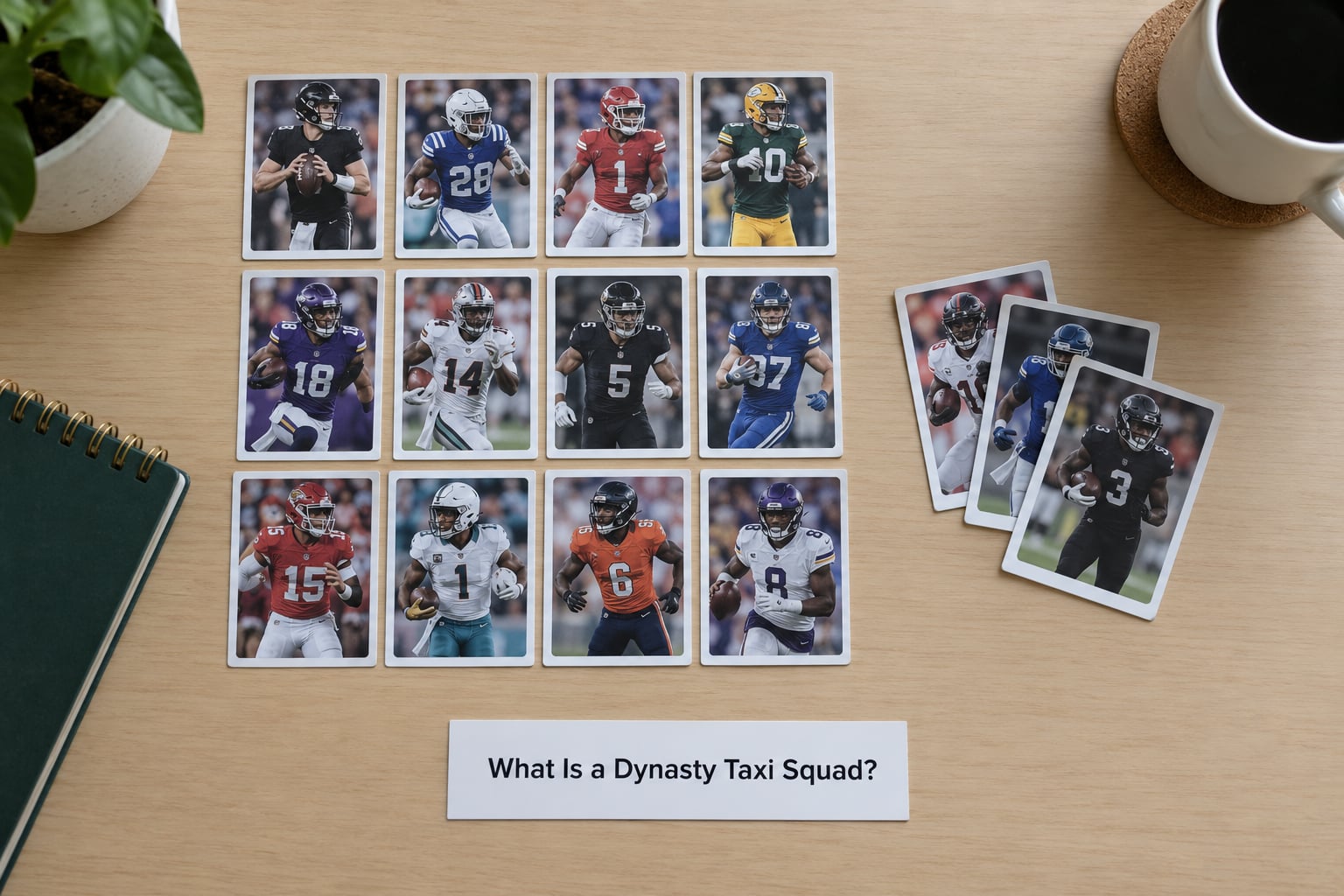
A taxi squad in dynasty fantasy football is a set of extra roster spots, usually three to five, that sit outside your active roster and hold developmental players who cannot be started or score until you promote them. Think of it as an NFL practice squad for your fantasy team.
The spots are separate from your active roster, your bench and your IR. Players sitting there are held but inactive: they do not count toward your lineup, they do not accumulate points, and most leagues stop counting them against your total roster limit. You are paying for the slot with opportunity cost, not with points.
The name comes from the NFL, where “taxi squad” was used loosely for reserve players before “practice squad” became standard. Cleveland Browns owner Arthur McBride reportedly kept extra players employed by his taxi company, which is where the term gets its odd and very fantasy-sports origin.
Why Do Dynasty Leagues Use Taxi Squads?
Taxi squads solve a roster math problem that dynasty creates on purpose. A rebuild usually means you have too many aging veterans and too many prospects, and not enough room for both.
Without taxi spots, a manager who drafts a developmental rookie in round four has one choice: drop a 30-year-old tight end who still produces 8 points a game, or cut the rookie. Taxi squads let you keep the prospect without paying that cost in production.
Leagues that adopt them are usually chasing a few specific things:
- Prospect protection. A fourth-round rookie tight end needs two or three seasons behind a real tight end before he is useful. Taxi space is the cheapest way to buy that time.
- Rebuild insulation. You can stockpile youth without punting your lineup every week to protect it.
- A brake on the waiver wire. Taxi players are protected from casual pickups by other managers, which keeps developmental players from becoming free production.
- Realism. The format mirrors how NFL teams actually manage depth, and it discourages the win-now-and-punt style that annoys most dynasty groups.
That last point is also where taxi squads generate friction. Managers in the r/DynastyFF taxi threads repeatedly describe the same complaint: someone parks a usable veteran on taxi to protect a losing record, and competitive balance suffers.
How Does the Taxi Squad Replacement Process Work?
The replacement process is usually the same five or six steps, and the exact wording depends on your platform and custom rules.
- A vacancy opens up. A starter gets injured and lands on IR, a player is cut or traded away, or a promoted taxi player takes a job on your active roster that someone else was holding.
- Check who is eligible. Look at your taxi players and confirm they still satisfy the eligibility rule your league uses — rookie status, second-year status, or an NFL experience limit.
- Activate or promote. Depending on the setting, the replacement either moves straight into the open active roster spot or is placed on IR under your league’s injury rules first.
- The replacement plays out the season. Most leagues limit how many taxi promotions you get, often once per season, and some allow taxi activation only in the offseason.
- Fill the empty taxi spot. Draft a rookie into it, add a waiver claim, take a free agent, or leave it open. On several platforms you have to add the player to your active roster or bench first, then move him down.
- Watch the eligibility clock. When a taxi player exceeds the eligibility window, he usually has to be promoted or dropped.
How Dynasty Taxi Squads Work in Different League Formats
Taxi squads are a dynasty tool, but every format has an equivalent slot with different rules. The table below is the common setup, not a universal one — check your own settings before assuming any row applies to you.
| Format | Who qualifies | Where eligible players sit | What happens after a vacancy |
|---|---|---|---|
| Redraft | Rarely used | No equivalent, players leave with the roster | New player joins at the draft or through waivers |
| Keeper | Occasionally, for developing keepers | Taxi or a protected slot if the league allows it | Replacement steps in, roster spot stays open for the season |
| Startup | Common for rookie development | Taxi spot outside the active roster | Replacement fills the active spot and takes the role |
| Keepers / dynasty with multiple years | Rookies, second-year players, or an NFL experience cap | Taxi spot, sometimes counting against roster limits | Promotion is one-way and capped by league settings |
| Dynasty baseball | Top prospects, often any prospect under an age limit | Minor-league roster spots | Promotion to the major-league roster when ready |
Who Can Replace a Player on a Taxi Squad?
Eligibility is set in the league settings, and the four most common rules are simple versions of the same idea. The first restricts taxi spots to rookies. The second allows rookies and second-year players. The third counts NFL experience instead of dynasty years, so any player with fewer than a set number of NFL games qualifies. The fourth has no eligibility cap at all, which some leagues use to allow veteran development.
Beyond the eligibility rule, three settings decide who can actually take the job:
- Primary versus secondary taxi. Some leagues split spots into a primary taxi that must always be filled and a secondary taxi that is optional. Dynamic secondary taxi, where the number of open slots flexes with your roster, is a common middle ground.
- Counting against the roster limit. A lot of leagues let taxi players sit outside your roster limit. Some require every taxi player to count, which changes how many prospects you can carry.
- Commissioner discretion. Some commissioners approve taxi moves outside a fixed window, or set how many promotions you get per year.
What Is the Difference Between a Taxi Squad and a Reserve Roster?
The difference is about role, not player quality. A reserve roster holds extra healthy players who are ready to start, protect against injury, or provide optional upside. A taxi squad holds players who are not ready at all.
In practice the reserve slot is a playing spot. You can start the player from your bench during your weekly lineup, and in some platforms bench players score even if not started. A taxi player does none of that until promotion.
That is also why the two cannot substitute for each other. If you need a week-one backup, taxi does nothing for you. If you need three years of development for a tight end, bench slots are a waste because they produce points you are trying not to bank.
How Many Players Should a Dynasty Taxi Squad Have?
Match your taxi spots to the length of your rookie draft. That is the sizing answer that shows up most often in dynasty manager discussions on r/DynastyFF, and it holds up because the spots exist to hold picks, not players generally. A four-round rookie draft pairs with four taxi spots; a three-round draft pairs with three.
The other common rule of thumb is roughly 1.5 times your number of bench starters, which in most dynasty leagues with 12 to 15 bench spots lands in the same neighborhood. Bench sizing in dynasty typically runs 12 to 15 spots, and three taxi spots is the most common configuration on Sleeper, with four or five also seen.
Neither number is a rule. The real question is how often your roster breaks. If you rebuild and you drafted six rookies who will not produce for two years, three spots is too few and you will end up cutting your own prospects. Four is plenty in most 12-team leagues with a four-round rookie draft.
What Strategy Should You Use to Build a Taxi Squad?
Every taxi player should have a promotion trigger written down before you put him there. If you cannot describe the specific thing that makes you call him up, you are just hoarding.
- Do not taxi running backs. Their value arrives in year one. The consensus in dynasty manager threads is to keep high-upside rookie RBs on the active roster where they can actually produce.
- Taxi wide receivers behind a crowded depth chart. A Day-3 or Day-4 wide receiver who is fourth on the depth chart will not see targets. Two years of practice squad time is the whole point.
- Park athletic tight ends. Some leagues run a deliberate tight end greenhouse: three athletic rookies sitting on taxi for two or three years, betting that one breakout pays for the rest.
- Hold developmental quarterbacks in superflex. A rookie passer you cannot start is a natural taxi resident, and in superflex the eventual promotion can win you a week.
- Handcuff selectively. A taxi running back can act as a low-cost backup, but only if your league allows taxi players to activate in season.
Watch contract length and trade value too. A taxi stash with two years of cost-controlled production left is the cheapest trade sweetener in dynasty, and contenders with no room on their roster are always shopping for exactly that.
How Do Taxi Squads Work During Drafts and Trades?
Drafts are where taxi squads matter most, and how they behave depends on the platform setting. Fleaflicker handles this directly: go to League > Settings > Edit Roster Requirements > Custom, edit the taxi settings to allow it, and owners can move drafted rookies into taxi spots themselves.
On other platforms you usually draft to a normal roster or bench slot and move the player into taxi before the draft is finalized. On Sleeper, waiver and free-agent pickups generally have to be added to your active roster or bench first, then moved down, which wastes a spot briefly and trips up a lot of managers.
On the trade side, always confirm whether taxi-eligible players can be acquired directly into taxi. Some leagues force traded players onto the active roster first, others let you place them straight into taxi, and a few let you trade a taxi player without ever promoting him. Managers in r/FFCommish threads treat that setting as a dealbreaker question before agreeing to a trade.
What Happens When a Taxi Squad Player Is Injured or Retires?
It depends entirely on the settings, and the outcomes range from almost nothing to a forced roster change. The most common options:
- Another eligible taxi player replaces him in the open active roster spot.
- He is promoted into the active roster under your league’s injury replacement rule and stays there.
- The taxi spot empties out and stays empty until you fill it.
- The league reverts to a roster requirement you no longer meet, forcing an immediate cut.
The pre-emptive move is to check your league’s injury replacement rule before the season starts. If it requires promoted players to be declared injured to activate, you want to know that in August, not in October.
A Practical Dynasty Taxi Squad Example
Here is a 12-team league with a four-round rookie draft, a 16-player active roster, a 12-spot bench and four taxi spots. Every manager has the same rules: taxi players must be rookies or second-year players, taxi does not count against the roster limit, one promotion per season, and eligibility expires after two years.
Manager A is rebuilding. He drafts a blocking tight end in round two and an athletic tight end in round four, moves both into taxi, and uses his other two spots on a late-round wide receiver and a developmental quarterback.
In week six his starting tight end lands on IR with a hamstring. Manager A promotes the blocking tight end, who starts for the rest of the year. In the offseason the athletic tight end loses his eligibility as a rookie, so he has to be promoted or dropped; Manager A promotes him and moves the late-round wide receiver down into the open taxi spot.
That is the whole loop, and it is why managers say cycling taxi slots is where the real edge lives. A taxi squad filled once and never touched again is a wasted squad.
What Are the Most Common Taxi Squad Mistakes?
Almost every complaint about taxi squads comes down to one of five behaviors.
- Using taxi to tank. Parking an aging veteran on taxi to protect a losing record is the loudest complaint in dynasty communities. It defeats the competitive balance the rule was designed to create.
- Never cycling the slots. If your taxi squad has held the same three players for three seasons and never produced a starter, the spots are being wasted.
- Duplicating positions. Three tight ends and no wide receivers is a bad use of a small resource. Test whether the taxi player is genuinely useful before he takes the spot.
- Ignoring platform rules. Assuming you can promote mid-season, or drop a waiver pickup straight into taxi, when your league does not allow it is the most common self-inflicted problem.
- Roster-limit confusion. In leagues where taxi counts against your roster limit, a full taxi can push you under the minimum and force a cut at the worst time.
Most managers fix all five by doing one thing: reading their own league settings carefully at the start of each season.
Frequently Asked Questions
Do all dynasty leagues use taxi squads?
No. Taxi squads are an optional setting, and plenty of dynasty leagues run without them, using bench and IR slots to cover development instead. They are far more common in dynasty than in redraft or keeper formats, since only dynasty has a multi-year window where a player can be held without contributing. Ask your commissioner before the draft whether the league has taxi spots and how many.
How many players can be on a dynasty taxi squad?
Three to five spots is the usual range, and three is the most common configuration on Sleeper. The most reliable sizing rule is to match your taxi spots to your number of rookie draft rounds, so a four-round rookie draft pairs with four spots. Another rule of thumb is about 1.5 times your bench starters. Whatever number you pick, check whether those players count against your roster limit.
Can a player on my active roster be a taxi squad player?
Only if your league allows it. Some settings let you move an active roster player down into taxi, which is useful for parking a veteran temporarily. Many leagues restrict movement into taxi to players who were added there directly, such as drafted rookies. A few leagues cap how many taxi players an owner can have or how many times you can move players in and out during a season.
Can I trade or acquire a player who is eligible for a taxi squad?
Usually yes, but the landing spot depends on the platform. Some leagues let a traded player go straight into taxi, others force him onto your active roster first and require you to move him down. That one question comes up constantly in trade negotiations, so confirm it before you agree to a deal. Also check whether taxi-eligible players can be dropped into taxi without using a promotion.
Are free agents eligible to replace players on a taxi squad?
It varies. Some platforms let you add a free agent directly into a taxi spot, while others require you to add him to your active roster or bench first and then move him down, which temporarily costs you a roster spot. That extra step is one of the most common sources of confusion on Sleeper. Check your league settings or ask the commissioner before the season starts.
Can a commissioner change taxi squad rules during a season?
Most platforms allow it, but it depends on the league’s bylaws. Commissioners can often change the number of spots, the eligibility rule, or the number of promotions per season mid-year. Changing the eligibility rule after a draft is where most arguments start, since some managers will have just stashed players under the old rule. Publish any change in the league thread before it takes effect.
Conclusion
Taxi squads are extra roster spots for developmental players who cannot score until you promote them, and the promotion is one-way. Eligibility, spot count and activation timing are all league settings, not universal rules.
Start by opening your league settings and confirming three things: how many spots you have, who is eligible, and whether you can promote in season. Then fill those spots with players whose position has a slow maturity curve, give each one a promotion trigger, and cycle the slots every season. That discipline, more than the spots themselves, is what makes a taxi squad worth having.