
If you want to know how to build your own fantasy football rankings, the method is shorter than most people expect: take projections, convert them to fantasy points under your scoring rules, subtract a replacement baseline at each position, group the results into tiers, then check where your order disagrees with consensus ADP. The build takes a focused evening and about two hours of work after that.
The reason to do it is not stubbornness. Default platform rankings are generic, and the gaps between them cluster in the middle and late rounds where your actual picks get made. Own rankings give you specific draft targets you can reason about.
Below is the process I use, in the order that saves the most rework.
Table of Contents
- What You Need
- Best Tools to Build Custom Rankings
- Step-by-Step: How to Build Your Own Fantasy Football Rankings
- Define Your League Context
- Gather Reliable Player Data
- Set Baseline Player Tiers
- Adjust Rankings for League Strategy
- Test and Finalize Your Rankings
- Common Mistakes
- Frequently Asked Questions
- How many players do I need to rank for my fantasy league?
- How often should I update my custom fantasy football rankings?
- How do I handle injury news before my draft?
- Are expert consensus rankings useful if I build my own?
- How do I adapt my rankings for PPR or a dynasty league?
- Conclusion
What You Need
Six things. Nothing here is exotic, and none of it requires a paid subscription.
- Your league settings, written down. Scoring format, roster size, number of teams, flex slots, superflex or two-QB, number of bench spots.
- A projection source. A free aggregate of at least two projection systems works better than one system alone.
- A scoring converter. This turns projected yards, receptions and touchdowns into fantasy points under your rules.
- A replacement baseline method. A simple default starter level works; you don’t need a proprietary model.
- A spreadsheet or a hosted cheat sheet tool. Both are covered below, and either produces the same rankings.
- A draft board that reads your ordering during the draft itself.
The single most-skipped item is the first one. Roster construction changes player value more than any opinion you hold, and it’s the one thing you can verify in ten minutes.
Best Tools to Build Custom Rankings
These are the four I see cited most often in draft-prep communities, and what each one actually does.
- FF Ranker Cheat Sheet Maker — drag and drop players into your own order, assign tiers, and tag players for later reference. The AI-generated answer on this query names it first for good reason.
- FantasyPros Draft Wizard — import expert consensus rankings as a starting set, then edit the order and add your own tier columns.
- RotoWire — carries both projections and consensus rankings side by side, which makes divergence easy to spot.
- TapThatDraft — built specifically around letting you set positional ordering yourself rather than inheriting a projection system’s player order.
Users on r/FFCommish and the Huddle forums describe the spreadsheet route most often: download a consensus ranking as CSV, add tier and baseline columns, and compare against ADP. That gets you the same output with no sign-up.
Step-by-Step: How to Build Your Own Fantasy Football Rankings
Define Your League Context
Your league settings decide what a player is worth before you look at a single projection. The same running back can be a second-round pick in one league and a bench filler in another.
| League setting | How it moves your rankings |
|---|---|
| Full PPR | Volume of targets becomes the dominant signal; high-volume pass-catchers rise, early-down backs flatten out |
| Half PPR or standard | Rushing efficiency re-enters the picture; touchdown-dependent backs move back up |
| Superflex or 2QB | Quarterbacks become scarce early; backup QBs become draftable well past their normal ADP |
| Single tight end slot | Tight end value collapses to a second-round ceiling; streaming beats drafting early |
| Six flex slots | Receiver depth matters more than receiver stars; wide FLEX changes the shape of every round |
| Small bench | Streaming has almost no value; draft bodies instead of streamers |
Redraft, best ball and dynasty also reward different things. A redraft ranking cares about one season of production. A dynasty ranking cares about the age curve and how long a player’s role holds up.
Gather Reliable Player Data
Collect role and opportunity data, not highlights. For each player you want in your top 150, note projected snap share, target share, red-zone touches, goal-line work, depth-chart competitors and age.
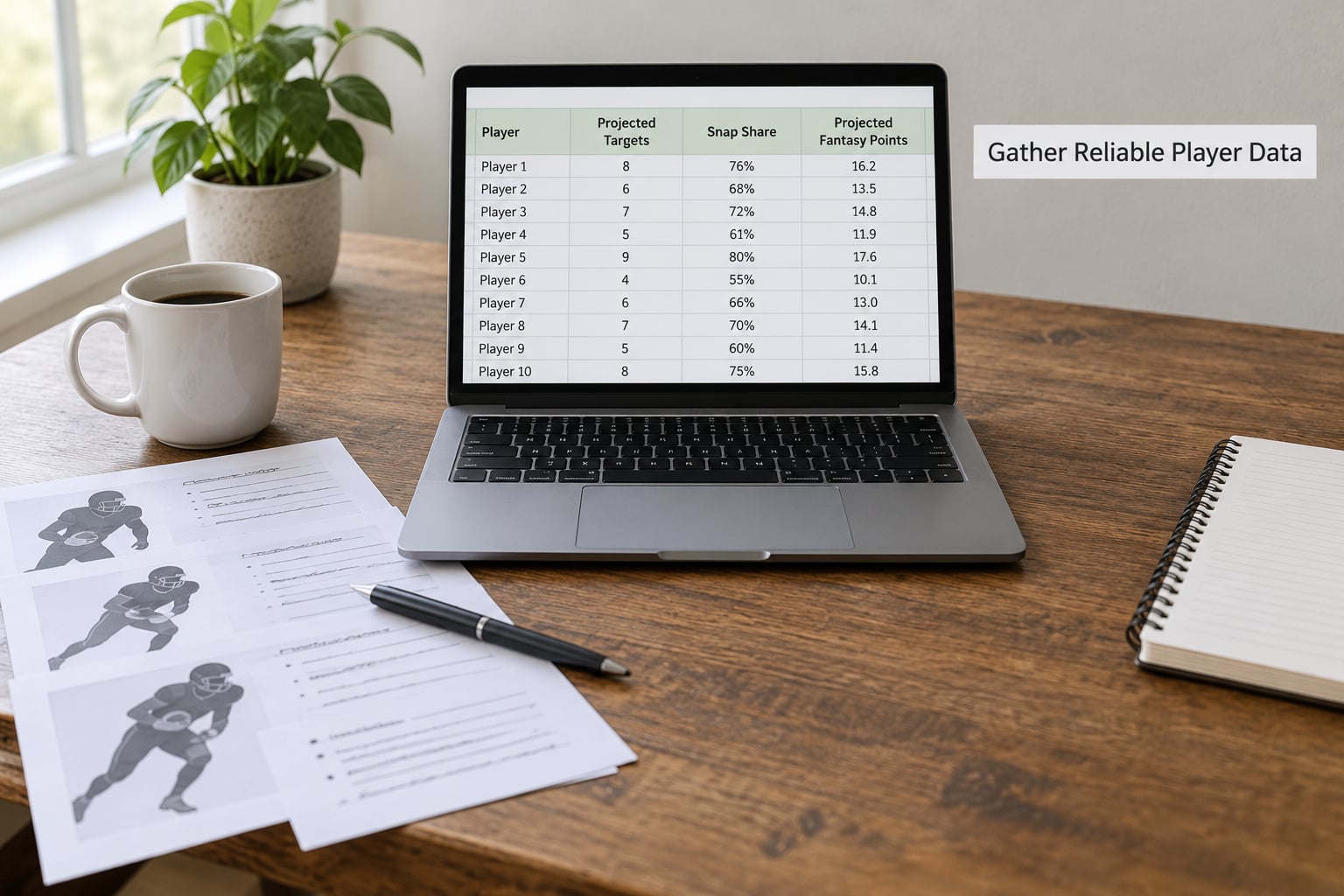
Two inputs deserve more trust than the rest. Ratios of expected stats — targets per route, touches per game — hold up well across seasons because they describe role. Raw player ordering from a projection system holds up worse, because a single system will happily rank a name fifth that eight experts rank first. Use projections for ratios and for the value curve, then order players using consensus.
Stay disciplined about where research stops. Twenty players per position with clear opportunity data is enough to draft well. Another four hours of reading will not change the shape of your tiers.
Set Baseline Player Tiers
Start with a replacement baseline: the number of fantasy points the last starter at each position would score in your league. The usual shortcut is the average of the last starter and the first bench player at that position. Then subtract it from every player’s projection.
What you get is points above replacement, and the players below your baseline go negative. That negative space is where the drafting happens.
| Player group | Projected points (PPR) | Replacement baseline | Above replacement | Consensus ADP |
|---|---|---|---|---|
| QB1 | 380 | 290 | +90 | 4 |
| RB1 | 290 | 165 | +125 | 6 |
| WR1 | 320 | 195 | +125 | 11 |
| WR2 | 305 | 195 | +110 | 17 |
| RB2 | 245 | 165 | +80 | 19 |
Read that table by the fourth column, not the last. RB1 and WR1 are worth the same to you even though one is picked six slots earlier. That gap is a value target, and it’s the kind of thing nobody’s default ranking will tell you.
Now convert those scores into tiers. Group players whose above-replacement scores differ by less than roughly ten percent into the same tier, and start a new tier when the gap widens.
Tier within position rather than running one global list. The forum consensus is close to unanimous on this: a global tier list produces targets that are awkward to use, because your draft board needs to know your next-best target at a specific slot, not a global Tier 3.
As a rule of thumb, use about 8 to 10 tight ends and 12 to 15 wide receivers per tier early, then thin out. Deep positions need more tiers because a drop-off there matters less. Tiers get wider as you move down the list, and the bottom two tiers can be merged into a single “avoid” group without cost.
For a dynasty league, add an age overlay before tiering. A 24-year-old with a growing role belongs near the top of his group even at identical projected points; a 32-year-old with the same projection belongs a full tier lower. Rookie and young-player rankings are where building your own tiers pays off most, since almost nobody publishes a usable list.
Adjust Rankings for League Strategy
Three adjustments happen after tiering.
First, positional scarcity. Count how many teams still need a starting quarterback at your pick. If three teams need one and two are available, the second one is worth an upgrade regardless of his projection.
Second, risk. A player with a defined role and no injury history can be drafted on projection alone. A player whose projection depends on staying healthy should either slide down a tier or be drafted only where his ADP has drifted above his tier.
Third, your own draft position. Rankings describe value, not need. Move a player up when he’s the best available option at your slot, and let a reach go when a teammate already has the same role.
Then compare against consensus ADP and mark the disagreements. Users across the FFL forums report the same habit: draft where your ranking and ADP disagree, fade the players both agree on too early.
Test and Finalize Your Rankings
Run three checks before you call it done.
- Opportunity audit. Spot-check twelve players against their team’s depth chart. If a player you ranked top 12 is behind two others at his position, fix it.
- Scoring audit. Convert three players by hand under your rules and compare to the sheet. Converter errors almost always show up here.
- Consistency audit. Every player in a tier should have a projected point total inside your tier width. Violations mean the tier or the baseline is wrong.
Load the result into a draft board and print it. Managers report one printable page with their own tiers beats a complex desktop tool during a live draft, because you need targets, not analysis.
Then set a maintenance rule: re-check your rankings weekly during draft season, and only after one of three things happens — a role change, a significant injury, or a projection update that moves a player by more than about 15 points. Re-ranking on every rumor is how you talk yourself out of good spots.
Common Mistakes
1. Copying consensus rankings and calling them your own. Fine as a starting point, useless as a finished product. Add your baseline, your tiers and your injury flags, and the ranking is yours.
2. Ranking on reputation instead of opportunity. A known name with a reduced role is a mid-round pick, not a first-round one. Rank the snap count and the target share, then check whether the name matches.
3. Using one projection system. Averaging two or three reduces single-model noise, and a position that only one system likes deserves a look before you ignore it.
4. Ignoring your league settings. The most common version is drafting standard-league tight end values into a PPR league. Check the settings line before the player line.
5. Over-fragmenting your tiers. Twenty-two tiers across a position means your tiers no longer tell you anything. Wider tiers are more honest about how close two players actually are.
6. Anchoring on ADP. ADP tells you where the market goes, not where the value is. Use it as the check on your own order, never as the order itself.
7. Redraft value in a dynasty league. Points above replacement matters in dynasty too, but it’s the age curve on top of it that separates a keeper from a one-season rental.
A few habits that hold up: write your tiers before you look at ADP so your opinion isn’t anchored; keep a separate waiver-priority column in the same sheet; and score your custom rankings against the actual draft after the season so next year’s build starts from evidence instead of memory.
Frequently Asked Questions
How many players do I need to rank for my fantasy league?
Rank about three times your league size. For a 12-team league that is roughly 36 players, and for a 12-team superflex league it is closer to 60. Going deeper has diminishing returns once you pass the players who will realistically be available at your final pick.
How often should I update my custom fantasy football rankings?
Check them weekly during draft season, but only revise after something concrete happens: a role change, a significant injury, or a projection update that moves a player more than about 15 points. Re-ranking on every rumor is the fastest way to abandon a good original list.
How do I handle injury news before my draft?
Drop the player’s tier by one full tier and treat his ADP as meaningless until a replacement is named. If the backup is already inside your top 150, he inherits the vacated target. Re-rank the position, not just the player, since injury news moves two or three names at once.
Are expert consensus rankings useful if I build my own?
They are the best available ordering of players and a good starting input. Projections are more reliable for stat ratios and the value curve than for the order they produce. So use consensus for the sequence, use projections for opportunity, and layer your own league settings and tiers on top.
How do I adapt my rankings for PPR or a dynasty league?
For PPR, weight target share above touchdown efficiency and expect late-round receivers to outperform their projections. For dynasty, keep the points-above-replacement math and add an age overlay, so a younger player at an identical projection sits a tier higher than an older one.
Conclusion
How to build your own fantasy football rankings comes down to four moves in order: write down your league settings, gather opportunity data from two or more projection sources, convert to fantasy points and subtract a replacement baseline, then group the results into positional tiers. Compare that order to consensus ADP and draft where the two disagree.
Start tonight with the part that takes ten minutes: open your league settings and note the scoring format, roster construction and flex slots. Everything after that depends on those three lines being correct.