Learning how to manage your bench in fantasy football comes down to one habit: sorting every reserve player into one of three buckets each week — insurance, upside, or dead weight. Do that and your bench quietly protects you through byes, injury weeks and breakouts. Ignore it and you will lose a playoff matchup to a kicker you were too lazy to cut in Week 6.
The whole process takes about twenty minutes on a Sunday morning, and most of that time is spent on judgment rather than clicking. Here is the framework I use, broken into the same seven steps I walk through every week.
Table of Contents
- What You Need
- Step-by-Step
- 1. Review Your League Rules and Roster Construction
- 2. Separate Starters From True Bench Players
- 3. Evaluate Opportunity Before Talent
- 4. Check Weekly Matchups and Schedules
- 5. Decide Whether to Hold, Promote, or Drop
- 6. Act Early When the Evidence Is Clear
- 7. Recheck Late for Lineup Locks and News
- Common Mistakes
- Filling every spot with interchangeable bodies
- Wasting bench spots on kickers and defenses
- Overreacting to one hot week
- Having no start-versus-stash rule
- Ignoring what other managers are doing
- Frequently Asked Questions
- How many bench players should I keep in fantasy football?
- When should I start my bench player?
- Should I drop a bench player for a worse player with upside?
- How do I manage bench players during an injury crisis?
- Is it better to hold a benched star or add a similar player?
- When should I make my final fantasy football lineup changes?
- Conclusion
What You Need
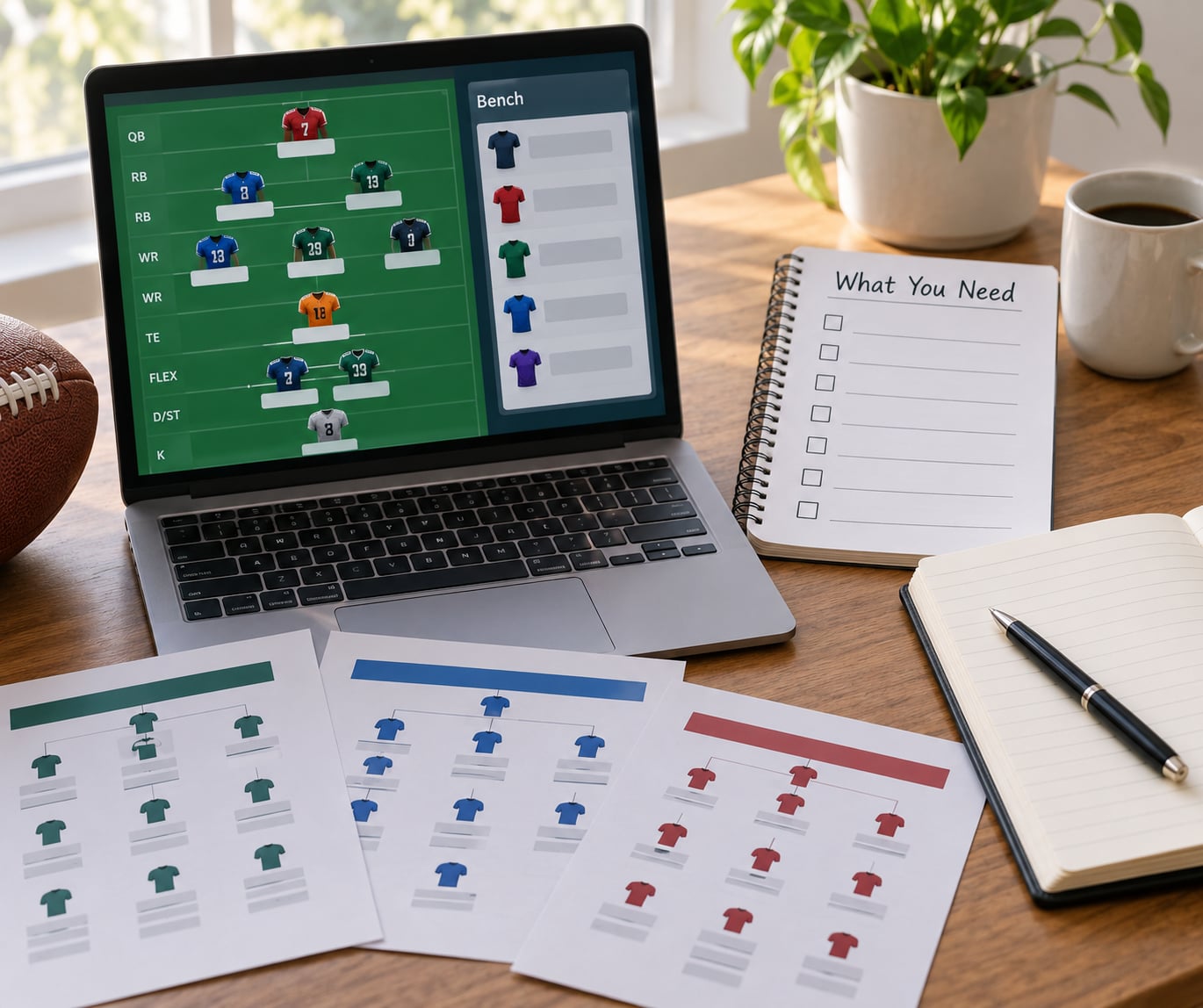
Before you touch a single bench slot, gather five things. Without them you are guessing, and guessing on the waiver wire is how people end up with four kickers and a 0.1% league finish.
- Your league settings page. Bench capacity, IR slots, taxi squad rules, flex eligibility, minimum and maximum players at each position, and the number of playoff weeks. Roster rules change what belongs on your bench, so read them once and know them cold.
- A role picture, not just a stat line. Depth chart snapshots, snap counts, target share and red zone touches for every player on your team and the guys behind them.
- Injury and news access. Practice reports, injury designations, coaching press conferences and any reported depth chart changes.
- A schedule and matchup view. This week’s opponent, the strength of the opponent’s defense, remaining byes, and playoff dates.
- Your waiver priority setting. Whether it is a rolling priority, a fixed one or a full FAAB league, it changes who you can realistically outbid for a player you want.
None of this needs to be a paid tool. Most managers get through the weekly routine with a free projection site, a news feed, and a notes file they actually keep.
Step-by-Step
1. Review Your League Rules and Roster Construction
Start with the constraints, because they decide everything else. A six-man roster with two bench spots is a completely different game from a sixteen-team league with seven bench spots and two IR slots. Short benches reward filling every hole with a reliable body. Deep benches reward lottery tickets.
How many bench players you should hold depends almost entirely on how many spots you have and how many teams you have to replace.
| Roster size | Typical bench spots | What those spots are for |
|---|---|---|
| 8 to 10 teams, standard rosters | 3 to 4 | One insurance body at your thinnest position, one or two upside stashes, one spare flex option |
| 10 to 12 teams with IR slots | 5 to 7 | Two insurance slots, two to three stashes, and an IR player kept for the season if your league allows it |
| 12 or more teams, dynasty or keeper formats | 7 and up | Young developmental players as much as weekly assets, since your bench is effectively a farm system |
Note the shape of that third row. In dynasty and keeper leagues, bench value is player value over several years, not points this Sunday. A second-year tight end with a growing role can outrank a usable running back for a rest-of-season roster spot.
2. Separate Starters From True Bench Players
Most bench problems are really role problems. Managers stash players who will never be relevant and cut players who quietly own a third of their team’s targets. Sort your bench into four groups and label them.
- Insurance. Your starting backfield is thin, or your only usable tight end has a bye. This is the spot that saves your week.
- Handcuff and timeshare. The back behind your starter is picking up meaningful carries while the starter is out. If the starter goes down mid-game, that handcuff is your whole week.
- Prospect. A young player on a good offense who has not yet earned a real role but is one injury away from one.
- Decline. A player whose targets, snaps or touches are falling week over week. This group is where your drop-and-add work happens.
Kickers and defenses are the two positions that almost never deserve a permanent bench spot in redraft leagues. Both are heavily concentrated at the top and cliff-drops everywhere else, so a cheap free agent on a good schedule usually does the job. Streaming them is about the money and roster spots you free up for running backs and wide receivers, which are the positions where a boom week makes every league-mate claim your drop.
Tight ends and quarterbacks sit in between. A backup tight end only earns a spot when your starter is a genuine injury risk and the replacement is actually on the wire. A backup quarterback earns a spot mainly as protection: cheap insurance, or a contingency if you started someone with a soft injury designation.
3. Evaluate Opportunity Before Talent
Talent is what a player showed last year. Opportunity is what is available this year, and on a bench spot opportunity matters more. A backup with an open path to a vacated target is worth more than a more talented player buried behind three others.
Look for four signals. First, a role that freed up: a team that lost a starter, a new offensive coordinator, or a scheme that runs more plays to a position. Second, the offensive line, since a shaky unit suppresses volume for everyone on it. Third, snap share trend rather than a single game, because one game is noise. Fourth, in PPR, target share, since a receiver who owns a fifth of his team’s targets has a floor that a non-factor does not.
PPR and standard scoring reward different bench profiles. In PPR, a wide receiver with a modest target share and a high floor is genuinely stashable because three catches will play up most Saturdays. In standard scoring, volume decides everything, and that receiver becomes a player you drop when someone better appears. The same roster can be good in one league and wasteful in the other, and that is fine — the sport is the sport, your league is not.
The inverse applies late in the season. In the final two weeks of a playoff run, floors beat ceilings. A sixth-round tight end who catches five passes every Sunday will beat a 0.1% rookie on your bench boost, and the rookie is the one you should be cutting.
4. Check Weekly Matchups and Schedules
Matchups decide the start-or-stash call more often than projections do. Look at what the opponent does defensively: how often they funnel targets to a given position, whether their corner rotation shuts down your slot, and whether their linebackers can cover a tight end over the middle.
Then widen the lens. Check the rest of the season, because a player facing three soft schedules after this week is worth keeping through a bad matchup. And check your own schedule — how many more weeks do you need a body at that position before your first hard bye?
Environment matters too. Weather, dome versus outdoor, and pace all shift expected touches. None of it should override role changes, but a bad weather report is a fine reason to prefer your floor option in a close call.
5. Decide Whether to Hold, Promote, or Drop
Now the actual decision. I use a simple three-question filter, and it takes about two minutes per player.
Question one: is my starter healthy? If yes, a bench player needs to be clearly better this week, not comparable. If no, the bench player is promoted automatically, and the question becomes whether a better body exists on the wire.
Question two: is the bench player’s role going up? Rising snaps, rising targets, a new coach, a competitor injured. If nothing is trending upward, you are holding a filler and waiting for a waiver wire that may never come.
Question three: would a league-mate take this player off the wire if I dropped him? This is the question most managers never ask, and it is the one that wins leagues. If the answer is yes, holding him has value even if he is on IR for three weeks. Managers talk about protecting a player from being stolen as claiming dibs, and in a twelve-team league a protected breakout is often worth more than the one you started.
Two more situations come up constantly. First, the trade chip: a benched player with a role and a young age is currency, and a manager who consolidates talent through a deal often beats one who keeps adding bodies. Second, the season-over player: anyone in a keeper or dynasty league should be graded on the next twelve months, not the next twelve days.
6. Act Early When the Evidence Is Clear
Make the move when the evidence is clear, not when it is confirmed. If a coach says a starter is out, if a player has logged under twenty percent of team snaps three weeks running, or if two of your opponents just claimed the only two upside players on the wire, act that week. Early action is how you get ahead of a waiver run instead of chasing it on Tuesday night.
The opposite is true for one-game events. A player who catches a touchdown and jumps six spots in a projections table has not changed roles. Do not rebuild your bench around a single noisy week — that swing-and-bench pattern is exactly how two good seasons turn into rebuilds.
Give new players a two-to-three week look before cutting them too. The waiver wire produces players who flash for one game and vanish, and patience on the front end avoids a lot of churn.
7. Recheck Late for Lineup Locks and News
Set a second, shorter check about ninety minutes before your league locks. Skim the inactive lists, the late injury designations, practice reports, weather, and any breaking role news. Most leagues use a Sunday afternoon or early evening lock, so the exact time matters more than the ritual.
On this pass you are only confirming, not rebuilding. Did an injury turn a healthy starter into a dud? Did a planned rest turn your insurance player into a must-start? Did weather knock out your kicker? Make those swaps and leave the rest of the bench alone.
Finish by writing one line per bench player — role, trend, and the condition under which you would drop him. Next week you will not have to re-derive any of it, which is where the real time savings live.
Common Mistakes
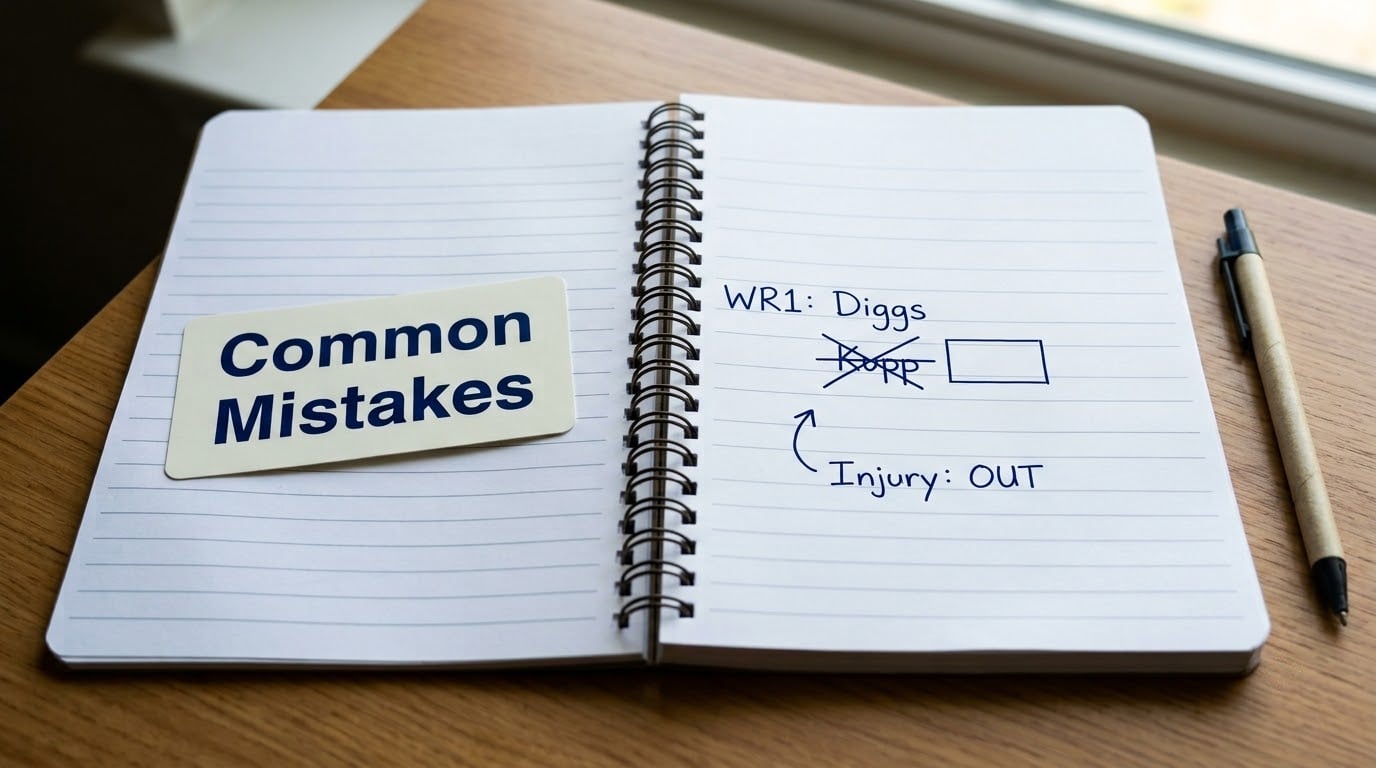
Most bad bench seasons come from one of five repeating errors. Each has a straightforward fix.
Filling every spot with interchangeable bodies
The most common failure. Four running backs who each need 20 touches a game to matter are three wasted spots. Reserve one or two slots for players you have no attachment to, and let them be pure upside.
Wasting bench spots on kickers and defenses
Both positions are top-heavy, and both are cheap on the wire most weeks. Stream them and keep the roster spot for a skill player who can actually change your standing.
Overreacting to one hot week
The flip side is dropping a stash because a player had one big week, or keeping him because he did. Judge trends over three weeks, not one box score.
Having no start-versus-stash rule
Without a written rule you will dither. The filter in step five is the rule: healthy starter, no upward trend in the bench player’s role, and someone else would take him off the wire, equals drop.
Ignoring what other managers are doing
In most leagues several people want the same two or three breakouts. Check waiver activity before you decide a player is worthless, and consider that the reason a guy is available at all is that three other managers already passed on him.
A few shorter habits keep a roster clean between weeks. Drop the first player who clearly fits the profile rather than the best available name, because add quality collapses once everyone else adds too. Keep one emergency flyer at your thinnest position. And stop churning: a roster you change every week is a roster where you never gave anything a fair run.
Frequently Asked Questions
How many bench players should I keep in fantasy football?
Match your bench to your roster size. In an eight-team league, three or four reserves are enough: one insurance body, one or two upside stashes and a spare flex option. In twelve-team leagues with IR slots, five to seven works, so you can carry a season-long injury stash. Deep rosters of twelve-plus teams can support seven or more, and dynasty formats should treat the bench as a farm system full of young developing players.
When should I start my bench player?
Start a bench player when your projected starter is out, limited or facing a matchup so bad you want a safer alternative. Otherwise promote a reserve only when they are clearly better this week, not merely close. In PPR, a bench wide receiver with a reliable target share can be a genuine weekly starter. Check the final inactive lists before locking, since late news often forces a last swap.
Should I drop a bench player for a worse player with upside?
Usually yes, provided you are confident in the upside and the player you are dropping has no real path to a role. A reserve with rising snaps or a vacated target is worth more than a safer body who projects to a quiet week. Make sure someone else has not already added the upside player, and check whether your waiver priority lets you outbid the competition if they do.
How do I manage bench players during an injury crisis?
Move any healthy reserve at the affected position into the lineup immediately, then sort the wire for replacements rather than replacing like with like. If your first back is out, take the best available running back, even one you would not have claimed normally, because volume beats the average projection. Then decide whether to keep a losing starter as bench insurance or cut him once the replacement games for him.
Is it better to hold a benched star or add a similar player?
Hold the star if his ceiling is meaningfully higher, or if keeping him prevents a league-mate from having the same asset. Add the similar player if the star is on IR long term, has a declining role, or if you need an immediate body to start this week. Two comparable players on your bench is usually redundancy you cannot afford, unless your roster is deep enough to absorb it.
When should I make my final fantasy football lineup changes?
Make your main moves early in the week, then do a confirmation pass roughly ninety minutes before your league locks. That final check covers inactive lists, late injury designations, weather and breaking role news, and it should only confirm or swap, not rebuild. Knowing your exact league lock time matters, since most leagues use a Sunday afternoon or early evening deadline.
Conclusion
Do one thing before your next lineup lock: write a one-line role note next to every player on your bench, then cross off anyone whose trend is flat and whose job another manager would take. That single pass usually finds two or three replaceable bodies, and it is where your weekly waiver additions come from. Once the labels are accurate, the rest is just matchups, opportunity and replacement value. Updated for 2026, this is the same routine every week of the season.