When one of your starters is on a bye week, they cannot be in your starting lineup, they score nothing, and you have to fill that spot with a bench player or a waiver-wire add. That is the whole mechanical effect, and it is a scheduling problem rather than a performance one. This guide covers 2026 rules, the positions that hurt most, and the replacement decisions that actually move your standing.
Table of Contents
- How Bye Weeks Affect Your Fantasy Lineup
- What Happens When a Fantasy Football Player Is on Bye?
- How Bye Weeks Differ from Injuries and Benching
- How to Replace Players on Your Fantasy Bye Week
- Step 1: Identify the vacant role, not the vacant name
- Step 2: Check the schedule and kickoff times
- Step 3: Compare projections, not names
- Step 4: Examine the matchup and the game script
- Step 5: Claim early, drop late
- Should You Start a Player Returning From Bye?
- How Bye Weeks Affect Redraft, Keeper, and Dynasty Leagues
- How Bye Weeks Affect Keeper and Dynasty Rosters
- Bye-Week Matchup Tools and Planning Checklist
- Frequently Asked Questions
- Do I need to replace a fantasy football player during their bye week?
- What is the best way to handle multiple players on bye in one week?
- Should I avoid starting a player who had a bye the previous week?
- Is a player on bye injured or bad for fantasy football?
- Should I pick up a replacement before or after a player returns from bye?
- How early should I plan for fantasy football bye weeks?
How Bye Weeks Affect Your Fantasy Lineup
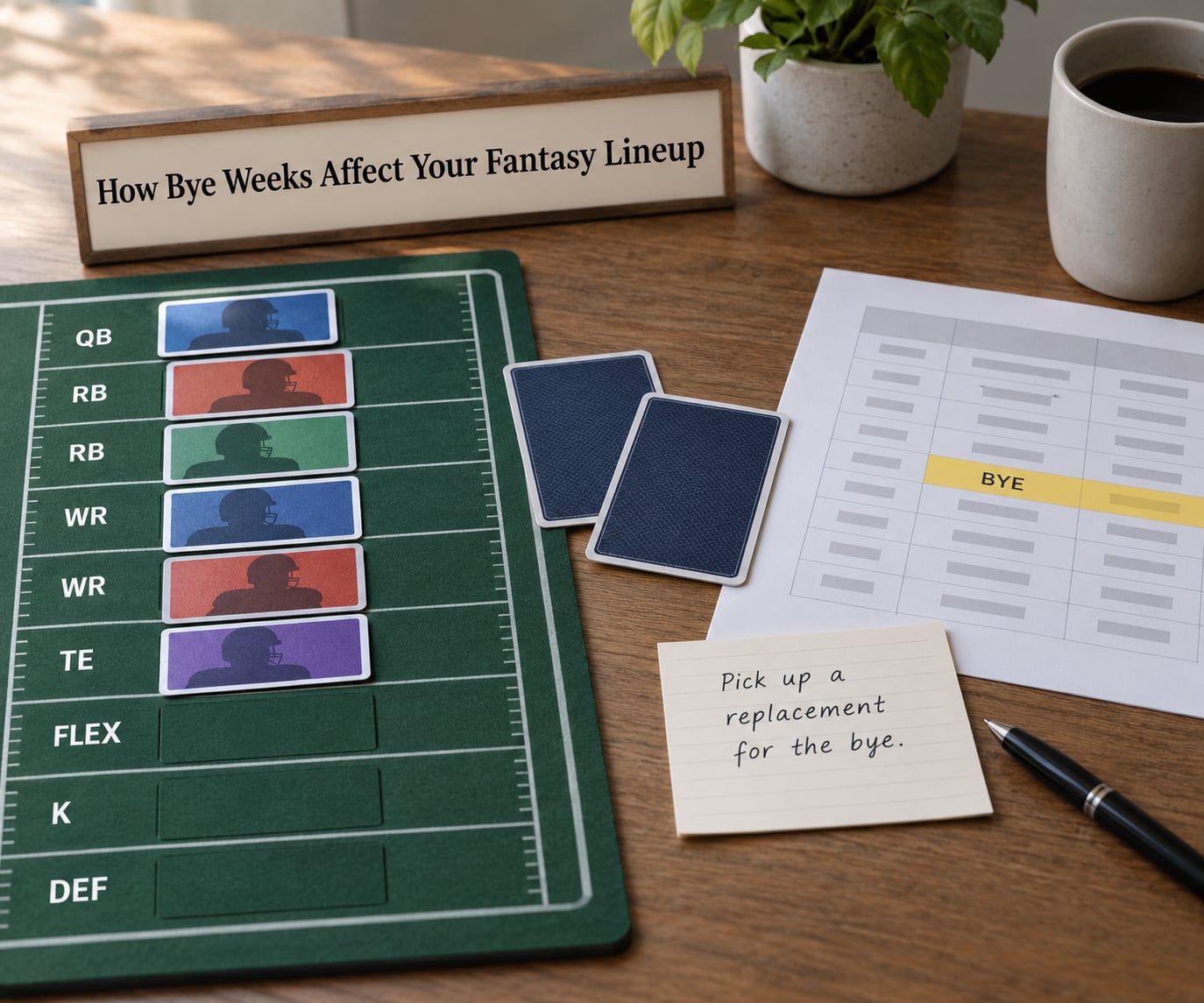
The NFL gives each of its 32 teams one bye, and those byes fall between roughly Week 4 and Week 14. Every player on that team is inactive in your league that week. In most platforms they show as a zero rather than being removed from your roster.
So the effect on your lineup is positional, not individual. One unavailable starter means one empty slot, and the size of that hole depends entirely on the position and on how much usable depth you own behind him. A starting kicker on bye is a nuisance. A starting tight end on bye with nothing behind him is a lost week.
Two things make byes feel worse than they are. First, several teams share each bye week, so your opponent is usually short a starter or two at the same time you are. Second, byes cluster in the middle of the season, and a stacked week means the waiver wire is picked over by twelve managers at once.
Before you replace anyone, check three things: what the player is projected for over a full season, who else on your roster plays that position, and whether the gap belongs in your lineup or in a flex spot. A zero is only a disaster when the replacement is unavailable too.
What Happens When a Fantasy Football Player Is on Bye?
On a bye week, the player’s game is never played, so no stats accumulate and no points are scored. Your lineup builder will either refuse to start them or let you start them for a guaranteed zero. Neither is what you want if a bench player can beat that zero.
Think about how a single bye ripples. Say your starting wide receiver is on bye, your flex slot is empty because your flex player is also on bye, and your only other wide receiver is a low-owned backup who faces a tough defense. That is three roster combinations affected by one decision, and it is a routine problem, not a special one.
Here is how the pain distributes across positions, using typical weekly production as a rough guide rather than a promise:
| Position | How hard the zero is to cover | Typical weekly output to replace | Usual move |
|---|---|---|---|
| QB | Easy on a 12-team roster, tight in superflex | Roughly 15 to 22 fantasy points | Stream from the waiver wire |
| RB | Hard. Depth is thin and the handcuff shares the bye | Roughly 12 to 20 fantasy points | Own a handcuff or accept the zero |
| WR | Moderate. Late-round depth is usually available | Roughly 10 to 18 points in PPR | Stream if the matchup is even |
| TE | Hard if you drafted one tight end | Roughly 7 to 13 points | Add a second tight end early in draft |
| K | Very easy | Roughly 8 to 13 points | Stream, do not roster two |
| D/ST | Very easy | Roughly 2 to 8 points depending on scoring | Stream weekly |
Kicker and defense are the only two positions most managers should never carry depth on. Everywhere else, a bye is a real cost.
How Bye Weeks Differ from Injuries and Benching
A scheduled bye is neutral. It tells you nothing about a player’s health, form or role, because it is a fixed part of the calendar announced long before the season. An injury is a live uncertainty, and a player who practiced limited all week is a different problem from a player who is simply not playing.
Benching is the third category, and managers mix it up constantly. A coach sitting a veteran for rest, a younger player, or a sore body has nothing to do with your team’s schedule, and the player usually keeps his workload in the next game.
The practical difference is how you react. To a bye, you react by finding points. To an injury, you react by finding out whether the player will play. To a benching, you react by checking whether the backup is the real guy now. Confusing the three is how people end up dropping a season-long asset for one bad week.
How to Replace Players on Your Fantasy Bye Week
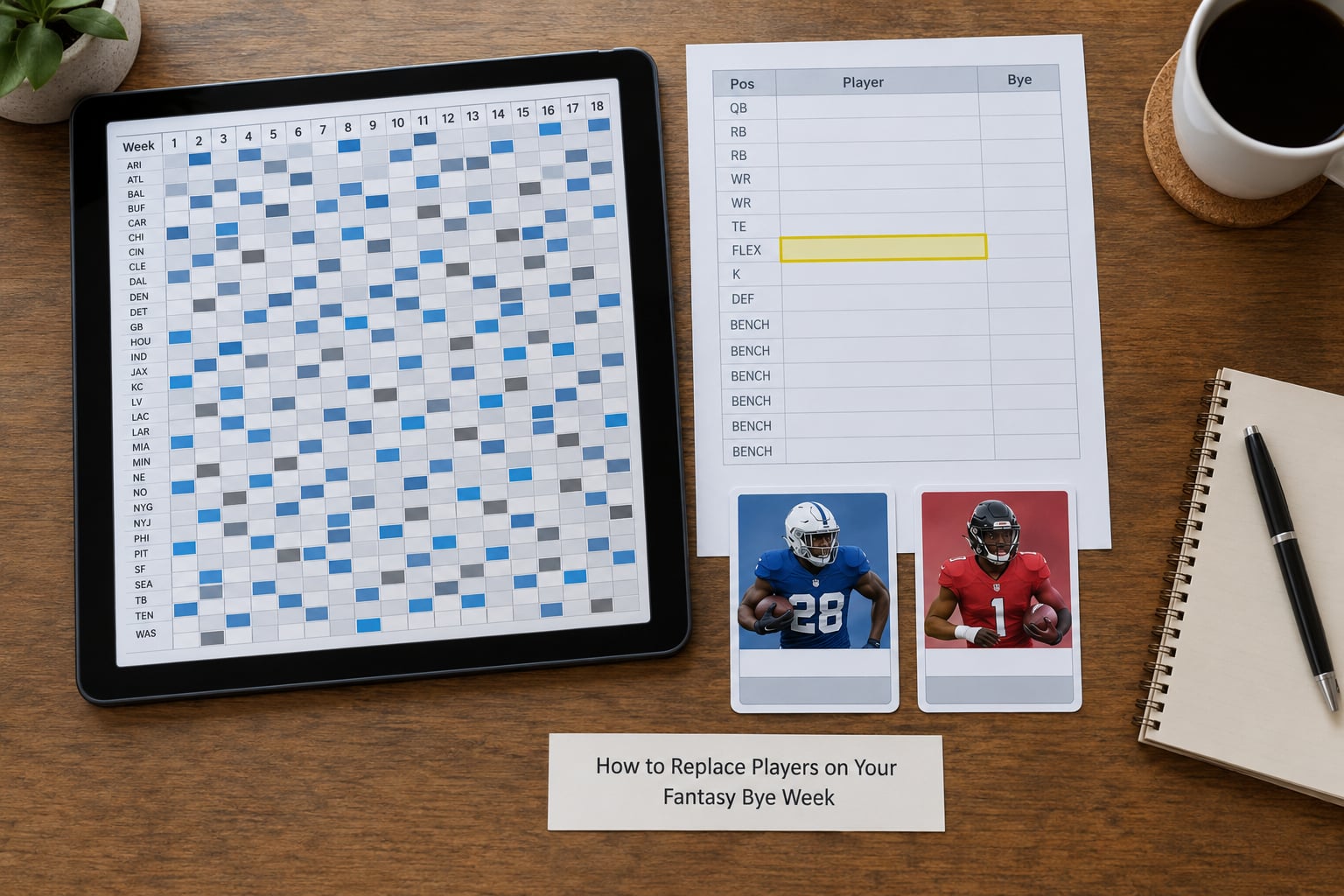
Here is the order I work through it, and it takes about ten minutes if you start a week early.
Step 1: Identify the vacant role, not the vacant name
Write down the position and what that player does for you. A first-down running back who never catches a pass is a different hole from a third-down receiver who runs routes under 50 percent of the time. The replacement has to match the role, and slotting a zero-target receiver into a first-down running back role wastes the week.
Step 2: Check the schedule and kickoff times
Matchups matter more during a bye because you are choosing from a thinner list. The two lowest-owned players scheduled against the worst defenses are your targets, and you have to see the game times, since a Sunday night game removes your ability to react to what happened earlier.
Step 3: Compare projections, not names
Sort the free agent list by projected points this week and ignore season totals. Some platforms will sort by projected points if you change the setting on the available player list. A player projected for 7 points in standard is worth more to you on a bye week than a bigger name projected for 4.
Step 4: Examine the matchup and the game script
Check who the opponent gives up to and how that team plays. A running back whose team has to win in the fourth quarter has a different ceiling than one in a comfortable lead. Defenses that allow a lot to running backs are the ones that survive a bye week in my experience.
Step 5: Claim early, drop late
Submit the claim a week before the conflict week if you can, because the good streaming options are claimed first. On a stacked bye week, some managers treat their bye week as a planning week, setting the following week’s lineup in advance so they are not making decisions at the deadline with bad information.
Should You Start a Player Returning From Bye?
Yes, almost always. The research on this question is reassuring rather than scary. A 2018 NBC Sports study tracked 1,409 weekly performances by the top 36 wide receivers across five seasons and found mean PPR output of 14.8 points before a bye and 15.5 points after one, with standard deviation widening slightly from 8.7 to 9.6. The first game back is not a downturn. It is slightly higher scoring and slightly less predictable, which matters in tournament formats and not much in weekly leagues.
The same study found timing matters more than the bye itself. Receivers coming off an early bye, Weeks 4 through 8, outproduced receivers coming off a late bye, Weeks 9 through 13, by roughly four PPR points in their first game back. Early byes tend to fall before defenses are fully settled, and late byes land in the stretch where opposing defenses know your personnel.
So evaluate the return like any other start. Has his role changed, who is the opposing corner, and is he a low-volume possession target or a player the offense actually runs passes through. Nothing about the bye week itself changes the answer.
How Bye Weeks Affect Redraft, Keeper, and Dynasty Leagues
A weekly redraft league is the format where a bye matters most, because you rebuild the lineup every week and the empty slot lands directly in your score. You manage it, take a zero where a zero is cheap, and move on.
How Bye Weeks Affect Keeper and Dynasty Rosters
Keeper and dynasty managers play the same weekly decisions but on a different clock. A player on your bench because of a bye is not a wasted roster spot, it is a season-long asset that happens to be unavailable for eight days. The trade mistake that hurts most is dropping a high-upside bench running back or receiver to hold a temporary kicker or a streamed defense. That is a downgrade you can still make next week, and you gave up real value for a single slot.
Short-bench and superflex leagues are where byes turn serious. With four bench spots and two quarterbacks on bye, there may be no legal lineup at all. If you play that format, buy depth at positions where you are thin and treat a bye conflict as a reason to trade a week before it hits, not during it.
One fact worth memorizing: the bye system ends before Week 15, so bye weeks do not touch your fantasy playoffs. Every week you agonized over from Week 4 to Week 14 was regular season. The byes never reach the money.
Bye-Week Matchup Tools and Planning Checklist
Most platforms publish the full schedule at the start of the season, so the entire season’s conflict weeks are knowable in August. Open it once, mark the weeks where two or more of your starters are off, and you have a map for the whole year.
Track each conflict week with a small sheet like this:
| Week | Players on bye | Positions short | Likely waiver target | Game time conflict |
|---|---|---|---|---|
| Week 6 | One WR, one TE | WR, TE | Low-owned WR vs. soft schedule | None |
| Week 9 | Starting RB plus handcuff | RB, flex | Handcuff if available, else accept zero | Sunday night |
| Week 12 | One RB, one K | RB only | Stream the kicker, take the RB zero | None |
The seven-day checklist: a week out, list the empty roles; four days out, check the free agent pool and pick two targets; the day of, submit the claim and confirm the replacement’s kickoff time; after waivers clear, set the lineup and stop. The time you are actually looking for is when you figure out that a player is returning from injury, and a bye week is a gift for that.
Frequently Asked Questions
Do I need to replace a fantasy football player during their bye week?
Only if you can beat the zero. Kickers and defenses are almost always worth streaming because the replacement pool is deep and cheap. Running backs and tight ends are different, since a replacement there is often worse than the zero you would take at kicker. Start with a bench player if he has a workable matchup, then look at the free agent list for anyone projected higher.
What is the best way to handle multiple players on bye in one week?
Rank the holes by how easily each one can be filled, not by how much you miss the player. Stream the positions with deep replacement pools first, usually kicker and defense, then decide whether your running back hole is worth a waiver priority or a zero. The mistake is burning your best claim on a mid-level tight end while leaving a more urgent running back spot unfilled.
Should I avoid starting a player who had a bye the previous week?
No. A bye week does not hurt a player’s form. A 2018 NBC Sports study of top wide receivers across five seasons found mean PPR output slightly higher after a bye than before one, 15.5 points versus 14.8, with a little more variance. Judge the return the way you would any game, by role, opponent and recent snap share, not by the week of rest the player just had.
Is a player on bye injured or bad for fantasy football?
No. A bye is a scheduled week off written into the calendar before the season starts, so it carries no information about health or form. If you are seeing injury notes, that is a separate problem with separate risk. Managers who treat a bye as a warning sign end up selling a healthy starter at the lowest point of the year.
Should I pick up a replacement before or after a player returns from bye?
Pick up the replacement before, ideally a week ahead, and let your own starter return to the bench when they come back. Claiming late means competing with the rest of the league for a thin pool of replacements on a stacked bye week. Once the conflict week passes, drop the temporary add rather than holding two kickers and hoping for a mistake.
How early should I plan for fantasy football bye weeks?
Before the season, and then a week before each conflict week. The full schedule is published in advance, so you can mark every week where two of your starters are off before your first game. The week-before habit is the important one, because it gets your waiver claim in before twelve other managers notice the same gap.
A bye costs you exactly the players on it, and nothing more. Mark the conflict weeks before the season, claim your replacements a week early, and take the zero at kicker without a second thought. That is the whole playbook.