Running a survivor pool league takes about an hour of setup and 20 minutes a week once the season starts. Each player picks one NFL team to win each week, cannot use the same team twice, and is out the week that pick loses. The last entry standing takes the pot.
The mechanics are simple. The administration is where leagues fall apart. Buy a spare Sunday and read how the commissioner role actually works, because the difference between a clean season and a season-ending argument is usually one document you wrote before collecting money.
Below is the process I walk every pool commissioner through: what to gather first, the weekly loop, the four edge cases that cause disputes, and the clauses that settle them.
Table of Contents
- What You Need
- The participant list
- A schedule and results source
- A hosting method
- Your house rules document
- Elimination and winning criteria
- Entry and prize details
- Step-by-Step: How to Run a Survivor Pool League
- How do you run a survivor pool league?
- What survivor pool rules should you use?
- The clause list
- The variants worth knowing about
- How do you track survivor picks and eliminations?
- The columns
- The habits that prevent disputes
- How do you handle a survivor pool tie?
- How do you run survivor pool weeks and reminders?
- Tuesday: open the week
- Wednesday to Friday: collect picks
- Saturday and Sunday: lock and score
- Sunday night or Monday morning: score and advance
- How do you announce the survivor pool winner?
- Common Mistakes
- 1. Publishing no written rules
- 2. Leaving buy-back terms vague
- 3. Changing the format after entries begin
- 4. No fixed pick lock time
- 5. Unintentional duplicate entries
- 6. No audit trail
- Frequently Asked Questions
- How many people should be in a survivor pool league?
- Can a survivor pool be based on NFL games instead of fantasy football?
- Should every player have the same number of survivor entries?
- What happens if two survivor pool players remain tied?
- Is a survivor pool different from a fantasy football league?
- What is the easiest way to track survivor pool picks?
What You Need
Get these six things decided before you send a single invitation. A pool that opens with unanswered questions invites the people who argue to set the rules later.
The participant list
Decide the ceiling before you recruit. Office pools of 15 to 30 work with one entry per person and no fuss. Pools of 100 or more usually run better on a multiple-lives format, because a single-elimination pool that size wipes out fast and ends with nobody standing by October.
A schedule and results source
You need the NFL schedule, a reliable final-score source, and a backup one. Scores get corrected, and postponed games do happen. Knowing where you will confirm results before the first pick matters more than it sounds.
A hosting method
Some commissioners run the whole thing from a shared spreadsheet. Others use a dedicated survivor pool site or a paid hosting platform that handles standings, reminders, and payment collection automatically. Decide which one, because it determines who logs picks and when.
Your house rules document
This is the single most important item on the list. One page, numbered, published before entries close, and unchangeable afterward. Everything ambiguous in a survivor pool eventually becomes an argument you have to referee.
Elimination and winning criteria
Spell out what happens on a tie, what happens if everybody is eliminated, how many entries one player may hold, whether teams can be picked again, and whether a pick counts if the game is postponed past your deadline.
Entry and prize details
Decide whether the pool charges anything, how the pot is split, who collects it, and who holds the money in between. If money changes hands, keep a written record of every entry and every payout. Organizing a paid football pool can fall under gambling rules that vary by state, so check yours or keep the pool free and run it as a bragging-rights league.
Step-by-Step: How to Run a Survivor Pool League
How do you run a survivor pool league?
Four phases cover the whole season: set the format and rules, collect entries, run a weekly pick-and-score loop, then eliminate, publish standings, and pay out at the end of the final regular-season week.
First confirm the sport. The overwhelming majority of survivor pools are NFL pools run over 17 or 18 weeks, and the plan below assumes that. College football works the same way with a shorter season, which changes the math because every week matters more.
Then set the entry deadline. A common and clean choice is the start of the first game of the season. Late entries complicate everything downstream, so if you allow them, say exactly how many and whether they get full weeks.
Write down the three core rules and share them before anyone pays. One pick per week, no repeat teams, one loss and you are eliminated. Players who arrive without those three understood will generate the first dispute of the season inside ten minutes of Week 1.
How you know step one worked: every entrant can state the rules back to you without checking the document.
What survivor pool rules should you use?
Beyond the three basics, you have maybe seven decisions to make. Every one of them should exist as a numbered clause in a document you send out with the invite.
The clause list
Copy this, adapt it, and leave it alone once entries close.
- Entries. Each participant may hold a set number of entries, stated up front. Entries count as separate entries in the standings and are treated separately for eliminations.
- Picks. One team per week, straight-up, covering the full game including overtime. No repeat teams all season.
- Deadline. Picks lock at a stated time each week, so a late pick never touches a result that already happened.
- Ties. If a game ends tied, the pick counts as a loss. If both teams are tied and both were picked by the same entry, that entry loses. State this even if it feels unlikely.
- Postponements. A game moved past the pick lock for that week counts as a loss for any pick already submitted. A game moved before the lock is simply picked again.
- Buy-backs. Either no revives, or revives allowed at a set price until a stated week. Never leave this open.
- Payout. Winner takes all, or a split among all surviving entries. State the split percentages.
- Winner date. The pool ends after the final regular-season game.
- Refunds. Entry fees are not refundable once the first game is played.
The variants worth knowing about
| Rule variant | How it works | Who it suits |
|---|---|---|
| No revives | One loss eliminates permanently | Small pools of 15 to 30, or anyone who wants zero arguments |
| Buy-back | Eliminated entries may return for a fee until a set week | Large pools that would otherwise empty out by Week 8 |
| Multiple lives | Three wrong picks and you are out | Pools of 50 or more where single elimination wipes everyone too fast |
| Second chance entry | One extra entry that only activates after your first dies | Players who want to keep a second-chance identity in the standings |
| Split pot | Final survivors divide the pot | Pools where you expect a late tie |
If you take one decision from this list, take the no-revives option for a small pool. Buy-back rules are the leading cause of survivor pool disputes, because a revive that is not priced and dated turns into an argument every time someone uses one.
How do you track survivor picks and eliminations?
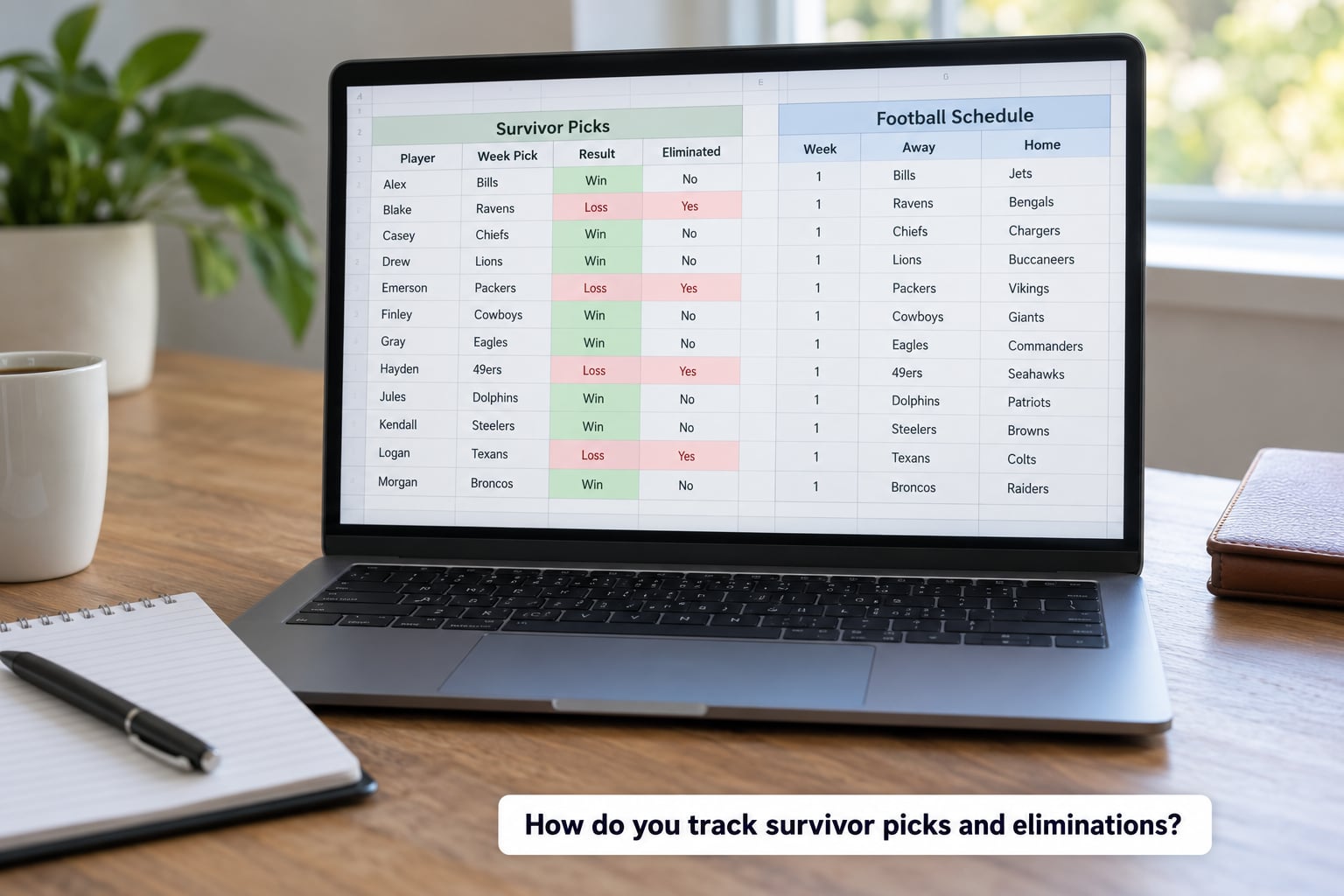
One sheet with one row per entry and one column per week beats anything more complicated. That structure is true whether you use a spreadsheet, a shared document, or a hosting platform.
The columns
- Entry name and owner. Name every entry so a player with three entries stays legible to everyone else.
- Teams used. Either a running list in one cell or a per-week grid, so repeat picks are visible immediately.
- Week 1 through Week 18. One cell per week holding the pick, then a result marker.
- Status. Alive, eliminated in week 7, revived in week 9, champion. Keep it to a fixed set of values so it can be filtered.
- Notes. Rule rulings, disputed picks, correction dates.
The habits that prevent disputes
Enter picks in one place only. If some entries arrive by text and others through the website, you will eventually lose one, and the player who lost it will be certain the sheet was wrong.
Log results from one source, note the date you logged them, and never edit a past week’s result silently. Corrections get a dated note. That single habit is what turns a spreadsheet into an audit trail.
Publish standings weekly, even when nothing happened. A league that hears from you every Sunday stays a league; one that goes quiet for three weeks gets rebuilt next year by somebody else.
How do you handle a survivor pool tie?
Resolve ties in a fixed order, decided before the season and not in the moment when money is involved.
Start with official results. Confirm the score against your primary source and a backup. Ties get overturned at the league office level often enough that assuming the first score is final is how commissioners lose credibility.
Then apply the published tiebreaker, in this order. Most pools use: the game ending in a tie is a loss for the pick. If that produces two remaining entries, the pool splits the pot. An alternative that many hosts prefer is fewest total wins across surviving entries, with the survivor who picked the team with the fewest wins taking the larger share.
Some pools use last team picked wins, since a survivor who has held onto a strong team longer arguably played it better. It is simple and it is defensible. Pick one and write it down.
Whatever you choose, do two things: tell the affected players before the next pick lock, and keep the decision in writing in the season log. Disputes that get answered same-day with a quote of the rule are short disputes.
How you know it worked: the two players involved accept the call, or the written clause settles it without either needing to be persuaded.
How do you run survivor pool weeks and reminders?
A survivor pool week is a short, repeatable loop. Most of it happens before kickoff, not after.
Tuesday: open the week
Send the week’s game list, note any bye weeks or schedule changes affecting eligibility, and remind players that each team can be used once. Include your pick lock time in the same message so nobody has to ask.
Wednesday to Friday: collect picks
Accept picks through one channel until the lock. If you want to allow changes after submitting, cap it at a single change before lock. Unlimited late edits is how a pick ends up matching a result the picker already knew.
Saturday and Sunday: lock and score
Lock at a fixed time, ideally before the first game. This is the setting injury news around. Many survivors pick a team whose quarterback is listed as questionable on Saturday morning, and the question of whether late injury news can undo a pick is exactly the kind of thing that needs a clause. The cleanest fix is locking before the first game and not revisiting it.
Sunday night or Monday morning: score and advance
Enter results, mark losses, update status, publish the new survivor count, and note anything disputed. Then close the week with a short message: survivors remaining, who was eliminated, and any ruling you made.
Keep standings and picks separate from fantasy football points. Survivor leagues have no weekly score to report, and trying to report one confuses the two formats and irritates players who signed up for the simpler one.
How do you announce the survivor pool winner?
The announcement is the last week of admin, and it is the part most hosts rush. Do it in this order.
Verify the final surviving entry against your own sheet and, if you use a platform, against the platform’s standings. Confirm that entry has no unused teams that would have been needed later and no pending disputes.
Resolve any open challenge before announcing. If a player disputes a Week 14 result and you have not ruled, do not announce a champion that week. Ruling first and announcing second is the only order that survives scrutiny.
Confirm the winner under the published rules, not under the rules you wish applied. Pull up the clause, follow it, and say in your announcement which clause decided it.
Pay out, then record it. Note the date, the amount, and the method. Keep entry records for the full season and beyond, since winnings of this kind are reportable income for many people.
Send a closing message that includes final standings, the full list of eliminated entries by week, the winning entry’s pick history, and any rule rulings you made during the year. That document becomes the archive, and it is what a returning organizer will ask you for in August.
Common Mistakes
Six errors account for nearly every ruined survivor season. Each one has a fix you can apply before your first entry.
1. Publishing no written rules
The fix: one numbered page, sent with the invite, unchangeable once entries close. Organizers running pools for around 15 people consistently publish an information document up front, and that is the reason those pools finish cleanly.
2. Leaving buy-back terms vague
The fix: either write no revives into the rules or price the revive, name the last week it can happen, and state that a revived entry returns with all previous weeks void. A buy-back rule with no price and no cut-off has produced entire seasons with no winner, which is the worst outcome a pool can produce.
3. Changing the format after entries begin
The fix: freeze the rules at the entry deadline. If a genuine problem surfaces, fix it in writing, tell everyone before the next lock, and apply the change to everyone equally.
4. No fixed pick lock time
The fix: publish a clock time and hold it. Every dispute about a pick made after kickoff disappears once a lock time exists.
5. Unintentional duplicate entries
The fix: state a hard cap per person and confirm entry names back to players before the deadline. One person accidentally holding four entries out of twenty skews the whole standings board.
6. No audit trail
The fix: date every standings update and every correction. When someone accuses you of changing a result, a dated log ends the conversation in seconds. Without one, you are arguing from memory against a screenshot.
Two more worth naming. Collecting entry fees through an account that proves nothing about who you are is how organizers get burned, so use a traceable payment method and tell players who is holding the pot. And if the pot empties with nobody left standing, write that scenario down now: refund, split among the last few eliminated, or roll to a charity. Deciding in advance is the entire point.
Frequently Asked Questions
How many people should be in a survivor pool league?
Fifteen to 30 players works best with one entry each and no revives, because a single-elimination pool that size stays interesting into December. At 50 or more, switch to three wrong picks and you are out, or allow buy-backs, since one loss eliminates far too many entries in the first month. Office pools of 100 to 150 are common and workable once multiple lives are built in.
Can a survivor pool be based on NFL games instead of fantasy football?
That is exactly what a standard NFL survivor pool is. Players pick one team to win each week, straight-up, rather than setting lineups or accumulating fantasy points. The distinction people get stuck on is scoring: survivor entries win or lose as a unit, and there is no weekly point total to compare between entries.
Should every player have the same number of survivor entries?
Equal entries is the fairest default and the easiest to administer, because every player has an identical path to the final week. Unequal entries are common in office pools that want to give executives or frequent losers a better chance. Either works, as long as the cap is published before entries close and every entry is tracked as its own row.
What happens if two survivor pool players remain tied?
It depends on a rule you wrote before the season, not one you choose in the moment. The most common setups treat a tied game as a loss for the pick, and if two entries survive to the final week the pot splits between them. A second option is a tiebreaker on fewest total wins. Whichever you pick, apply the published clause and record the ruling in writing.
Is a survivor pool different from a fantasy football league?
Yes, in three ways. Survivor players pick a team to win; fantasy players pick individual players for a lineup. Survivor entries are eliminated after a loss, while fantasy teams keep scoring all season. Survivor results depend on one game a week, so weekly injury news matters far more, and repeat-team restrictions mean saved teams are often worth more than good ones.
What is the easiest way to track survivor pool picks?
A shared spreadsheet with one row per entry and one column per week handles pools up to about 100 entries and costs nothing. Columns for teams used, pick, result, status, and notes are enough, and weekly standings updates built from it take five minutes. Paid hosting platforms automate reminders and elimination, but the same column layout applies whichever tool you choose.
Start with the rules document, not the platform. Write your nine clauses, decide no revives or a priced revive with a cut-off week, name your pick lock time, and print the no-winner scenario into the document. Send that page out with the invitation. Everything after that is a weekly twenty-minute loop you can run from a phone.