Fantasy football roster limits by position are the minimum and maximum number of players your league requires or allows you to carry at each position, and the platform enforces them every time you add, drop or submit a lineup. Most of the confusion comes from one detail: the number people call a limit is usually a minimum you have to satisfy, not a ceiling you have to stay under. Once you can tell those two apart, the rest of the settings page stops being intimidating.
This guide covers what those rules mean, how roster size adds up, how different league formats change the counts, and how to use the rules instead of fighting them. It is written for redraft managers, dynasty general managers, and anyone about to spend an evening in a commissioner’s settings page.
One quick warning before we start. Search results for this question are polluted with real-NFL roster rules like the 45-man active limit and the practice squad. Those belong to the NFL, not to your fantasy team. Nothing in this article applies to actual player contracts.
Table of Contents
- What Are Fantasy Football Roster Limits by Position?
- Roster limit is not the same as roster size
- Soft minimums and hard maximums
- How Many Players Can You Add at Each Position?
- What happens when you are over a cap or under a minimum
- How Do Roster Minimums and Maximums Affect Your Team?
- How Do League Settings Change Position Limits?
- How Do You Build a Roster Around Position Limits?
- Frequently Asked Questions
- Does IR count toward my fantasy football roster limit?
- What are the position limits for fantasy football in ESPN?
- Do you really need three quarterbacks in a superflex league?
- Is it better to put a running back or wide receiver in the flex spot?
- How many players per position should I draft?
- Can a commissioner change roster limits during the season?
- Conclusion
What Are Fantasy Football Roster Limits by Position?
A roster limit is a rule in your league settings that controls how many players you may hold at a given position. Your platform uses those rules for two different jobs: making sure you can always field a legal starting lineup, and capping how many players you can stockpile at one position. One job is a floor, the other is a ceiling, and only one of them is usually active in a redraft league.
Here is what a common 16-player redraft roster looks like once the settings are translated into numbers.
| Position | Starting minimum | Common range managers carry | Hard cap, if your league uses one |
|---|---|---|---|
| Quarterback | 1 | 2 in standard, 3 to 4 in superflex | Usually 3 to 4 |
| Running back | 2 | 4 to 5 | Often 6 or 7 |
| Wide receiver | 3 | 5 to 6 | Often 6 or 8 |
| Tight end | 1 | 2 to 3 | Often 3 |
| Kicker | 1 | 2 | Almost always 2 |
| Defense or special teams | 1 | 2 | Almost always 2 |
| Bench | Fills the rest of the roster | 6 to 9 spots | Fixed by the commissioner |
Treat the middle column as the rule and the third column as a habit. Plenty of good drafts end with 3 quarterbacks in a single-QB league, and nobody in the league cares.
Roster limit is not the same as roster size
Roster size is the total number of players your team holds, and it is set by adding up starters, flex, bench, IR and any other reserved spots. Position limits are the rules that govern how those total spots get filled. A 16-player roster with no position maximums is a normal setup, not an oversight, and it gives you far more freedom in a draft.
Soft minimums and hard maximums
A soft minimum means the position has to be filled for your lineup to be legal, but the roster can dip below that number on deadline days when injured players sit in IR. A hard maximum means the platform blocks you from making the add. Hard caps are common in auction drafts and rare in redraft leagues, which is why managers routinely get caught by them: one auction owner in a ten-team league set limits of 3 QB, 4 RB, 5 WR and 2 TE, then bought the running backs he wanted early precisely because he had no bench room to stash fliers behind them.
How Many Players Can You Add at Each Position?
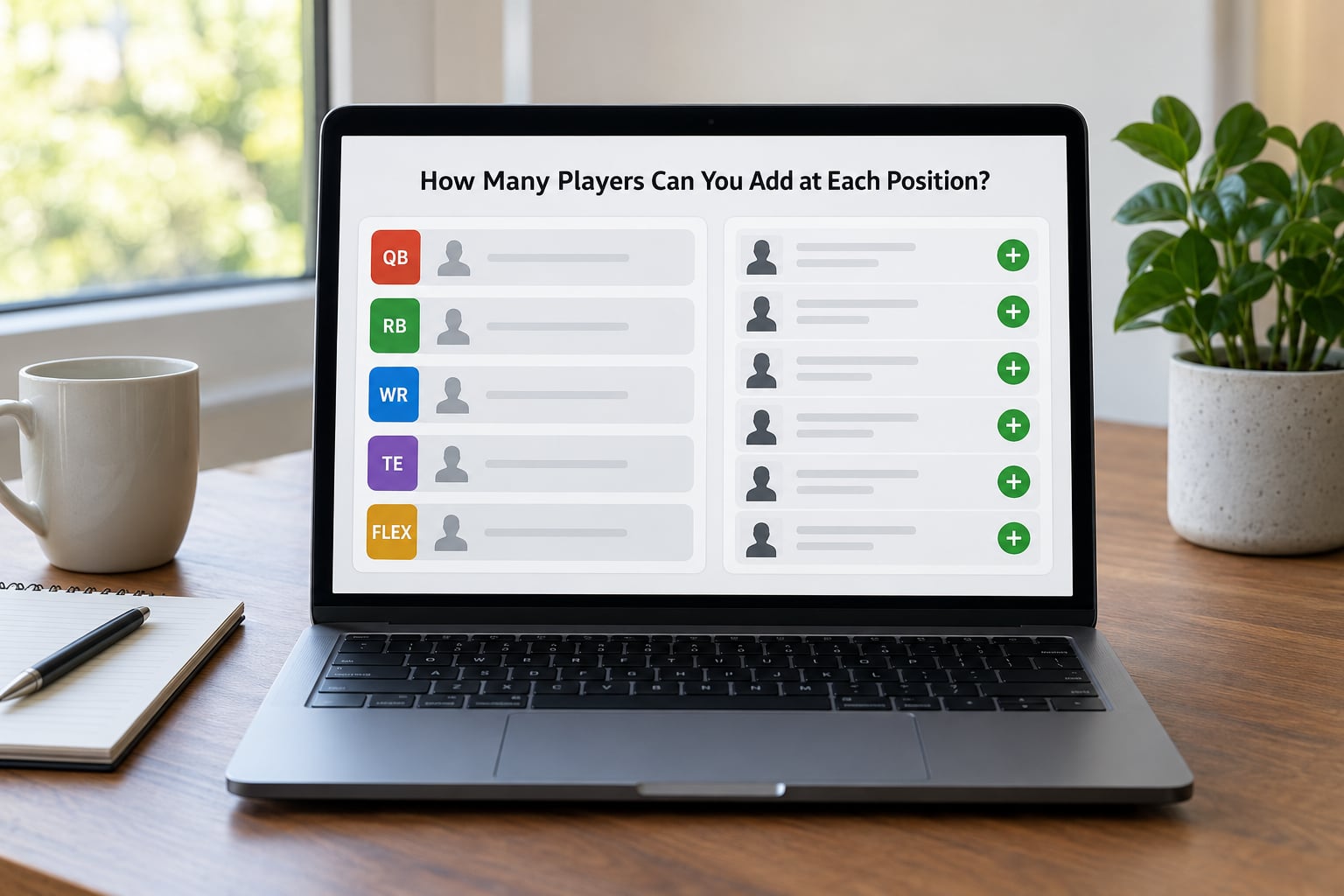
The cleanest way to know your limit is to add up the spots instead of guessing. Take a standard 9-category redraft roster: 1 QB, 2 RB, 3 WR, 1 TE, 1 flex, 1 kicker, 1 defense or special teams, plus 6 bench spots.
| Roster part | Spots | Notes |
|---|---|---|
| Starters | 10 | The legal lineup you submit each week |
| Flex | Included in the 10 | Often eligible for RB, WR or TE only |
| Bench | 6 | Depth, stashes, and bye-week insurance |
| IR | 1 or 2 | Occupies a roster spot on most platforms |
| Total | 16 | Some formats run 19 or more |
That arithmetic is the whole mechanic. The starting lineup requirement defines your minimums, the bench defines how much extra depth you can hold, and the IR determines how many of those players are temporarily parked outside your lineup while still occupying a roster spot.
So the answer to how many players you can add at a position is usually the difference between your total roster and everything else. On that 16-spot roster, if you hold 2 quarterbacks, 2 kickers, 2 defenses and 1 tight end, you have 9 players left to split between running backs and wide receivers.
What happens when you are over a cap or under a minimum
Over a hard cap, the add simply fails. The player shows as available on the waiver wire and the message usually names the position you are capped at. Some platforms also block drops that would leave you short of a minimum, which is the setting that catches new managers off guard: drop your last tight end on a Tuesday with a flex-only league and the platform may not let you.
Under a minimum, behavior varies. Most platforms let your lineup be illegal with a zero at a position and score you accordingly. A few lock you from submitting lineups once your roster is too thin. That is worth checking before a week where your last tight end lands on IR.
How Do Roster Minimums and Maximums Affect Your Team?
Roster minimums shape your draft long before they cause problems. The lineup requirement is a promise your platform makes to itself that every owner can field a valid team, so a 3 WR league guarantees a heavy run on receivers every year. That is not a bug in your draft prep, it is the setting working as intended.
Maximums change the player pool instead of the demand. When a 14-team PPR league caps running backs at 4 and receivers at 4, the clubs below those numbers face a real shortage, and the clubs sitting on five surplus running backs cannot add anyone. Managers in that setup regularly discover halfway through the draft that they spent a third-round pick on a fourth running back with nowhere to put him.
Uneven requirements deserve their own paragraph because they create different pressure at each position. A roster of 1 QB, 2 RB, 2 WR, 1 TE, 1 kicker, 1 defense, 1 flex and 6 bench leaves almost nothing on the bench, which turns into a mirror of your starting lineup. Add a second flex and a superflex and the same total roster suddenly holds far more usable depth. The spot count can stay identical while the entire draft strategy flips.
That thin-bench setup is not a mistake, by the way. Owners who keep rosters deliberately small are keeping the waiver wire active for everyone, since fewer players are stashed and more adds are available. On forums, commissioners regularly weigh removing a bench slot to help injury-hit teams replace players, and the argument goes both ways.
How Do League Settings Change Position Limits?
Roster limits are a by-product of everything else you chose when the league was created. Change the scoring or the lineup and the counts move with it.
| League type | Typical total roster | What changes about position limits |
|---|---|---|
| Standard redraft | 16 to 19 | Lowest QB count, one flex, usually no position caps |
| PPR redraft | 16 to 20 | More receivers drafted, flex eligibility often includes tight end |
| Two tight ends | 16 to 20 | Second TE is a real starter, so TE minimums become 2 |
| Superflex | 16 to 20 | Second flex is any offensive player, so quarterbacks are drafted in bulk |
| IDP | 18 to 30 | Roster grows by several spots to hold individual defenders |
| Keeper redraft | 16 to 20 | Same limits as redraft, but keepers lock a slot before the draft |
| Dynasty | 25 to 50 | Minimums are far higher, since youth and upside matter as much as production |
Platform defaults vary more than most people expect, and the search question about ESPN comes up every year because the answer is “it depends which league type you picked.”
| Platform | Common default | Worth checking |
|---|---|---|
| ESPN | 10 starters, 6 bench, 16 total in most 9-category leagues | Whether the flex is RB/WR/TE or RB/WR |
| Yahoo | 10 starters, 9 bench, 19 total in many standard formats | Default position caps on add and drop |
| NFL.com | 10 starters, 6 bench, 16 total | Whether IR is one or two spots |
| Fantrax | 10 starters, 6 bench, 16 total in the common template | Every number is editable before the draft |
| Sleeper | Often 16, with superflex and larger rosters common | Taxi squad rules and roster minimums |
All five let a commissioner change these numbers, which is exactly why league mates argue about them. A dynasty league debating whether to grow from 25 to 31 roster spots, or a redraft league that quietly tightens caps mid-draft, both trace back to the same issue: the setting is a competitive choice, not a default to accept.
How Do You Build a Roster Around Position Limits?
Budget your draft by minimums first. Work out how many players your starting lineup consumes, then decide what the bench is for. With 6 bench spots, four of them covering injury replacement and two free for fliers is a workable split. Spending all six on fliers means one scratch and you are scrambling.
In auction leagues, hard caps are the strategy, not a side note. A 3/4/5/2 limit set tells you to buy your reliable running backs before the price climbs, because you cannot fill a fifth slot later. In redraft leagues with no caps, the reverse logic applies: the bench is your stashing tool, and the guys at QB and kicker are the cheapest way to hold it.
Replacement level is where limits bite hardest. A position with fewer roster spots across the league gets drafted deeper, so a fourth-round receiver may be the last one available to a manager in a 10-team league and the 12th-best receiver on the board in a 14-team one. Check how many teams are in the league before you decide a position is thin.
Weekly, the flex spot is a limit you can exploit. Before lineup lock, sort your bench by opponent rather than by projected points: the flex goes to the player with the best matchup, not the best season projection. With a superflex spot, do the same for quarterbacks, since your droppable backup rarely needs to be your starter. And do it before your league’s lock time, not after, because a Thursday night player who starts on a short week may not be a usable flex option by the time you can act on the news.
If you are the commissioner, publish the numbers before the draft instead of adjusting mid-draft. Managers who learn about a cap the round after they drafted their fourth tight end will not forget it, and a league that changes roster rules mid-season is a league that loses a team. Most platforms allow a change only with league-wide consent or before the draft, so check the settings permissions before you promise anything in a group chat.
Frequently Asked Questions
Does IR count toward my fantasy football roster limit?
On most platforms, yes. A player placed on IR still occupies a roster spot, and the IR spot itself is part of your total roster, so a 16-player roster with 2 IR spots only has 14 usable slots at any moment. The one thing IR does not do is satisfy a starting lineup minimum, since an IR player cannot be started. Some custom settings exclude IR from the total, so check the roster settings page rather than assuming.
What are the position limits for fantasy football in ESPN?
In most ESPN 9-category leagues the default roster is 10 starters plus 6 bench, 16 players total, with 1 QB, 2 RB, 3 WR, 1 TE, 1 flex, 1 kicker and 1 defense or special teams. The flex is usually eligible for RB, WR or TE only. The numbers change when a commissioner picks superflex, two tight ends or a larger bench, so read the settings in your own league.
Do you really need three quarterbacks in a superflex league?
Most owners do carry three or four, and some carry five. Because the superflex spot can start any offensive player, a zero at quarterback is only acceptable if you have nobody to plug in, so the second and third quarterbacks are insurance rather than weekly starters. In a single-QB league the same three quarterbacks is wasted space, since only one can score in a week.
Is it better to put a running back or wide receiver in the flex spot?
The player with the better matchup, every week. In non-PPR leagues a running back is usually the safer flex floor because a mediocre rushing total still adds points, while in PPR the reception upside of a receiver can outweigh a bad game. Sort your bench by opponent strength and take the best available option rather than defaulting to one position out of habit.
How many players per position should I draft?
A common target on a 16-player roster is 2 quarterbacks, 4 or 5 running backs, 5 or 6 wide receivers, 2 tight ends, 2 kickers and 2 defenses or special teams, which fills the starters plus 6 bench spots. Add a third or fourth quarterback only in a superflex league. Once your lineup minimums are met, the remaining picks are best spent on extra depth at running back and wide receiver.
Can a commissioner change roster limits during the season?
Usually only with league-wide consent, and on most platforms the setting is locked once the draft or the first matchup is complete. Changes made mid-season are the fastest way to lose a manager, especially caps that shrink a position someone has already filled. If a change is genuinely needed, announce it before the waiver period, keep it to one adjustment, and apply it to every team equally.
Conclusion
The rule worth remembering is simple: a position limit is usually a minimum you must satisfy, and a maximum only exists if your commissioner typed one in. Add up your starters, flex, bench and IR to get the real total, then draft against those numbers instead of guessing at them.
Open your league settings before your next draft or waiver period and write down the counts. If you are the commissioner, publish them before the draft starts. That single step is how fantasy football roster limits by position stop being a source of frustration and start working in your favor.