To budget in an auction draft, split your league’s auction dollar pool into per-position buckets before draft day, set a hard maximum bid for every player on your list, spend about 85-90% of the money on starters, and hold the rest for late-round bids. A 12-team 200-dollar PPR league typically looks like this: 33% at running back, 33% at wide receiver, 8% at quarterback, 8% at tight end, 2% on kickers, 2% on defense, and 14% on bench spots.
The reason it matters is simple. Auction dollars do not roll into the season, and everyone in your league is buying from the same player pool. Spend carelessly in the first ten minutes and you end up with a roster of replacement parts, an empty wallet, and no bench.
Budgeting here means taking the flat dollar amount your league charges, dividing it by position, and then converting each bucket into a per-player price you will not exceed. Auction and salary cap drafts are the same thing; managers use the words interchangeably, and so does every platform from ESPN to Sleeper.
Table of Contents
- What You Need Before the Draft Starts
- Your league settings, written down
- Two or three tiered rankings
- Projected auction values
- A budget tracker
- Your team need list and a target at each price
- Step-by-Step: How to Budget in an Auction Draft
- 1. Set Your Total Auction Budget
- 2. Split the Budget in an Auction Draft by Position
- 3. Create Player Value Tiers and Bid Ceilings
- 4. Set a Maximum Bid Before Every Round
- 5. Budget Starters and Bench Separately
- 6. Adjust Your Budget When the Draft Goes Sideways
- 7. Track Every Bid and Every Remaining Dollar
- Common Mistakes That Blow Up a Budget
- Bidding wars you entered voluntarily
- Overspending on quarterback and tight end
- Hoarding cash out of fear
- Buying your favorite player above your ceiling
- Ignoring league size and format
- Drafting without a target at each price
- Frequently Asked Questions
- How should I allocate my budget for the auction draft?
- What is the best strategy for an auction draft?
- What is the best strategy for a $200 fantasy football auction draft?
- How long does a 12 team auction draft take?
- Should I spend my full budget in an auction draft?
- How do superflex and IDP auction budgets differ from a standard redraft?
- Conclusion
What You Need Before the Draft Starts
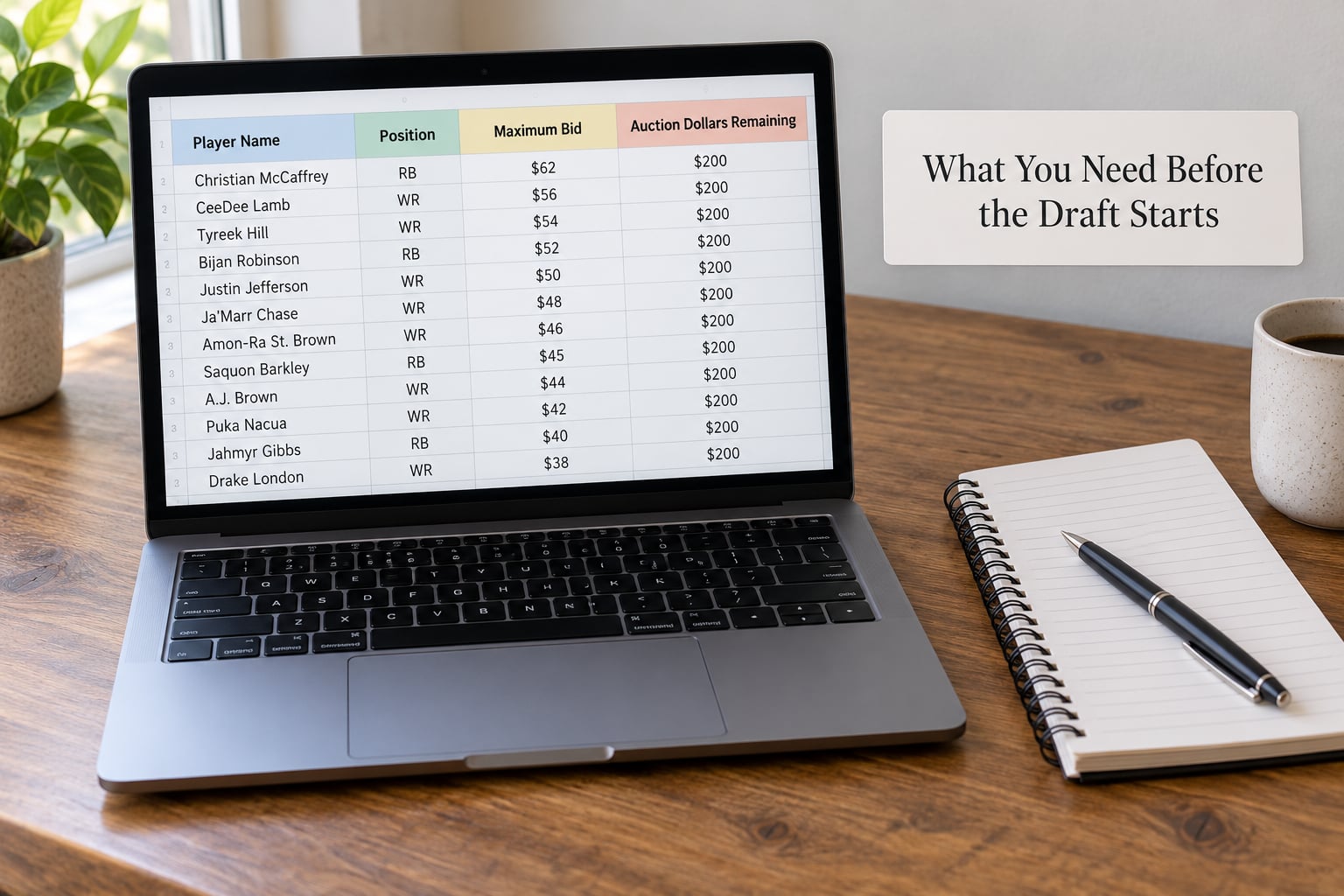
Everything below depends on preparation you finish before draft day, not during it. Managers who set numbers the night before can think during the draft. Managers who set them during the draft just react.
Your league settings, written down
Budget, roster size, starter count, flex spots, superflex or IDP slots, scoring format, and whether it is a redraft, keeper, or dynasty startup. A superflex league turns quarterback from a one-starter position into a two-starter position, and that single change rewrites your budget.
Two or three tiered rankings
One ranking from a projection site, one from a beat writer, and one of your own. Your ranking is the one that matters, because it is the list you will actually bid from. Tiers matter more than exact order: the gap between first and fifth at running back matters, the gap between fifth and sixth barely does.
Projected auction values
Most major platforms and draft tools publish an auction value per player, which is simply the price that player is projected to go for given your league size and settings. Treat it as a reference point, not gospel, and adjust it in your head for league context. In a 10-team league, everything costs more than in a 16-team league.
A budget tracker
A spreadsheet, a notes app, or a dedicated auction tracker. You need four columns: position, auction dollars spent, players bought, and auction dollars remaining. Most managers also add a column for what they still owe each position, which is the number that keeps you honest in the back half.
Your team need list and a target at each price
For every player you want, name a second and third option at a similar price. Drafts move fast and your first choice is frequently gone before you get to him. Forum owners describe this constantly: the plan is a guideline, and the guideline only works if you brought a backup.
Step-by-Step: How to Budget in an Auction Draft
1. Set Your Total Auction Budget
Start with the number your league charges, usually 100 or 200 dollars, and treat it as a hard ceiling you are allowed to spend down to zero but never past. Then subtract your reserve before you plan a single purchase.
Most successful managers hold back 10-15% for the final two hours of the draft. A common rule reported in r/fantasyfootball is to keep 10-15 auction dollars specifically for late wins on players that will go for one dollar. When half the league is broke, those bids are free. Reserving that money at the start costs you almost nothing, because the players you want early are not the players that will be available at the end.
Worked example on a 200-dollar budget: 185 planned spending, 15 held in reserve, released only for bench spots and for a genuine star if one falls into your price range late.
2. Split the Budget in an Auction Draft by Position
This is the core table of the whole approach. Use it as a starting allocation, then adjust for league size and format.
| Position | Share of budget | 200-dollar league | 100-dollar league | Roster spots |
|---|---|---|---|---|
| Quarterback | 8% | 16 | 8 | 1 starter plus bench |
| Running back | 33% | 66 | 33 | 2 starters plus bench |
| Wide receiver | 33% | 66 | 33 | 3 starters plus bench |
| Tight end | 8% | 16 | 8 | 1 starter plus bench |
| Kicker | 2% | 4 | 2 | 1 starter |
| Defense | 2% | 4 | 2 | 1 starter |
| Bench and flyers | 14% | 28 | 14 | 7 bench spots |
Running back and wide receiver together take about two-thirds of the pool, which matches what most auction owners report spending. Quarterback stays low in a one-QB league for an arithmetic reason: the difference between the first and the sixth quarterback at your position is a couple of fantasy points a week, and the auction price for that difference is frequently 15 dollars. Paying down at quarterback and tight end frees money for the two positions that swing your weekly score most.
Adjust for size. In a 10-team league, scarcity is lower, so premium players cost more and your middle-tier targets disappear faster. In a 16-team league, value runs deeper and you can find two starting-caliber running backs in the 40s. A dynasty startup shifts the whole shape, because 55-65 dollars on a top-five quarterback is normal there and reckless in redraft.
3. Create Player Value Tiers and Bid Ceilings
Now convert each bucket into prices. Take your 33% running back budget, decide how many running backs you will own, and divide. Four running backs on a 66-dollar budget is about 16 each on average, which sounds too high until you realize two of them are bench guys you will buy for two dollars.
Work backwards instead. Decide who your one expensive running back is and cap him, then decide who your replacement running backs are and cap them, then check the total against your bucket. Typical ceilings in a 12-team 200-dollar PPR league:
- Stud tier: the top eight to ten players at a position. Bid up to 85-90% of your position budget on one of them, and only one.
- Value tier: the next four to six. These are the players you actually want two or three of. Cap them at about 25-40% of the position budget each.
- Streaming tier: everything else. Cap at 3-5 dollars.
- Flyer tier: the rest of your bench, bought for one to three dollars late.
Write the ceiling down next to every name. A ceiling you decided in advance is a rule; a ceiling you decide while two rivals are bidding is a wish.
4. Set a Maximum Bid Before Every Round
The bid clock makes this non-negotiable. Most platforms run 30 seconds in slow leagues and 10 to 15 seconds in fast ones, and a timer is not long enough to open a spreadsheet. So before the draft starts, decide the maximum you will pay on each target and refuse to exceed it, even if the price is one dollar under your true value.
The reason is a bidding war. Two owners chasing the same player is how a 45-dollar running back becomes a 70-dollar running back, and how a 16-dollar quarterback becomes 28. If a rival wants that player at your cap, let them have him and take the next name on your list at half the price. The auction value of the player you replace him with has not changed just because you passed.
One exception worth naming: if your target is a genuine difference-maker and the price is within two or three dollars of your cap, take it. Everything else waits for the next player.
5. Budget Starters and Bench Separately
Spend roughly 85-90% of your pool on the players who will actually start in week one, and 10-15% on the bench. Bench spots are where auction drafts are won, because that is where you find the free difference: a backup running back with a real workload, a receiver on a team’s first depth chart, a kicker on a good offense.
Most managers plan one to four dollars per bench spot. Seven bench spots at an average of three dollars is 21 dollars, and that is the money that replaces the first starter who gets hurt in September.
Do not confuse a bench player with a starter you paid for. If your flex spot can score from any position, a receiver you bought at four dollars who projects as your fourth receiver is worth more on your roster than a tenth-ranked tight end you bought for 16.
6. Adjust Your Budget When the Draft Goes Sideways
Your plan will not survive contact with the draft board. It will, however, survive contact if you know in advance how to respond. Here is the decision table I use.
| What just happened | What to do |
|---|---|
| You overspent on a running back in the first hour | Move to a wide receiver value tier immediately and stop bidding on running backs above 5 dollars. Do not try to win back the difference at tight end or kicker. |
| Nobody is bidding on your running backs | Do not buy them cheaper out of fear. Buy one at value and spend the difference on the top receiver who comes to you later, or on bench. |
| You are well under at your position by the midpoint | Buy two extra depth pieces at that position rather than one. Depth is the cheapest way to convert surplus budget into a better roster. |
| A top wide receiver goes for an absurdly low price early | Push through your next two picks at that position. The other teams that need receivers will chase you, and you will collect your own top target cheap. |
| Several teams are broke while you still have money | Stop value shopping and start winning players for one to two dollars. Auction dollars have no value after the draft. |
| An injury news item drops mid-draft | Do not reprice the whole board on one report. Bid at your old ceiling if the player is a core piece and lower it one tier otherwise. |
Use your nominations as a budget weapon while you are adapting. Nominating an expensive player you do not want forces a rival to spend money they needed for something else. In a league full of fans of one franchise, nominate that franchise’s best player early and let somebody else overpay. You lose nothing you wanted, and you have bent the budget of someone you will face in a week.
7. Track Every Bid and Every Remaining Dollar
The most common draft-night failure is not overspending. It is losing track. Forum threads are full of managers saying they had no idea they were the only owner still holding money.
Update your tracker after every single purchase, not every few rounds. Write down what you owe each position and what you have left, then check the two numbers against your plan every fifteen minutes. A pacing checkpoint makes drift visible early, when you can still fix it.
| After your pick number | Share of budget spent | Spent on a 200-dollar budget | Remaining |
|---|---|---|---|
| 2 | 23-27% | 46-54 | 146-154 |
| 4 | 50-58% | 100-115 | 85-100 |
| 8 | 70-78% | 140-155 | 45-60 |
| 12 | 83-88% | 165-175 | 25-35 |
| 16, roster full | 98-100% | 195-200 | 0-4 |
If you are behind these checkpoints with half your roster unfilled, you have already lost the money game. The fix is to bid like a buyer rather than like an owner, which means taking your two-best values at whatever they cost.
Common Mistakes That Blow Up a Budget
Bidding wars you entered voluntarily
A price that doubles between the opening bid and the final bid is a price somebody invented, not a price the market set. The second owner in every war almost always loses relative to the alternative player waiting at a lower number. Refuse to be that owner.
Overspending on quarterback and tight end
These are one-starter positions with smooth replacement curves. Money spent on your second tight end is money not spent on your second receiver, and the gap in weekly production is usually larger at wide receiver. Cap both positions and move on.
Hoarding cash out of fear
Ending a draft with 40 unspent dollars is a wasted draft. Those dollars do nothing in week one, they do not roll over, and they do not come back. The correct target is a roster that is full and a wallet at zero.
Buying your favorite player above your ceiling
Everyone has three or four favorites. They will be overpriced by definition, because everybody wants them. If a player is on both your target list and your ignore list, the ignore list wins.
Ignoring league size and format
A percentage split copied from a 16-team league does not translate to a 10-team league, and a redraft split does not translate to dynasty. Superflex leagues need a much larger quarterback number, IDP leagues shift value toward linebackers and defensive backs, and keeper leagues need a reserve for the keepers you will need to match. Recalculate before every league.
Drafting without a target at each price
Having a list of twenty names you love and no second option for any of them is the same as having no list. A budget plan only works when every planned purchase has a backup at a similar price.
Frequently Asked Questions
How should I allocate my budget for the auction draft?
Split the total pool by position before draft day. In a 12-team 200-dollar PPR league a workable starting point is 33% running back, 33% wide receiver, 8% quarterback, 8% tight end, 2% kicker, 2% defense, and 14% for bench spots. Running back and wide receiver together absorb about two-thirds of the money because they produce the widest weekly swings. Then convert each bucket into a maximum bid per player using your tiered rankings, and reserve 10-15% for late-round bids.
What is the best strategy for an auction draft?
Buy tiers, not players. Decide in advance which players sit in your stud, value, streaming, and flyer tiers, set a maximum price for each one, and let the draft come to you. Nominate expensive players you do not want to drain opponents, refuse bidding wars, and hold back 10-15% for the end when the league runs out of money and players go for one dollar. Spend your full budget; unspent auction dollars are wasted dollars.
What is the best strategy for a $200 fantasy football auction draft?
Treat 200 dollars as spendable, not as a target. Plan to spend about 185 on named players and keep 15 in reserve for bench spots. Buy one stud at running back and one at wide receiver, fill the other starter slots in the value tier, then load up on depth at one to four dollars per player. If you have excess money at the midpoint, buy two extra pieces at the position you are strongest at rather than one. Finish at zero.
How long does a 12 team auction draft take?
Plan for three to five hours, and longer in superflex or IDP leagues where roster sizes are bigger. Most platforms run 20 to 30 second bid windows in standard leagues and 10 to 15 seconds in fast settings, and that clock is the real reason to set maximum bids in advance. Have your tracker open in a second window and update it after every purchase, because you will not have time to reconstruct your remaining money mid-round.
Should I spend my full budget in an auction draft?
Yes, aim to finish at zero. Auction dollars do not carry into the season, so money left in your wallet at the end is money you simply did not use. That is different from never planning to spend it: reserve 10-15% early so you can win cheap players late, when every other manager is broke. The reserve exists to be spent, and if your roster is full and you still have cash, keep bidding until the draft ends.
How do superflex and IDP auction budgets differ from a standard redraft?
Superflex turns quarterback into a two-starter position, so raise quarterback to roughly 15-20% of the budget and plan on two quarterbacks instead of one. IDP leagues shift value toward linebackers and defensive backs, which typically take 20-25% combined, while running back and wide receiver drop to 25-30% each. Dynasty startup auctions reward young players and usually put 55-65 dollars on a top-five quarterback. Keeper leagues need a reserve for the keepers you must match.
Conclusion
Budgeting an auction draft comes down to three things, in order. Calculate your total budget and reserve 10-15% of it before you plan anything. Split what remains into positional buckets, then convert each bucket into a maximum price for every player on your list. After every purchase, update what you have spent and what you have left, because the draft is won and lost on that number.
Start tonight with the settings sheet and the tracker. Everything else follows from those two.