
How return yards scoring affects fantasy players comes down to one setting most managers never check. Return yardage scoring is an optional commissioner toggle, and it is off by default on every major platform, but where it is switched on it adds a second points stream on top of normal offensive production. That extra stream creates a tier of low-cost players your rankings have never accounted for.
The reason it stings is that return points are added, not subtracted. A backup running back who carries the ball four times and returns two kicks can outscore a starter in a week where the starter’s game went sideways. Nobody’s offensive ranking was wrong. The scoring rule just paid a stream that the rankings ignore.
I’ve spent enough drafts in return-yardage leagues to know the failure mode: a manager picks a zero-projection flier on the waiver wire in week three, the flier returns kicks for 41 yards, and the whole league reshuffles. Understanding the setting protects you from both the boom and the busted scoring preset that your commissioner picked in August without reading it.
Table of Contents
- What Is Return Yards Scoring in Fantasy Football?
- Where the return yard setting lives on each platform
- Return yards, all-purpose yards and receiving yards are three different stats
- How Return Yards Scoring Affects Fantasy Players
- Return points are additive, not substitutive
- Why zero-projection waiver players rise
- The 2024 kickoff rule change is the cleanest case study available
- How Return Yards Scoring Affects Fantasy Player Projections
- The touches times yards times rate formula
- Which Positions Benefit Most?
- The punter slot and D/ST scoring are where settings get strange
- Return Yards Scoring by League Type
- How to Adjust Fantasy Rankings and Draft Strategy
- Audit your league in two minutes
- How return yards scoring affects fantasy player floors
- Identify low-volume, high-upside returners
- Dynasty nuance: rookies lose return jobs as they develop
- What to do if return scoring is accidentally broken
- Plan for variance in playoff weeks
- Frequently Asked Questions
- Do return yards count in fantasy football?
- How many points are return yards worth in fantasy football?
- Are return specialists worth drafting in fantasy football?
- Does return-yard scoring help running backs or receivers more?
- Should return yards change my fantasy player rankings?
- What is the difference between punt returns and kickoff returns in fantasy scoring?
- Conclusion
What Is Return Yards Scoring in Fantasy Football?
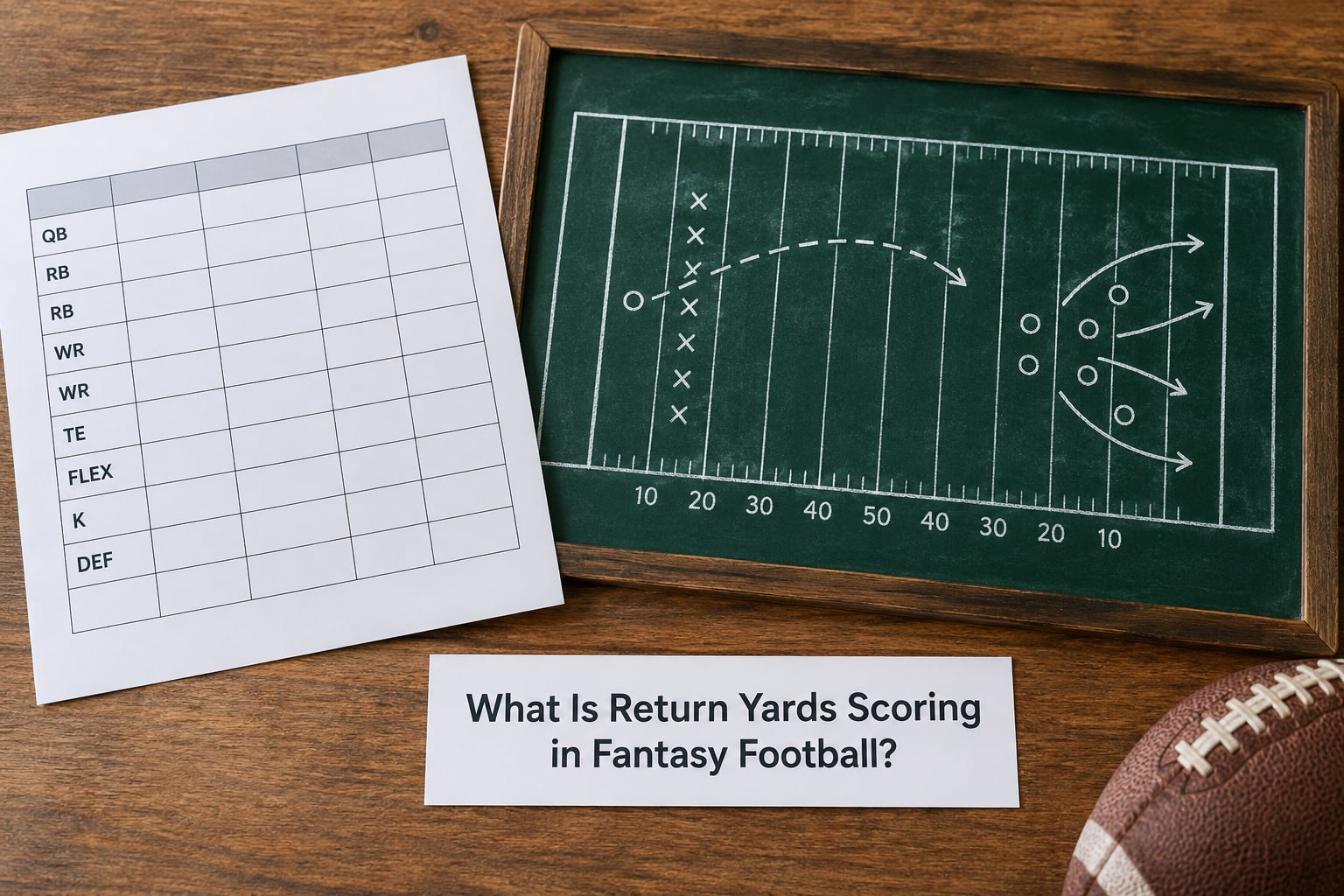
Return yards scoring means your league awards fantasy points for the yards a player gains on kickoffs and punts. Kickoff return yards come from taking the ball at the 25 or so and running it back to field position. Punt return yards come from catching a punt and finding space upfield. Both are special teams stats, and both are tracked separately from anything a player does on offense.
Most platforms present this as a points-per-yard rate plus a separate value for a return touchdown. The common rate is 0.1 points per return yard, which is the same arithmetic as 1 point for every 10 return yards. Some commissioners set 0.05, some set 0.02, and a few layer a return TD bonus on top that managers describe in forum threads as broken.
You may also see punt returns and kickoff returns scored at separate rates, which is more common in dynasty formats where punt value is treated as scarce. Punt returns are rarer, so a punt-return-only player can be genuinely hard to replace.
Where the return yard setting lives on each platform
Because the setting is buried in a scoring menu rather than a headline toggle, a lot of managers assume it does not exist. That assumption is how broken leagues happen.
- ESPN: League Settings, then Scoring Settings, where kickoff and punt return touchdowns sit alongside sacks and turnovers with adjustable weights. Return yards themselves are handled through the custom scoring option rather than a single slider.
- Yahoo: Settings and Message Center, then Edit Settings, then the Scoring tab. Yahoo exposes separate lines for punt return and kickoff return yardage.
- Sleeper: League settings under Custom Scoring, where you can add points per return yard alongside points per reception and points per rushing yard.
- Fantrax: League Rules, then Scoring, with return yards editable per return type.
- MyLeagueManager: Settings, then Custom Scoring, with points-per-yard options for both return categories.
If your platform is not on that list, the honest answer is that scoring granularity varies. That is exactly why the audit step later matters.
Return yards, all-purpose yards and receiving yards are three different stats
Return yards are not all-purpose yards, and neither is all-purpose yardage the same as receiving yardage. All-purpose yardage is a fantasy-made stat that rolls receiving, rushing and return yards into one number. Return yards scoring scores only the special teams portion. A receiver catching five passes for 80 yards and adding 20 return yards scores on 80 in a standard offensive setup, and scores on 100 only if your league explicitly applies the return rate to return yards.
This trips people up constantly. Check whether your setup scores all-purpose yardage as a separate stat category, because some platforms let you score all-purpose yards and return yards at the same time, which double-counts the return yards for the same player.
How Return Yards Scoring Affects Fantasy Players
The mechanism is simple: your points per return yard multiplied by actual return yards, added to whatever the player already earned. A returner with 3 return opportunities for 25 yards each earns 75 return yards, and at 0.1 points per yard that is 7.5 fantasy points before a single offensive snap.
Return points are additive, not substitutive
Nothing about return scoring reduces a player’s offensive value. Your 300-yard receiving total is worth exactly what it was before you turned the setting on. The setting only adds, which means offensive superstars are unaffected in value and low-owned players are the ones whose price moves.
That is the whole answer to which players gain: the ones with return work who are not already owned. The ones who lose are not really losing, they are simply unaffected while the rest of the league’s supply of return yards gets drafted around them.
Why zero-projection waiver players rise
Projected-points systems assign almost nothing to return yards, because most projections were built for a league format where return yards are worthless. In a return-yardage league, those projections are flat wrong, and the gap shows up on the waiver wire first.
Managers running a league with 0.1 points per kick return yard report the same pattern: waiver pickups projected at zero were consistently returning 8 to 12 points. The projection was not wrong about who would play. It was wrong about which yards counted.
The 2024 kickoff rule change is the cleanest case study available
In 2024 the NFL moved kickoffs toward an XFL-style format where the receiving team could choose to let the ball go to the end zone for a touchback, cutting the default hang time and making the fair-catch-or-return decision live almost every kick.
Before the change, a kickoff return was an event. After it, it became a genuine weekly choice with real upside. Return-touch volume per season rose substantially, and any league scoring return yardage saw production climb without a single roster change. Managers who had built a waiver strategy around return fliers got the best accidental edge of their season.
The lesson generalizes: external rule changes move return opportunity more than any draft-day decision you make. A projection built before a rule change is measuring a different game.
How Return Yards Scoring Affects Fantasy Player Projections
Projecting return production takes three numbers, and only the third is a league setting. Get the first two wrong and the formula gives you false precision.
The touches times yards times rate formula
Expected points = expected return touches × expected yards per return × points per return yard.
Add return touchdowns as a separate small expectation. A player averaging 25 yards per return who breaks out for a 95-yard touchdown is a different category of outcome, and I would rather model that as a low-probability bump than fold it into the average.
The hard part is expected touches. A dedicated returner handles most punts and kickoffs, so touches track his team’s games and his health. A slot receiver returning kicks shares the job and might touch the ball three times a week. A zero-projection waiver flier might touch it once and score 4 points, which is why the flier strategy works and fails so violently.
Here is the break-even math that turns return yards into a comparable offensive number, so you can judge whether a return role is worth a roster slot:
| Return yard rate | Yards to match 1 PPR reception (1 pt) | Yards to match 1 standard reception (1 pt at 10 yards) | Yards to match 1 rushing TD (6 pts standard) |
|---|---|---|---|
| 0.1 pts per yard | 10 yards | 100 yards | 60 yards |
| 0.05 pts per yard | 20 yards | 200 yards | 120 yards |
| 0.02 pts per yard | 50 yards | 500 yards | 300 yards |
Read that table once more because it explains the whole topic. At 0.1 points per return yard, a single return for 10 yards equals a PPR reception. At 0.02, you need 50 return yards for the same thing, which is a season’s worth of work for most players.
So the answer to whether return scoring matters is entirely about the rate. Below roughly 0.02 points per yard it is a rounding error and you can ignore it. At 0.1 it is the equivalent of a full receiving slot, and any league running that rate is playing a different game from the consensus rankings.
Which Positions Benefit Most?
Positions gain in proportion to how much special teams work they do and how little that work is already priced into their value. That description fits offensive players first and specialists second.
| Archetype | Typical return role | Why return scoring helps | What to watch |
|---|---|---|---|
| Slot or WR3 | Shares punt and kick duties | Cheap offensive baseline plus a real weekly return floor | Whether the coach keeps him on returns in a lead |
| RB3 / change of pace | Kick returns when the starter sits | Turnover-prone two-way backs get a points floor others lack | Goal-line and early-down usage, which drives value anyway |
| Tight end | Occasional punt returner | Low baseline makes any return bonus disproportionately useful | Blocking-heavy offenses rarely give a TE return work |
| Punt-only returner | Punts, no kick returns | Scarce skill, and punt return yards usually score at a higher rate | Whether your league scores punts and kicks separately |
| Punter | Punt yardage, sometimes punt return points | A punter roster spot turns a normally ignored player into a weekly starter | Punt distance, hang time and whether the league scores punts separately |
| Defense / special teams | Return touchdowns credited to D/ST on some setups | A defensive return TD is a rare, high-ceiling scoring event | Check whether your D/ST unit is credited for return scores |
The punter slot and D/ST scoring are where settings get strange
Most redraft leagues drop punters from rosters entirely, which removes one of the cleanest return-value plays available. A punt returner’s points come with essentially no offensive competition, so in a league that keeps punter spots, a starting punter is frequently a better return-scoring play than a starting receiver.
On defense, some platforms credit the D/ST unit with return touchdowns and some credit the individual returner. If your league credits the unit, a return touchdown becomes a defensive scoring event, which changes the risk profile of a streaming defense entirely.
For IDP leagues the effect is bigger still, because linebackers and defensive backs are already in starting lineups and return work is pure added variance on top of tackles and passes defended.
Return Yards Scoring by League Type
Return yards scoring behaves differently depending on the base offensive format, because the value of a return yard is relative to the value of an offensive yard in your league.
| League format | Return yards rewarded? | How that changes player selection |
|---|---|---|
| Standard | Only if custom scoring adds it | Modest effect, since a receiving yard is worth so little; return TD value dominates |
| Half-PPR | Only if custom scoring adds it | Return yards become roughly as valuable as offensive yardage, so two-way players pull ahead |
| PPR | Only if custom scoring adds it | Return yards are additive to a reception economy, which is where zero-projection fliers get interesting |
| Dynamic returner slot | Yes, by design | Returners occupy a dedicated roster spot, so bench slots get stacked with cheap return fliers |
| IDP with return scoring | Usually yes | Lineup spots are tight, so a defender with return work fills two scoring categories |
Note the pattern: none of these formats scores return yards by default. Every one of them is a deliberate commissioner choice, and that is why the setting so often catches a league by surprise.
How to Adjust Fantasy Rankings and Draft Strategy
Once you know your league’s rate, the adjustment is arithmetic rather than opinion. Work through these steps in order.
Audit your league in two minutes
Open your league settings, find the scoring section, and look specifically for any line mentioning return yardage, punt return, or kickoff return. Then check three things.
- Is there a rate at all? Some platforms show a return-yard line set to zero, which is functionally off but visibly present.
- Is it combined with all-purpose yardage scoring? If both are on, return yards are being counted twice for the same player.
- Is there a return TD bonus stacked on top? One point per 10 return yards plus an extra 2 points per return touchdown is the setup that breaks a league.
Write the rate down before you draft. You cannot apply it mentally in the fifth round.
How return yards scoring affects fantasy player floors
The mistake is trying to slot returners into the existing rankings. Offensive rankings describe offensive production, and return production is a separate axis. Add it as a floor instead.
For every player on your board with return duties, add projected return yards times your rate to his projection, then look at which players cross a meaningful threshold. In a 0.1 league, a player who projects 150 return yards gains roughly 15 points of season-long expectation, which is worth a full starting slot. In a 0.02 league the same player gains 3 points and is a rounding error.
Identify low-volume, high-upside returners
The best return picks are players whose offensive role is genuinely secondary. A WR4 who returns every punt has a weekly floor that a starting WR without return work does not. Those players are usually available in round 10 or on waivers, which is exactly the return you want from a late pick.
What to avoid is the player whose only value is return work and whose offensive role is about to expand. More offensive involvement usually means fewer return touches, and the points you were buying quietly disappear.
Dynasty nuance: rookies lose return jobs as they develop
This is the pattern that trips up 32-team dynasty managers. A rookie who returns kicks and punts as a college standout collects return points now, then loses the job the moment he earns a real offensive role. Early-round prospects frequently carry return work that disappears by their second season.
The usual adjustment is to apply a discount to the return portion of a young player’s projection, weighted by how likely his offensive role is to grow. A rookie who projects 400 receiving yards should not also be credited with a full-time return job.
What to do if return scoring is accidentally broken
If your commissioner enabled it late and the league is now lopsided, resist the urge to reset the season. Most platforms freeze stats on a set day and time, which is why a scoring change applies only from that point forward. Your league rules summary should spell out when that freeze happens.
Two workable fixes: leave it and adjust your roster construction toward returners, or change it at the freeze boundary so everyone plays under the new rule for the remaining weeks. Announce either choice in the league thread before the draft, not after standings are decided.
Plan for variance in playoff weeks
Return scoring widens the spread of weekly scores. A player averaging 6 return points per week might post 0 or 18 in any given week, and in a one-game playoff that single distribution matters more than any season-long average.
The practical move is to hold returners as flex options and stack them rather than treating them as locked starters. In a points league, their week-to-week swing adds variance that helps you climb in one week and hurts you the next, so lineups built around them need other weekly games decided.
Frequently Asked Questions
Do return yards count in fantasy football?
Only if your commissioner turns them on. Return yardage scoring is off by default on ESPN, Yahoo, Sleeper, Fantrax and MyLeagueManager, and it lives inside the custom scoring menu rather than a headline toggle. Where it is enabled, kickoff and punt return yards are scored separately from receiving or rushing yardage and added to the player’s total. Most managers assume the setting does not exist, which is how leagues end up playing a format nobody agreed to.
How many points are return yards worth in fantasy football?
It depends entirely on your league’s rate. At 0.1 points per return yard, ten return yards equals one PPR reception. At 0.05 you need twenty yards, and at 0.02 you need fifty. Most leagues set either 0.1 points per yard or the equivalent phrasing of 1 point for every 10 return yards. Below roughly 0.02 the setting barely moves a season total, while at 0.1 a starting returner can be worth a full offensive slot.
Are return specialists worth drafting in fantasy football?
They are worth a late-round pick or a waiver claim in leagues that score return yards, and nothing in leagues that do not. The reason is the floor: a specialist with no offensive role still collects points every week your team plays. The catch is that this is also where you will find the most volatile players on your roster, so a single zero-carry week can cost you a matchup. Treat them as roster additions, not as core assets.
Does return-yard scoring help running backs or receivers more?
Receivers gain more in practice, because slot and WR3 players are the ones who actually share punt and kick duties, while running backs lose return touches as soon as they become the primary offensive option. Change-of-pace backs are the exception, since a backup whose starter sits keeps both jobs. The exception that flips the answer is a league that keeps punter roster spots, where punt returners have no offensive competition at all.
Should return yards change my fantasy player rankings?
They should change your projections, not your ranking order. Return points are additive, so no offensive player’s value falls because you enabled the setting. What changes is the value of players whose return work was projected at zero, particularly late-round receivers and waiver fliers. Apply the adjustment as a separate points floor on top of existing projections rather than reordering the board, since standard rankings were built without return yardage in mind.
What is the difference between punt returns and kickoff returns in fantasy scoring?
Punt returns happen a few times a game and come with far more yardage per return, so they carry most of the weekly value for a return specialist. Kickoff returns are far more frequent but average far fewer yards. Some leagues score the two categories at separate rates, with punts valued higher because the opportunity is rarer. Before projecting anything, check whether your settings list punt and kickoff return yardage as one line or two.
Conclusion
Return yards scoring affects fantasy players through addition, not substitution, which means the players who gain are the ones whose return work your rankings priced at zero. The setting is off by default, so start by confirming whether your league has it on and at what rate.
At 0.1 points per return yard, treat returners as a real positional tier worth late picks and waiver priority. Below 0.02, ignore it. Either way, judge return production as a situational adjustment on top of your offensive projections, and re-check it after any rule change, because the 2024 kickoff format showed how quickly opportunity can shift underneath a roster.