
A vampire league is a fantasy football format where one team, the Vampire, sits out the draft entirely, builds its roster from leftover undrafted players and free agents, and picks its own matchup each week. After every win, the Vampire steals one same-position starter from the team it beat. Everyone else’s roster is locked for the year.
That single change turns a normal redraft league into something closer to a scavenger hunt. The draft stops being the whole season, and the waiver wire becomes the most competitive part of the league.
I’m not going to pretend there’s one canonical rulebook for this format, because there isn’t. Groups that run vampire leagues in 2026 each pick their own details on ties, deadlines, and playoff steals. What follows is the version that works, plus the spots where you get to choose.
Table of Contents
- How a Vampire League Works in Fantasy Football
- The Basic Rules of a Vampire Fantasy Football League
- Rules at a glance
- How the Vampire Builds Its Roster From Leftovers and Free Agents
- How the Vampire is selected
- What happens during the draft itself
- Free agent access after the draft
- How the Steal and Swap Actually Works
- The weekly calendar
- What makes a swap legal
- Ties in a Vampire matchup
- Injuries, drops, and players who disappear
- Stopping the kicker and defense loophole
- Can a Vampire League Be Scored Differently From a Regular League?
- Why the format behaves differently under each scoring system
- Vampire League vs Dynasty, Redraft, and Consolation Leagues
- How to Set Up a Fair Vampire League
- The commissioner checklist
- League size and the scheduling math
- Platform notes
- Frequently Asked Questions
- What is a vampire league in fantasy football?
- Are all vampire leagues played as dynasty leagues?
- How many teams can return after elimination?
- Do revived teams keep their original rosters?
- How are ties handled when a Vampire matchup ends level?
- Start With the Rulebook, Not the Draft
How a Vampire League Works in Fantasy Football
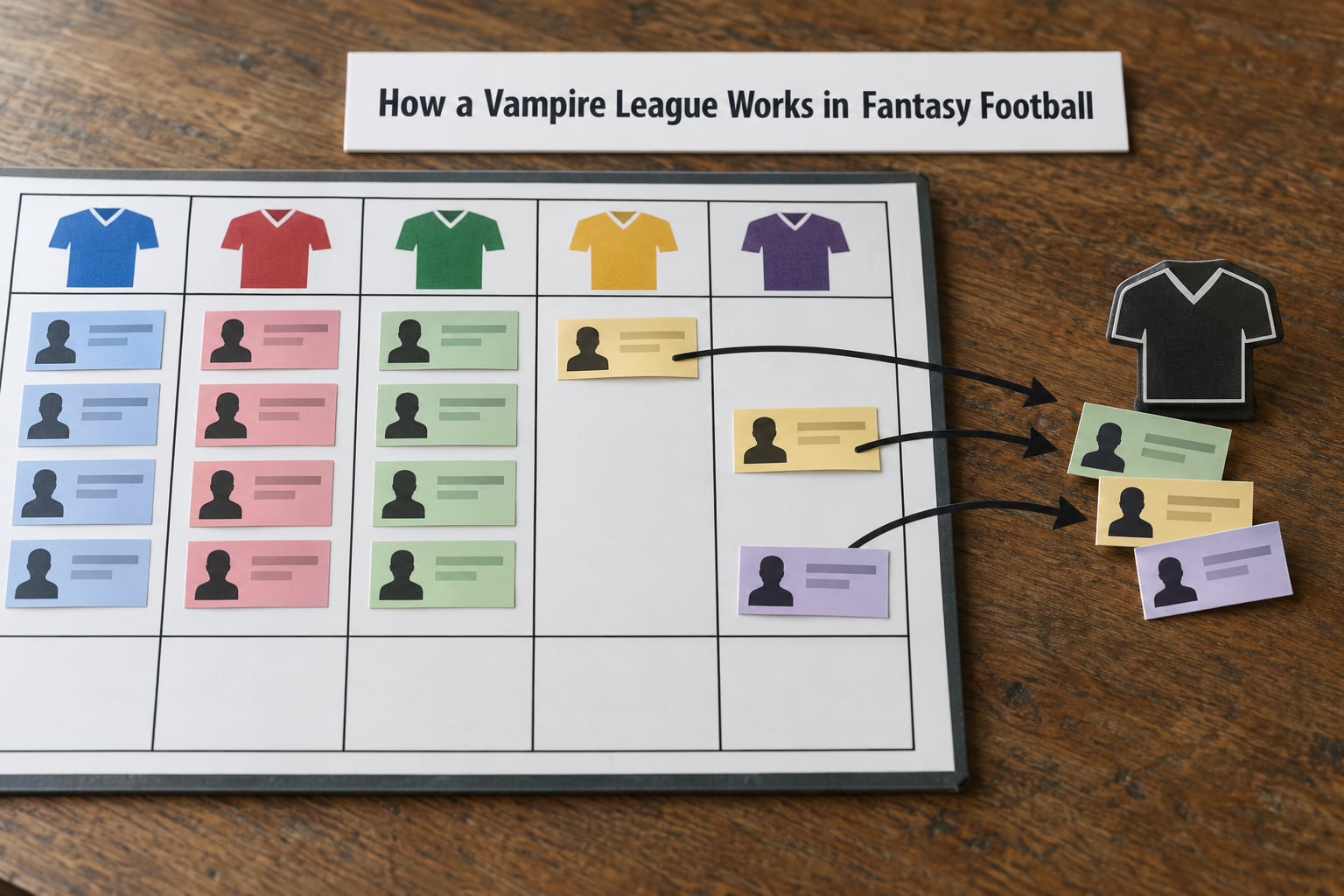
The short version: eleven or more managers run a normal snake draft, then have their rosters frozen. The Vampire claims everyone left undrafted, streams free agents all season, chooses its own weekly opponent, and each time it wins it trades one of its own starters for a same-position starter from the losing manager’s lineup.
Two consequences follow from that. First, the Vampire starts the season behind, because the tail end of a snake draft is mostly replacement-level players and guys who weren’t drafted in a standard league. Second, the ceiling is enormous, because the Vampire can swap in a starter from any team it beats.
Commissioners who run the format report that it produces far more week-to-week chatter than a standard league. That tracks. Managers who can’t add or drop anything spend every week on lineup choices and trade math, and the Vampire spends every week on the waiver wire.
It’s not a league for everyone. If your group wants a fair, low-drama season, use a normal redraft. If you want a season where a 2-6 team can still make playoffs because it keeps robbing your best running back, a vampire league is a good fit.
The Basic Rules of a Vampire Fantasy Football League
This is the list to copy. Ten rules cover the format, and everything else in this article is a detail hanging off one of them.
- The Vampire does not participate in the draft. It takes no picks in any round.
- Human managers run a standard snake draft. Normal order, normal rounds, normal roster limits.
- Human rosters lock at the end of the draft. No add/drop, no waiver claims, no trades outside a forced steal.
- The Vampire gets first claim on every undrafted player immediately after the draft ends.
- The Vampire can sign free agents all season and does not need to win to do it.
- The Vampire chooses its own matchup each week from the teams still in the league.
- A win triggers one same-position swap. The Vampire gives up one of its own starters and takes one of the loser’s starters at the same position.
- Only active starters are eligible to be stolen or traded away. Bench players are safe.
- One swap per week, not per matchup won. Two wins in a week still produce one swap.
- No swaps during the playoffs unless your league specifically votes them in.
Rules at a glance
| Rule | Human teams | Vampire |
|---|---|---|
| Draft participation | Full snake draft | None |
| Add/drop and waivers | Locked all season | Free agents, all season |
| Picks its matchup | No | Yes, each week |
| Trades | Only a forced swap, and only to the Vampire | Same, plus signing free agents |
| Playoff steals | Not allowed by default | Not allowed by default |
How the Vampire Builds Its Roster From Leftovers and Free Agents
The draft ends and eleven managers have full rosters. One manager has nothing. What fills that roster comes down to two things: who plays the Vampire, and how much freedom they get to sign players.
How the Vampire is selected
Three methods show up in practice. The most common is a volunteer pool with a random draw among everyone who opted in, which is what most groups end up with once someone volunteers to run the league. The second is a random draw from the full league, so any manager can get stuck with it. The third is assignment to the last-place team from the prior season, which punishes bad luck with bad luck and is generally a bad idea.
Volunteer-and-draw works best. Nobody can argue the outcome was rigged, and the person running the Vampire role usually wants it.
What happens during the draft itself
The Vampire sits out entirely, which means the pool of undrafted players is larger than usual. In a typical 10-team league the draft consumes 180 or so selections, and every player left over is available to the Vampire at the moment the draft ends. There’s no claim window and no priority queue at that stage. The Vampire takes what it wants, then fills out remaining slots with undrafted rookies and the deepest free agent pool in the league.
Some commissioners handle the empty draft slots with junk keepers, placing a few throwaway players into open Vampire slots so the draft grid still looks full. It’s cosmetic, but it stops the league from spending draft night with six empty rows.
Free agent access after the draft
This is the part that decides whether the format is fun or miserable. The Vampire should have unrestricted free agent access every week. Some leagues also give the Vampire top waiver priority when humans would otherwise be allowed to claim something, which keeps the rulebook simple: humans are locked, the Vampire streams.
Everything the Vampire signs counts against roster limits. If it picks up a backup running back, that is a bench slot burned, and in a small league there are not many to spare.
How the Steal and Swap Actually Works
The swap is the entire reason people try this format, so it needs an exact written procedure. Here is the version that survives a full season without arguments.
The weekly calendar
Most commissioners run it on two deadlines. The Vampire chooses its matchup by Wednesday, before the weekly games are set, so human lineups lock on the standard platform deadline. Then on the following Tuesday, after the games resolve, the Vampire names the player it is giving up and the player it is taking. The commissioner executes the swap.
That ordering matters. Picking the matchup before lineups lock stops the Vampire from choosing a soft opponent after seeing who it wants to attack. Deciding the swap on Tuesday after the commissioner has run waiver adds gives managers the weekend to react to what happened.
What makes a swap legal
The swap is one-for-one and same-position. If the Vampire’s starting wide receiver beats a league, it gives up its starting wide receiver and takes the loser’s best starting wide receiver. It cannot give up a tight end to take a wide receiver. It cannot take a benched player. It cannot take the player it just lost a week ago if that player is no longer a starter.
Ties in a Vampire matchup
This is the single most common commissioner question, and most published rulebooks skip it. In r/FFCommish the thread that keeps surfacing is exactly this: a Vampire matchup ends tied, and nobody knows whether the steal triggers.
Write the answer down before Week 1. The cleanest version is that a tie is a tie, the Vampire gets no steal, and the standard platform tie-breakers decide the standings result. That keeps the swap tied to an actual win, which is easier to explain six months later than a special coin-flip clause.
Injuries, drops, and players who disappear
Another gap in most rulebooks: what happens when the player being stolen gets hurt, gets dropped, or leaves the league between the win and the Tuesday execution. Handle all three. A reasonable default is that if the targeted player is unavailable, the Vampire may select any active starter at that position from the same team, or the swap lapses and neither team moves.
The cleanest default of all is that the swap lapses. Fewer moving parts, less to argue about.
Stopping the kicker and defense loophole
Once a Vampire is rolling, it can swap kickers and defenses every single week without any real cost. Community discussion keeps circling this and no standard answer exists. If it bothers you, write a limit into the rulebook: a position can only be swapped once every three weeks, or the Vampire keeps the swapped-in player for a minimum number of weeks before swapping that position again.
Can a Vampire League Be Scored Differently From a Regular League?
Yes, and most successful vampire leagues change the scoring for a specific reason. A Vampire that streams defenses and kickers every week behaves very differently from a manager who locked those players in August.
Point-per-reception scoring usually helps the Vampire, because a low-volume receiver accumulated off the wire can outperform a drafted bust. Standard scoring tends to favor the drafted roster’s running backs. Whichever you pick, decide it before the draft and write it in the rulebook.
Defensive scoring is the biggest lever. If you use points allowed tiers, a Vampire streaming the best defensive matchup each week gains an edge that dwarfs any other setting. Tightening the tiers, or scoring interceptions and fumble recoveries more heavily, claws some of that back.
| Setting | Standard league | Vampire league | Why |
|---|---|---|---|
| Receiving | 1 point per reception | 1 point per reception | Boosts streamed receivers |
| Points allowed by defense | Tiered, 10+ to under 10 | Narrower tiers or flat scoring | Limits weekly defense streaming |
| Interceptions | Minus 1 to 2 | Plus 1 to 3 | Rewards waiver-wire defenders |
| Kicking | Points per made field goal and extra point | Points per made field goal only | Removes repeated kicker swaps |
| Flex slots | WR, RB, TE | WR, RB, TE, QB | More waiver pickups scoreable |
| IR slots | 2 to 6 | 0 | Locked human rosters stay playable |
Dropping IR slots is a real decision, not a formality. Humans cannot add a replacement for a season-ending injury, so you either keep large IR slots or accept that an injured starter is a roster hole until the season ends.
Why the format behaves differently under each scoring system
Standard scoring rewards volume and consistency, and the Vampire has neither early. A drafted team knows exactly what its RB1 is going to do in October. The Vampire’s best player might be a tight end it claimed on a Tuesday because the starter went on injury report.
PPR closes part of that gap, because a replacement-level receiver catching five passes beats a drafted player catching two. It also makes bench players more valuable to the Vampire, since a benched receiver can still be stolen the moment he starts.
What PPR does not fix is the defense problem. Points-allowed scoring is the setting most likely to break the balance, because the Vampire can identify the single best defensive matchup of the week and take it every time, while a human manager locked into a bad matchup in September cannot escape it. If your human managers complain about the Vampire’s defense every single week, that setting is the reason and you should tighten the tiers before next season.
Scoring for punts and kickers is where rules get fiddly. Most platforms let you exclude punts from the scoring table, which is worth doing because punt return points rarely separate real kickers from scrubs and add noise to the standings.
Vampire League vs Dynasty, Redraft, and Consolation Leagues
The Vampire format confuses people because it borrows vocabulary from several other formats. It is closest to a locked redraft league with one team operating outside the rules, and it shares its playoff bracket with a standard league.
| Format | Roster management | Season structure | What defines it |
|---|---|---|---|
| Vampire | Humans locked; Vampire streams free agents all year | Single season, snake draft, playoffs | One non-drafting team that steals a same-position starter after each win |
| Redraft | Full add/drop and trades | Single season, annual reset | Rosters reset every year with no continuity |
| Dynasty | Multi-year rosters, trades, devy drafts | Years, not weeks | Keeping drafted assets across seasons |
| Consolation | Normal roster rules | Single season | A bracket for eliminated teams after the playoffs start |
| Guillotine | Survivor elimination | Weeks, one loss ends a season | Losers are eliminated, not ranked |
A vampire league is not a consolation league. The Vampire competes for the championship the same week everyone else does, it just gets to pick its own schedule along the way. It’s also not a guillotine league, where one loss ends your season, though managers who’ve played guillotine tell me the drama is comparable.
The distinction that trips people up is roster management, not the playoff bracket. In every one of these formats except dynasty, rosters reset at the end of the year. What separates the Vampire is that eleven of the twelve rosters stop changing three weeks into September, while the twelfth changes every week until the playoffs.
Practical result: a dynasty manager is always weighing a bad week against a future season, and a redraft manager is always weighing this week against the waiver wire. A vampire manager is weighing this week against the fact that they cannot plan beyond it. Three completely different decisions, which is why porting strategy from one format to another rarely works.
Vampire Dynasty is a real variant. Same rules, but rosters carry into the following season, and the surviving humans keep their core while the Vampire has to rebuild from a new leftover pool every year. It gets harder to recruit players for, in my experience.
How to Set Up a Fair Vampire League
Everything above depends on the rulebook being written before the entry deadline, not during Week 5. Groups that publish exact rules in advance attract players; groups that wing it lose members.
The commissioner checklist
- League size. Publish the number before recruiting. Eight teams works best, ten is fine, twelve gets thin at the bottom of the waiver wire.
- Vampire selection method. Volunteer pool, random draw, or last place. Say which.
- Whether humans are fully locked. Including the trade veto, if any.
- Free agent access for the Vampire. Weekly unrestricted, or weekly with a submission deadline to the commissioner.
- Matchup selection deadline. Wednesday before lineups lock is the standard choice.
- Swap decision deadline. Tuesday after games, executed by the commissioner.
- Same-position rule and the active-starters-only rule. Both spelled out.
- Tie handling. Stated plainly, including whether a steal triggers.
- Injury and drop handling. What happens if the targeted player is gone.
- Anti-abuse clause. A minimum holding period on kickers and defenses.
- Playoff rules. Whether steals stop, and whether the Vampire still picks its matchup.
- Tiebreakers. Use your platform’s standard order so nobody has to learn a new one.
- Byes and the schedule. In an 8-team league there are two Vampire matchups per team through Week 14, which is what makes the format work.
- Payout structure. Weight the prize toward the Vampire to make the lopsided start feel fair.
League size and the scheduling math
The reason 8 teams is the recommended size is scheduling, not vibes. With one Vampire and seven human teams, each human plays the Vampire twice in a 14-week regular season, and the Vampire plays eight matchups against a seven-team pool. No human faces the Vampire three times. At 10 teams the human teams face the Vampire three times in 14 weeks, which means the Vampire is a bigger share of every schedule than it should be. At 12 teams the waiver pool is stretched thin enough that the Vampire spends early weeks with empty roster slots.
Platform notes
No major platform has a vampire toggle. You build it on top of existing settings, and where you place each piece differs. On ESPN, use League Manager, which lets you run a custom transaction process and execute the weekly swap as a commissioner without unlocking every human roster. On Yahoo, set the league to a League Manager style with manual roster changes restricted, and plan to make swaps through Yahoo’s transaction tool. On Sleeper, keep add/drops off for human teams and let the commissioner approve the Vampire’s claims in one setting. On Fantrax, use custom transactions and set the roster to a locked state for everyone except the Vampire’s manager.
Menu names drift between seasons, so check your platform’s current help page before draft night rather than trusting a screenshot from an old group thread.
Frequently Asked Questions
What is a vampire league in fantasy football?
A vampire league is a single-season fantasy football format where one team, called the Vampire, skips the draft completely. It builds its roster from players left undrafted plus any free agent it wants to sign during the season. Every other manager drafts normally and then has their roster locked for the year. After each weekly win, the Vampire trades one of its own starters for a same-position starter from the team it beat.
Are all vampire leagues played as dynasty leagues?
No. Most are single-season redraft leagues where the draft happens once and rosters reset the following year. Dynasty variants do exist, where human rosters carry over between seasons and the Vampire rebuilds from a new leftover pool each year, but those are harder to recruit for and play differently. The single-season version is the default and by far the most common.
How many teams can return after elimination?
In a vampire league, nobody is eliminated before the playoffs, so there is no revival process. All human teams play every week of the regular season, and the Vampire picks its own opponent each week. The only bracket that starts after elimination is the standard consolation bracket, which is set up exactly as it would be in a normal league, with no special Vampire privileges.
Do revived teams keep their original rosters?
In a standard vampire league, human teams keep the roster they drafted and never add or drop for the rest of the season, so injuries and bye weeks are permanent problems you have to roster around. The Vampire keeps whatever it has claimed, plus anything it steals after a win. If you want humans to be able to add injured players, turn on IR slots before the draft rather than after something breaks.
How are ties handled when a Vampire matchup ends level?
Write the rule before Week 1. The most common and simplest answer is that a tie produces no steal, because the swap is triggered by a win, and the platform’s standard tie-breakers decide the standings result. Handling this in advance matters because most published vampire rulebooks say nothing about ties, and it is the question commissioners get asked most often.
Start With the Rulebook, Not the Draft
If you’re commissioning one, the first job is not picking a league size or a scoring system. It’s writing the thirteen or fourteen rules above into a single post that every member reads before committing.
Ties, swap deadlines, what happens when a stolen player gets hurt, and whether kickers can be swapped weekly are the four details that generate arguments. Settle them in advance and the rest of the season runs itself.
Then check the 2026 schedule for the closest bye week and make sure the Vampire’s matchup count works with your league size. Eight teams is the safe choice.