
All-play scoring in fantasy football means every team in your league plays every other team every week, and your win-loss record follows the full weekly scoring order rather than a single head-to-head result. You gain a win for each team you outscore and a loss for each team that outscores you, so the week’s top scorer finishes the week 9-0 in a 10-team league and the last-place team goes 0-9.
That simple idea changes how a whole league season feels, and it raises questions that the short explanations online usually skip. How many games do you actually play in a season? Do bench players count? What happens when a starter has a zero-point game? Here is the full mechanic, the math behind it, and the settings you need to publish before your draft.
Table of Contents
- What Is All-Play Scoring?
- What Happens During a Typical Scoring Week?
- How Each Player’s Points Are Calculated
- How All Play Scoring Is Calculated Week by Week
- What Happens When a Starter Has a Zero-Point Game?
- All-Play-All vs. All-Play-Any-One
- Do Starter Bonuses Still Matter?
- What Are the Best All-Play Scoring Variations?
- Four-player and six-player all-play
- All-play plus head-to-head
- Weekly high-low
- All-play-any-one with a percentage bonus
- All-play combined with median scoring
- What Are the Advantages and Disadvantages?
- How Should You Set Up an All-Play League?
- Frequently Asked Questions
- Do all-play starters score more than bench players?
- What happens if my starter does not play in an all-play league?
- Is all-play-any-one the same as standard all-play?
- Should all-play leagues use a minimum playing-time rule?
- How do keeper and dynasty leagues handle all-play scoring?
- How many games do you play in an all-play season?
- Conclusion: Start With the League’s Matching Rules
What Is All-Play Scoring?

All-play scoring is a league format where every team plays every other team every week. Your starters’ fantasy points are ranked across the whole league, and you are credited with a win against each team ranked below you and a loss to each team ranked above you.
It exists because head-to-head scoring punishes volume. A manager who outscores nine of ten teams can still lose the week to the one manager they drew. All-play removes that single coin flip and rewards total production instead.
The standard weekly format is the version described above. Two variants sit alongside it. All-play-any-one means only your best single lineup of the week competes; a manager can enter a lower-scoring lineup as a percentage bonus and still be credited. All-play-all means every lineup you submit during the season is pooled and scored against the league, which suits dynasty-style leagues where you keep an archive of best lineups.
The word that trips people up is that all-play is neither a head-to-head league nor a pure total points league. It produces a win-loss record built from points, which is exactly what makes the standings readable at a glance.
What Happens During a Typical Scoring Week?
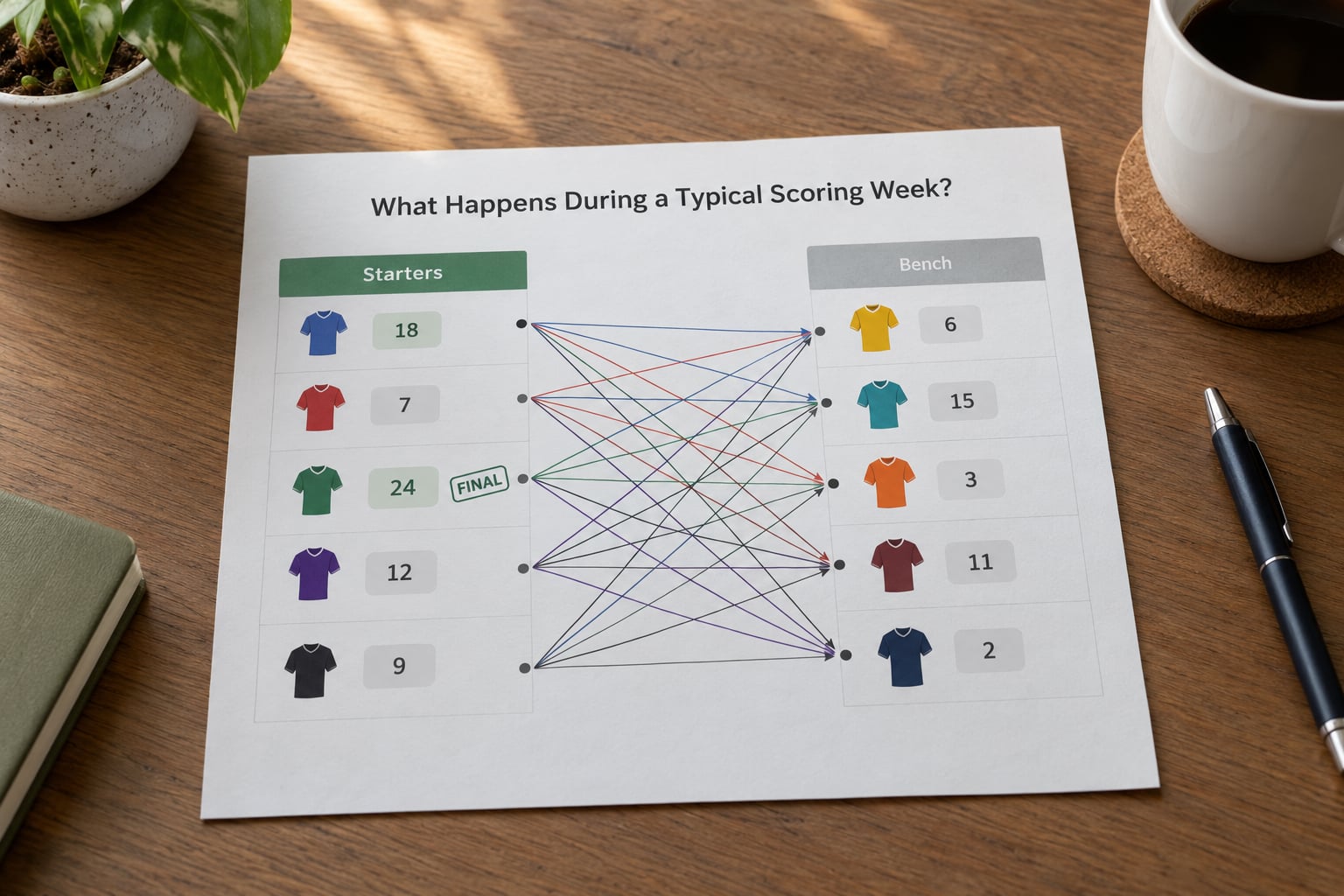
The scoring week runs on a fixed sequence: lineups lock, games finish, official stats post, and your record updates. Most of the week feels like normal fantasy football. All-play only changes the last step.
- Lineups lock. Your starters are set before the first game of the week. Bench players do not score in the standard all-play format, so an empty or thin starter slot is a real cost.
- Games finish. Nothing is scored until the slate ends, which on a Sunday-heavy schedule means Monday night or Tuesday morning for anything in play at that point.
- Stats post. The platform totals your starters’ points using your league’s individual scoring settings, then publishes a score for every team.
- Ranks are assigned. All teams are sorted from highest score to lowest. Ties share a rank.
- Records update. Wins and losses are added to every team’s season record at the same moment, so the standings never reflect partial weeks.
Corrections are the part that surprises people. Official stats get adjusted after the fact, and a scoring change anywhere in the league can move a rank. A team sitting in fourth can drop to seventh if a running back loses a fumble after the stat was first posted, and everyone below them gains a win. Most platforms let the commissioner view and accept corrected totals, so check your league’s final numbers before the next week’s waiver run.
How Each Player’s Points Are Calculated
Every manager’s weekly score comes from summing the individual points of their starters, and those individual points come from your league’s player scoring settings. The table below is one clearly labeled sample system, not a platform default, and it is the only place scoring is decided before the matchup format ever applies.
| Position | Sample scoring setting | Worked example |
|---|---|---|
| Passing | 1 point per 25 passing yards, 4 per passing TD, 2 per interception, minus 2 per fumble lost | A quarterback with 300 yards, 3 TD and 1 INT scores 12 + 12 minus 2 = 22.0 points |
| Rushing | 1 point per 10 rushing yards, 6 per rushing TD | A running back with 120 yards, 1 fumble lost and 1 TD scores 12 + 6 minus 2 = 16.0 points |
| Receiving | 1 point per reception (PPR), 10 yards per reception, 6 per TD | A wide receiver with 6 catches for 84 yards and 1 TD scores 6 + 8.4 + 6 = 20.4 points |
| Kicking | 3 per extra point, 5 per field goal, 1 per kickoff touchback | A kicker with 3 extra points and two field goals, one from 52 yards, scores 9 + 10 = 19.0 points |
| Defense | Sack 2, interception 3, safety 5, blocked kick 2, minus 3 per point allowed | A defense with 2 sacks, 1 interception and 10 points allowed scores 4 + 3 minus 3 = 4.0 points |
Whether that system is points per reception, half-PPR or non-PPR changes your draft board and it changes what a winning week looks like in all-play, but the mechanics below stay identical either way.
How All Play Scoring Is Calculated Week by Week
Take a 10-team league where your starters produce 24.3 fantasy points in week 6. Your manager finishes the week with 24.3 total points, because the score itself is what gets ranked. The number of wins follows from your finish position, not from a matchup.
| Weekly finish | Wins added | Losses added | Record that week |
|---|---|---|---|
| 1st (142.6) | 9 | 0 | 9-0 |
| 2nd (128.1) | 8 | 1 | 8-1 |
| 3rd (119.4) | 7 | 2 | 7-2 |
| 4th (110.2) | 6 | 3 | 6-3 |
| 5th (98.7) | 5 | 4 | 5-4 |
| 6th (24.3, your team) | 4 | 5 | 4-5 |
| 7th (18.7) | 3 | 6 | 3-6 |
| 8th (16.0) | 2 | 7 | 2-7 |
| 9th (11.2) | 1 | 8 | 1-8 |
| 10th (88.5) | 0 | 9 | 0-9 |
A 12-team league works the same way. The fourth-highest score of the week finishes at 8-3, which is the number that surprises new managers most often: finishing third or fourth out of twelve is still a winning week.
What Happens When a Starter Has a Zero-Point Game?
In a standard all-play league, a starter who does not play produces zero fantasy points, and zero is a real score. You are not protected from the slot. If your wide receiver is inactive, you get a big zero where a starter should have been, and every manager above you in the scoring order gains a win against you.
Two details decide whether that zero hurts as much as it sounds. First, the empty slot still costs you if your league has a minimum playing-time rule or a lineup bonus for filling every starter position. Second, if your platform supports bench players scoring in the all-play variant you chose, an inactive starter can be replaced before lineups lock, which removes the zero entirely.
Commissioners usually handle this in one of three ways. The strict option is zero points, no exceptions, which keeps the standings honest. The charitable option awards the league’s lowest starter score to any manager with an inactive starter, which reduces randomness without creating an advantage for good lineups. The third option adjusts nothing and simply expects managers to manage their bench. Pick one, write it into the league’s settings or constitution, and hold to it all season, because changing it after a bad week is what turns a league sour.
All-Play-All vs. All-Play-Any-One
The two variants differ in what you are allowed to submit and how many of your lineups score. All-play-any-one credits only your highest weekly score; all-play-all pools every lineup you submit across the season and ranks the whole pool against the field.
| Format | Which players score | Record math | Best fit |
|---|---|---|---|
| Standard weekly all-play | Starters only, one lineup per week | 9 games per week in a 10-team league | Redraft leagues that want a simple, predictable week |
| All-play-any-one | Your best lineup of the week, plus an optional percentage lineup that only scores as a bonus | Same games as standard, but you can hold a lineup in reserve | Casual leagues where managers take a week off sometimes |
| All-play-all | Every lineup you submit, ranked together | Records accumulate across a growing pool rather than one weekly score | Keeper and dynasty leagues with deep benches |
Standard all-play is the most forgiving for weekly rivalry because everyone plays the same number of games. All-play-any-one rewards flexibility and punishes managers who do not bother submitting a backup. All-play-all is the most strategic and the most confusing for a league starting from scratch, since the standings table has to show more than one row per manager.
Do Starter Bonuses Still Matter?
Yes, and the bonus settings are worth more in all-play than in head-to-head. A weekly starter bonus of 2 points for starting your best projected lineup, or a lineup bonus for filling every starting slot, adds points at the exact moment when every extra point moves you up a rank. In a 12-team league that is worth up to a quarter of a win.
The distinction to keep straight is that matchup format and individual scoring are two separate switches. All-play decides how your weekly total becomes a record. Scoring settings decide what your weekly total is. Bonuses belong to the second switch, so they are fully compatible with all-play rather than a replacement for it.
Minimum playing-time rules also stay in play. Requiring, say, 4 targets for a wide receiver to score or 60 percent of team snaps for a running back shrinks the pool of possible scorers and raises the weekly ceiling for everyone. In all-play that means fewer genuinely bad weeks, which several managers like and others find too generous.
What Are the Best All-Play Scoring Variations?
Once you know the mechanic, the useful question becomes which version to run. These are the setups that work in practice.
Four-player and six-player all-play
Small all-play leagues tighten the scoring order. In a four-team league, second place earns a 2-1 week, so one bad game costs you much more than in a twelve-team league. Six players is the sweet spot for a casual group that wants frequent standings movement without the swing factor of a large league.
All-play plus head-to-head
This hybrid gives you two records. Your all-play record adds up to nine wins or nine losses a week, then your head-to-head result against your scheduled opponent adds one more win or loss on top. A manager who finishes second in a 10-team league goes 8-1 on all-play and can finish the week at 9-1 with a win, or stay at 8-2 with a loss. It keeps the Sunday rivalry intact while softening unlucky schedules, which is why this variant keeps resurfacing in home leagues.
Weekly high-low
Only two games count: your best weekly score and your worst weekly score. It strips out the middle entirely, which rewards both a ceiling and a floor. It works well with all-play because the win total becomes enormous and the standings separate quickly.
All-play-any-one with a percentage bonus
Your top lineup scores as normal and a second lineup scores at 25 or 50 percent. Managers who take a week off still get something on the board, and the all-play-any-one option above it prevents double-dipping on the same players.
All-play combined with median scoring
Tie the season standings to the league median. A manager can post the league’s top week and still finish below the median and lose, which pushes the strategy toward consistency rather than ceiling. It is a good second-season format for a league that got too top-heavy under plain all-play.
What Are the Advantages and Disadvantages?
The main advantage is that all-play removes schedule luck from the standings. You cannot be punished for drawing the league’s best manager, and you cannot ride an easy schedule through an undefeated season built on bottom-of-the-league opponents. In a ten-team league a manager finishes the season 117 games deep, since 9 opponents a week across 13 weeks is 117 games, so a consistently strong team can post a 117-0 record.
That last fact is also a warning. Records inflate fast in the first weeks, and a manager sitting at 14-4 after two weeks is not necessarily better than someone at 12-6. Early standings in an all-play league carry very little information, which annoys managers who check them daily.
On the other side, a bad week can cost up to nine losses at once. In a total points league a bad week just lowers your total; in all-play it can drop you from first to seventh in the standings and hand every manager below you a win. Some managers also lose the weekly head-to-head drama that makes them play on Sunday night.
The last practical problem is platform support. Not every site runs all-play natively, and a commissioner whose platform lacks it has to track standings in a spreadsheet. One fantasy football community regular described the format’s real appeal plainly: not getting punished for finishing second or third in scoring and losing the week to one opponent. That is worth the bookkeeping for some groups and not worth it for others.
How Should You Set Up an All-Play League?
Decide the format before the draft, not during it. A workable order: choose the matchup variant, publish the zero-point rule, then set individual scoring, and only then talk roster size.
- Pick the matchup variant. Standard weekly all-play for a casual redraft league, all-play-any-one for a group with inconsistent participation, all-play-all or the head-to-head hybrid for keepers.
- Publish the zero-point and inactive-starter rule. Write one sentence into the league constitution and link it in the league chat.
- Set individual scoring depth. Decide between non-PPR, half-PPR and PPR, then decide whether bonuses and minimum playing-time rules are on.
- Choose roster size and flex slots. A superflex slot at running back or tight end is the single most effective change for reducing all-play zero weeks.
- Set weekly prizes. Highest score of the week, highest single-player score and best draft pick are all easy to automate and keep managers engaged through slow weeks.
- Define playoffs. Seed the top six or eight by record, note your tiebreakers in order, and decide whether a team can be eliminated.
- Confirm your platform. Sleeper offers an all-play points league type in its league settings. ESPN’s closest option is a total points league ranked by overall standing, which does not convert to a win-loss record. Yahoo and NFL.com change their settings menus between seasons, so open the league settings menu before inviting members and read what your format options actually say rather than trusting a list from a forum post.
- Plan the spreadsheet fallback. If your platform will not do it, keep one column per manager and one row per week. Record each weekly finish position, add wins as teams in the league minus finish position, and total the columns at the end of the season.
The spreadsheet version takes about ten minutes a week and removes all ambiguity if you publish the column layout up front.
Frequently Asked Questions
Do all-play starters score more than bench players?
In standard weekly all-play, only your starters score. Bench players are used for insurance, and a manager who starts a player who does not play gets zero. Some all-play-any-one and all-play-all variants let bench lineups score, so check whether your league has that switch on before you assume your bench is dead weight all season.
What happens if my starter does not play in an all-play league?
They score zero fantasy points, and that zero is ranked like any other score. Every manager above you in the weekly scoring order gains a win and you take a loss to each of them. A superflex slot at running back or tight end, plus a minimum playing-time rule, are the two settings that reduce how often a big zero shows up.
Is all-play-any-one the same as standard all-play?
No. Standard all-play uses one lineup per week and your highest score is your weekly total. All-play-any-one lets you submit a second lineup that scores at a reduced percentage as a bonus. All-play-all goes further and ranks every lineup you submit across the entire season together.
Should all-play leagues use a minimum playing-time rule?
It is worth considering, and it depends on your group. A rule such as 4 targets for a wide receiver or 60 percent of team snaps for a running back reduces random zeroes and raises the weekly scoring floor for everyone. Groups that want week-to-week volatility usually skip it, and groups that get frustrated by unlucky zeroes usually turn it on.
How do keeper and dynasty leagues handle all-play scoring?
Keepers and dynasties suit all-play-all better than standard weekly all-play, because a deep roster means many submitted lineups. The records stop being clean weekly wins and losses and become a running total across the pool. Set the pool rules and the tiebreakers in writing before your first keeper draft, since the standings table changes shape.
How many games do you play in an all-play season?
In a 10-team league you face all 9 opponents every week, so a 13-week regular season is 117 games per manager and 585 games across the league. A perfectly consistent top scorer could finish 117-0, which is why early all-play records inflate so quickly and mean so little.
Conclusion: Start With the League’s Matching Rules
Choose the matchup variant first, because it decides everything downstream. Standard weekly all-play fits a casual redraft league, all-play-any-one handles inconsistent participation, and all-play-all suits keepers and dynasties. Then write down the zero-point rule, confirm your platform supports the format, and only after that settle your player scoring settings.
What all-play buys you is a record that reflects the whole league’s weekly production instead of one scheduled opponent. That is worth the bookkeeping for most groups, and the groups that stick with it usually stop arguing about lucky schedules by week four.