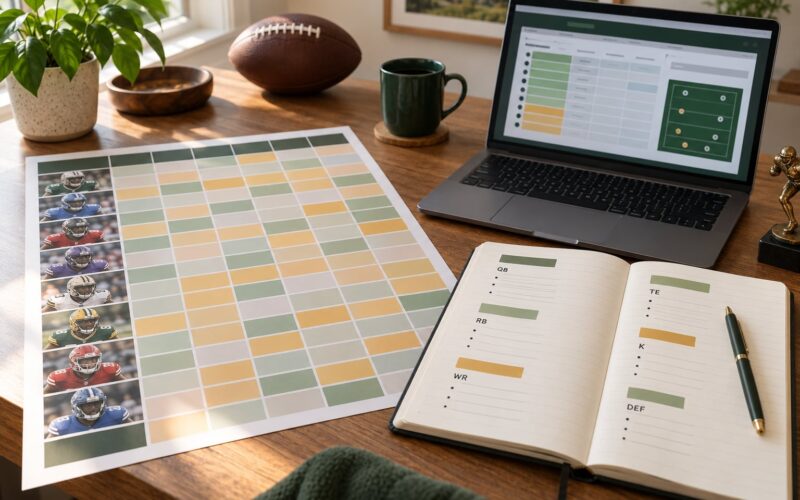
Homer bias in fantasy football is the habit of overvaluing players because they play for your favorite team, and undervaluing everybody else’s. The fix is not willpower, it is setup. Most managers who want to learn how to draft without home team bias do it the same way: they rank every player on the same measurable factors before the draft starts, then let a prepared queue make the picks.
The whole process takes maybe two hours of preparation and about ten seconds of discipline per pick. That is the honest answer to this query, and everything below is just the mechanics.
Fandom is not the problem. Letting a team logo sit next to a player’s name on a screen at 11:40pm when your pick is in four minutes is the problem.
Table of Contents
- What You Need
- Step-by-Step: How to Draft Without Home Team Bias
- 1. Set league-neutral ranking criteria
- 2. Separate player grades from personal team feelings
- 3. Build tiers instead of a rigid overall order
- 4. Draft for value and opportunity, not names
- 5. Use a bias check before every pick
- 6. Review the draft after each round
- Common Mistakes
- Frequently Asked Questions
- How do I stop rooting for my team when drafting fantasy football?
- What if my favorite player is available when I am already on the clock?
- Does playing at home actually make an NFL player more valuable in fantasy football?
- How should I handle home team bias in a dynasty league?
- What is the best way to compare two players on different teams?
- Should I avoid drafting players from my favorite team entirely?
- Conclusion: Start With a Neutral Board
What You Need

You need six things ready before your league goes live, and none of them are optional if you want a repeatable process.
A board with the logos turned off. Most drafting platforms let you switch to a text or color-only view. If yours does not, cover the team column with a strip of paper. One manager on r/fantasyfootball described letting the board pick for him and being mildly surprised he ended up with so few Vikings players, which is about the outcome you want from a bias-control system.
Your league settings, written down. Team count, scoring format, roster slots, number of keepers, and whether it is redraft or dynasty. Scoring changes everything. In a 12-team PPR league, a target share and reception volume matter far more than a goal-line vulture’s 4 rushing touchdowns; in a standard league, the reverse.
Verified notes, not vibes. A source of projections you trust, a source of depth charts, and somewhere to record injury updates. The point is to arrive with your own conclusions already written down, so nothing important gets decided in the ninety seconds before your turn.
A tier sheet. Twenty-five to thirty tiers, each holding four to six players, ordered within tier by role and upside rather than by a single global ranking.
A two-player queue. Every drafting app supports a queue. Two is deliberate: it keeps a replacement ready without handing your brain a long menu to browse at speed.
A quiet draft environment. If your league mates trash talk in the room, close the chat. Bias spikes when someone is being loud about taking your guy.
You know you are ready when you can name, without hesitating, the three players you would target at each of your first five picks and the one player you would take on your own queue at any pick inside forty. If you pause on those, keep prepping.
Step-by-Step: How to Draft Without Home Team Bias
Learning how to draft without home team bias comes down to six repeatable moves. Do them in order, once, before the draft, then execute on autopilot.
1. Set league-neutral ranking criteria
Write your criteria before you look at any player you have feelings about. Mine are: expected weekly fantasy output, role security, opportunity volume, availability, and how the player’s production interacts with my league settings. Team identity is not on the list, and neither is the player’s personality, highlight reels, or what the fanbase thinks.
Compare two players from different teams on those five factors only. Say you are choosing between a rookie running back with an established role on an offense that finishes drives inside the 20 and a second-year receiver who saw a third of his team’s targets last season. Ask which one your scoring format rewards more reliably. If your honest answer leans toward the rookie because of who he plays for, that lean is the bias, and you have just caught it before it cost you a roster spot.
2. Separate player grades from personal team feelings
For every player on your favorite team, do a three-line exercise. First, write the grade your projection source gives them. Second, write the specific concern you have, phrased as something measurable: target share below the number that sustains PPR production, a crowded depth chart, a documented hamstring issue, an age curve that drops next year. Third, write what independent consensus says about that same player.
Now compare line two with line three. If you cannot produce a measurable concern, your excitement is doing the work your analysis should be doing, and you are reaching. The fix is to give homer players one slot on a short “watch” list rather than a place in the queue.
3. Build tiers instead of a rigid overall order
A single ranked list of 200 players invites fiddling, and fiddling is where bias slips in. Tiers are more resistant because a tier is a statement about value, not about identity. Tier 1 holds the players you would take in the first two rounds no matter who they play for. Tier 8 holds guys you would take in round nine.
Tiers also handle league variance better. In a 12-team PPR league the WR cliff arrives early because twelve teams need twelve volume receivers; in a 10-team standard league running backs survive much deeper. Build the tiers to your league, then break ties inside each tier by role security and age.
4. Draft for value and opportunity, not names
At every pick, ask five questions: what is this player’s expected weekly value, how scarce is this position at my pick, is his role secure for the whole season, how confident am I in his availability, and is there someone else on the board offering similar production at a lower draft cost?
The fifth question is the anti-homer question. If you are about to take the best player from your team at pick 22 because he is the best player from your team, look for the identical archetype from another roster. Usually the difference is ten picks of roster strength, and ten picks of extra depth is exactly what you need when your second starter goes down in week 6.
Redraft and dynasty split here. In redraft, weight next season’s production and availability heavily. In dynasty, weight youth and role path, and expect your favorite team’s best young player to have a higher ADP than his current output justifies, which is precisely when value shows up.
5. Use a bias check before every pick
This is a thirty-second routine. Ask yourself three things.
Would I make this same pick if he wore a different uniform? Does my reasoning describe the player or the franchise? And is he still value at this exact pick number, given what has already gone off the board?
If the answer to the first question is no, you are not drafting, you are cheering with your roster. Go back to your tier sheet and pick the highest player in the tier you are targeting. If you cannot name the tier, you are shopping, not drafting.
6. Review the draft after each round
Record each pick the moment you make it, along with one line on why. Note the rounds where team preference moved you at all, even slightly. After every round, glance back at your tier sheet and see whether your roster matches the tiers you set.
By round three you will usually spot the pattern, and correcting it early is far cheaper than correcting it in week 5. Emotional momentum compounds: one homer pick makes the next pick easier to justify, and two make the third feel inevitable.
The post-draft audit takes twenty minutes in January. Pull your picks next to where your pre-draft sheet had them, and count how many spots you spent above the consensus ADP because of team loyalty. Most managers find two or three, and the number tells them exactly how much room they have to fix it next season.
Common Mistakes
These are the failures that show up most often in home leagues, and each one has a mechanical fix rather than a pep talk.
Overvaluing quarterbacks. If your favorite team has a young, exciting passer, you will draft him far above his ADP. Fix: set a hard ceiling at two QB slots filled and one QB on the roster, decided before the draft.
Reaching for familiar names. You know his role because you watch the team every week, which is exactly the problem, since fandom overweights narrative. Fix: no queue entries from your team until the round when your tier sheet says that tier is live.
Ignoring replacement value. A round 8 pick is worth more than a round 3 pick only if you never use the round 8 spot. Fix: measure each pick against what is still available at your next pick.
Avoiding an entire team. This is the opposite error and it is brutal. If you refuse every player on a franchise and twelve teams need a quarterback, you will be picking a backup in round four. Fix: never exclude a team, only exclude specific players you graded honestly.
Double-dipping on one team. Three players from your team is a portfolio, not a roster. Fix: cap yourself at two, and only if both graded inside your top two tiers.
Using loyalty to excuse a weak rookie or injury profile. Fix: your team gets no exemption. A player with an unclear role and an open-practice report gets graded exactly like the same profile on a rival roster.
How much bias a league can absorb depends entirely on the format, and pretending otherwise is how managers end up playing a losing game by accident.
| Format | Bias tolerance | Reason |
|---|---|---|
| Friend home league, 8 to 12 teams | High after round 10 | The social fun is part of the reason you joined; late-round favorites cost almost nothing |
| Redraft league with money on the line | Near zero from round 1 | Championship payout makes every early pick expensive |
| Dynasty startup | Low, but weighted by age | Youth premiums reward taking your team’s best prospect late, not early |
| Best ball | Near zero | There is no weekly management, so draft construction carries the whole season |
| Daily fantasy contest | Zero | Every slate is priced against thousands of other lineups |
One more tip: check keeper decisions and league settings with the same discipline you apply to picks. A keeper is often where homer bias does the most damage, because you get the player years before you would have drafted him and there is no market feedback to tell you the price was wrong.
Frequently Asked Questions
How do I stop rooting for my team when drafting fantasy football?
You do not stop rooting, you stop letting the rooting pick. Rank every player on expected production, role security, availability, and your scoring format before the draft, then let a two-player queue built from those tiers make your picks. Fandom stays in the conversation and out of the decision. Managers who use this method usually find they end up with fewer players from their team, and they rarely mind.
What if my favorite player is available when I am already on the clock?
Treat availability as neutral information rather than a reason to act. Ask whether he is in the tier you are targeting and whether his value holds at this pick number. If he is your target, take him and feel good about it. If he is a tier below where you are picking, the right move is usually the best player in your tier, because another manager who likes him less may let him slide.
Does playing at home actually make an NFL player more valuable in fantasy football?
Barely, and far less than most fans expect. Home games give a small scheduling edge in the NFL, but a home date does not reliably create more targets, more carries, or better fantasy scoring. Treat home and away as close to equivalent when ranking players, which is another good reason to turn off team colors and logos on your draft board entirely.
How should I handle home team bias in a dynasty league?
Dynasty rewards the same discipline but over a much longer window. Rank your team’s prospects on role path and age rather than on how often you watch their highlights, and expect them to be drafted earlier than their production justifies. Late-round homer picks are reasonable in startup because the cost is low. Early-round homer picks are the ones that set a roster back several years.
What is the best way to compare two players on different teams?
Score both on the same five factors: projected weekly fantasy points, opportunity volume, role security, availability, and fit with your league settings. Write the numbers in two columns and read across. If you find yourself adding an unofficial column for how much you like the team, that column is the bias, and it should not exist.
Should I avoid drafting players from my favorite team entirely?
No, and this is the most common overcorrection. Refusing a whole franchise leaves you short at positions every league needs, especially quarterback and tight end. The rule is to grade honestly and never exclude a team. You will sometimes end up with three or four of your guys, and if they were genuinely top-tier, that is a good outcome rather than a failure of discipline.
Conclusion: Start With a Neutral Board
The first action is small: open your draft platform this week, turn the team colors and logos off, and rebuild your ranking as tiers. Set your league context, write your criteria, then commit to the thirty-second bias check before every pick.
That is how to draft without home team bias, and it is enough. You can still be the loudest person in the group chat about your team on Sunday. Just let the board make the picks on Saturday.