Scouting training camp news for fantasy value comes down to one habit: sort every report into a structural change, a real position battle, a role clarification or noise, then act only on the first three. Ten focused minutes a day is enough once you know what a participation report actually tells you.
Most managers read camp wrong in one of two directions. Some treat every headline as breaking news and rebuild their boards twice a day, while others dismiss the whole month because a quarterback they dislike is throwing well in practice.
Neither approach survives contact with August. If you want a repeatable answer to how to scout training camp news for fantasy value, here is the method I use: establish a baseline, grade the source, decode the participation detail, convert it into fantasy production, then log the trend across practices before touching a lineup. It works for redraft, best ball, keeper and dynasty leagues, though the timing of when you act changes a lot between them.
Table of Contents
- What You Need
- Step-by-Step: How to Scout Training Camp News
- 1. Establish the Player’s Baseline Role
- 2. Separate Reports From Rumors
- 3. Watch for Changes in Participation
- 4. Check Whether the News Affects Fantasy Production
- 5. Compare Multiple Reports and Sources
- 6. Track the Trend Instead of One Headline
- 7. Turn Findings Into League Decisions
- Common Mistakes
- Frequently Asked Questions
- Do preseason game results matter for fantasy football?
- Does the NFL preseason record matter?
- Which rookies looking good in camp should I roster?
- How much should I react to a PUP list designation?
- Who are the most reliable sources for training camp news?
- Should I adjust my rankings now or wait until Week 1?
- Conclusion
What You Need
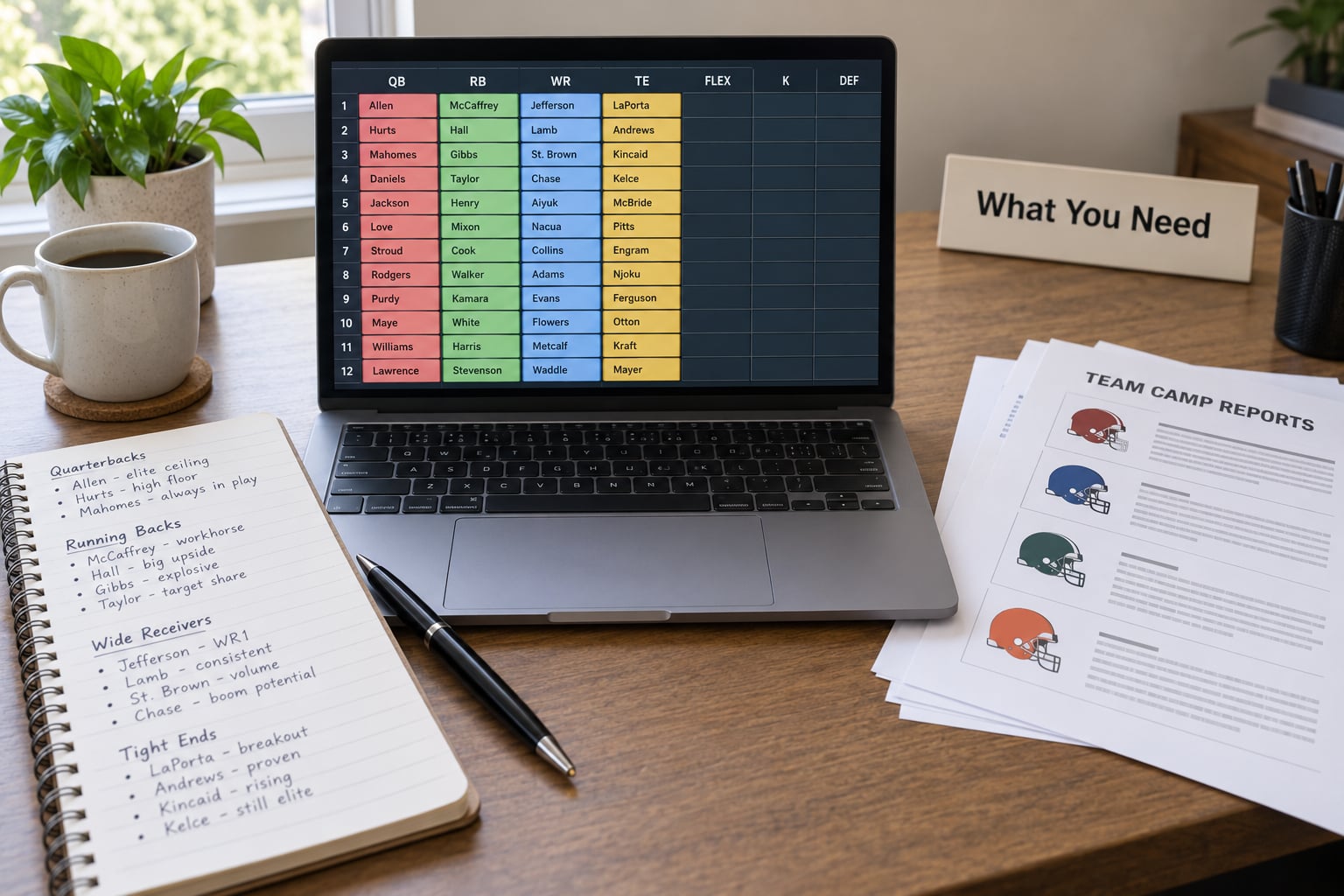
You need four things before camp news is worth anything: a baseline role for the player, a source you trust on that team, a record of what changed, and knowledge of your own league settings. Miss any one of them and the news gets filtered through guesswork.
The baseline comes from last season’s role, not last season’s points. A running back with 280 touches and a receiver with 140 targets are different players now even if their fantasy points were identical. Age curve, contract year and the team’s personnel grouping all set the floor you are measuring camp news against.
The source list is short by design. Follow two or three reporters who cover your team directly, plus one aggregator for volume. Everything else can wait. On the fantasy side of the ledger, what matters is whether your league scores rushing yards, whether you can start three receivers, and whether you play on waivers late in the season, because those settings decide how early you need to act.
Finally, keep a log. A single column with date, player, what changed and your confidence takes about a minute per entry. By week three of camp it becomes more valuable than any single reporter’s notebook, because it shows you the trend instead of the loudest take of the day.
Step-by-Step: How to Scout Training Camp News
The process below runs in order and takes roughly ten minutes per player you are actually considering. The order matters, because most bad camp decisions come from reading a report before establishing what the player’s job should be.
1. Establish the Player’s Baseline Role
Start with the role the player is expected to have, not the role his fantasy reputation implies. Projected snaps, touches, targets and goal-line work give you a fair floor before a single practice is reported.
Write the baseline down in one line: projected snaps, expected target share, expected carries, and the fantasy replacement you would happily start instead. If a camp note does not change one of those four numbers, it is commentary. If it changes one of them, it goes on your short list.
This step kills most overreactions. A player already projected for 200 carries does not become dramatically more valuable because he looked good in a red-zone drill, while a backup already projected for 40 catches becomes interesting the moment he starts taking first-team reps away from a starter.
2. Separate Reports From Rumors
Grade every report by how specific and how attributable it is. A coach naming a player, a beat writer describing reps with numbers attached and an official injury designation are evidence. A reposted photo with no context is not.
I use four tiers. Tier one is an official designation such as the injury report or a PUP placement. Tier two is a direct quote from a coach or player about a role. Tier three is a reporter’s on-the-ground observation with specifics. Tier four is anonymous sourcing, social media posts and reposts of other reporters’ work.
Tier four is not useless, but it is a lead, not a conclusion. Forum threads are good for spotting what everyone is talking about, which tells you what to check next, and weak evidence for what is true. Managers on Reddit and r/nfl threads repeatedly say the same thing: beat writers with direct team access get believed, aggregators get tolerated, and hype language without a single data point gets ignored.
3. Watch for Changes in Participation
Participation detail is the highest-value part of a camp report and the most often skipped. The words to look for are full participation, limited participation, individual work, shell drills and no participation at all.
Limited participation is not an injury signal on its own. Teams hold players back on purpose during install periods, and a veteran working through a recovery day can be limited in practice and still play a full snap count on Sunday.
Here is how I read each level:
- First-team reps in a scrimmage or team period — the clearest signal available. The coach is simulating game situations, and this is the only camp data that maps directly to Week 1.
- Full participation with a starting offensive line — confirms the player is being treated as a starter in the current install.
- Individual position work only — neutral. It can mean a new role, a rehab plan or simply that the coach wants an extra rep.
- Limited or no participation — check the injury report before drawing any conclusion, because the two often conflict for the first few days of camp.
Practice participation reports are deliberately vague about diagnosis. The designation tells you whether a player is available; the participation report tells you whether they are on the field. You need both before changing a lineup.
4. Check Whether the News Affects Fantasy Production
Role news only matters once you convert it into production. A starting job means snaps, snaps mean touches, and touches split into carries, targets, red-zone targets and goal-line carries.
Position by position, ask a different question:
- Quarterbacks — who takes the first-team reps, who gets the bulk of the two-minute and goal-line packages, and whether the offence is built around play-action or a quick pass to specific targets. Run game script matters as much as the headline.
- Running backs — early-down versus passing-down work, goal-line carries, and whether the team is using a committee or leaning on one back every week. Handcuff identification starts here.
- Wide receivers — route participation, alignment in the slot versus outside, pre-snap motion usage and whether a player is running the routes of a former No. 1 target rather than a filler role.
- Tight ends — whether the team lives in 11 personnel or 12, who is the blocker versus the receiving tight end, and whether the offence leans on play-action that requires a tight end in the flat.
Worked example: a rookie wide receiver running first-team slot routes in a team period is worth more information than a veteran receiver described as looking sharp, because slot routes usually indicate a target share the depth chart did not project.
5. Compare Multiple Reports and Sources
Corroborate before you act, but do not mistake repetition for confirmation. If four outlets publish the same line, check whether they all cite the same beat writer. One source repeated four times is still one data point.
Independent confirmation looks different: a second reporter at the same camp describing the same reps, an official designation that matches the narrative, or a coach confirming it the next day. Agreement between two people who saw separate things is a pattern. Agreement between two people relaying one tweet is a copy.
This is also where you check for the story that contradicts the noise. A popular narrative about a player losing a job often runs ahead of the beat reporter’s actual observations, and the reporters are usually the ones who were standing there.
6. Track the Trend Instead of One Headline
One practice is a sample of one. The value is in repetition, so log the change and check it against the next three practices before moving a player on your board.
A useful trend looks like: limited participation on day one, full participation for three straight days after that, first-team slot reps in two of them. That is a recovery arc and probably no roster change. A different trend — full participation every day and reps away from the incumbent in three separate periods — is a role change.
Because of this I do not trade on camp news before the second week. By then the genuinely meaningful shifts have repeated, and the reaction has not yet been fully priced into every league-mate’s board.
7. Turn Findings Into League Decisions
Camp news should change different things in different league formats, and at different times. Applying the right evidence at the wrong stage is the most common waste of good information.
In a best ball draft, camp barely matters before the draft because rosters lock at the draft and you cannot fix anything later. Use camp to avoid the two players you would hate owning: an injury with a real timeline and a quarterback who has lost the job outright.
In redraft leagues, use camp through August to finalise your cheat sheet and set waiver priorities. The player whose first-team reps moved to someone else on Tuesday is the player you will want on your waiver list in week six, not in week one.
In keeper and dynasty leagues, look at multi-year signals instead of single-season ones. A young player losing a starting job in camp to a veteran on a one-year deal is often a better dynasty asset than the narrative suggests, because the opportunity usually comes back the following year.
And in every league, wait for a second source plus a repeated pattern before changing a weekly lineup. A camp trend that never repeats was never a trend, and your Week 1 board will be better for ignoring it.
Common Mistakes
Overreacting to injury headlines is the most expensive habit in camp. A report about a player dealing with something vague on day two usually resolves before the first game. Check the official injury report twice a week, and treat participation above rumour.
Ranking anonymous reports is the second one. Unnamed sourcing is normal in August, but it carries no specifics, so it belongs in tier four. Using it to justify a trade is gambling with someone else’s information.
Ignoring context causes the errors that feel smart later. A coach praising a player after a scripted practice means less than the same coach naming a player as the starter. Context is the whole evaluation.
Confusing camp participation with production is the trap most managers fall into. Practice is short, unpadded and scripted. A quarterback who throws well in seven-on-sevens has still not demonstrated anything about his Week 1 snap count.
Failing to update projections is the quiet leak. If you note a change but never revise the projection it should have revised, you did the work for nothing. Every logged change should produce a new number for that player.
Two smaller habits are worth adding. Read at least one beat writer from a team you do not own, because league-wide value changes often come from division rivals. And keep your expectations for rookies modest, since rookie camp hype tends to peak in week one and fade by week three.
Frequently Asked Questions
Do preseason game results matter for fantasy football?
Preseason box scores matter for role, not for scoring. Focus on snap counts, target share, red-zone touches and how often a player lines up with the first-team offensive line. A starter who plays one series is a starter. A backup who plays twenty-five snaps as the clear slot receiver tells you far more than any passing line a third-string quarterback posts.
Does the NFL preseason record matter?
Almost never. Preseason records are built by coaches who are protecting players and evaluating backups, and the schedules are not balanced across the league. Teams with strong records frequently rest their best starters and teams with poor records are evaluating their backup quarterbacks. Use individual player usage, never the win-loss column, to inform your lineup.
Which rookies looking good in camp should I roster?
Roster rookies who earn first-team work in a position that has no settled starter, especially running backs and slot receivers. Rookie quarterbacks are a different case: even strong camp reports rarely translate into Week 1 production, so treat them as low-upside flyers unless a veteran is unavailable. Fade any rookie hype that comes from a practice report rather than a depth chart with a name on top.
How much should I react to a PUP list designation?
Treat the first PUP designation as a question, not an answer. Most players placed on the list at the start of camp return before Week 1, and the designation covers anything from a minor tweak to a season-ending injury. Read it alongside the practice participation report and the coach’s own language. Only a player who misses multiple weeks of participation deserves a real downgrade.
Who are the most reliable sources for training camp news?
Reporters who cover your team on the ground beat everyone, because they name coaches, count reps and can tell you whether a change repeated. National writers add context but are usually relaying team-level reporting. Aggregators are useful for speed and terrible for originals. Social accounts and forum threads are best treated as a signal about what people are talking about rather than what is true.
Should I adjust my rankings now or wait until Week 1?
Adjust the parts of your board that camp news legitimately resolves, like a lost starting job or a broken injury, and leave everything else alone until the first games are played. Use August for waiver priorities, dynasty planning and trade targets, then finalise lineups once you have seen real snaps. Rank changes made in the first week of camp are usually just reaction to volume.
Conclusion
Start tomorrow with one team and one position group. Write the baseline role for the two or three players in a battle you care about, pick the reporter covering that team, and log what changes across the next three practices.
Everything else follows from that habit. Managers who track role changes through camp usually arrive at their draft and their waiver list with the board already half-finished, and they stop paying for headlines that were never going to reach a lineup.