
A fantasy baseball points league gives every play a custom point value and adds up your total for the season, while a roto (rotisserie) league gives you points for where you rank in each statistical category. That one difference changes how you draft, who is worth owning, and how often you have to look at your roster.
Short version: points leagues reward total production volume, and rotisserie leagues reward being good at everything without being terrible at anything. Ask anyone who plays both formats and they will tell you the same thing: the same roster can win one and finish fifth in the other.
This guide breaks down how fantasy baseball points leagues differ from roto leagues across scoring, standings, roster management, and weekly strategy, plus the scoring settings that make a points league worth playing. It was updated for the 2026 season.
Table of Contents
- How Fantasy Baseball Points Leagues Differ from Roto at a Glance
- How Scoring Works in Points Leagues and Roto
- How points leagues convert a game into points
- How roto converts a season into points
- How fantasy baseball points leagues differ from roto in the scoring math
- How Standings Are Determined
- How Roster Management Changes
- How Weekly Strategy Differs
- Head-to-head is a separate axis from points versus roto
- How Player Value Is Judged
- How League Size, Budgets, and Drafts Affect the Choice
- Which Should You Choose?
- Frequently Asked Questions
- How do fantasy baseball points work for pitchers?
- How does roto scoring work in fantasy baseball?
- What is the difference between head-to-head and roto?
- Are points leagues or roto leagues better for beginners?
- Do points leagues have playoffs?
- Can you win a points league with one great player?
- What point values should a new points league use?
How Fantasy Baseball Points Leagues Differ from Roto at a Glance
| Criterion | Points League | Roto (Rotisserie) League |
|---|---|---|
| How you score | Each play converts to points at a league-set value: a home run might be 4 points, an earned run minus 1 | Each category ranks all teams, and your rank becomes points: in a 12-team league, first in home runs takes 12 points and last takes 1 |
| Typical categories | Counting stats plus some ratio stats, each with a numeric value set by the commissioner | Usually 5×5: batting average, home runs, runs batted in, stolen bases and wins or OBP, plus ERA, WHIP, strikeouts, saves and wins |
| What wins the title | Highest season-long point total | Most category rank points across the season |
| Standings movement | Totals only climb, so gaps grow slowly and games are usually decided over months | Ranks shift daily, so a single hot weekend can swing several categories |
| Roster construction | Build for volume across many stats and stack up production | Build for balance so no category collapses |
| Waiver wire priority | Highest-upside arms, bullpen churn, and pitchers about to start | Players who help a category you are losing without hurting others |
| Streaming | Limited value: a streamed player cannot fix a season total | Core strategy: stashed players can swing a weekly category matchup |
| Effect of one great player | Huge, especially a high-volume starter | Helps, but only if that player does not sink your batting average or ERA |
| Weekly time commitment | Lower, since only total accumulation matters | Higher, since standings and category targets change constantly |
| Skill expression | Projection accuracy and volume identification | Balance, category targeting, and punting well |
One row deserves emphasis before we go further. Points leagues do not have to be head-to-head, and roto leagues do not have to be season-long. Those are two separate settings, and mixing them up is the single most common confusion in this part of fantasy baseball.
How Scoring Works in Points Leagues and Roto
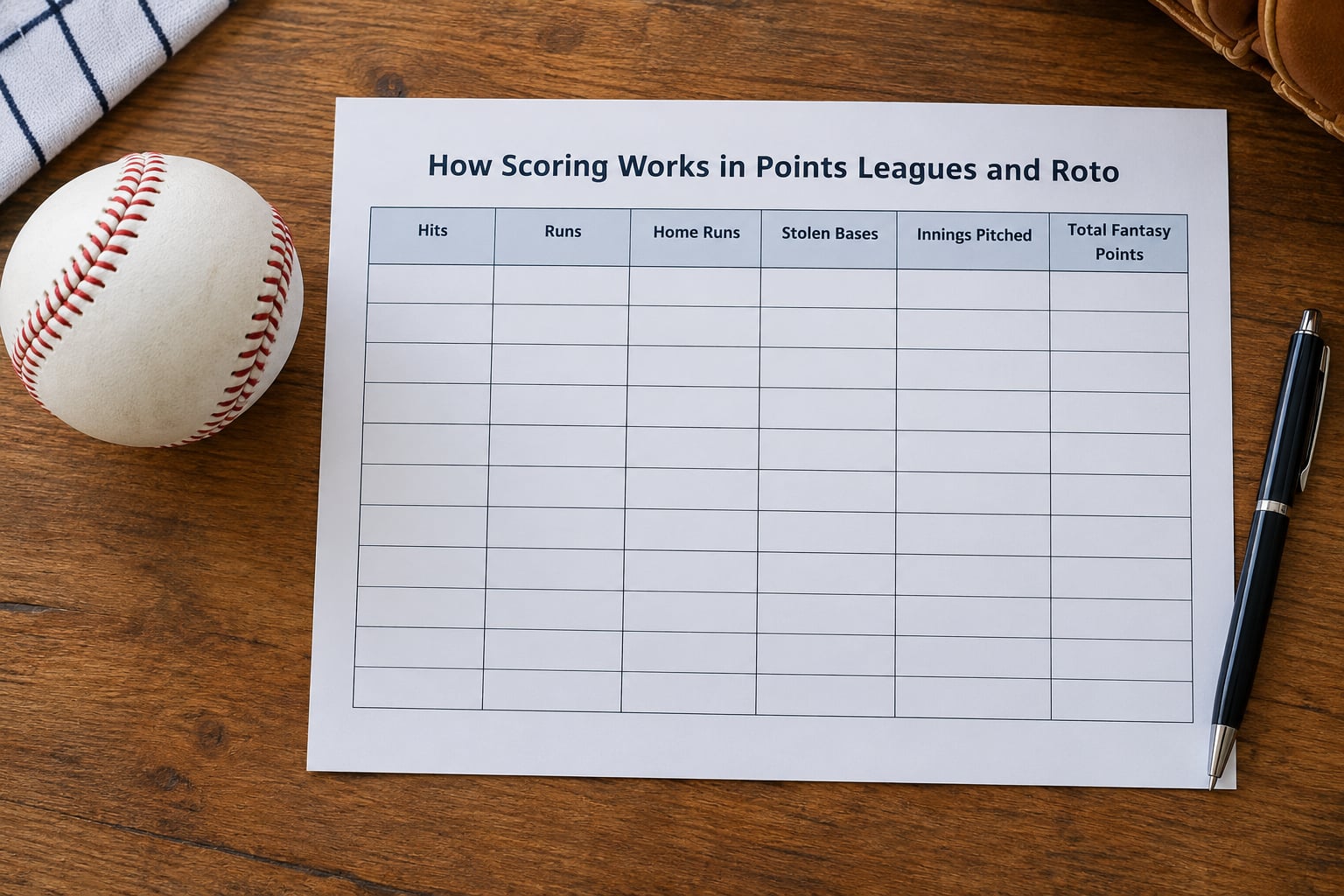
In points scoring, nothing is relative. Your leaguemate hits 40 home runs and you hit 20, and you still collect 80 points if the league values home runs at 4. In roto scoring, that same home run total is worth a rank, and rank is what pays. Last place in home runs in a 12-team league takes 1 point no matter how many you actually hit.
How points leagues convert a game into points
Each real-life event maps to a value. Single, walk, strikeout, each base stolen, each run, each home run and each out recorded on the mound all carry a number the commissioner picks in league settings. A common batting preset gives 1 point per single, 2 per double, 3 per triple, 4 per home run, 1 per run, 1 per RBI and 2 per stolen base.
The pitching side is where points leagues get their reputation. Because a starting pitcher works roughly five times as many innings as a reliever, per-inning values turn starters into the highest-scoring players on a roster. One community-maintained table circulating on r/fantasybaseball uses 1 point per inning pitched, 1 per out, 5 per win, minus 4 per loss, 8 per save, minus 1 per earned run and minus 0.5 per hit allowed. Sporting News publishes a comparable list at 1 point per single, 2 per double, and between 2.25 and 3 points per inning pitched with minus 2 per earned run.
Do the math on a starter versus a closer with a typical preset and the gap is not subtle. A starter who throws 200 innings at 3 points each, plus 12 wins at 5, minus 70 earned runs at 1, turns into roughly 750 pitcher points. A closer with 3 saves at 8 points and a clean 60-inning season has nowhere near that ceiling.
How roto converts a season into points
Rotisserie scoring ignores the raw totals except for ranking purposes. In a standard 12-team 5×5 setup, your team is ranked first through twelfth in each of ten categories, and the points are added up across all of them. Finishing first in home runs and last in batting average nets you 12 points plus 1 point: 13 out of a possible 120.
That is why balance matters so much in roto. The manager who wins five categories outright and places sixth in the other five ends up with the same 65 points as the manager who never wins a category but never sinks in one either.
How fantasy baseball points leagues differ from roto in the scoring math
Here is the same roster scored both ways, using illustrative numbers. Manager A built for points: two power hitters, a high-average shortstop, a workhorse starter and a closer. Manager B built for roto: a .300 hitter, a steals-and-on-base-percentage source, two solid five-category contributors and a mid-rotation staff.
Manager A’s roster out-produces Manager B’s almost every night and wins the points title by a wide margin. Manager B’s roster is dull, consistent and stays out of the basement in every category, which is exactly what wins a rotisserie title. Neither manager made a mistake; they were optimizing different things.
How Standings Are Determined
Points league standings are a single number per team that only moves in one direction, and that simplicity is the format’s main appeal. A manager who trails by 60 points in July knows the season is probably gone, while the manager ahead knows how to coast. Some points leagues still run a playoff structure at the end, which turns the cumulative leaderboard into a bracket, but plenty of them crown whoever finishes first.
Roto standings are ten little leaderboards stacked on top of each other. Your rank in batting average is independent of your rank in stolen bases, so a single player can lift two categories and sink a third in the same week. Standings also move in both directions, which keeps a competitive league interesting long after the standings in a points league have settled.
Ties are handled differently too. Two points teams with identical season totals usually end up sharing a rank or splitting it, and most platforms treat it as a tie rather than a win. Two roto teams with identical category rank totals get the same treatment. The difference is that ties in points tend to happen at the top rarely but in the middle of the pack often, while ties in roto are broken by single decimal places in a ratio stat.
How Roster Management Changes
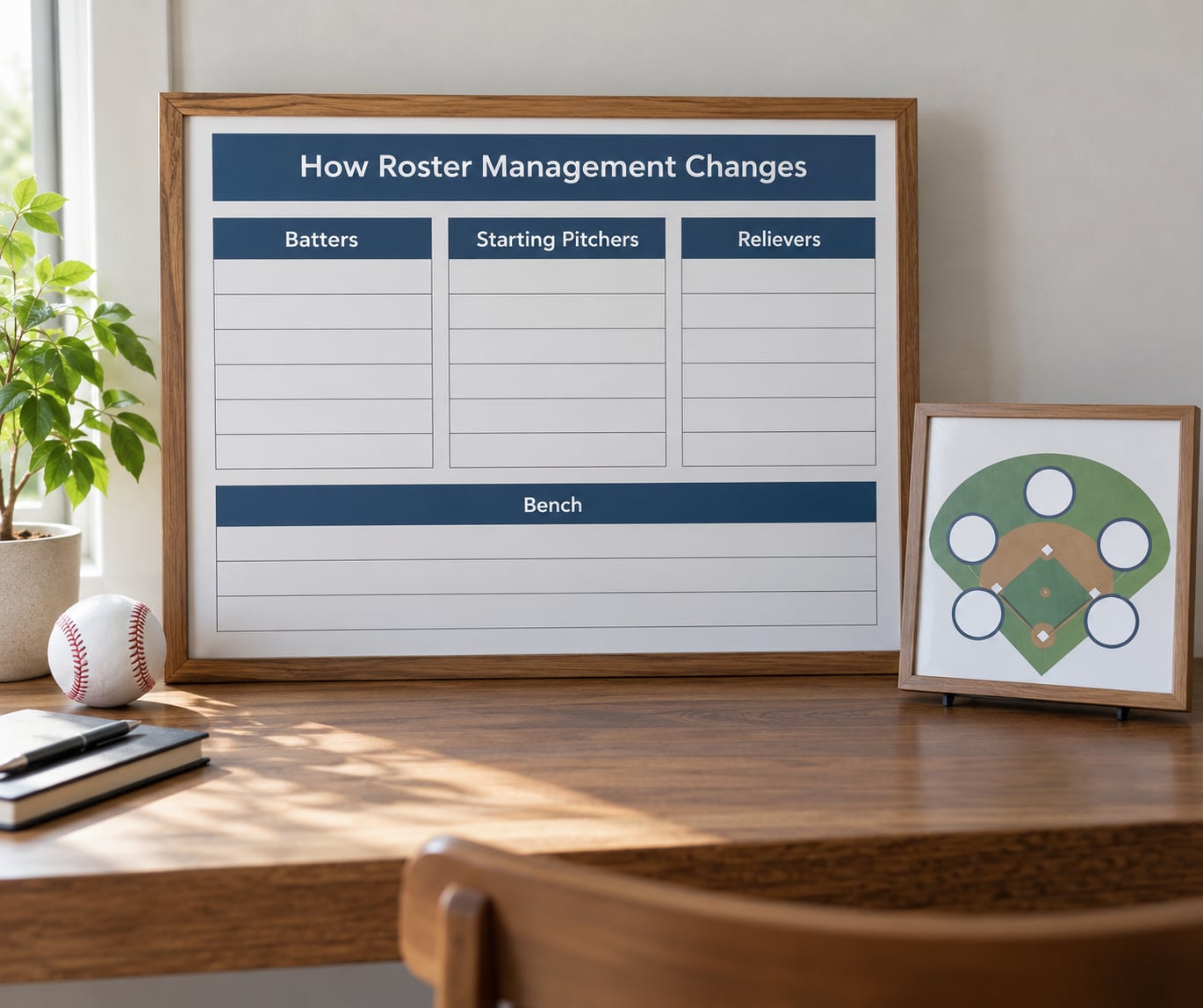
Roster management in a points league revolves around adding volume. If two players project for the same number of fantasy points, take the one with a better injury history or a clearer path to playing time, because the format does not reward the subtle differences in category quality. Bench spots exist to cover injuries and to hold players you will add at the deadline, but a streaming strategy that works in a weekly roto league will not rescue a season total.
In roto, every roster slot can damage a category. Adding a player with a poor batting average to chase home runs can cost more rank in average than the power is worth. Managers constantly track which categories they can win, which they can safely punt, and which require one more weekly pickup to close a gap of ten runs.
Pitching rotations get managed in opposite ways. A points manager wants starters projected for the most innings, so a rotation spot has enormous value at the draft table and on the waiver wire. A roto manager cares more about strikeouts and saves, so a high-whiff reliever with zero innings can be more valuable in a category league than a rotation starter with modest Ks.
That said, the day-to-day habit difference is smaller than most people expect. r/fantasybaseball managers report playing points and category leagues in the same season without burning out, because the weekly work is identical: check lineups, check the wire, set your lineup. What changes is the question you ask while you do it.
How Weekly Strategy Differs
In a points league, each week is a deposit and none of them matter much on their own. A manager streaming a pitcher on a hunch can win the week and still lose the season. The only weekly decisions with real leverage are injury management and keeping a full lineup of players who project at high weekly totals.
In roto, the week is the whole game. Stashing a southpaw against a right-handed-heavy opponent, punting a category you have no chance in, and chasing a save on a bad closer are all legitimate weekly tactics. A roto manager will trade a large weekly gain in one category for a small loss in another, as long as the net rank points go up.
Head-to-head is a separate axis from points versus roto
Plenty of explainers treat head-to-head points as the opposite of roto, and that is wrong. Head-to-head describes matchup structure: each manager is paired with another manager each week and earns a win, a loss, or a tie. Points versus roto describes the scoring method used to decide that result. The two settings are independent, which gives four common league types.
- Points, season-long. Custom point values, cumulative totals, one champion at the end.
- Points, head-to-head. Custom point values, weekly matchups, weekly records plus optional playoffs.
- Roto, season-long (categories). Rank points in each category, cumulative total, one champion.
- Roto, head-to-head (most categories). Rank points decided by weekly category sweeps, so a manager can go 5-0 in one week and still finish last.
That fourth format is the one that surprises new commissioners most. Winning six of ten categories in a week can still produce a losing week, because a roto head-to-head league is often scored best record rather than most categories won.
How Player Value Is Judged
Points leagues reward players who produce across many categories every week. A hitter who goes 2-for-4 with a home run scores in five or six different stat lines in a single game, and a pitcher who works five innings with strikeouts scores in three. Multi-category contributors hold their value because there is no scenario where their production is wasted.
Roto value is narrower and more conditional. Stolen bases are only worth acquiring if you need them, because a 30-stolen-base player usually tanks your batting average. Wins are the most debated stat in either format: in points leagues the community argues endlessly because a pitcher on a bad offense collects W points for something the pitcher did not control, and in roto the same pitcher is just one of ten ranked teams.
Role security is the other divider. A closer with a locked-in job is gold in roto for the saves category and decent in points for a smaller number of innings. A setup man with a fluctuating role can be worth more in points, where an extra two innings a week still adds raw totals, than in roto, where his saves total is a coin flip.
One practical warning from the community: most published rankings and projections are built for standard 5×5 roto. If you play points, reweight the projections yourself or you will consistently overvalue average-and-on-base-percentage hitters and undervalue high-volume arms.
How League Size, Budgets, and Drafts Affect the Choice
League size changes the calculus more than most people expect. In a 12-team roto league, ranking eleventh in a category still costs you a point, so a bad week in one category is cheap. In a 10-team roto league, the same week is more costly, which makes punt decisions sharper. Points scoring does not care about league size at all, since every team is measured against the same absolute totals.
Auction budgets interact with format too. In points, a manager who spends heavily on upside volume can still finish first if those players stay healthy. In roto, the same spend can produce a roster loaded with categories the manager cannot win, which is why experienced roto auctioneers often refuse to bid on a player whose batting average is a problem.
Keeper and dynasty leagues sharpen the split further. A kept player in points has to keep producing, but the format does not punish a prospect’s current stat line the way roto punishes a batting average. In roto, prospects are often kept for the path to playing time rather than the season they are in.
Commissioner note: switching an existing league’s format is possible on every major platform, but do it between seasons rather than mid-season. Changing scoring retroactively re-ranks history and creates arguments about whether your standings were earned under the old rules. League platforms differ here, so check your provider’s current documentation before promising members a migration. r/fantasybaseball’s league guide wiki is the reference most of these threads point back to for the four-format taxonomy.
Which Should You Choose?
Choose points if you want a clean season-long total, if you check your roster a couple of times a week rather than every day, and if you would rather identify high-volume players than manage category standings. Points leagues also forgive a manager who does not enjoy weekly category math, and the scoring settings are the most fun part to set up for a commissioner who wants something other than default 5×5.
Choose roto if you like puzzles that reset every week, if you enjoy streaming and stashing, and if you want a season where a great April still matters in September. Roto rewards careful roster balance, and a manager who avoids category collapse will beat a stronger roster that keeps getting surprised.
If you are still torn, a fair test is to look at how you lost your last league. If you lost because one prospect collapsed or your staff underperformed, points scoring reduces that variance because volume accumulates all season. If you lost because you finished eleventh in batting average in August and never recovered, roto is the format where that mistake could have been repaired week by week.
The honest answer is that both formats reward the same underlying skill, knowing what will happen before it happens. They just ask you to prove it on different scoreboards.
Frequently Asked Questions
How do fantasy baseball points work for pitchers?
Pitcher points are awarded per event, not per category rank. Each inning pitched or out recorded carries a set value, each win adds a larger chunk, and saves are usually worth the most per appearance. A starter who throws 200 innings at 3 points each plus 12 wins at 5 points can outscore a closer several times over, which is why starting pitchers dominate points drafts.
How does roto scoring work in fantasy baseball?
Roto scoring ranks your team against every other team in each statistical category, then converts that rank into points. In a 12-team 5×5 league, finishing first in home runs takes 12 category points and finishing last takes 1. Those category points are added across all ten categories, and the manager with the highest season-long total wins.
What is the difference between head-to-head and roto?
Head-to-head describes matchup structure: managers are paired weekly and earn a win, loss, or tie. Roto describes a scoring method: points come from your rank in each category. A league can be head-to-head and roto at once, or head-to-head and points at once. The two settings are independent, which produces four common league types.
Are points leagues or roto leagues better for beginners?
Points leagues are usually easier for beginners because one running total tells you where you stand, and there is no category math to track. Roto teaches more in a season, since you learn how your roster construction moves each category. A good middle path is a mixed league that scores both a points total and category standings.
Do points leagues have playoffs?
It depends on the league. Most season-long points leagues simply crown the highest cumulative total with no playoffs at all. Some head-to-head points leagues run a playoff bracket after the regular season. The key difference from roto is that points totals only accumulate, so a playoff bracket is a formality unless the commissioner resets totals at the cut.
Can you win a points league with one great player?
You can get close, but a single superstar rarely carries a points title on his own. High-volume players help enormously, especially a workhorse starter, but injuries and negative categories like earned runs drag on totals. A roster of steady multi-category producers usually finishes ahead of a roster built around one big season.
What point values should a new points league use?
Start near the community tables most managers share: 1 point per single, 2 per double, 3 per triple, 4 per home run, 1 per run, 1 per RBI, 2 per stolen base, and for pitchers 3 per inning pitched, 5 per win, 8 per save, minus 1 per earned run and minus 0.5 per hit allowed. Test the values on last season’s data before you commit.
The shortest version of all of this: points leagues measure what your roster produces, and roto leagues measure where your roster ranks. Decide which of those two questions you would rather spend a summer answering, then set your scoring settings accordingly.
If you are drafting this year, do one thing before anything else: run your intended point values against last season’s player totals. You will learn in about ten minutes whether your preset rewards the game you actually want to play, or accidentally buries the players you were about to draft.