A fantasy baseball sleeper is a player the market drafts far later than his real ceiling justifies. To find one, you fix your league settings first, then hunt for the widest gap between where a player is being taken and where his skills and role actually project him, confirm that gap with underlying numbers instead of last season’s results, and buy him at the price the board sets. The whole process takes about an hour if you have a projection set and a consensus ranking open side by side.
Most of what gets published under this query is a list of names with a draft position attached. Lists go stale in a few weeks, and they tell you nothing about how the person who made them got there. This guide is the process instead, so you can run it yourself on any draft, in any year, in any league size.
Table of Contents
- What You Need to Find Fantasy Baseball Sleepers
- Step-by-Step: Identifying High-Upside Players
- How to Find Fantasy Baseball Sleepers in a Draft: Set the Board First
- 1. Look for playing time that fantasy leagues undervalue
- 2. Separate skill improvements from noise
- 3. Find players whose profiles fit the category
- 4. Use role and opportunity forecasts to set a ceiling
- 5. Compare value with the live draft board
- 6. Make the pick using a clear decision rule
- Common Mistakes When Identifying Fantasy Baseball Sleepers
- Frequently Asked Questions
- Which position is best for finding fantasy baseball sleepers?
- How early should I target a hidden sleeper in my fantasy baseball draft?
- What statistics best reveal a fantasy baseball breakout candidate?
- How do I evaluate a minor-league hitter before his MLB call-up?
- How can I tell whether a sleeper pick is value or a fantasy bust?
- Conclusion: Build Your Sleeper List Before Draft Night
What You Need to Find Fantasy Baseball Sleepers
A fantasy baseball sleeper is a player whose projected production sits well above his average draft position, so he goes well outside the first ten to fifteen picks at his position and then returns top-of-rotation or top-of-order value at that pick. He is not the same thing as a flier, and he is not the same thing as a value pick. That distinction matters more than anything else in this guide.
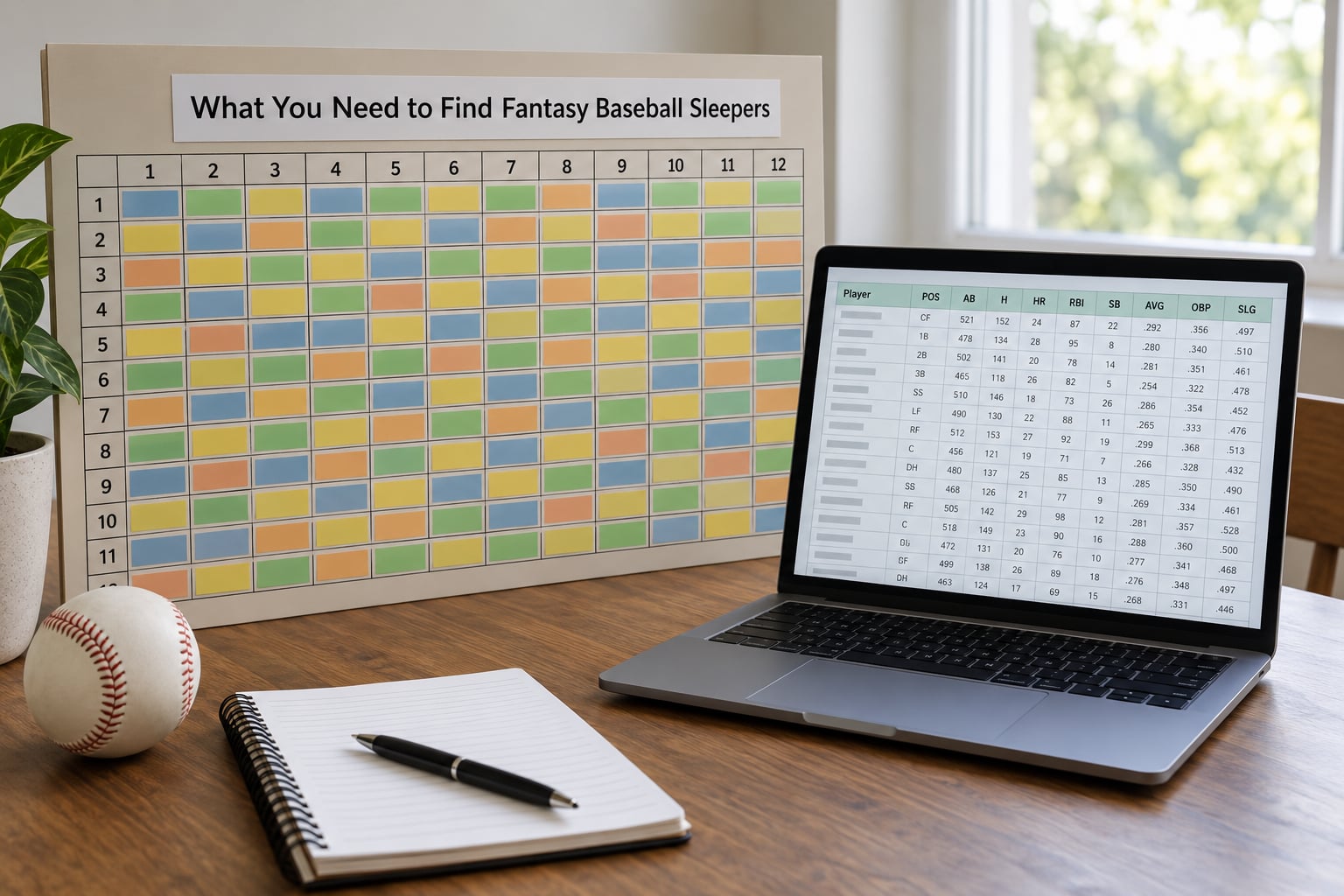
You need six inputs. League settings, because a 260th-round pick in a 12-team league is a wasted pick in a 20-team one. Your roster construction rules, meaning how many spots you have at each position and how you fill them. Batting statistics by season, at least three of them. Underlying metrics such as expected wOBA, barrel rate, launch angle and hard-hit rate for hitters, or expected FIP, strikeout rate, walk rate and pitch quality for pitchers. Minor-league reports from the levels a player is likely to arrive from. And a news feed, because role changes travel faster than projections do.
Two free tools cover most of it. A consensus site such as FantasyPros gives you average draft position and expert consensus ranking across sources. A projection site such as FanGraphs gives you the underlying numbers. Managers in the r/fantasybaseball threads keep saying the same thing: one source for the market’s opinion, one for the underlying truth, never two sources that both just repeat last year’s leaderboard.
Step-by-Step: Identifying High-Upside Players
How to Find Fantasy Baseball Sleepers in a Draft: Set the Board First
Before you screen a single player, write down your format, your league size and the pick numbers where a player becomes worthless to you. In a standard 12-team league with 12 active spots plus five bench, a pitcher drafted around pick 180 is usually a replacement-level gamble. The same pitcher at pick 90 in a 15-team league is a starter on most teams. The player did not change. Your board did.
In an NL-only or AL-only league, stretch the bands further. Half the player pool disappears, so a once-uninteresting pick in a 200 can be a starting-caliber bat. The result of this step is a written set of three numbers: the earliest ADP you consider a sleeper, the latest pick you would take one at, and the positions where you have room to be wrong. That written band is the real answer to how to find fantasy baseball sleepers in a draft, because the board decides who counts as a sleeper, not a highlight reel.
1. Look for playing time that fantasy leagues undervalue
Almost every durable breakout starts as a role question before it becomes a skill question. Look for open starting jobs, a times-at-bat change that managers have not priced in, a platoon split that has shifted in a player’s favor, a teammate whose injury frees a spot, and prospects about to be given a real at-bat every night.
My rule is that a role change needs a source, not a hunch. The best sources are a beat reporter’s note about a job competition, a club’s own transaction or roster move, and a promotable prospect whose minor-league line survives the jump to a worse league. Promotion alone is not a thesis. Promotion plus a job nobody else can hold is. When you finish, you should have a short list where every name has one written sentence explaining why his playing time goes up, and where that sentence does not rely on the word “could.”
2. Separate skill improvements from noise
Small samples lie constantly. A hitter who went four for twenty with two home runs has not improved. To separate signal from noise, watch multi-year trends instead: strikeout rate and walk rate, contact quality, expected wOBA, barrel rate, hard-hit rate, launch angle and batted-ball damage for hitters. For pitchers, expected FIP, strikeout-to-walk differential, ground-ball rate and pitch quality.
The tell is direction with a plausible cause. A hitter’s walk rate climbing while his strikeout rate falls usually tracks a swing change or a move to a line where he sees one pitch type less. A pitcher adding a pitch with real run value usually shows up in his release point and spin profile before it shows up in his results. I want roughly a full season of supporting data before I trust it, and when the evidence comes from the minors I weight a strong league more heavily than raw numbers from a weak one. The result of this step is a two-page list, not twenty names.
3. Find players whose profiles fit the category
A sleeper is only a sleeper if his profile pays in your scoring system. Speed, on-base percentage and extra-base hits dominate in a category league that rewards them. Power and durability decide weeks in a points league. Strikeouts and innings are the whole game in a quicksim league, where a single bad start can cost more than a good one gains.
Sort your two-page list by fit, not by upside. A middle infielder with no speed is not a sleeper in your league, he is a bad pick. Speed on base, a strong walk rate, or one elite category can each be enough, but only when your league pays for that specific thing every week. After this step you have a short position-specific list where every surviving name has a stated reason he fits the way you score.
4. Use role and opportunity forecasts to set a ceiling
Now convert the role thesis into a range instead of a guess. Look at projected batting-order slot, projected plate appearances, competition inside the dugout, eligibility rules that affect when a player can slot into your lineup, and workload or injury context that changes the range’s width.
Build three numbers for each candidate: a conservative floor, a median case and an upside case. Write them down before you look at the live board, because the board is genuinely persuasive in the moment. A conservative case built from the median projection is the most honest floor, and the upside case should describe what happens if the role thesis works exactly as written. If the upside case cannot be defended with a sentence, the thesis is not finished. The output is a one-line projection band per player, which is what you will actually draft from.
5. Compare value with the live draft board
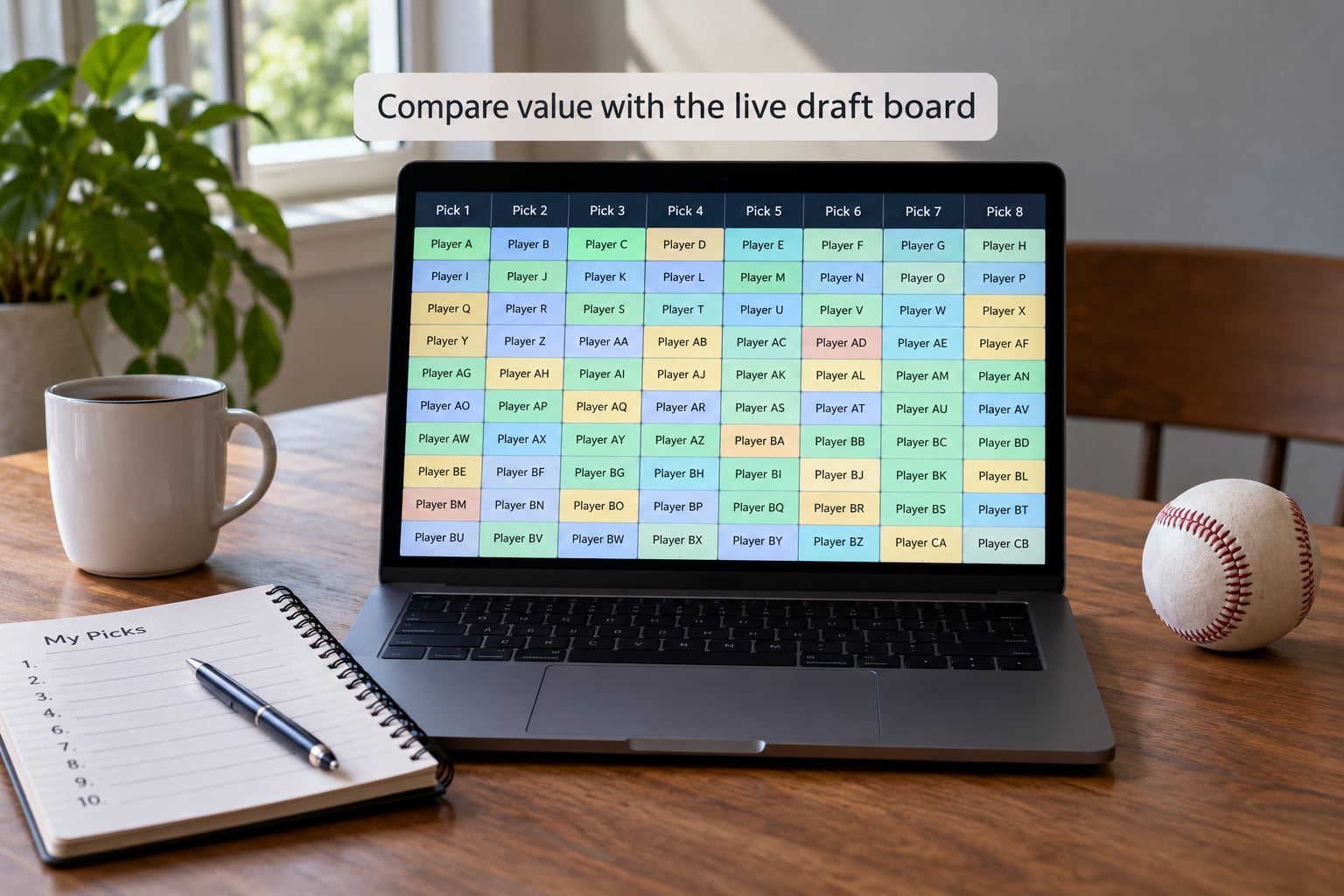
Compare each candidate’s ceiling, floor, positional scarcity, roster fit and current draft price against the players being taken at nearby picks. The useful comparison is always against what is available, not against who you wanted. If the board reaches your target and someone two rounds later still sits there, take him and move on.
Sometimes value exists only in certain formats. A high-variance bat with a great median and a lousy floor is a real pick in a points league and a bad one in a league where a bench spot is precious. A steady, low-upside starter is boring and correct in a deep league where ten teams need arms. Run a mock draft on a simulator to sanity-check the price before draft night, because a simulator will happily let you wait until round 12 for a player nobody in a real draft will wait that long for. The result is a draft board with a value tier and a reach tier kept visibly apart.
6. Make the pick using a clear decision rule
Write the rule before draft night so emotion has nothing to work with. Take the player when all six of these are true: playing-time evidence has a named source, the skill gain is repeatable and visible in underlying numbers, the profile fits how your league scores, age and workload project at least two usable seasons, the draft price is at or below your written threshold, and the players being taken ahead of him are ones you would rather have.
If four of the six are true, note the name and keep drafting. If five are true and the price is drifting early because a run of hitters just went off the board, take him right there. Every condition matters less than having written it down in advance, which is the only reason the rule works under pressure. Managers who post about their best draft picks in the fantasy baseball forums are usually the ones running a rule instead of reacting to a hot streak, and the ones who regret round three fliers are usually reacting.
Common Mistakes When Identifying Fantasy Baseball Sleepers
Treating a low average as a low ceiling. A .230 average with weak contact quality really is a bad signal, but a low batting average alone says very little about a hard-hit or barrel rate that keeps climbing. Judge the quality of contact, not the result of it.
Targeting players with no regular playing time. A roster spot is not a role. If your thesis needs 550 plate appearances and the projection gives him 300, you have a parts player, and parts players fail in ways that end your season.
Overreacting to a small sample. The correction is a time threshold you set in advance. If the skill change is visible across a meaningful stretch at-bats or a full minor-league season, it counts. Anything shorter is a note to revisit, not a pick.
Ignoring roster fit. A good player at a position you already have three of is worth less than a slightly worse one at a spot nobody wants. Count your spots before you fall in love.
Projecting a breakout role too aggressively. This is the mistake people admit to most. The fix is to write the floor as if the role thesis does not work, then check whether you would still be willing to own him at that floor.
Two habits cover most of the rest. Separate reliable sleepers from pure fliers, because readers consistently tire of advice that mixes them. And know the exit plan: a sleeper who fails in April is a waiver wire priority add, not a reason to bench someone else you spent an earlier pick on.
Frequently Asked Questions
Which position is best for finding fantasy baseball sleepers?
Starting pitcher, by a wide margin, because rotation spots are easier to project than batting-order slots and because the market treats any starter without a memorable name as interchangeable. Second base and shortstop produce the next best candidates, since defensive position caps the ceiling on a young bat and hides players with no established role yet. Catcher is usually last, since playing time is locked by the worst hitter on the roster.
How early should I target a hidden sleeper in my fantasy baseball draft?
Target him slightly before consensus, not far before it. If your threshold is the 150th pick, take him anywhere from 120 to 150, and only if the players you are passing over are ones you genuinely prefer. Reaching three rounds early to guarantee a modest gain usually costs you a round in which a bigger mistake happens. Write the threshold down, respect it, and let the board decide.
What statistics best reveal a fantasy baseball breakout candidate?
Underlying numbers over results. For hitters, expected wOBA, barrel rate, hard-hit rate and multi-year walk-to-strikeout trends. For pitchers, expected FIP, strikeout-to-walk differential, pitch quality and ground-ball rate. Track-to-track data such as release point and spin rate confirm what results have not yet shown. A candidate should improve across at least two of these before you call him a sleeper.
How do I evaluate a minor-league hitter before his MLB call-up?
Judge the level first, then the line. Numbers from a high-level league travel better than numbers from a low-level one, so adjust your expectations upward or downward accordingly. Then look at plate discipline, contact quality, and whether the player hit well against both left-handed and right-handed pitching. Finally, confirm the call-up comes with a job, not just a roster spot, since a promotion without guaranteed at-bats changes nothing.
How can I tell whether a sleeper pick is value or a fantasy bust?
Value means your upside case is reachable and your floor is playable in your format. A bust means the role thesis was the entire argument, with no supporting skill evidence underneath it. Judge the pick in mid-April, not in September: if the playing-time assumption is intact but the underlying numbers have regressed toward his baseline, the thesis was wrong. If both are holding, relax and let him finish the season.
Conclusion: Build Your Sleeper List Before Draft Night
Sleeper hunting is a process, not a list of names. Pick your league settings and write the draft positions where a sleeper is worth owning. Screen for playing time with a named source behind it. Add players whose underlying skills have genuinely improved, then cut anyone whose profile does not pay in your scoring system. Build a floor, a median and a ceiling for each survivor before draft night, and buy them at the price the board sets rather than the price your anxiety sets.
Start with the league settings today. That routine is how to find fantasy baseball sleepers in a draft season after season, and most of the work happens before the clock on draft night ever starts. Everything downstream of that first decision is faster, and the manager with the narrowest board usually wins the sleeper category of the draft.