
A fantasy football rules dispute gets settled the same way every time: pin down the exact question, find the written rule that covers it, lay out the facts on a timeline, and let that rule decide. If your league has a constitution or bylaws, the answer is almost always sitting in the text you agreed to before the season started.
The hard part isn’t finding the rule. It’s stopping the conversation from turning into a referendum on your commissioner. Most of the arguments I’ve seen blow up over three months have one thing in common: nobody wrote the disputed decision down at the time it was made, so everyone remembers it differently.
This process takes about 30 minutes for most disputes, and longer only when money is involved. It works the same whether you’re the commissioner making the call or a manager asking for one.
Table of Contents
- What You Need
- Step-by-Step: How to Settle a Fantasy Football Rules Dispute
- Pause the argument and define the exact issue
- Check the written rules and platform settings first
- Build a dated evidence timeline
- Apply the rule to the specific facts
- Propose the most neutral resolution
- Ask the commissioner for a final ruling
- Close the dispute and preserve the decision
- Common Mistakes
- Frequently Asked Questions
- Can a commissioner change a fantasy football rule during a dispute?
- Should we ask the fantasy platform to decide a league rules dispute?
- What if the league has no written rule for the situation?
- How do we settle an invalid lineup or roster dispute?
- Can league members vote to overturn a commissioner’s decision?
- When is a trade dispute a veto and when is it gamesmanship?
- Conclusion
What You Need
Gather these before you say anything about who is right. Most disputes that drag on for a week were disputes where somebody started arguing from memory.
- Your league constitution or bylaws. A shared doc, a pinned message, or a page in the league site. If you don’t have one, that’s your first problem to name out loud.
- Platform settings. Scoring format, roster spots, IR eligibility, waiver settings, trade review window, and whether settings are locked for the season.
- Transaction and scoring records. The trade screen, the waiver claim confirmation, the lineup timestamps, the scoring breakdown for any week in question.
- Messages. Screenshots of the group chat or league text, with dates visible. Keep the originals, don’t crop them.
- Commissioner guidance. Any written ruling the commissioner has issued before on anything similar.
- A written account from each side. Two or three sentences each, describing what they think happened and which rule they think applies.
Screen captures matter more than people expect. Platform setting histories and transaction logs are timestamped, which means they settle arguments that memory can’t.
Step-by-Step: How to Settle a Fantasy Football Rules Dispute
Pause the argument and define the exact issue
To settle a fantasy football rules dispute, first shrink it until it’s answerable. “This league is rigged” is not an issue you can rule on. “Does a player who was dropped and re-acquired in Week 6 keep his original draft-round keeper slot” is an issue you can rule on.
Write the question in one sentence and get both sides to agree on that sentence before you research anything. If a manager cannot restate the other side’s version of the question accurately, the real dispute is about something else, and you’ll find out faster this way.
Then sort it into one of three buckets, because each one gets decided differently. A rule violation is a clear break of a written rule. A settings change is a league operating differently than someone remembers, where no one did anything wrong. An ambiguous rule is a genuine gap in the constitution, and it gets a fix, not a verdict against a person.
Check the written rules and platform settings first
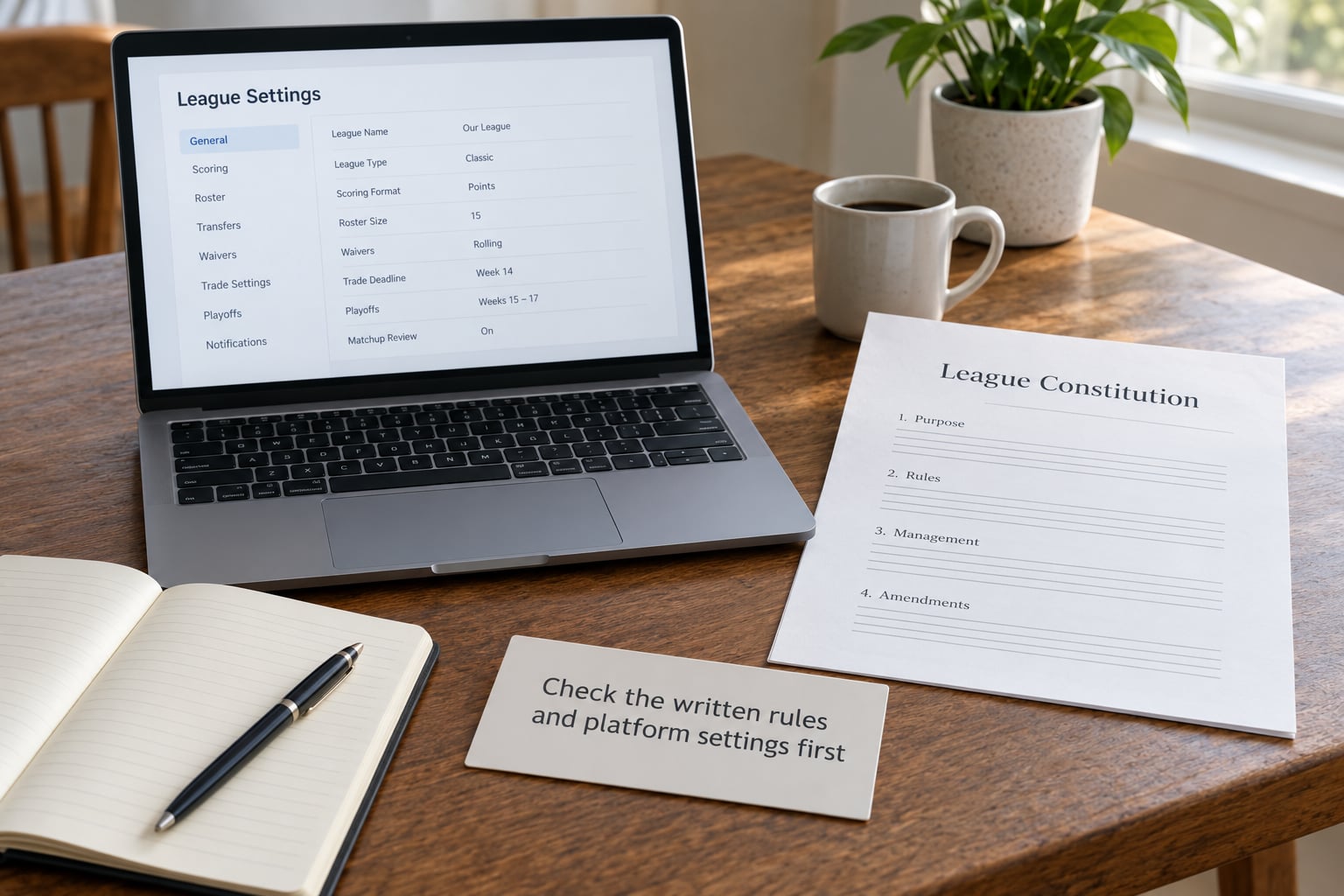
Open the constitution and read the clause the dispute actually touches, not the one that sounds most dramatic. Then open the platform’s league settings and confirm the current values: roster limits, IR slots, scoring format, trade review window, and whether the commissioner has locked settings for the year.
That last point settles a surprising number of arguments. A lot of “the commissioner changed the rules” complaints turn out to be a manager discovering a setting that was always configured that way and had simply never mattered to them.
The written agreement should control the result, not intent. If the rule text says one thing and the commissioner meant something else, the text wins for this season, and you fix the wording for next season.
Build a dated evidence timeline

Write out every relevant event with a date and time: when the trade was submitted, when the review window closed, when the commissioner announced a rule change, when the lineup was submitted, when the injury report came out. Platform timestamps fill most of these in for you.
Keep the order strictly chronological and keep the original records intact. Screenshot everything while it’s still available, because a settings screen you can no longer reach is an argument you can’t close.
Mark clearly which facts are agreed by both sides and which are contested. That single distinction does most of the work in the next step.
Apply the rule to the specific facts
Match the narrowest clause that actually applies and walk through it line by line with the timeline beside you. If the rule says a trade can be vetoed within 48 hours by a simple majority, count the votes against that exact threshold rather than a looser one you remember.
Keep two categories separate. What the platform did is a fact, fixed by transaction history. What the league decided to do about it is policy, set by the commissioner or a vote. Conflating those two is the single most common source of confusion in these arguments.
If the clause is genuinely silent or two clauses conflict, write that down plainly instead of guessing at intent. A named gap is a much stronger outcome than a ruling nobody trusts.
Propose the most neutral resolution
Start with the outcome the written rule requires. That’s the default answer, and anything else needs a stated reason.
If the rule genuinely leaves room for discretion, pick the remedy that is consistent, proportionate, and hardest to describe as favoritism. Reversing a single roster mistake, letting the trade stand but logging the warning, or running a draft lottery for the affected pick are all options. Reducing a manager’s win because the commissioner disapproved of their tactics usually is not.
Ask yourself the test question directly: if the two managers had been swapped, would I still propose this? If the answer is no, you’re not done.
Ask the commissioner for a final ruling
Send a short written case, not a long message thread. Five parts work: the disputed rule, the timeline, the evidence, the outcome you’re requesting, and a fallback if the first option isn’t available.
Give a deadline that’s real, like 48 hours, and state in advance whether silence counts as approval. A commissioner who doesn’t respond by the deadline is easier to hold to a written standard than one who simply never got around to it.
If the commissioner is personally involved in the dispute, they should step back and let the league decide. If nobody else will take it, that’s a governance gap worth fixing before next season.
Close the dispute and preserve the decision
Post the ruling in the league chat with three things: the rule that was applied, the facts it was applied to, and the outcome. Explain the reasoning, not just the verdict, because a reasoning-free ruling gets relitigated the next time something similar happens.
Log the decision with a date, the rule cited, the outcome, and the precedent it sets. Then make the correction, whatever that looks like: adjusting a score, reversing a roster move, or amending a trade.
Finally, patch the rule. If it was ambiguous, rewrite the clause in plain language while the memory is fresh, and get the league to agree to the new wording before the next deadline.
Common Mistakes
Arguing from memory. Someone remembers the rules conversation from draft night. The constitution is right there. When the two conflict, the document wins, and anyone relying on recollection is guessing.
Interpreting a rule so it changes retroactively. A ruling that would have been wrong last Tuesday isn’t made right by applying it this week. If the rule was ambiguous for part of the season, deal with the affected games explicitly rather than pretending the ambiguity never existed.
Mixing emotions with evidence. “The league should know what he did in Week 4” is not evidence of anything. Strip the timeline down to dates, timestamps, and screen captures, and let the rule do the work.
Treating platform support as the arbiter. Support can confirm what the settings are and whether a trade fell inside the review window. They will not tell you whether your league constitution permits a veto, and they have no view on fairness.
Letting an informal opinion become precedent. A casual “yeah, that’s fine” in a group chat is not a ruling. Anything that changes how the league operates should be written down, even if it’s short.
A few habits prevent most of this. Post settings screenshots at the start of every season so nobody is guessing in Week 9. Require that any change to a rule be posted in the league chat and acknowledged, not announced in a side conversation. Publish your tiebreaker order in a fixed hierarchy, so playoff arguments never turn into opinion exchanges. And keep a single ruling log where every past decision lives.
Frequently Asked Questions
Can a commissioner change a fantasy football rule during a dispute?
Usually not mid-dispute, and most constitutions say so explicitly. The common structure allows rule changes for the next season, or by a league vote with notice. A change announced while a dispute about that same rule is open is the hardest to defend, because it looks like the outcome shaped the rule. If your constitution is silent, treat the change as a proposal, take a vote, and let the dispute be decided under the rule that existed when the disputed action happened.
Should we ask the fantasy platform to decide a league rules dispute?
No. Platform support confirms facts like current settings, roster limits, and whether a trade cleared the review window, and that is genuinely useful. They do not interpret your league constitution and will not rule on fairness, vetoes, or intent. Use them as a source of timestamps and configuration data, then apply your own written rules to those facts yourself.
What if the league has no written rule for the situation?
Say so out loud instead of improvising. Ruling on an unwritten situation creates a precedent nobody agreed to, which is how inconsistent enforcement starts. The right move is to resolve the immediate case as fairly as you can, log the decision, then write the missing rule and get the league to approve it before it matters again. Managers who want leverage in that moment should collect evidence now while the timeline is still clear.
How do we settle an invalid lineup or roster dispute?
Work from timestamps, not from claims. The platform’s lineup lock time, the transaction log for the add or drop, and the current roster state together show what actually happened. Apply the rule your constitution sets for invalid lineups, which usually means the affected player scores zero, and check whether the rule includes a grace period before the lock. Then log the ruling so the next occurrence is automatic rather than contested.
Can league members vote to overturn a commissioner’s decision?
Only if your constitution says so, and that clause should name the threshold, who counts as a member in good standing, and what happens on a tie. A simple majority of all members is the easiest to run; a two-thirds threshold is harder to overturn and works better for rule changes than for single disputes. If your league has no voting clause, the commissioner’s decision stands until you add one, so build it in before the next argument.
When is a trade dispute a veto and when is it gamesmanship?
A veto is a formal mechanism your constitution has to authorize, usually requiring a vote inside a defined review window. An accusation of collusion is a different matter entirely and is never grounds for a veto on its own; it needs evidence of an illegitimate arrangement between managers. A lopsided but legal trade is gamesmanship, not cheating, and most constitutions give you no remedy for it unless they include a fair-trade rule. Write that clause before someone needs it.
Conclusion
Write down the exact disputed action in one sentence, locate the clause that governs it, and assemble a dated timeline before you ask anyone to decide anything. That order is what keeps a disagreement from turning into a season-long grudge, whether you’re making the call or asking for one.