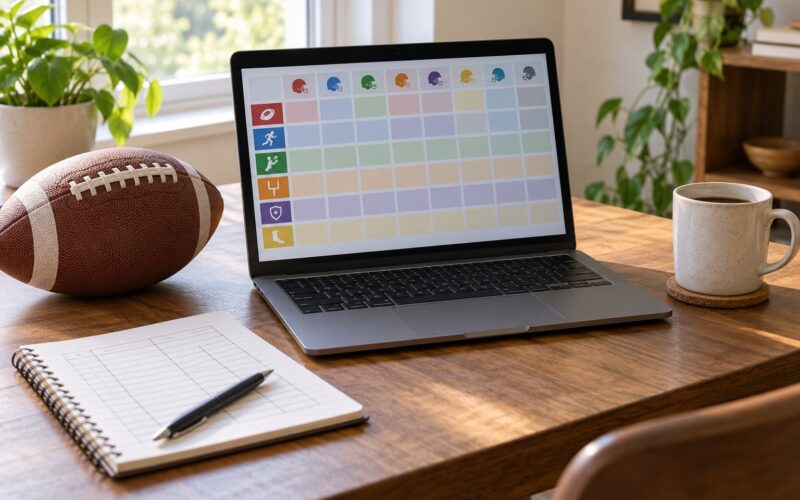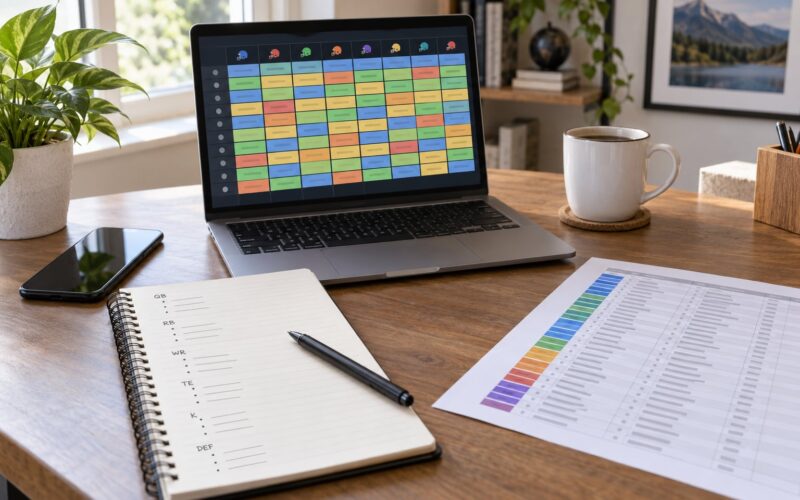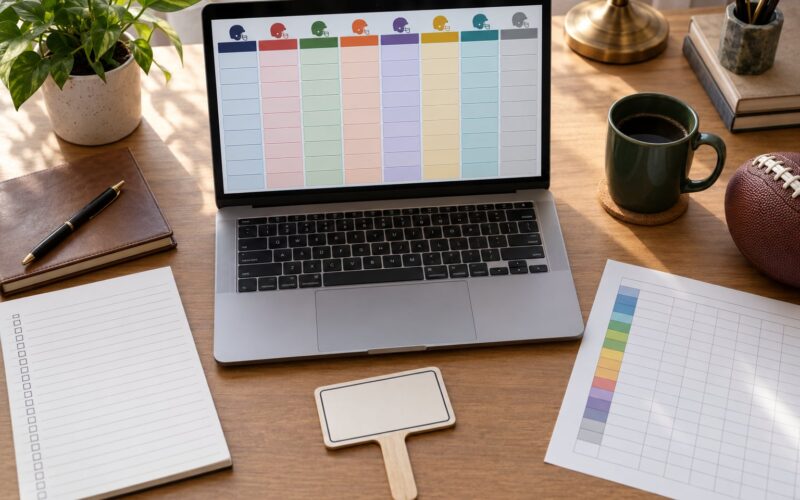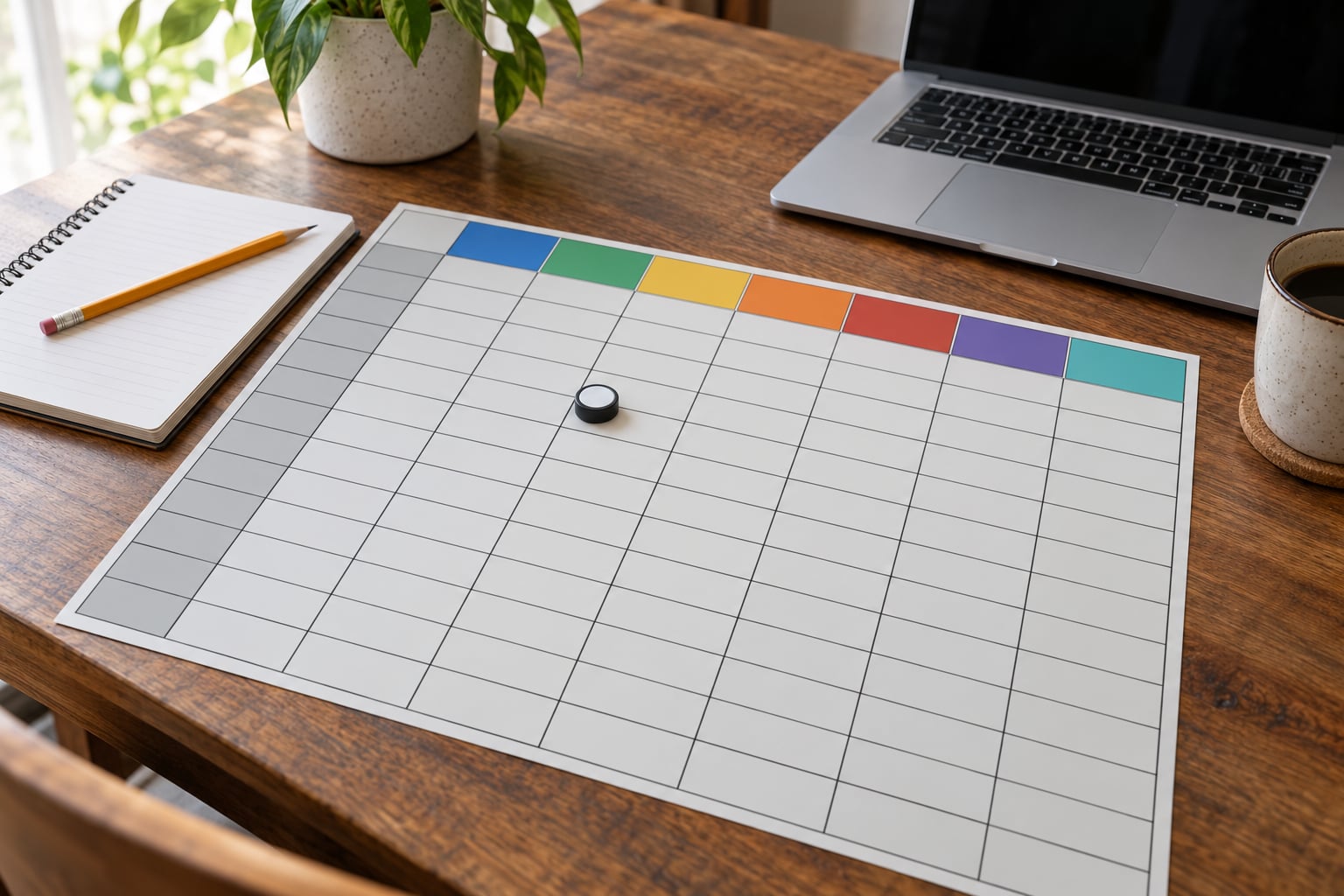
A fantasy football draft board is the shared record of your in-person draft: a grid where every column is a team and every row is a round, and each cell holds the player that team took in that round. Using one well means everyone can see what is gone, nobody duplicates a pick, and you keep a portable copy of the draft after the stickers come down.
The hard part is not buying a board. It is running the same five-beat routine on every pick without losing your place when the direction of the draft flips in round two. This guide walks through that routine, what to bring, and what to do when the board and the laptop disagree.
I have run drafts where the board was a poster on a fridge and drafts where a laptop fed a TV in the living room. The mechanics are identical: the board is the source of truth, the league platform is the archive.
Table of Contents
- What You Need
- Step-by-Step: How to Use a Draft Board at an In-Person Draft
- 1. Set Up the Board Before the In-Person Draft Starts
- 2. Know What Each Draft Position Means
- 3. Keep the Board Updated After Every Pick
- 4. Use Tiers, Not Just Rankings
- 5. Track Position Runs and Value
- 6. Make a Quick Pick Decision
- 7. Use a Backup System for Late Rounds
- Common Mistakes
- Frequently Asked Questions
- Do I need a draft board if my league already runs on ESPN, Sleeper, or Yahoo?
- Is a paper draft board better than a digital one?
- How do I handle a position run without panicking?
- What do I do if someone picks a player who is already drafted?
- Should I change my player rankings during the draft?
- Conclusion
What You Need
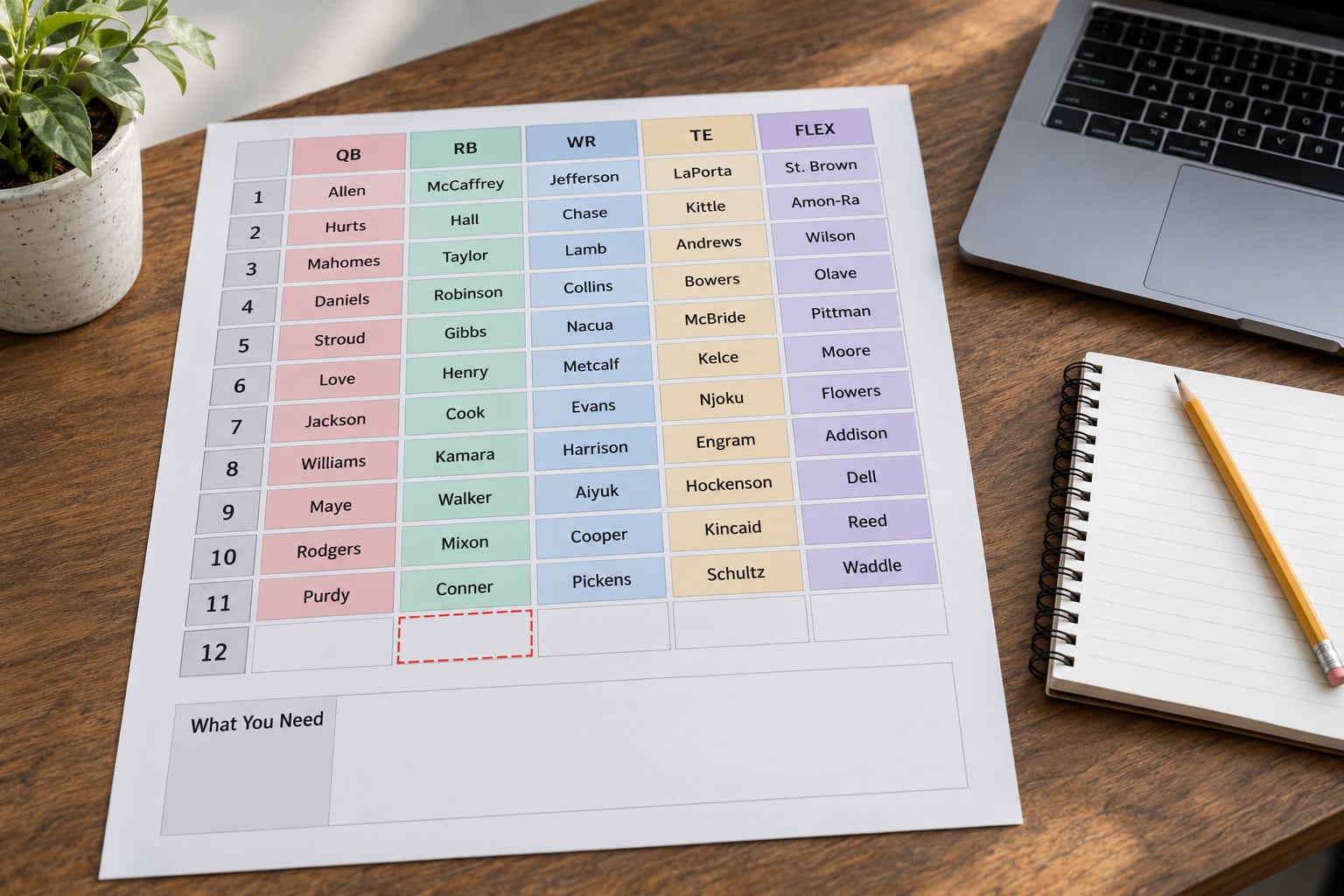
Assemble the kit a day early. Rushing setup is how drafts lose their first ten minutes to nothing.
- A board that matches your league. Count teams and rounds first. A 12-team redraft league running 16 rounds needs a grid with 12 columns and 16 rows. Buying a 10-team board and squeezing two columns in is where drafts go sideways.
- Player stickers or a dry-erase marker. Sticker kits usually ship with one label per slot, so buy for teams multiplied by rounds. A 12-team, 16-round league needs 192 labels; round up and keep the extras in a bowl, because running out mid-round is a real problem.
- A printed player list. One per manager, sorted by position, plus one master copy. Owners need their own paper so they are not leaning across the table reading upside down.
- A clean copy of your league settings. Roster positions, scoring format, number of bench slots, keeper rules, number of dynamic players if you use them.
- A timer. A phone with a two-minute countdown works for most rooms. Some hosts skip the timer entirely and just call picks on the honor system.
- Roster sheets. One per team so owners can track what they already own and what their needs are.
- A backup tracking method. A laptop running your league platform, or at minimum a numbered sheet where every pick gets written down in order. This is what saves you when the board is unreadable from the back row.
Step-by-Step: How to Use a Draft Board at an In-Person Draft
The board is easy once you separate two jobs: recording picks and making picks. Recording is mechanical and belongs to the commissioner or a designated spotter. Making picks belongs to the owner on the clock. Blurring those two is how drafts stall.
1. Set Up the Board Before the In-Person Draft Starts
Before anyone walks in, fill in the parts that never change: team names across the top, and the draft order underneath them. Write the order out rather than assuming the platform will handle it, because on a physical board nobody can see the platform.
Then count the players you actually have. Walk the grid cell by cell and confirm every column and every row exists and nothing is printed twice. A missing cell in round nine at 10pm is an argument you do not want to have.
Mark the current pick before the draft starts, and mark it with something you can see from a chair. A big arrow or a magnet on the team column is enough.
2. Know What Each Draft Position Means
Draft position is not just a slot number. It tells you which players will still be available when you pick and how long you will wait between turns.
In a snake draft with 12 teams, pick 1 and pick 12 both wait roughly eleven selections between turns, so those owners are usually drafting from the top of their board. Pick 6 gets a mid-round queue twice per draft. In a linear draft, everyone waits the same span between picks and the only advantage is order, which makes early picks far less valuable.
Map that back to your roster. If your league starts 16 players, the last pick in a snake draft lands around the 180th selection overall, which means your first two picks behave like mid-round picks for most managers. Write your expected wait times on your roster sheet before the draft and draft accordingly.
3. Keep the Board Updated After Every Pick
Use the same five steps every time, in this order:
- The commissioner calls the team on the clock.
- The owner calls the player name out loud.
- Check that the player is still available on the board or the master list.
- Place the sticker, or write the name, in that team’s column on that round’s row.
- Mark the player as taken by striking the name from the list, and enter the pick into the league platform.
Read step three back, every time. That is the pause that prevents a duplicate pick, which is the single thing owners worry about most at a live draft.
Snake drafts also mean the next slot moves in the opposite direction. Round one goes left to right, round two goes right to left. Point at the next column before you announce it, so you never leave six managers staring at a board that has silently stopped advancing.
4. Use Tiers, Not Just Rankings
A ranked list of 200 names tells you who is better. It does not tell you who is still available when your turn comes. Tiering solves that.
Group players into tiers of roughly eight to twelve names where the players inside a tier are near equals. Tier one might hold five quarterbacks, tier two the next six, tier three the next eight. When half a tier is gone, your pick moves down a tier, and the drop-off between tiers tells you where value disappears.
Write your tiers on the back of your list or in a column on your roster sheet, then cross off players as they go. Your tiers shrink in real time, and the player you want at pick 60 is the top name left in the tier you flagged at pick 30.
5. Track Position Runs and Value
Position runs are real, and chasing them is how you end up with four tight ends. Notice the run, then ask whether it creates a shortage you can profit from elsewhere.
Say three running backs go off the board in a span of six picks. Options: take the fourth back yourself if your roster needs it and the price is right, pivot to the best receiver on the board, or wait and take a receiver two picks later at a better price. What you should not do is reach two spots up the board for a fifth receiver because the room got nervous.
Scarcity is the useful signal. A position run makes the next player at that position expensive, which makes other players at similar projected value cheap. Value plus scarcity, not nerves, should drive the pick.
6. Make a Quick Pick Decision
When the clock is running, use a fixed sequence so you do not stall:
- Find the best player still available for your roster.
- Compare him against the position you actually need most.
- Check scarcity at that position.
- Confirm the pick on the board and the master list.
- Call it before the timer expires.
If two players are within a rounding error of each other on your sheet, take the one your league values more. That is the whole decision. Live drafts reward people who commit, not people who deliberate for ninety seconds on pick 34.
7. Use a Backup System for Late Rounds
Rounds ten and onward are where boards fail. Stickers run out, the dry-erase grid smears, and nobody can read a name written on a laptop lid from three feet away.
Keep a numbered pick log. Every selection goes on it as teams multiplied by rounds, in order: pick number, team, player. From round nine onward, read from the log instead of squinting at the board, and keep the board current in batches rather than pick by pick.
Also keep one offline copy of your player list. If the wifi drops, a phone hotspot, or the laptop dies mid-draft, you can still run the last two rounds on paper. And put a break in the schedule around round eight, before the board starts to smudge and attention starts to drift.
Common Mistakes
Trusting rankings you did not refresh. Preseason projections from months ago are not your board on draft night. Fix: update your list in the week of the draft, then print it and stop looking at news during the draft.
Ignoring scarcity. You take the best player on the sheet every round and end up without a tight end or a second wide receiver. Fix: before each pick, note which positions on your roster sheet are empty and check the board for who is left there.
Forgetting to mark a player as taken. The name stays on the list and gets called twice. Fix: strike every player off the master list the moment the sticker goes on the board, before the next team is announced.
Changing strategy because of one run. Three wide receivers go in a row and suddenly everyone is drafting receivers, including you. Fix: notice the run, price the next receiver, and only pivot if your own roster value says to.
Using a board that does not match your league settings. The board has 12 columns and the league has 14 teams, or the board’s rows stop at round 14 in a 16-round league. Fix: recount teams and rounds against your settings before anyone arrives.
Letting the commissioner pick and record at the same time. That is how the current pick gets skipped and how a sticker lands in the wrong column. Fix: split the jobs, or pause the draft until the record is fixed.
Under clock pressure, one habit prevents most of this: after every pick, put a finger on the next column and say the team name before you speak. It takes two seconds and it keeps the board moving.
Frequently Asked Questions
Do I need a draft board if my league already runs on ESPN, Sleeper, or Yahoo?
No, but most leagues that go in person use both. The league platform is the official record that produces your standings and stats, and the board is what everyone in the room can see. Owners often use a physical board for the theater and a laptop as the shared record, with the commissioner entering each pick. The board prevents duplicate picks and stops arguments about whether someone already took a player.
Is a paper draft board better than a digital one?
Paper wins for atmosphere and fails on readability, since owners in the back row cannot see small sticker text. A digital board projected on a TV solves that and adds timers, search, and stat lookups, but needs power, wifi, and a laptop. Many leagues run both: the board for the room, the laptop as the record. Magnetic boards sit between the two, faster to update and easy to reset.
How do I handle a position run without panicking?
Let it happen and price it. Note which positions are going off the board and how fast, then decide whether you want the next player at that position or whether the run has made everyone else cheaper. Taking a player two spots above your slot just because others are panicking is how rosters get lopsided. Judge the run by scarcity and your own roster needs, not by how loud the room gets.
What do I do if someone picks a player who is already drafted?
Stop the draft before the next pick is called. Confirm the player was already on the board or the master list, then have the commissioner correct the record: remove the second selection from the league platform and fix the board cell. Announce the correction out loud so nobody carries it forward. If the pick is reversed officially, note who took the player originally and record it properly before resuming.
Should I change my player rankings during the draft?
Mostly no. Live injury news and last-minute lineup changes happen, but re-ranking an entire board mid-draft costs more time than it gains. Adjust only for news that directly affects a player you are likely to take, and note the change on your sheet so you stay consistent. Consistency matters most in the late rounds, where the board is hard to read and you are relying on the list you brought to the table.
Conclusion
Start with the setup, not the strategy: count your teams and rounds, label the grid, write the draft order across the top, and confirm every cell exists before anyone arrives. Then run the same routine on every pick: call the team, call the player, confirm the player is still available, mark the board, and enter it into the league platform.
If you take one thing from this guide, take the habit of reading back the next column after every pick. That single pause is what keeps a draft board accurate, and knowing how to use a draft board at an in-person draft well comes down to a record everyone trusts.