The NFL schedule release hands you every regular-season date at once, and that single document is enough to map bye weeks, spot the easiest opponent runs, and find the players your league’s playoff weeks actually reward. Most managers glance at it for a day and lose the rest. Spend two focused sessions on it and you can build a draft board that is already schedule-aware before your league even drafts.
The work breaks into a simple order: read the dates, build the bye grid, translate opponent strength into fantasy points rather than win-loss records, then narrow everything to the four weeks your league scores. Do those four things in that sequence and the schedule stops being trivia and starts being a decision tool.
Table of Contents
- What You Need
- Build a bye grid before anything else
- Step-by-Step
- Step 1: Confirm when the release lands and what you can still change
- Step 2: Build the bye grid before you look at any player
- Step 3: Convert opponent strength into fantasy points, not win totals
- Step 4: Map the playoff window your league actually uses
- Step 5: Turn the schedule into ranked board edits
- Common Mistakes
- Frequently Asked Questions
- When is the NFL schedule released, and when can I draft fantasy football?
- How do bye weeks work in fantasy football?
- How do I read a strength of schedule chart for fantasy football?
- Should I drop my kicker or defense during a bye week?
- Is an early bye week better than a late one?
- Should I weight the schedule more than player talent in my rankings?
What You Need
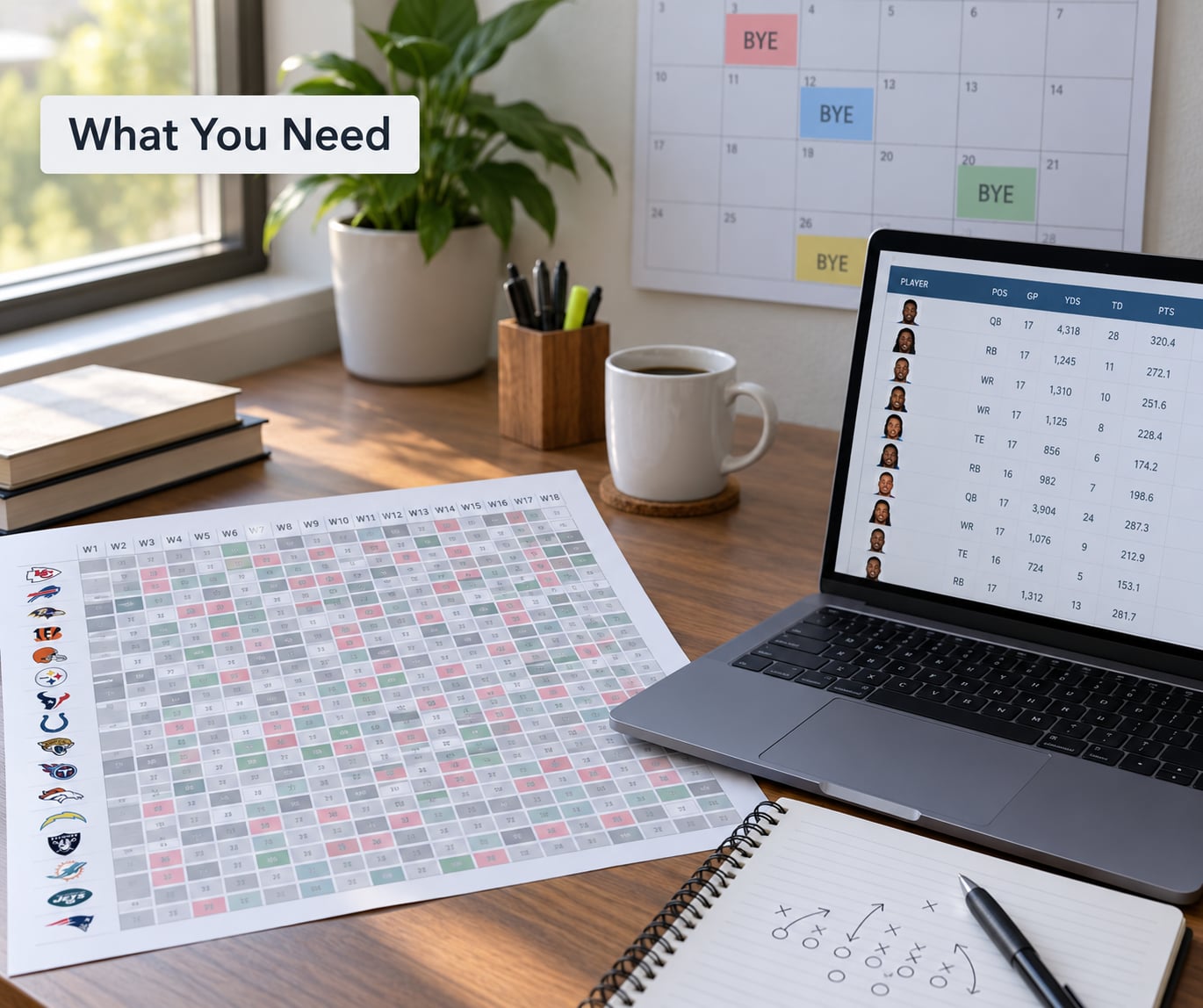
Start with the official release itself, not a screenshot from an aggregator. The league office publishes dates, kickoff times and broadcast partners for all 272 regular-season games, and those broadcast windows matter later when you are deciding kickers and defenses. Most major fantasy sites re-publish the same data within hours, so either source works as long as it is complete.
Next, your own league settings. The number of playoff weeks decides which NFL weeks matter, and a four-week playoff starting in week 14 uses a completely different slice of the schedule than a three-week playoff starting in week 15. Write those settings down before you look at a single player.
Build a bye grid before anything else
Thirty-two teams share eight bye weeks spread across weeks 5 through 14, with four teams off in most weeks and two in the final two. Map them onto a single page so you can see which of your own players are dark at the same time. Managers get into trouble when three of their projected starters share one week, and that problem is fully visible in the release.
You also need an opponent-adjusted projection source, meaning a tool that shows how many fantasy points each defense has allowed at each position rather than how many games the opposing team has won. A 9-7 team with a great pass rush can be tougher on quarterbacks than a 3-14 team that blitzes nothing.
Then gather player game logs from at least the prior season, a note on every team’s offensive line and coordinator changes, and an empty document for your draft board. The notes matter as much as the numbers. A schedule that looks soft means nothing if the player no longer touches the ball.
Finally, put your bye week dates into your phone or desktop calendar the same day. Manual entry takes ten minutes and it removes the single most avoidable zero week of the season.
Step-by-Step
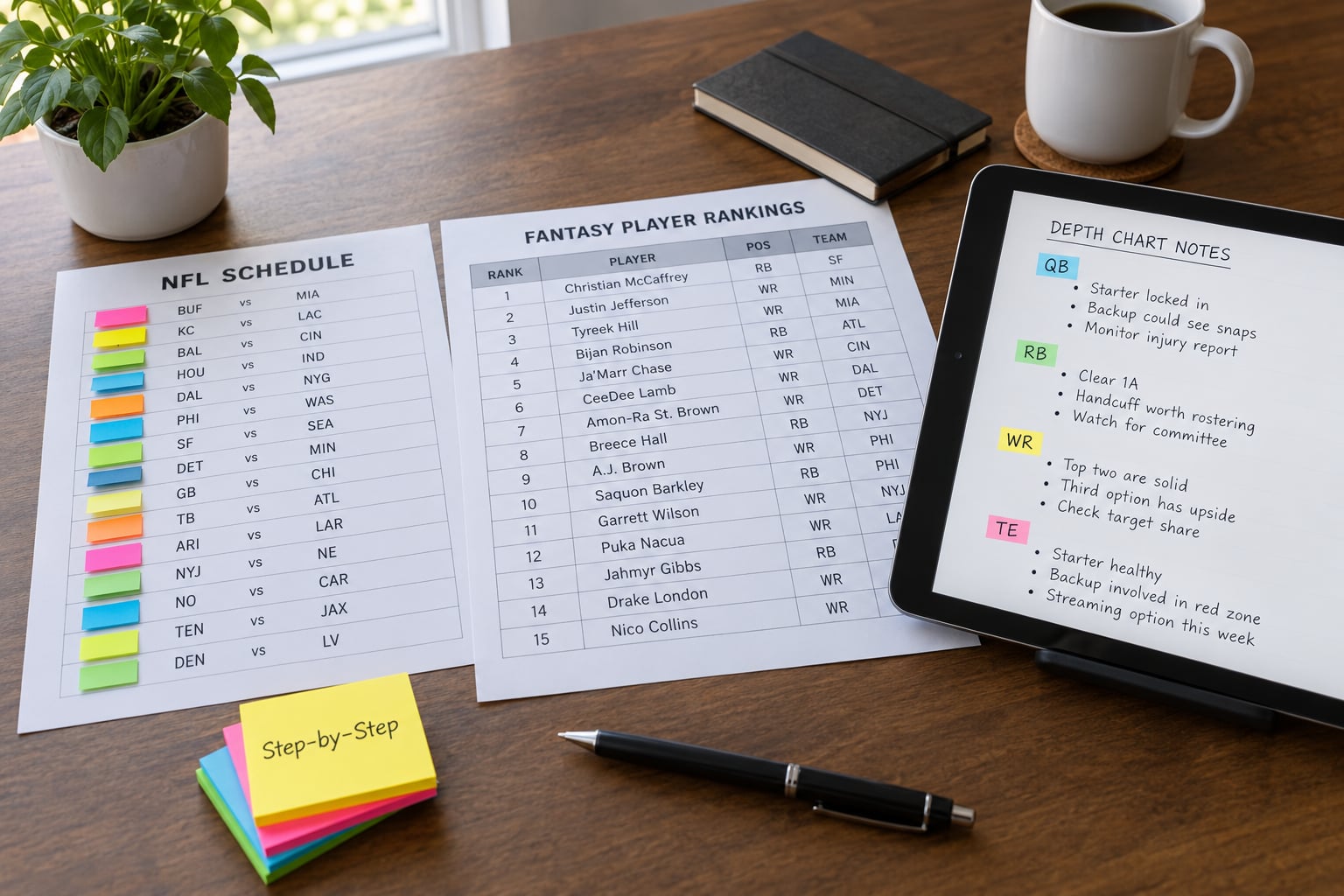
Step 1: Confirm when the release lands and what you can still change
The release usually arrives in mid-May, which means most redraft drafts are still weeks or months away. That timing is the point. You are not reacting to results, you are shaping a board before other managers have done the work. Your draft spot, league size and roster format are all still adjustable at this stage, and so is your keeper or dynasty plan.
Write down three things the release lets you decide this week: which positions you will draft deep, which players you refuse to reach for, and which teammates already have a bye week before their Week 1 matchup. If your keeper league has two players on the same bye week, one of them becomes a trade chip later.
Step 2: Build the bye grid before you look at any player
Bye weeks drive more lost value than almost any other schedule factor, because a benched starter scores zero. Give every team on your roster a column and mark its dark week. Then sort your roster by dark week so you can see the shape of your season at a glance.
Where your own players are fine, the grid still gives you leverage. A player on your bench in week 8 is free real estate for a two-game stretch, which is exactly the window to stream a defense or kicker. Add those streaming candidates to the same grid so you know you already own them before your opponent does.
Step 3: Convert opponent strength into fantasy points, not win totals
The single biggest mistake in schedule analysis is using a team’s record as a proxy for how hard that team is to play. Records are noisy. Four of a team’s games may come against opponents with winning records, and the rest against teams already eliminated by week 12.
Read the schedule like this instead. For each player, list the opponent by week and note how many fantasy points that defense has allowed at the player’s position over its last several games. Averaging four to eight games smooths out the single-game swings that make early-season data useless.
Then add context the numbers miss: which side of the ball has the ball more, whether the opponent plays indoors, and whether a divisional game means an unfamiliar scheme or the same one for the fourth time. Divisional rematches are usually more predictable than a rotating opponent, so treat them as a lower-variance matchup rather than a star opportunity.
The check that this step worked: every player on your short list has at least three named favorable weeks, not just a soft schedule in general.
Step 4: Map the playoff window your league actually uses
Most fantasy postseasons span four weeks near the end of the regular season, which usually means weeks 14 through 17, though plenty of leagues start earlier or run to Week 18. Whatever the range is, that window is where your season is decided and where schedule analysis pays off most.
Pull up the opponent for every player you rate in the top tier for each of those weeks and mark the matchup easy, neutral or difficult. Players who run well against the toughest opponents in that window are the most stable foundation for a playoff roster, because their floor survives bad luck.
Two late-season wrinkles deserve a look. Weather matters more in weeks 15 through 17 than in September, so a road team in a cold outdoor stadium is worth downgrading relative to a dome team. And flex scheduling moves kickoff times in weeks 17 and 18, so plan to check the updated slate before setting those lineups rather than trusting the release you studied in May.
Do the same exercise through the trading deadline and for dynasty formats. Before a trade deadline, a player facing an easy three-game stretch is worth more than one with the same season average and a brutal run. In dynasty, the schedule is a recurring asset you can price into a rebuild.
Step 5: Turn the schedule into ranked board edits
This is where the release finally produces draft decisions. Sort your list by position and move players whose season schedule clusters their best games in your playoff weeks, provided their role and talent hold up. If two running backs are within half a round of each other, the one with three soft opponents in your playoff window is the safer pick.
Mark two backups on every committee running back you draft. Schedule tells you which backup becomes relevant first: the one whose team has the more favorable offensive line and a clearer path to snaps when the starter sits is the better insurance policy.
Finish by writing one line per player explaining the schedule-based reason for their rank. When the season starts and a player looks like a dud, that line tells you whether the schedule was wrong or the player was, which is a different correction.
Common Mistakes
Reading the release once in May and never again. The schedule itself is fixed, but the fantasy picture around it moves every week. Revisit your playoff-window notes before your draft, before the trade deadline and again around week 12, when games start to have real meaning.
Using win-loss records as strength of schedule. A team that wins with a terrible defense is still a bad matchup for a quarterback. Fix: work from fantasy points allowed by position, then sanity-check with context like pace and home field.
Treating strength of schedule as a projection. A soft schedule raises a floor; it does not create touches, targets or carries. Fix: only move a player on schedule when the role is already secure. Talent and opportunity set the ceiling, the schedule softens the downside.
Ignoring byes until the dark week arrives. Losing two starters to the same week is a guaranteed self-inflicted loss. Fix: sort your roster by bye week the day the release drops, then fill your open slots early when waiver prices are low.
Applying a redraft approach to best ball or dynasty. Best ball drafts have no in-season decisions at all, so early byes matter far less and easy playoff schedules matter more. Dynasty owners should look at the schedule as a recurring pattern rather than a single season asset.
Editing the board without checking the depth chart notes. A coordinator change two weeks before training camp can erase an entire schedule argument. Fix: pair every schedule-based edit with a role check, and revisit it at camp when the depth chart settles.
Frequently Asked Questions
When is the NFL schedule released, and when can I draft fantasy football?
The league publishes the full regular-season schedule in mid-May, and most redraft leagues draft in late August or early September, after training camp and most preseason games. That gap is your analysis window. Use May to map byes and playoff matchups, then re-check everything in August when rosters and depth charts are clearer.
How do bye weeks work in fantasy football?
Each of the 32 teams sits out exactly once during the regular season, across weeks 5 through 14, with four teams off in most weeks. Any player on that team contributes nothing that week, so a bench can only cover one or two dark spots at a time. Sorting your roster by dark week at the start of the season shows exactly where you need help.
How do I read a strength of schedule chart for fantasy football?
Look for the opponent’s average fantasy points allowed at your player’s position, not the opponent’s win-loss record. Read the last five to eight games rather than the full season, since early games carry little information. Then note whether games are home or away, indoors or outdoors, and divisional or non-divisional before drawing conclusions.
Should I drop my kicker or defense during a bye week?
Usually not. Kicker and defense are the two most droppable positions because they can be replaced any week with a better matchup, and byes are a temporary gap rather than a performance problem. Keeping them wastes a roster slot, but dropping them reflexively means rebuilding a streamer every dark week instead of filling gaps with offense.
Is an early bye week better than a late one?
Neither is reliably better in isolation, and the sample sizes are too small to treat timing as a rule. What matters is what the bye week does to your roster: early byes give you a usable stretch for streaming, while late byes can hurt a team still chasing a playoff spot. Check your own roster’s shape rather than picking a side of the argument.
Should I weight the schedule more than player talent in my rankings?
Talent sets the ceiling and the schedule sets the floor, so talent wins on a blank slate. Use the schedule to break ties between similar players, to pick the safer weekly opponent matchups, and to decide between two committee running backs. Any player who would not make your board in a neutral schedule should not make it because his opponents look soft.
Start tomorrow by printing the full schedule and coloring in every bye week for your roster. That one page tells you where your season is fragile, and everything after it, opponent strength, playoff windows, draft board edits, becomes a smaller, clearer job.